
Grapes grow across almost every state and territory in Australia, but success depends heavily on where in those states you're gardening. The sweet spot for backyard grape growing sits in the southern half of the continent, think South Australia's Barossa and Adelaide Hills, Victoria's Yarra Valley and Mornington Peninsula, the Hunter Valley and Riverina in NSW, Margaret River in WA, and the Tamar Valley in Tasmania. Queensland's Granite Belt also works well at altitude. If you're in tropical far-north Queensland or the Northern Territory, the equation changes significantly, but it's not impossible with the right variety choices.
Where Do Grapes Grow in Australia: Guide for Home Gardeners
Marcus Whitfield
9 Aug 2026
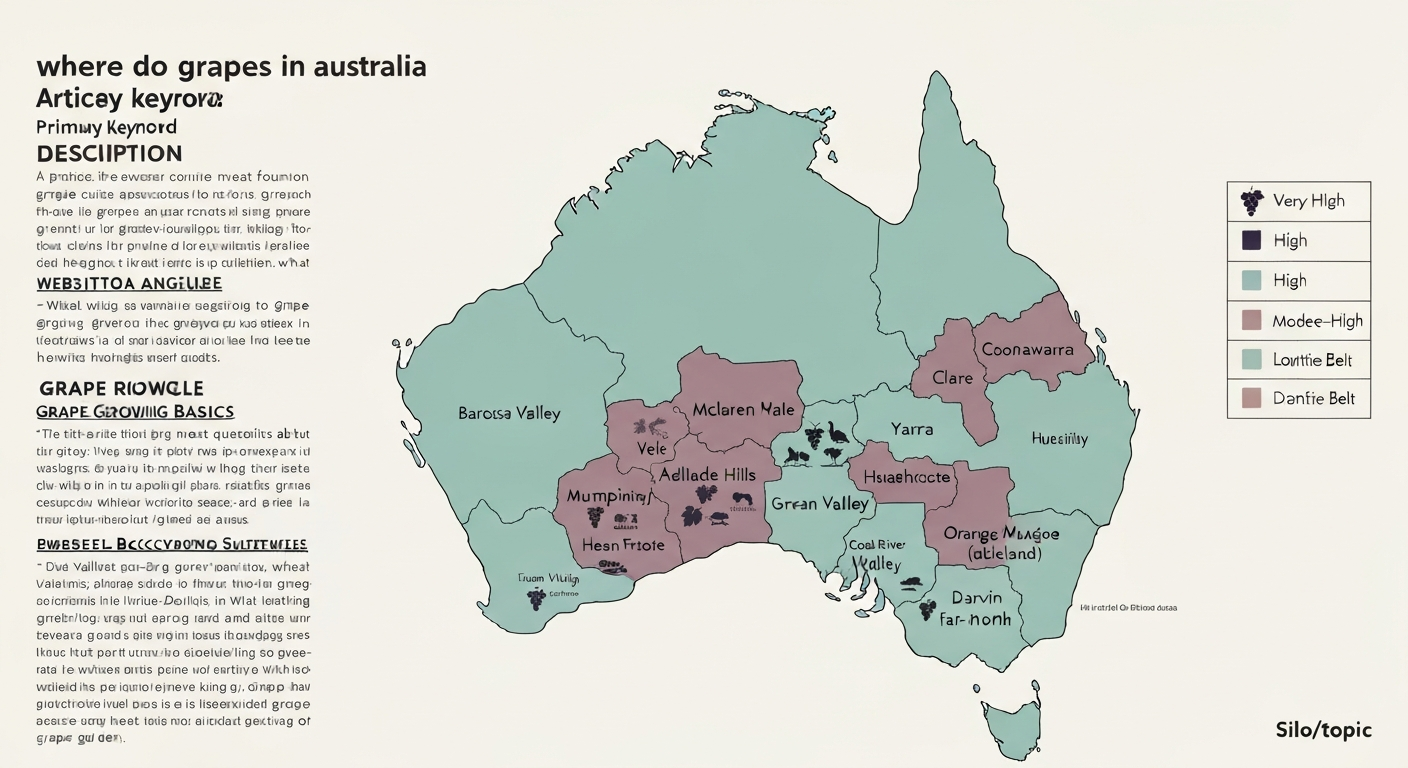
At a glance: Australian grape regions and home-garden suitability
Australia's main viticultural zones cluster in the south-east and south-west of the continent, where a Mediterranean or cool-temperate climate gives vines the warm ripening season and cool dormancy period they need. The Bureau of Meteorology's frost potential maps are handy for identifying frost-prone hollows versus safer elevated sites when you're deciding exactly where to plant in your garden. Below is a quick state-level summary of suitability before we dig into the detail.
| State / Territory | Overall Suitability | Key Backyard Zones | Primary Challenge |
|---|---|---|---|
| New South Wales | High | Hunter Valley, Riverina, Orange, Mudgee, Southern Highlands | Humidity and downy mildew in coastal areas |
| Victoria | High | Yarra Valley, Mornington Peninsula, Heathcote, Murray River zone | Late frost risk in southern cool areas |
| South Australia | Very High | Barossa Valley, McLaren Vale, Adelaide Hills, Riverland, Clare Valley, Coonawarra | Heat and salinity in flat inland zones |
| Western Australia | High | Margaret River, Great Southern, Swan Valley (with irrigation) | Summer drought; nematodes in sandy soils |
| Tasmania | Moderate–High | Tamar Valley, Coal River Valley, Huon Valley | Short season; late frost; slower ripening |
| Queensland | Moderate | Granite Belt (altitude > 700 m), cooler tablelands | Humidity, disease pressure, insufficient chill at low altitudes |
| Northern Territory / far-north QLD | Low–Moderate | Darwin Surrounds (tropical varieties only) | Lack of winter chill; high humidity; disease pressure |
One thing I'd stress right away: don't let state borders dictate your thinking. A garden in Orange, NSW sits at 900 metres elevation and behaves climatically more like cool-climate Victoria than the warm coastal strip near Sydney. Conversely, a garden in coastal WA near Perth can experience a heat loading comparable to parts of inland SA. Micro-climate matters enormously with grapes.
Region by region: recommended varieties for home gardens
This table is the practical heart of the article. It maps each major region to the table, seedless and wine varieties that perform best for backyard growers, based on climate heat sums, disease tolerance and reliable ripening. Treat it as a starting shortlist, your specific site conditions may nudge you toward one end of the list or the other.
| Region / State | Best Table Varieties | Best Seedless Varieties | Best Wine Varieties |
|---|---|---|---|
| Hunter Valley (NSW) | Muscat Hamburg, Waltham Cross | Thompson Seedless (Sultana) | Shiraz, Semillon, Verdelho |
| Riverina / Murray-Darling (NSW/VIC) | Muscat Hamburg, Cardinal | Thompson Seedless, Crimson Seedless | Shiraz, Cabernet Sauvignon, Muscat Gordo |
| Orange / Southern Highlands (NSW) | Flame Seedless, Italia | Flame Seedless | Pinot Noir, Chardonnay, Riesling |
| Yarra Valley / Mornington (VIC) | Muscat Hamburg | Flame Seedless | Pinot Noir, Chardonnay, Pinot Gris |
| Heathcote / Grampians (VIC) | Muscat Hamburg, Waltham Cross | Thompson Seedless | Shiraz, Grenache, Viognier |
| Barossa / McLaren Vale (SA) | Muscat Hamburg, Italia | Thompson Seedless, Crimson Seedless | Shiraz, Grenache, Cabernet Sauvignon |
| Adelaide Hills (SA) | Flame Seedless | Flame Seedless | Pinot Noir, Sauvignon Blanc, Chardonnay |
| Riverland / Coonawarra (SA) | Muscat Hamburg, Cardinal | Thompson Seedless, Crimson Seedless | Cabernet Sauvignon, Shiraz, Merlot |
| Margaret River / Great Southern (WA) | Waltham Cross, Italia | Flame Seedless | Cabernet Sauvignon, Chardonnay, Semillon |
| Swan Valley (WA) | Muscat Hamburg, Cardinal | Thompson Seedless | Chenin Blanc, Verdelho, Shiraz |
| Tamar / Coal River (TAS) | Muscat Hamburg | Flame Seedless | Pinot Noir, Chardonnay, Riesling |
| Granite Belt (QLD) | Flame Seedless, Muscat Hamburg | Flame Seedless | Shiraz, Verdelho, Chardonnay |
| Darwin / Tropical NT | Black Muscat, Muscat Hamburg (with care) | Limited options | Not recommended for wine production |
Climate and growing conditions: what grapes actually need
Grapes are more climate-specific than most backyard fruit trees. Getting the fundamentals right before you even buy a vine will save you years of frustration. Here's what actually drives success or failure.
Heat accumulation and growing-degree days
Wine Australia's Climate Atlas measures heat in growing-degree days (GDD) and growing-season temperature (GST) to classify viticultural zones. Wine Australia's Climate Atlas and regional snapshots provide growing‑season temperature (GST), growing‑degree‑days (GDD) and other climate metrics used to classify Australian viticultural zones and match varieties to regional heat sums and season length Wine Australia's Climate Atlas and regional snapshots provide growing‑season temperature (GST), growing‑degree‑days (GDD) and other climate metrics used to classify Australian viticultural zones and match varieties to regional heat sums and season length.. In practical terms, this means warm-season varieties like Shiraz and Thompson Seedless need a decent heat budget to ripen fully, think regions with a GST above about 18 degrees Celsius. Cool-climate varieties like Pinot Noir and Riesling ripen beautifully in zones with a GST of 14 to 17 degrees. If your garden sits in a region with insufficient heat accumulation (parts of inland Tasmania, high-altitude NSW tablelands), choosing early-ripening varieties is not optional, it's essential.
Winter chill hours
Most European wine and table grape varieties (Vitis vinifera) need 400 to 700 hours below 7 degrees Celsius during dormancy to break bud properly and produce an even canopy. Almost every productive viticultural zone in southern Australia easily meets this requirement. The challenge flips in the tropics, Darwin and far-north Queensland get very few chill hours, which causes patchy, erratic budburst and poor fruit set with standard varieties. If you're gardening in truly tropical conditions, you'll need to investigate tropical or subtropical varieties specifically bred for low-chill environments.
Frost risk
Spring frost is the single biggest natural risk for backyard vines in southern Australia. Vines break dormancy and push tender new shoots in early-to-mid spring, and a single frost event at that stage can wipe out an entire season's crop in an hour. The BOM's frost potential maps are genuinely useful here, check them before deciding where in your garden to position vines. Avoid frost hollows (low-lying spots where cold air pools), and prefer sites with gentle air drainage down a slope. In places like the Yarra Valley, the Granite Belt and Tasmania's inland valleys, late spring frosts are a real management task, not a rare event.
Soil requirements
Grapes are remarkably adaptable to soil type, but they prefer well-drained soil with a pH between 6 and 7. Heavy, waterlogged soils cause root disease and should be avoided or improved with raised beds or drainage. Sandy soils drain well but struggle to hold nutrients and moisture, a useful match for varieties that hate wet feet, but you'll need to irrigate carefully. Pre-planting soil tests are worth doing; lime or gypsum additions to correct pH or improve structure are far easier before planting than after. The Victorian DPI and SA's Vinehealth Australia both recommend a combined soil and petiole-testing program to guide nutrition decisions long-term.
Water and irrigation
In most Australian viticultural regions, summer rainfall is unreliable and irrigation is standard practice. Drip irrigation is the method recommended by AWRI for efficiency, disease management (keeping the canopy and berries dry) and targeted delivery. For backyard systems, a simple moisture probe or inexpensive tensiometer takes the guesswork out of watering schedules, you irrigate based on actual soil moisture rather than a fixed calendar, which is both more water-efficient and better for vine health. Most established vines in cool-temperate areas can survive on 300 to 400 mm of irrigation per season; hot inland zones need considerably more.
Planting timing and how long until your first harvest
Planting timing comes down to the form of vine you're buying. Dormant bare-root vines (the most common and usually cheapest option) should go in the ground during winter dormancy, June to August across most of southern Australia. NSW DPI Grapevine Management Guide recommends planting dormant bare‑root vines in winter and potted vines in frost‑free periods NSW DPI Grapevine Management Guide recommends planting dormant bare‑root vines in winter and potted vines in frost‑free periods.. This lets them establish roots before spring growth begins. Potted vines can be planted almost any time during the growing season as long as frosts have passed and you keep the soil moist during establishment. In warmer climates like SA's Riverland or WA's Swan Valley, potted vines planted in late spring can settle in well with some shade cloth protection in the first few weeks.
As for harvest timing, be realistic. The NSW DPI Grapevine Management Guide is honest about this: most vines produce a small, usable first crop in year two, but a reliable and worthwhile harvest typically arrives in years three to four. In the first year, the job is establishing a strong root system and training framework, resist the urge to let the vine crop heavily, because it slows long-term development. I've seen backyard growers get impatient, let the vine overbear in year two, and then wonder why it struggled for the next few seasons. Be patient: the vine is worth it.
- Year 1: Plant bare-root vine in winter; establish single trunk; remove all flower clusters
- Year 2: Train permanent cordon or arms; allow a very light crop (1 to 2 bunches per shoot maximum)
- Year 3: Vine reaches near-mature structure; first meaningful harvest possible
- Year 4 onward: Full cropping potential; apply standard pruning and fruit-thinning practices
New South Wales: backyard zones and recommended varieties
NSW spans an enormous range of climates, from the humid subtropical coast to the arid outback, which means the question isn't really 'can grapes grow in NSW' but 'which part of NSW are you in?' The most reliable zones for backyard vines are the inland valleys and elevated areas, the Hunter Valley, Mudgee, Orange, Cowra, and the Riverina around Griffith and Wagga Wagga.
Coastal and near-coastal NSW
The humid coastal strip from Sydney northward is the toughest environment for grapes in NSW. High summer humidity and rainfall create near-perfect conditions for downy mildew and powdery mildew, the two most damaging fungal diseases in Australian viticulture. You can still grow grapes here, Muscat Hamburg on a pergola works reasonably well as a shade vine with table fruit as a bonus, but you'll need to commit to a preventative spray program and accept that berries may split in wet seasons. Choose disease-tolerant varieties and keep canopies open for airflow.
Hunter Valley
The Hunter Valley has a long tradition of Semillon and Shiraz, and both work beautifully at the backyard scale. Summer humidity is a challenge here too, but the well-drained red clay loams of the valley floor suit vines well. Shiraz ripens reliably, Verdelho is excellent, and Thompson Seedless makes a good table grape. Avoid very late-ripening reds like Cabernet Sauvignon, the wet autumn can arrive before they're fully ripe.
Orange, Mudgee and the tablelands
Elevated zones above 600 metres, particularly Orange (around 850 m to 1,100 m) and the Southern Highlands, give you proper cool-climate viticulture. Pinot Noir, Chardonnay and Riesling all shine here. Flame Seedless is the best backyard seedless table grape for these areas, and it's reliable. Spring frost is a genuine management issue at altitude, be prepared to cover young vines or use windmill frost fans if you're serious about protecting a crop.
Riverina and Murray-Darling (western NSW)
Griffith and the Riverina get serious heat and sunshine, which is why Thompson Seedless (Sultana) and Crimson Seedless thrive here as both table and dried-fruit grapes. Irrigation is essential, you cannot rely on rainfall. The flat alluvial soils are fertile and easy to manage, but check for nematodes before planting on former vegetable ground, and consider grafted rootstock if nematodes are a concern.
Victoria: backyard zones and recommended varieties
Victoria is arguably the most diverse grape-growing state in Australia. You have cool maritime zones (Mornington Peninsula), warm inland plains (Murray-Darling, Rutherglen), volcanic hills (Heathcote, Grampians), and a progressively cooler south-west, all within a single state. That diversity makes variety selection critical, and it means what works in Mildura is very different from what works in the Yarra Valley.
Yarra Valley and Mornington Peninsula
These cool, maritime-influenced zones are some of the best addresses in Australia for Pinot Noir and Chardonnay at the backyard scale. Wine Australia's research consistently confirms that Pinot Noir finds a genuine home in these regions. For table grapes, Muscat Hamburg and Flame Seedless are your best bets, they ripen comfortably in the Yarra's warm summers without needing the heat loading of inland areas. Late spring frost is a real risk, especially on low-lying sites near the Yarra River; north-facing or elevated backyard sites are strongly preferred.
Heathcote, Grampians and central Victoria
These regions sit in the warm-to-moderate middle ground. Shiraz absolutely loves the Cambrian soils of Heathcote, and at the backyard scale it's a rewarding variety, reliable, flavoursome and not excessively vigorous. Grenache and Viognier also do well here. For table grapes, Muscat Hamburg and Thompson Seedless work with irrigation. Autumn rain can be light and reliable ripening is generally achievable for most varieties that suit a GST of 17 to 19 degrees.
Murray-Darling and Rutherglen (northern Victoria)
This is warm, dry country that needs irrigation but rewards it generously. Muscat Gordo Blanco (Muscat à Petit Grains) is a classic backyard table and wine grape for Rutherglen, and Thompson Seedless is a workhorse table grape across the Murray-Darling zone. Cabernet Sauvignon and Shiraz ripen well without disease pressure being as severe as in humid coastal areas. Phylloxera management is important in parts of northern Victoria, check the current Victorian phylloxera zone maps before buying vines, as movement regulations apply.
South Australia: backyard zones and recommended varieties
SA is Australia's most celebrated wine state, and for good reason, the climate across most of the southern portion is exceptionally well-suited to viticulture. For home gardeners, SA offers a wide menu of options from warm coastal plains to genuinely cool hill country.
Barossa Valley and McLaren Vale
These warm, dry, Mediterranean-climate zones are outstanding for backyard Shiraz, Grenache and Cabernet Sauvignon. The soils are generally well-drained clay loam over limestone or ironstone, and the warm summers produce reliable, flavour-concentrated fruit without excessive disease pressure. Irrigation is needed through summer, drip systems work best. Thompson Seedless and Crimson Seedless are both excellent backyard table grapes here. The Barossa's old-vine Shiraz tradition is genuinely inspiring for backyard growers; even a young vine of a quality clone will produce rewarding fruit within four years.
Adelaide Hills
Rising to over 500 metres, the Adelaide Hills delivers a cool-climate experience within half an hour of the CBD. Pinot Noir, Sauvignon Blanc and Chardonnay all perform exceptionally here. For table grapes, Flame Seedless is reliable and popular, it handles the cooler nights well and produces crisp, sweet berries. Spring frost is a genuine risk on lower hill sites; avoid frost-collecting gullies and opt for mid-slope positions with good cold-air drainage. The cooler soils and higher rainfall mean irrigation needs are lower than the valley floor, but supplemental water through dry spells is still worthwhile.
Clare Valley and Coonawarra
Clare Valley is exceptional for Riesling, the combination of warm days and cool nights, well-drained limestone soils and reliable season length makes it one of the world's great Riesling addresses. At the backyard scale, Riesling here is genuinely achievable and deeply satisfying. Coonawarra's famous terra rossa over limestone is Cabernet Sauvignon country, and the variety adapts beautifully to backyard scale in this zone. Vinehealth Australia's rootstock research (including the Coonawarra Rootstock Trial) is particularly relevant here, the calcareous soils can cause lime-induced chlorosis, so rootstock selection matters. Rootstocks like 140 Ruggeri and 1103 Paulsen handle the alkaline conditions well.
Riverland (SA's hot interior)
The Riverland, stretching along the Murray River from Renmark to Blanchetown, is hot, flat, and heavily dependent on irrigation from the Murray. Summer temperatures regularly exceed 40 degrees Celsius, and salinity in irrigation water and soils is a real management consideration. For backyard growers here, Thompson Seedless and Crimson Seedless are proven performers. Grafted rootstocks with salinity and drought tolerance (1103 Paulsen, Ramsey) are strongly advisable. The extreme heat means canopy management is critical, you want enough leaf cover to shade fruit and prevent sunburn, but not so much that airflow is restricted and disease pressure builds.
Western Australia, Tasmania and Queensland: a quick summary
WA's Margaret River is arguably Australia's most consistent producer of world-class Cabernet Sauvignon and Chardonnay, and both translate beautifully to the backyard scale. The Maritime climate keeps temperatures moderate, autumn is dry and reliable, and disease pressure is lower than east-coast humid zones. Swan Valley near Perth is warmer and drier, think Verdelho, Chenin Blanc and Muscat Hamburg for table grapes. Sandy soils in WA are highly nematode-prone, so grafted rootstock with nematode resistance (Ramsey, 1103 Paulsen) is essentially mandatory in most Swan Valley soils.
Tasmania is genuinely exciting for cool-climate varieties, but the short growing season requires careful variety selection. Pinot Noir, Chardonnay and Riesling are the reliable trio for the Tamar and Coal River valleys. Season length is the binding constraint, late-ripening varieties simply won't finish before autumn cold arrives in many years. If you're in southern Tasmania, I'd stick with varieties that have a track record in the Huon Valley. The upside is that disease pressure from downy mildew is lower than on the mainland.
Queensland's Granite Belt, centred around Stanthorpe at above 700 metres elevation, gets genuine winter chill and a Mediterranean-ish growing season. Shiraz, Verdelho, Chardonnay and Flame Seedless all work here. Below the Granite Belt on lower-altitude Queensland sites, the lack of chill hours and high humidity make standard Vitis vinifera varieties a difficult proposition. Some tropical varieties have been trialled near Bundaberg and in the Darwin region of the NT, but this is genuinely challenging territory and honest expectations matter.
Site preparation, trellis and training basics
Getting the site right before planting is the highest-leverage thing you can do. NSW DPI extension guidance summarises the key principles well: choose a north-facing or north-east-facing slope in cooler climates to maximise solar exposure, avoid frost hollows where cold air collects on still clear nights, ensure good air drainage around and through the canopy, and provide some wind shelter (but not so enclosed that airflow is restricted, which promotes disease). Test your soil pH before planting and adjust to the 6 to 7 range if needed.
For trellis choice, backyard growers have three practical options. A pergola or arbour works beautifully for table grapes where you want shade and fruit above head height, Muscat Hamburg trained over a pergola is a classic Australian backyard setup. A single-wire bilateral cordon (VSP, vertical shoot positioning) is the most common and efficient system for small rows and wine varieties. Divided canopy systems like Scott-Henry or Smart-Dyson can improve fruit exposure and airflow in more vigorous varieties but require more pruning skill. Start simple: a VSP trellis with two foliage wires is all you need for most backyard situations.
Pests, diseases and the management basics you can't skip
Powdery mildew and downy mildew are the two diseases you'll spend the most time managing as a backyard vine grower in Australia. Wine Australia and AWRI note that downy mildew can cause significant damage even at low infection levels, a small percentage of infected bunches can ruin an entire crop's quality. The key is preventative management: start sprays before symptoms appear (at around 10 cm shoot length), maintain good coverage, alternate product chemistry to reduce resistance, and keep canopies open through shoot positioning and leaf removal. Sulfur-based products handle powdery mildew; copper-based products handle downy mildew. Both are available from hardware or garden centres.
Phylloxera deserves a specific mention for Australian gardeners. This soil-borne root pest devastated European vineyards in the 19th century and is now present in parts of Victoria and other mainland regions. Australia's National Phylloxera Management Protocol and state biosecurity legislation divide the country into phylloxera-free, risk and infested zones, and the movement of vine material between zones is regulated. If you're buying vines in a phylloxera-risk area or moving plant material interstate, check your state's current zone status and quarantine requirements (ICA procedures apply). In phylloxera-free areas like SA and WA, own-rooted vines are permitted, but grafted vines on resistant rootstock are still worth considering for other soil-health reasons.
- Powdery mildew: Use sulfur sprays preventatively from budburst; maintain open canopy for airflow
- Downy mildew: Apply copper-based products before rain events; start early in the season
- Phylloxera: Check your state's biosecurity zone before buying or moving vine material
- Birds: Net bunches or use bird-exclusion netting from veraison (colour change) onward
- Bunch mites and thrips: Monitor visually; address with appropriate registered products if needed
- Nematodes (WA, warm inland zones): Choose nematode-resistant rootstock at planting
Rootstock: do you need it and how to choose
The short answer for most Australian backyard growers: grafted rootstock is worth the small extra cost in any phylloxera-risk zone, any sandy soil with nematode history, any saline or heavy alkaline soil, or any site with known drainage problems. In phylloxera-free SA and WA, you can technically plant own-rooted vines, but rootstocks like 1103 Paulsen and 140 Ruggeri offer genuine drought and salinity tolerance that make them worth considering even there. Vinehealth Australia's Coonawarra Rootstock Trial results provide detailed, locally relevant data on how each rootstock performs in calcareous and clay soils, worth reading if you're planting in SA's limestone belt.
| Rootstock | Best Suited To | Key Traits |
|---|---|---|
| Ramsey | Sandy soils, high nematode risk (WA, warm inland) | High nematode resistance, drought tolerant, high vigour |
| 1103 Paulsen | Dry, saline, calcareous soils (Riverland, SA) | Drought and salinity tolerance, moderate-high vigour |
| 140 Ruggeri | Shallow, alkaline, calcareous soils (Coonawarra, Clare) | Excellent lime tolerance, drought tolerant, moderate vigour |
| Merbein 5489 / 5512 | General Australian conditions, low-K berry requirement | Bred for local conditions, moderate vigour, good fruit composition |
| Own-rooted | Phylloxera-free sandy/loam soils (parts of SA, WA) | No graft, lower cost — check biosecurity zone first |
Your next steps: choosing varieties, buying vines and getting started
Once you've identified your climate zone and matched it to a shortlist of varieties from the tables above, the practical next steps are straightforward. Buy vines from a reputable nursery that can confirm the vine is grafted onto appropriate rootstock (if needed), true-to-variety, and free of disease. Dormant bare-root vines purchased in winter are typically the most affordable option; certified nurseries exist in every state. Prepare your site in autumn, soil test, adjust pH, install trellis posts and wires, so the vine goes into a ready garden when you plant in winter.
Don't try to grow too many varieties at once in a small backyard. Pick two or three that suit your climate and your preference (table versus wine, red versus white), plant them properly, and learn from them. A small, well-managed planting of three vines will outperform ten neglected ones every time. If you're choosing between seedless table varieties for your region, the logic is similar to what backyard growers face when choosing seedless grapes in other temperate climates around the world, the principles of matching chill hours, disease tolerance and season length apply everywhere. If you're gardening outside Australia, check local guides such as the best table grapes to grow in Vancouver BC for climate-specific recommendations. For growers in similar temperate regions, see our guide to the best table grapes to grow in Oregon for variety-specific recommendations. For growers interested in seedless table grapes, see our guide to the best seedless grapes to grow in the UK for variety comparisons and care tips. For gardeners in cooler North American climates, see a regional guide to the best seedless grapes to grow in Michigan for comparable variety recommendations and cold-climate tips. The regional guidance here gives you Australia-specific answers, but the core grape-growing fundamentals are universal.
Grapes are one of the most rewarding plants you can grow in an Australian backyard, they're long-lived, productive once established, and there is genuinely something for almost every climate from Tasmania's cool river valleys to SA's sun-baked Riverland. The key is matching variety to location, setting up a proper trellis from day one, and committing to the first three years of establishment. After that, the vines largely look after themselves, and the harvest is something to be genuinely proud of.
FAQ
At a glance — where do grapes grow in Australia and which regions suit backyard vines?
Grapes grow best across southern and south‑western Australia where Mediterranean to cool temperate climates provide the heat sum and season length vines need. Major home‑garden regions: South Australia (Barossa, Adelaide Hills, Riverland), Victoria (Yarra Valley, Mornington Peninsula, Gippsland), New South Wales (Hunter Valley, Riverina, Southern Highlands), Western Australia (Margaret River, Great Southern), Tasmania (Tamar Valley), and cooler highlands such as the Granite Belt (QLD). Northern Territory and tropical north Queensland are generally unsuitable for most common grape types without protected, heavily managed environments. For backyard success focus on local climate (heat, frost risk and season length) rather than state borders.
What basic climate and seasonal conditions do grapevines need?
Key requirements: adequate heat accumulation during the growing season (varieties differ in heat need), a distinct dormant (cool) period for many varieties, low-to-moderate frost risk during budburst and flowering, and a season long enough for grapes to reach ripeness (sugar, acid and flavour balance). Practical metrics: growing‑season temperature/GDD guides variety choice; many table/wine grapes suit Mediterranean climates with warm, dry summers and cool winters. Chill hours are less rigid than for temperate fruit trees but very warm winter regions can produce late-ripening or uneven crops. Use BOM and Wine Australia climate maps to check local frost frequency and seasonal warmth.
Which grape types (table, seedless, wine) suit which Australian regions?
General matches: - Cool regions (Tasmania, Yarra, Mornington, southern Highlands): table grapes for fresh eating and cool‑climate wine varieties such as Pinot Noir, Chardonnay and sparkling cultivars. - Warm inland and Mediterranean regions (Riverland, Riverina, Barossa, McLaren Vale): heat‑tolerant wine varieties (Shiraz, Cabernet Sauvignon, Grenache) and many table grapes (Crimson Seedless, Thompson). - Moderate/warm coastal regions (Hunter, Adelaide Hills, Margaret River): a mix — table grapes and mid‑season wine varieties (Sémillon, Chardonnay, Shiraz). - Granite Belt (QLD) and higher-altitude pockets: some cool‑climate varieties succeed. Avoid tropical lowlands (NT and far north QLD) for standard vinifera without controlled environments.
State/major-region breakdown with recommended backyard varieties (concise)
Quick regional recommendations (backyard scale): - NSW: Hunter & Southern Highlands — table: Crimson Seedless, Thompson; wine: Shiraz, Chardonnay, Semillon; highlands: Pinot Noir. - VIC: Yarra/Mornington/Gippsland — table: Crimson, Flame Seedless; wine: Pinot Noir, Chardonnay, Riesling. - SA: Barossa/Adelaide Hills/Riverland — table: Thompson, Crimson; wine: Shiraz, Cabernet, Grenache; Adelaide Hills cool sites: Pinot, Chardonnay. - WA: Margaret River/Great Southern — table: Crimson; wine: Cabernet, Shiraz, Chardonnay; Great Southern: Riesling, Pinot. - TAS: Tamar Valley/Coal River — table: some seedless; wine: Pinot Noir, Chardonnay, sparkling varieties. - QLD: Granite Belt (higher altitude) — table: Crimson; wine: Shiraz & cool varieties in cooler pockets; lowland QLD generally unsuitable. - NT: generally unsuitable for vinifera outdoors. Choose site‑appropriate rootstock and check local extension advice and climate micro‑site.
Can you provide a simple region → recommended varieties table for the article?
Region → Recommended backyard varieties (brief): - Tasmania: Pinot Noir, Chardonnay, Riesling, Crimson Seedless - Yarra Valley / Mornington (VIC): Pinot Noir, Chardonnay, Sparkling blends, Flame/Crimson - Hunter / Southern Highlands (NSW): Semillon, Shiraz, Chardonnay, Thompson Seedless - Riverland / Riverina / Barossa (SA/NSW/VIC): Shiraz, Cabernet, Grenache, Thompson, Crimson - Adelaide Hills (SA): Pinot Noir, Chardonnay, Sauvignon Blanc - Margaret River / Great Southern (WA): Cabernet, Shiraz, Chardonnay, Riesling - Granite Belt (QLD): Shiraz, Pinot (cooler pockets), Crimson Seedless Note: choose varieties by local microclimate, frost risk and intended use (table vs wine). This table is a starter — consult local nurseries and extension services for heat‑sum matching.
When should I plant vines and how long until the first harvest?
Planting timing: - Dormant, bare‑root vines: plant in late winter when fully dormant (after most frost risk) — common in temperate areas. - Potted vines: can be planted any frost‑free time, useful in warmer areas and for staged planting. Harvest timing: - Young vines often set usable fruit in year 2; expect small first crops and more reliable yields in years 3–4 with proper training/pruning. Time to full production varies by variety and rootstock but many backyard vines reach steady production by year 4–5.