
Yes, you can grow grapes in a greenhouse, and it works surprisingly well, especially if your outdoor climate is too cold, too wet, or too short-seasoned for reliable harvests. A greenhouse does not magically fix every challenge grapes throw at you, but it gives you real control over temperature, humidity, and frost timing that can turn a borderline climate into a productive one. The honest caveat: greenhouse grape growing takes more active management than sticking a vine in the ground and hoping for the best. Get the setup right, though, and you can harvest table or wine grapes in climates where outdoor vines would never ripen fruit.
Can You Grow Grapes in a Greenhouse? How to Start

Marcus Whitfield
4 May 2026
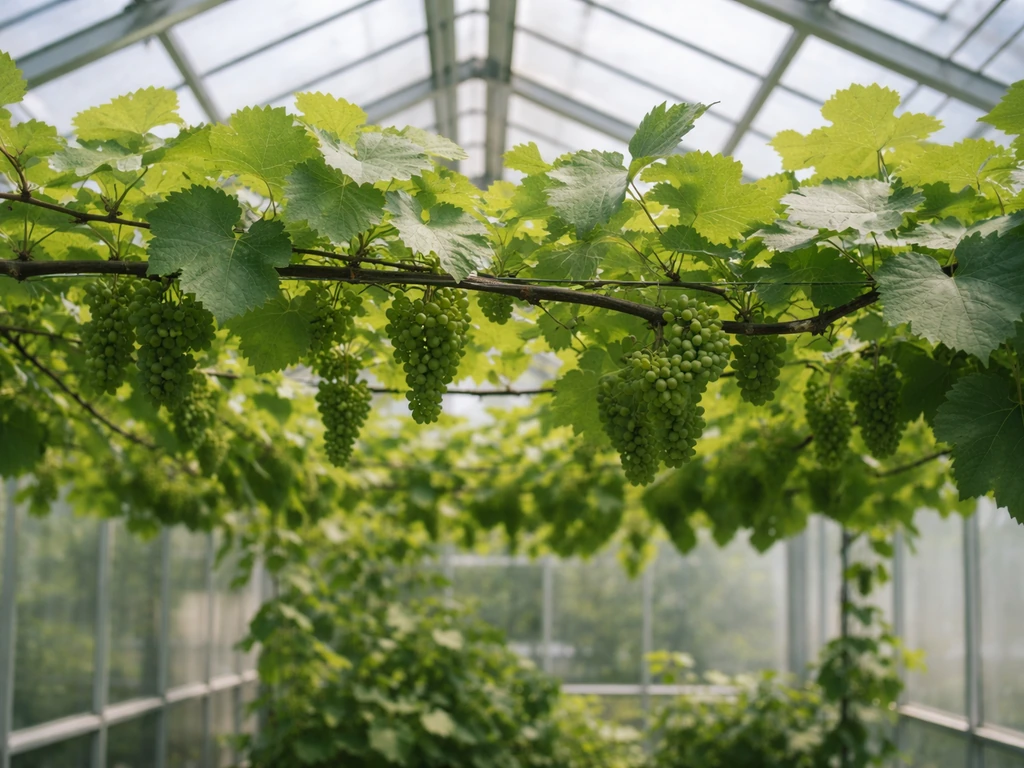
Should you actually grow grapes in a greenhouse?
The case for greenhouse grapes is strongest in a few specific situations. If you are in a short-season region like northern Michigan, the Canadian border states, or anywhere that gets hard frosts before grapes fully ripen, a greenhouse or high tunnel can add the weeks of warmth you need. Cool, wet climates where Botrytis (gray mold) destroys crops year after year are another obvious fit, since a covered structure lets you manage humidity and keep rain off the clusters. Grapes have been grown this way in places like northwestern Michigan, the Wine Islands of British Columbia, and Lancaster, Pennsylvania, all of which have tricky outdoor conditions.
The case against greenhouse grapes is mostly about scale and expectations. Cluster weights tend to run lower in protected cultivation than in the open field. One study of 'Flame Seedless' found greenhouse clusters averaged 343 grams versus 741 grams in open field conditions. That does not mean lower yields overall, because high tunnels in some Michigan trials produced roughly twice the yield of open field per unit area over three years, largely by protecting fruit from rot and weather damage.
But individual clusters will often look smaller, which matters if you are aiming for showroom-quality table grapes. If you are growing for the pleasure of eating fresh grapes, making wine, or just proving the plant will grow in your yard, greenhouse production is absolutely worth it.
If you are simply wondering whether grapes will grow at all in your climate, you might first want to look at the general question of growing grapes in your region or state before deciding whether a greenhouse is the right tool. But if you already know outdoor conditions are the obstacle, read on.
Setting up your greenhouse for grapevines
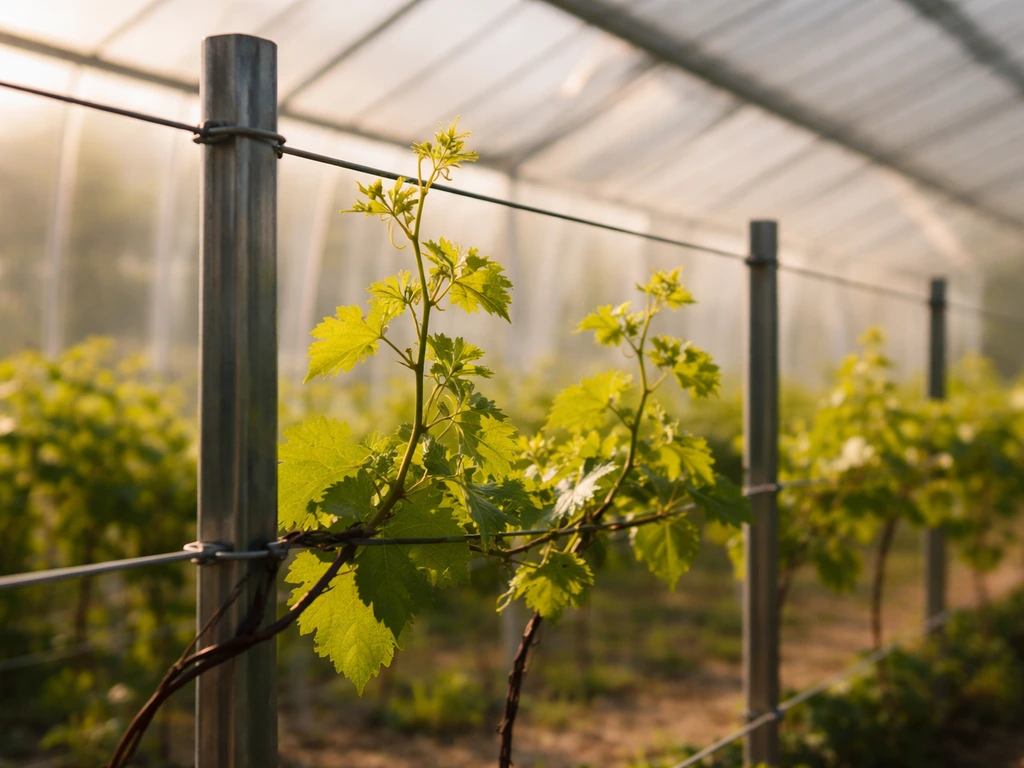
Grapes inside a greenhouse need four things managed well: light, temperature, ventilation, and humidity. Miss any one of them and you will fight problems all season.
Light
Grapes are high-light crops. They need full sun, which means your greenhouse orientation and glazing material both matter. A single-span structure running east to west captures more winter light in northern latitudes. Use a glazing material with high light transmission and keep the structure clean. Shading the glass or plastic is rarely needed unless you are in a hot southern climate where summer heat becomes the bigger problem. Under high light conditions, CO2 inside a poorly ventilated greenhouse can become limiting to photosynthesis even before temperature peaks, which is another reason good airflow is not optional.
Temperature
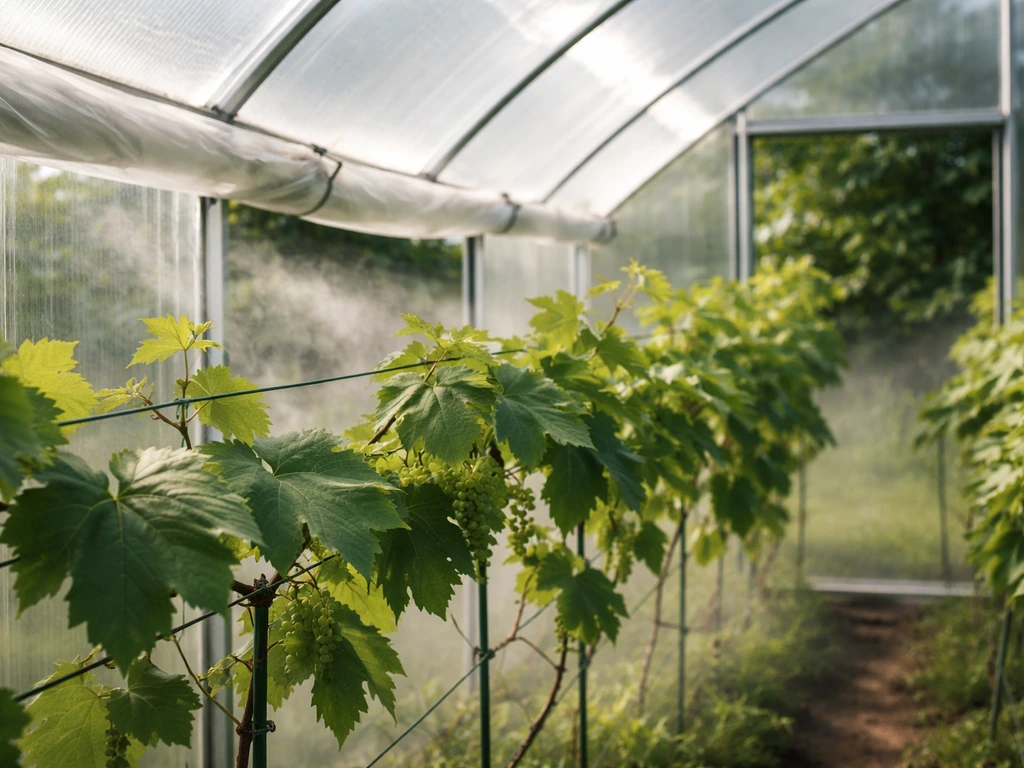
During the growing season, grapevines do well between roughly 60 and 85°F. The greenhouse earns its value at the shoulder ends of the season, keeping temperatures above damaging frost thresholds in spring when buds are vulnerable and extending warmth into fall when fruit is ripening. Early-season bud stages are especially sensitive to cold snaps, so protecting that window is the main argument for using a structure in cold-climate zones. In summer, you may actually need to vent aggressively to prevent temperatures from climbing too high. A small fan heater can also help during cool spring nights, particularly for varieties like Muscat of Alexandria that benefit from extra warmth to aid ripening.
Ventilation
This is the one area where most home greenhouse growers underinvest, and it costs them dearly with grape disease problems. You need enough ventilation capacity to flush hot, humid air quickly on warm days and to keep air moving around the canopy. Ridge vents combined with side vents create passive airflow in smaller structures. For any serious production, add fans. University of Georgia guidance recommends verifying fan performance with independently tested specifications so you know actual airflow rates, not just marketing numbers. Airflow also matters for pollination, since a gentle breeze helps move pollen between flowers on a self-fertile vine.
Humidity
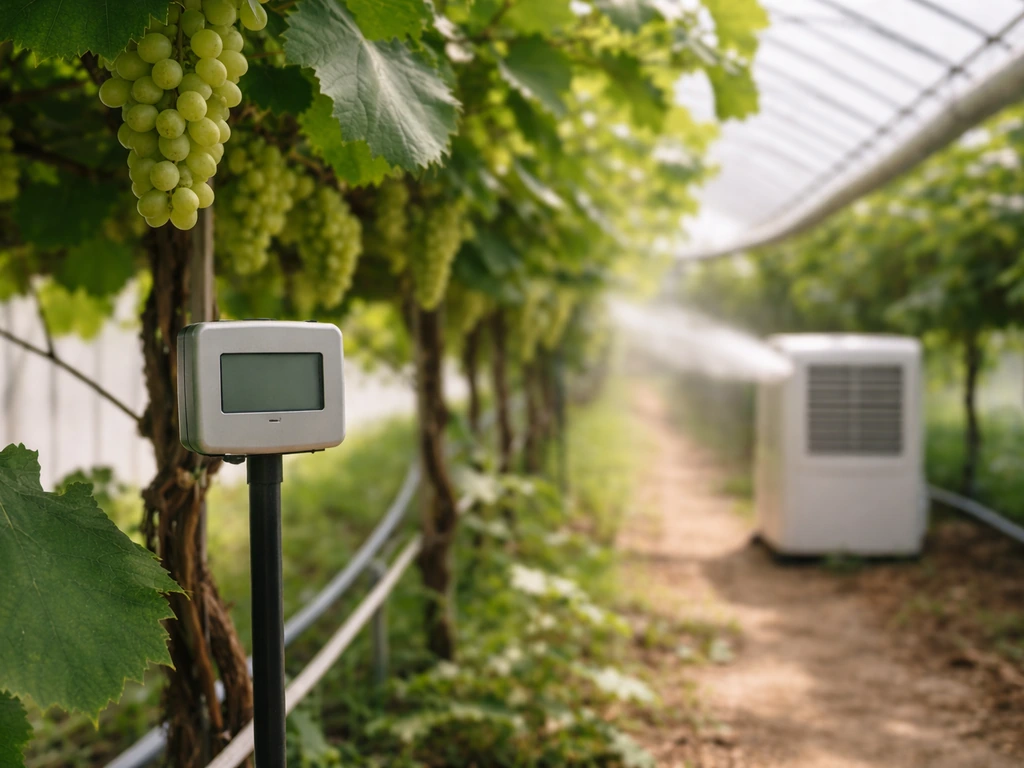
Keep relative humidity below 85 percent as a general rule, and definitely below 92 percent when fruit is developing. Botrytis bunch rot, the grape disease most likely to ruin your greenhouse crop, thrives when relative humidity exceeds 92 percent and free moisture is present on tissue. The temperature range where it does the most damage is roughly 58 to 82°F, which overlaps almost perfectly with your grape-growing season. Watering in the morning rather than evening, avoiding overhead irrigation, and maintaining good airflow are your first defenses. Dehumidifiers can supplement ventilation in very humid climates.
Picking the right grape variety for your climate zone
A greenhouse does not erase your hardiness zone. It shifts your effective microclimate warmer, typically by one to two zones in a well-managed structure, but the variety you plant still needs to be a reasonable fit for your region. Choose wrong here and you will fight the vine instead of working with it.
Cold climates (Zones 3 to 5)
If you are in a genuinely cold zone, say Zone 4 or 5, a greenhouse matters most for season extension rather than variety substitution. You can grow cold-hardy hybrids like Marquette, Frontenac, Frontenac Gris, La Crescent, Itasca, and Clarion, all developed by the University of Minnesota breeding program specifically for these conditions. These varieties were bred to survive without protection, so in a greenhouse they will thrive.
Greenhouse production of Frontenac in particular has been researched specifically for protected cultivation, and the indoor environment also reduces pest pressure that affects the variety in vineyard settings. If you are in the Calgary range (roughly Zone 4a), cold-hardy hybrids in a heated greenhouse are your most realistic path to consistent harvests. That overlaps with what you would consider if growing grapes in Canada more broadly.
If you are asking can you grow grapes in Canada, the short answer is yes, especially with a greenhouse or high tunnel that extends the season and reduces cold and wet-weather risk.
Moderate climates (Zones 6 to 7)
In Zone 6 or 7, a greenhouse unlocks a wider selection. Disease-susceptible but flavorful varieties like Muscat of Alexandria become viable because you can manage humidity and keep rain off the fruit. Table grape favorites like Flame Seedless and Thompson Seedless can ripen reliably with the added heat units a greenhouse provides. For wine grapes, varieties like Chardonnay, Pinot Noir, and Riesling can work if your structure gives you adequate heat accumulation through the season.
Warmer climates (Zones 8 and above)
In warmer zones, a greenhouse makes less sense for most table and wine varieties because the outdoor climate already provides enough warmth. The exception is using a structure for disease management in particularly wet or humid regions. In the Deep South, a high tunnel focused on air circulation can dramatically reduce bunch rot losses even without adding meaningful heat units.
| Climate Zone | Best Use of Greenhouse | Recommended Varieties |
|---|---|---|
| Zone 3 to 4 | Frost protection, season extension, heat accumulation | Marquette, Frontenac, La Crescent, Itasca, Clarion |
| Zone 5 | Season extension, disease control | Frontenac Gris, Marquette, Concord, Niagara |
| Zone 6 to 7 | Disease control, ripening boost for quality varieties | Flame Seedless, Muscat of Alexandria, Riesling, Chardonnay |
| Zone 8+ | Disease management in wet climates | Flame Seedless, Thompson Seedless, local wine varieties |
Table grapes vs wine grapes in the greenhouse
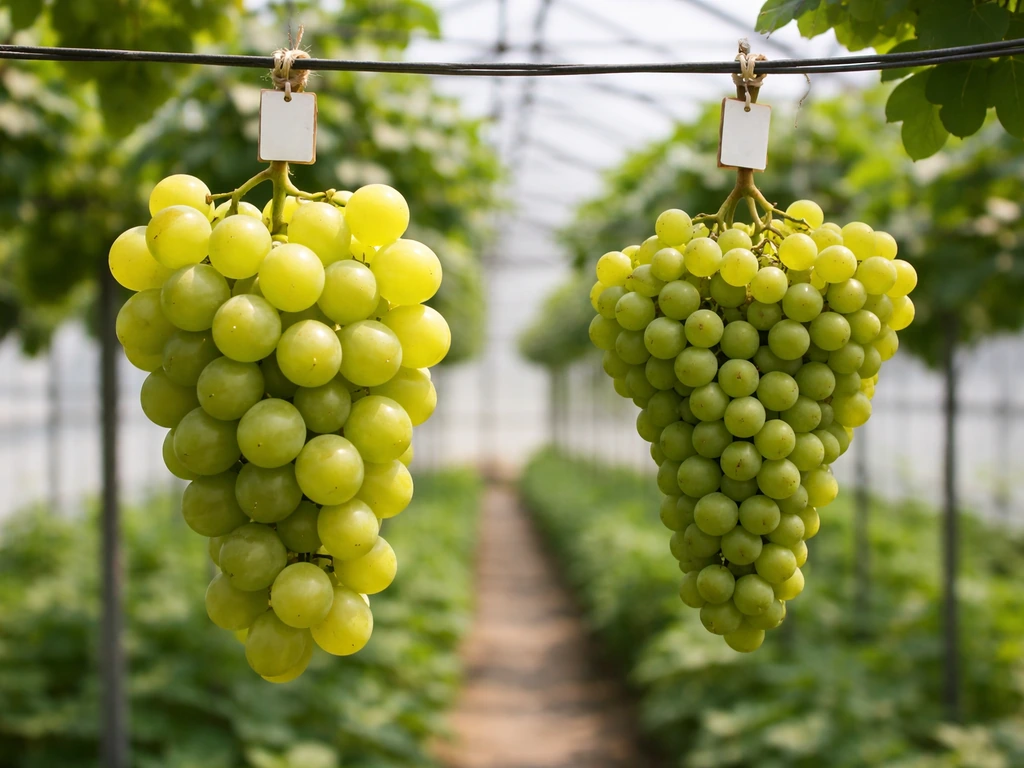
Table grapes are generally easier to manage in a greenhouse because you are optimizing for appearance and eating quality rather than the precise sugar-to-acid balance that winemaking demands. Wine grapes are absolutely doable, but greenhouse conditions can alter ripening trajectories, and the heat accumulation patterns inside a structure differ from outdoor vineyards. If you are serious about wine grape quality, track heat units during the season and compare them to what your target variety needs to reach full maturity.
A peer-reviewed study on Flame Seedless uses accumulated heat units (GDD) and threshold base and upper temperatures to model its harvest period in both open-field and protected greenhouse conditions [track heat units during the season](https://pmc. ncbi. nlm. nih.
gov/articles/PMC8145767/). The goal is matching the variety's ripening requirements to the heat your greenhouse can realistically deliver.
Planting and training your vines inside
Getting roots established
Plant bare-root vines in late winter or early spring, once soil temperatures inside the structure are consistently above 45°F. Space vines at least 4 feet apart for smaller structures and up to 8 feet apart if you want to eventually develop full cordon arms along a wire system. If the vine's roots will be inside the greenhouse, be aware that they will dry out faster than vines rooted in open ground, so your watering attention needs to match that reality. The RHS specifically flags this as a common oversight for indoor growers.
In the first year, remove any flower clusters that appear. This feels wasteful but it is the right call. The vine needs to put energy into root and shoot development, not fruit. ATTRA's high tunnel establishment guidance makes this point clearly, and it applies equally to greenhouse vines.
Trellis and training systems
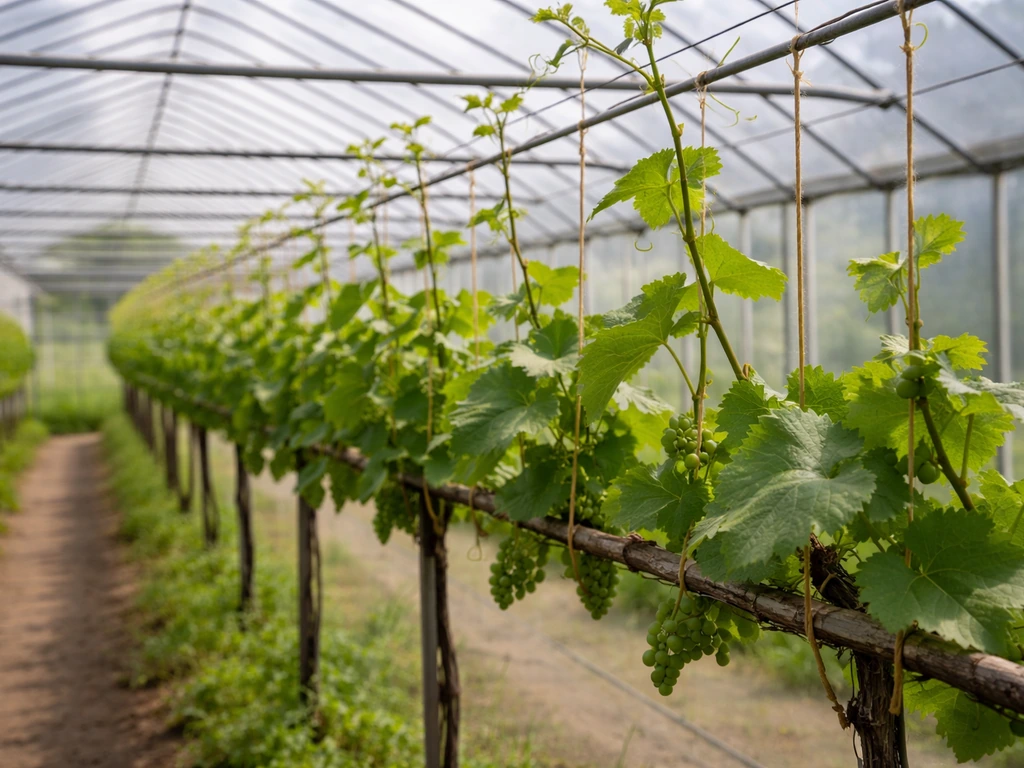
The two most practical training systems for greenhouse grapes are the Vertical Shoot Position (VSP) system and variations of the Geneva Double Curtain (GDC). VSP trains shoots upward into a narrow vertical wall above the cordon, with the fruiting zone positioned below. Cordon height in a VSP system is typically around 5.5 to 6 feet from the ground, which works well in a standard greenhouse bay. VSP is clean, manageable, and lets you keep the canopy open enough for air circulation and spray penetration, both critical for disease management indoors.
The Geneva Double Curtain system suits more vigorous American-type varieties and spreads the canopy horizontally with two separated fruiting wires. It is a better fit in wider, taller greenhouse structures where VSP would feel cramped. ATTRA's high tunnel training guidance covers GDC-style approaches in detail and is worth reading before you build your wire system.
Pruning comes down to two choices: spur pruning or cane pruning. Pruning choices like spur pruning help match the fruitful buds to where they reliably originate, which can balance vegetative growth with good fruiting. Spur pruning works well with VSP and cordon-trained vines where fruitful buds reliably originate close to the cordon. Cane pruning is used when fruiting buds are more productive further out on last season's wood. The variety you plant largely determines which method fits best. Ask your nursery supplier which pruning style they recommend for your specific cultivar.
Establishing the cordon arms takes time. Under normal conditions it can take two full growing seasons, though some research with table grapes in high tunnels found cordons could be established by the end of the first year with vigorous growth management. Do not rush it. A properly established cordon in year two or three will produce much better than a vine you pushed too hard in year one.
Managing the growing season inside a greenhouse
Pruning and dormancy timing
Do your dormant pruning in late winter, before bud swell begins. Inside a greenhouse that is heated even slightly through winter, buds can break earlier than you expect, so watch the vine rather than the calendar. Grapes produce fruit on current-season shoots that grow from last season's wood, so the pruning decisions you make now directly set up your crop. First-year pruning is straightforward: cut everything back to one or two buds on the strongest shoot to start building the trunk cleanly.
Watering and feeding
Water deeply and infrequently rather than lightly and often. Drip irrigation at the root zone is ideal because it keeps foliage and fruit dry, which directly reduces disease pressure. Vines with roots entirely inside the greenhouse will need more frequent checks than vines with roots extending outside the structure. During rapid shoot growth in spring, check soil moisture every two to three days. Back off after veraison (when berries start to color and soften) to concentrate sugars.
Feed with a balanced fertilizer at bud break, shifting to a lower-nitrogen formula as the season progresses. Too much nitrogen in midsummer pushes excessive vegetative growth at the expense of fruit quality and makes the canopy dense and disease-prone. If your vine is putting out thick, lush shoots well into summer, ease back on feeding.
Pollination and fruit set
The good news: almost all cultivated grape varieties are self-fertile with both male and female organs in the same flower, so you do not need multiple plants for pollination. The less-good news: inside a greenhouse with few pollinators and limited airflow, you may get inconsistent fruit set. Fruit set is considered poor when fewer than 30 percent of flowers develop into berries. To improve set, open vents and run a fan during bloom to move pollen around. You can also hand-pollinate by gently brushing flowering clusters with a soft brush or even just tapping the clusters to release pollen.
Watch for shot berries, the small, underdeveloped berries scattered through a cluster that form when pollination or fertilization is incomplete. If you see a lot of shot berries, the first culprits are poor airflow during bloom and heavy initial flower load. Thinning excess flower clusters before bloom, which also improves overall berry size and cluster quality, can reduce competition among developing fruitlets and lower shot-berry incidence.
Canopy management through the season
Shoot positioning and topping are ongoing tasks from early summer through harvest. Tuck shoots into the VSP wire system as they grow so they do not flop over or shade each other. Top long shoots that outgrow the trellis by cutting them back to a leaf or two beyond the top wire. Thin any overcrowded shoots to keep the canopy open. All of this sounds like a lot of work but each task is quick, and the payoff in disease resistance and fruit quality is significant in a greenhouse environment where you cannot rely on wind and sun to dry things out as effectively as outdoors.
Keeping pests and diseases under control
Greenhouse conditions reduce some outdoor pest pressures while potentially intensifying others. The closed environment means fewer insects chewing on leaves but also less natural predator activity, and the warm, sometimes humid microclimate is ideal for fungal diseases if you let it get away from you.
Botrytis: your primary threat
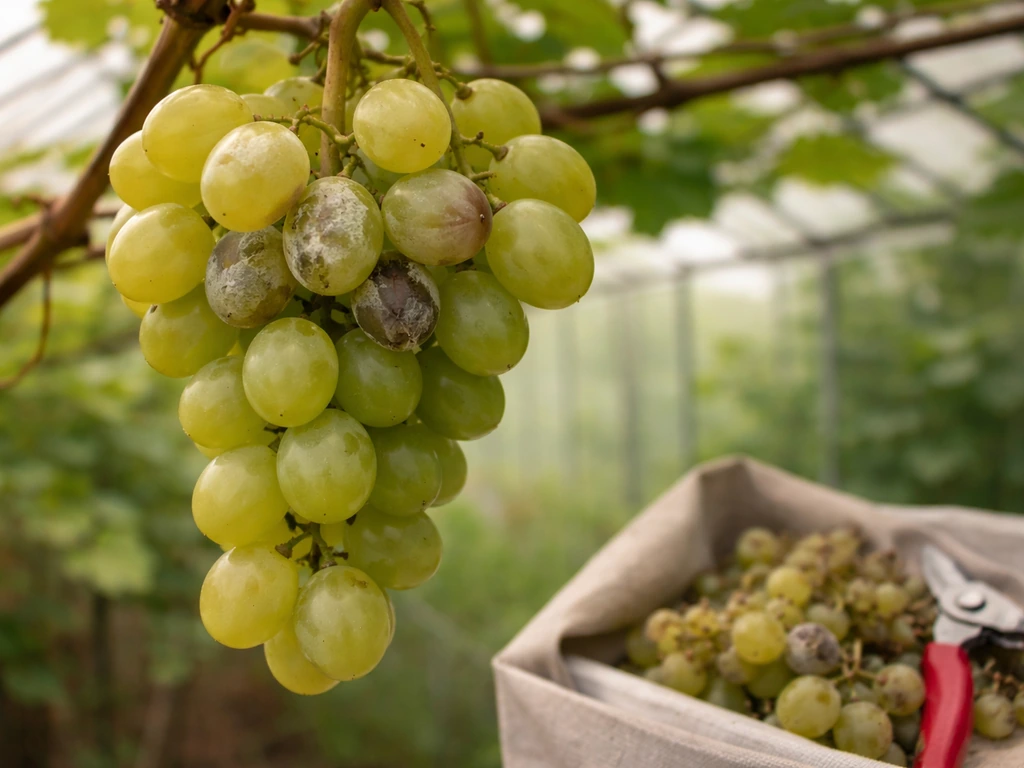
Botrytis bunch rot (gray mold) is the disease most likely to cause serious losses in a greenhouse grape setup. It thrives at temperatures between 58 and 82°F when relative humidity exceeds 92 percent and moisture sits on plant tissue. That window describes a poorly managed greenhouse almost perfectly. Your prevention strategy has to start with the physical environment: ventilate aggressively, water at the root zone only, keep humidity below 85 percent, and thin the canopy so air moves freely through the fruit zone.
Sanitation is the next layer. Remove and dispose of any mummified fruit, pruning debris, and infected tissue promptly. Botrytis overwinters on dead plant material and reinfects from there. After sanitation and environmental control, fungicides become the third layer when needed. Rotate chemical classes to prevent resistance, and make sure any product you use is labeled for use in enclosed structures. Note for Canadian growers: if you are using a pesticide labeled for greenhouse use, you need to be careful about keeping the structure closed to prevent spray drift, as Canada.ca pesticide guidance for high tunnels specifically flags this compliance issue.
Other disease and pest considerations
Powdery mildew can be a problem in warm, dry greenhouse conditions, which is somewhat counterintuitive but real. Good airflow and preventive sulfur applications early in the season keep it manageable. Spider mites often increase in hot, dry greenhouse environments because natural predators are absent. Scout the undersides of leaves weekly starting in midsummer. If you spot stippling or webbing, introduce predatory mites or apply an appropriate miticide before populations explode. Aphids can also build up quickly inside a greenhouse. Yellow sticky traps help with monitoring and controlling whiteflies and fungus gnats.
- Keep relative humidity below 85 percent with active ventilation, especially at night and after watering.
- Water only at the root zone using drip irrigation, never overhead.
- Remove all dead wood, mummified fruit, and diseased leaves promptly throughout the season.
- Thin the canopy so clusters are exposed and air can move around them.
- Scout weekly for mites, aphids, and early disease symptoms starting at bud break.
- Rotate fungicide classes if you spray for Botrytis or powdery mildew to prevent resistance buildup.
- Use sticky traps to monitor flying insect pressure throughout the season.
Harvesting your grapes and planning what comes next
Knowing when to pick
Grapes do not continue to ripen after harvest, so timing your pick is critical. Unlike tomatoes or pears that can finish ripening on a shelf, a grape picked underripe will stay underripe. Taste is your best guide for table grapes: the berry should be sweet with a slight crunch, and the seeds should have turned from green to brown. For wine grapes, track Brix (sugar content) with an inexpensive refractometer and aim for the target range your variety needs, typically 22 to 26 Brix for most red varieties and 20 to 23 Brix for whites, though this varies.
Watch for shatter (berries dropping from the cluster) and any signs of disease as ripening approaches. Both signal that your harvest window is narrowing. In a greenhouse, you have some ability to manage the microclimate to extend the window slightly, but do not wait too long. Once a cluster shows the first signs of Botrytis, the rest of the cluster can turn within days in warm conditions.
After harvest: what the vine needs
After picking, the vine still needs time to harden off and go into dormancy properly. Do not cut irrigation completely the moment you harvest. Gradually reduce watering and let the canopy start to yellow and drop leaves naturally. This is when the vine is moving carbohydrates back into the root system for next year's growth. If you have been trying to grow wine grapes, take notes on ripening dates and Brix levels at harvest. That data tells you whether your greenhouse environment matched the heat requirements of that variety, and it guides whether to adjust management or try a different cultivar.
Your practical next steps for getting started
If you are ready to move from planning to doing, here is where to focus your energy first. Identify your hardiness zone and decide whether your goal is frost protection, season extension, or disease management, because that choice shapes everything from structure type to variety selection. If you are wondering, can you grow grapes in a greenhouse, the short answer is yes, but you will still need to manage temperature, humidity, and disease pressure carefully.
A basic high tunnel (a single 30-by-100-foot structure is a common starting point for hobbyists) is cheaper and simpler to manage than a fully glazed greenhouse, and it handles most of what home growers actually need. Grapes are also one of the easiest fruits to grow under cover, whether you are aiming for table grapes or wine grapes table or wine grapes.
Once you have the structure sorted, choose one variety that is well-suited to your zone, plant one or two vines, and commit to the first-year establishment rules: no fruit, build the trunk, and get the trellis wires in place before growth gets ahead of you.
If you are curious whether growing grapes hydroponically might be a simpler indoor alternative, that is a different approach worth exploring separately, as the root zone management and nutrient delivery are fundamentally different from soil-based greenhouse growing. For most home growers, soil or a quality container mix in a greenhouse outperforms hydroponics for grapevines because of the root volume grapes ultimately need. Either way, start simple, keep notes, and let the vine's second and third years show you what your setup can actually do.
FAQ
Can you grow grapes in a greenhouse in a warm climate where outdoor vines already ripen fruit?
Yes, but most of the time you will be using the greenhouse mainly for disease control, not for extra ripening. In warmer zones, grapes can overheat quickly, so plan for strong ventilation and light shading only if needed, otherwise you risk dense canopy growth and higher Botrytis risk from humidity pockets.
Do greenhouse grapes need heating in winter?
Often not for cold-hardy hybrids, but some heating can help if you are trying to push earlier budbreak or protect borderline varieties. A key decision is your target, frost avoidance versus extending the season into fall, and then you can size your heat source to hold temperatures above damaging bud thresholds during the earliest weeks.
What is the biggest mistake with humidity control for greenhouse grapes?
Trying to manage humidity mainly by watering less. Botrytis prevention depends more on airflow and keeping fruit tissues dry, so prioritize ventilation capacity, canopy openness, and root-zone drip irrigation first, then use dehumidification only as a supplement in very humid locations.
Should I irrigate overhead if I am trying to cool the greenhouse?
No. Overhead watering wets leaves and clusters, which directly increases gray mold risk during the temperature and humidity window Botrytis favors. If you need cooling, use ventilation and, if necessary, controlled heating or airflow management rather than adding moisture to the canopy.
How do I know if I need fans, not just vents?
If your greenhouse cannot reliably flush hot, humid air during warm afternoons, vents alone may not be enough. As a practical check, run airflow tests if possible, then verify that the canopy has consistent movement and that humidity spikes are not lingering near the fruit zone.
Are greenhouse grapes still self-pollinating if there are few insects?
They are often self-fertile, but enclosed airflow limits consistent pollen movement, so fruit set may be uneven. During bloom, you should actively move air with a fan and open vents when temperatures allow, and be ready to hand-pollinate if you see low set.
What should I do if I see shot berries in most clusters?
First correct bloom airflow and flower load. Thinning excessive clusters before they compete heavily can reduce underdeveloped berries, and ensuring a gentle, consistent breeze during flowering helps pollen transfer. If shot berries persist, check that your vine is not under nitrogen stress or over-crowded during the bloom period.
Can I grow wine grapes in a greenhouse the same way as table grapes?
You can, but ripening may shift because heat accumulation patterns differ inside structures. Track Brix and harvest timing carefully, and expect you may need to adjust shoot growth management or the fruiting load to reach the variety’s maturity targets rather than assuming outdoor timing will match.
How late can I wait to harvest greenhouse grapes?
Avoid waiting for disease to start in the first affected cluster tissues. In warm, humid microclimates, clusters can deteriorate quickly once Botrytis begins, so you should watch for early symptoms and pick promptly even if sugar looks close to target.
Should I stop watering completely right after harvest to harden off the vine?
No. Instead, reduce irrigation gradually so the vine can transfer carbohydrates back into the roots and properly prepare for dormancy. A hard stop can stress the plant and affect vigor going into the next season.
How many vines should I start with if I am new to greenhouse grape growing?
Start with one variety and one to two vines. This makes it easier to diagnose problems like humidity-driven disease, heat stress, or inconsistent fruit set, and it gives you time to learn trellising and pruning pacing without committing to a full production scale too early.