
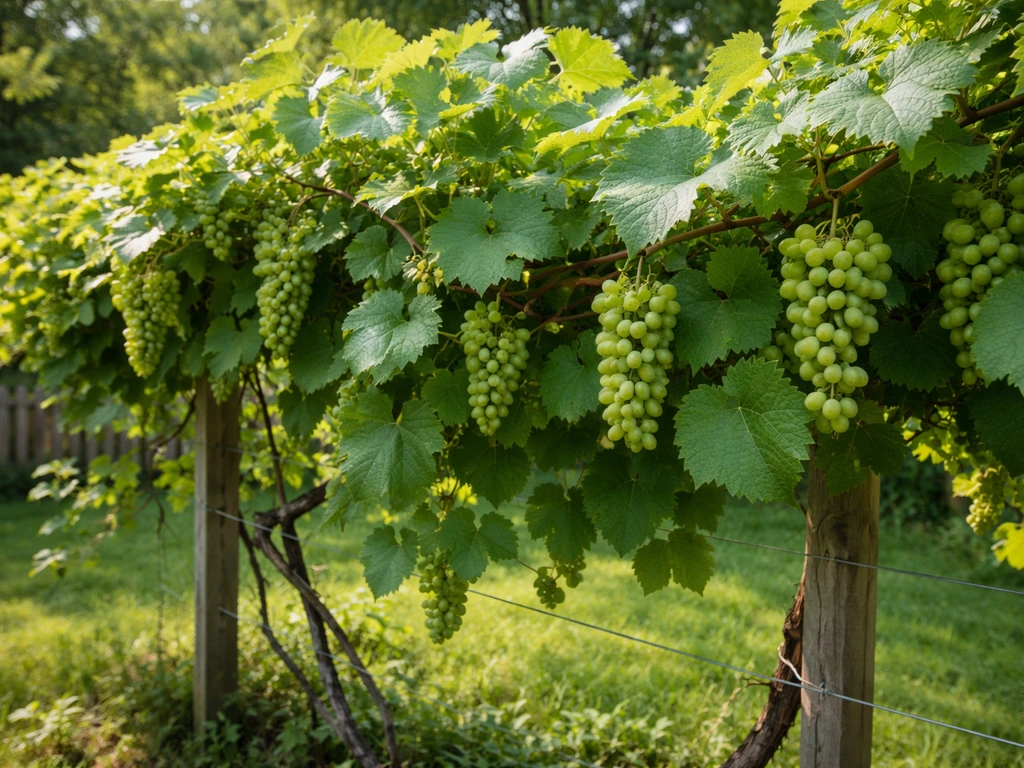
Yes, you can absolutely grow grapes in Pennsylvania, and plenty of home gardeners do it successfully every year. The state's mix of hardiness zones (roughly Zone 5a in the coldest northern highlands up to Zone 7b in the warmer southeast) means grapes are genuinely viable across most of the state, as long as you pick varieties matched to your local winter lows and manage the region's humidity-driven disease pressure. The biggest mistakes beginners make are planting the wrong variety and picking a shady or poorly drained spot. Get those two things right and you're most of the way there. Because Pennsylvania covers similar cold-weather growing conditions, the same general grape-growing approach can help you figure out whether you can grow grapes in Maine can you grow grapes in maine.
Can You Grow Grapes in Pennsylvania? How to Start Today

Pennsylvania viability: can grapes actually grow here?
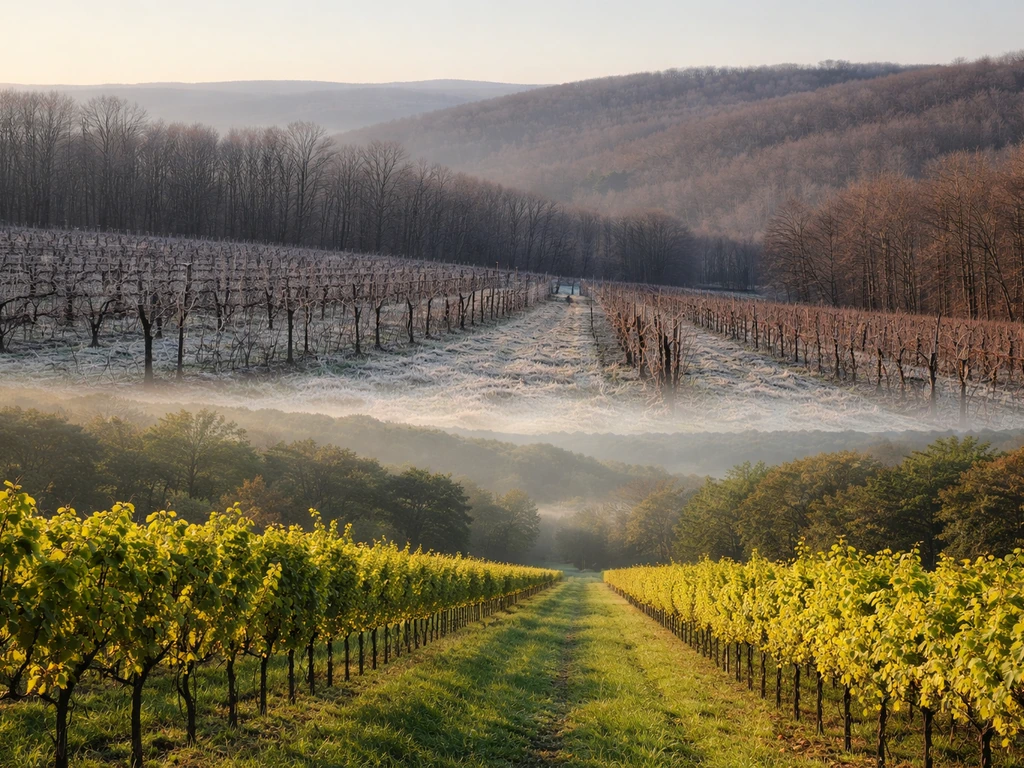
Pennsylvania is genuinely good grape-growing territory, but it's not uniform. The northern tier and higher elevations (think the Pocono plateau or parts of Potter and Cameron counties) sit in Zone 5a to 5b, where winter lows can drop well below -10°F. The central and western regions are mostly Zone 6a and 6b. The southeast corner, including the Philadelphia suburbs and the lower Delaware Valley, pushes into Zone 7a and 7b, which is some of the mildest growing climate in the Northeast. Each of these zones changes which varieties are realistic for you.
As a rough benchmark from Penn State Extension: European vinifera varieties (Cabernet Sauvignon, Chardonnay, etc.) need winter lows to stay above about 0°F to avoid serious damage. French-American hybrid varieties tolerate lows down to around -5°F. If you're in the colder parts of the state and lows regularly push past those numbers, you'll need cold-hardy American-origin varieties or selected hybrids bred for tough winters. If you're in the warmer southeast, you have real options with certain vinifera varieties, though disease management still matters a lot. Most of Pennsylvania falls in the hybrid-friendly middle ground, which is actually a sweet spot for productive home growing.
One honest thing to set expectations on: Pennsylvania summers are warm and humid, and that combination drives fungal disease pressure. Black rot, downy mildew, Phomopsis, and Botrytis (bunch rot) are all documented problems in PA vineyards. This doesn't mean grapes are too hard to grow here, it just means variety choice and airflow matter a lot. Neighbors growing grapes in drier states like Maryland or New York's cooler finger lakes region face different tradeoffs. In PA, disease resistance is a top-tier selection criterion, not an afterthought.
Pick the right variety for PA winters and disease pressure
Concord is the go-to recommendation for good reason. Penn State Extension specifically calls it well-adapted to Pennsylvania with good pest resistance and cold hardiness. It's a native American variety (Vitis labrusca type), produces reliably, and handles the freeze-thaw swings that can stress fancier cultivars. If you want table grapes and jam grapes and you're in Zone 5b through 6b, Concord is the low-risk starting point. The flavor is distinctly 'grapey' and not everyone wants that in a wine grape, but for fresh eating and home use it's hard to beat.
If you want wine-style or hybrid varieties with better disease resistance and a wider flavor range, French-American hybrids are the practical choice for most of Pennsylvania. Varieties like Marquette, Frontenac, and Noiret handle cold well and have reasonable disease resistance. Traminette, a white hybrid developed partly from Gewurztraminer, performs well in PA and has become popular with home growers who want aromatic whites. Vidal Blanc is another durable white hybrid worth considering in Zones 6 and up. Penn State Extension ties cultivar selection to a 'relative cold-hardiness of grapevines grown in Pennsylvania' reference, and it's worth checking that resource for the most current list before you buy.
If you're in the warmer southeast (Zone 7a or 7b) and want to try vinifera varieties, some growers do have success with Cabernet Franc and Riesling in well-chosen sites. But go in knowing the disease management workload is higher, and a bad wet summer can hurt your crop even with good practices. If you're brand new to growing grapes, starting with a proven hybrid or Concord will teach you the vine's growth habits without also fighting cold damage and disease at the same time.
| Variety | Type | Best PA Zone | Disease Resistance | Best Use |
|---|---|---|---|---|
| Concord | American | 5a–7b | High | Table, juice, jam |
| Marquette | Hybrid | 5a–7b | Good | Red wine, fresh eating |
| Traminette | Hybrid | 5b–7b | Good | White wine, aromatic |
| Frontenac | Hybrid | 5a–6b | Good | Red wine, cold climates |
| Vidal Blanc | Hybrid | 6a–7b | Moderate | White wine, versatile |
| Cabernet Franc | Vinifera | 6b–7b | Lower | Red wine, warmer sites only |
| Riesling | Vinifera | 6b–7b | Lower | White wine, warmer sites only |
Site and soil: sun, drainage, pH, and preparation
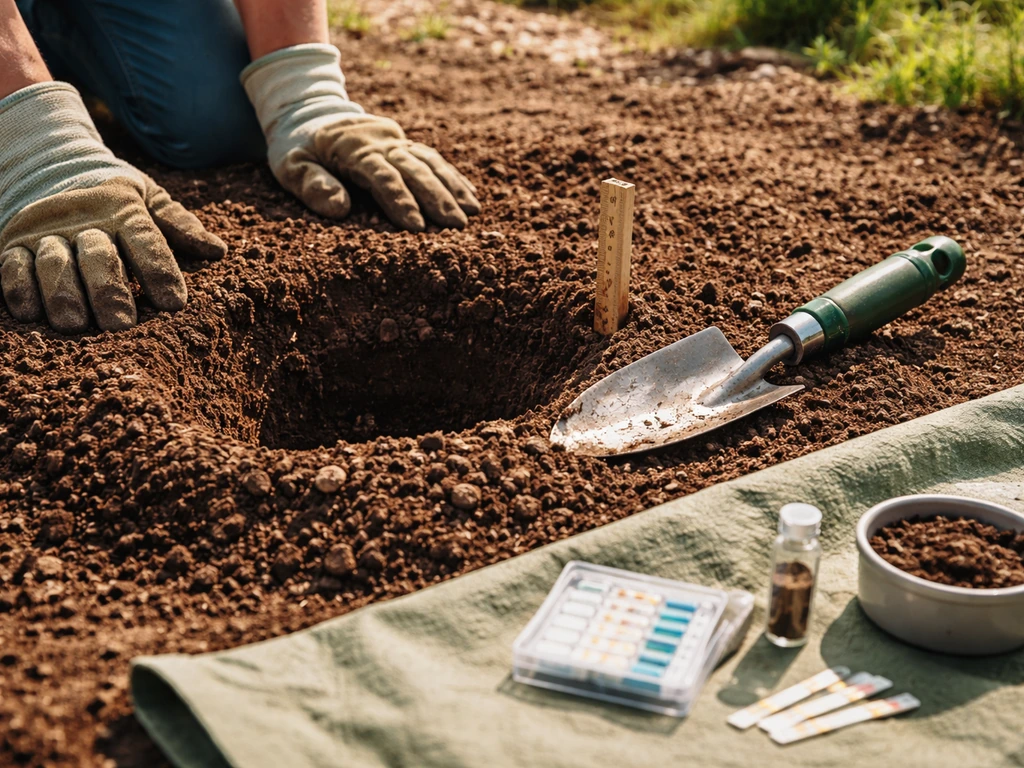
Full sun is non-negotiable. Penn State Extension is clear that grapes require full sun for proper ripening and flavor development. Practically, that means at least 7 to 8 hours of direct sun per day during the growing season. A south or southwest-facing slope is ideal because it maximizes heat accumulation and helps the canopy dry out faster after rain, which directly reduces fungal disease pressure. Avoid spots where buildings, trees, or fences shade the vines in the afternoon, and don't plant in low spots where cold air pools on frosty nights.
Drainage matters as much as sun. Grapes tolerate drought reasonably well once established, but they hate wet feet. Heavy clay that stays waterlogged after rain will stress roots and invite disease. If your soil drains slowly, either build raised rows, amend heavily with compost and coarse material, or find a different spot. A gentle slope naturally improves both drainage and cold air drainage, which is why many PA vineyards sit on hillsides.
For pH, Penn State Extension recommends a soil pH of 5.6 to 6.4 for grapes. Get a soil test before you plant. Penn State's soil testing lab is inexpensive and gives you Pennsylvania-specific amendment recommendations. If your soil is too acidic (below 5.6), add lime to bring it up. If it's too alkaline, which is less common in PA but possible in areas with limestone bedrock, sulfur can bring it down. Don't guess on this, a $15 soil test can save a lot of frustration later.
Prepare the planting area by working in compost and correcting pH the fall before you plant if possible. Remove grass and weeds thoroughly in the planting row. Perennial weeds like bindweed and quackgrass competing with young vines in the first year are a real headache, so the more prep work you do beforehand, the better.
Planting plan and timing (spring vs fall)
Spring planting is the right move for Pennsylvania. Penn State Extension recommends planting bare-root dormant plants in spring as soon as the soil can be worked, which in most of PA means late March through mid-April depending on where you are. Bare-root stock is typically what nurseries sell in late winter and early spring, and it's the most economical way to start. The plant is dormant, roots are exposed, and you're getting it in the ground while it can settle in before summer growth kicks off.
Fall planting is common for some perennial crops, but for grapes in Pennsylvania it introduces real risk. Young bare-root vines planted in fall have to survive a full winter before they've had a chance to establish any root mass in their new location. Spring planting gives the vine an entire growing season to develop roots before facing its first hard freeze. If you're choosing between fall and spring, go with spring every time.
One thing worth knowing upfront: grapes do not fruit right away. In the first year, your goal is just root establishment and getting a strong primary shoot. In the second year, you start training the structure. Most home growers see their first real usable harvest in year three or four. That's not a failure, that's just how vines work. Setting that expectation at the start keeps you from pulling plants that are actually doing fine.
Trellising and spacing for home grape growing
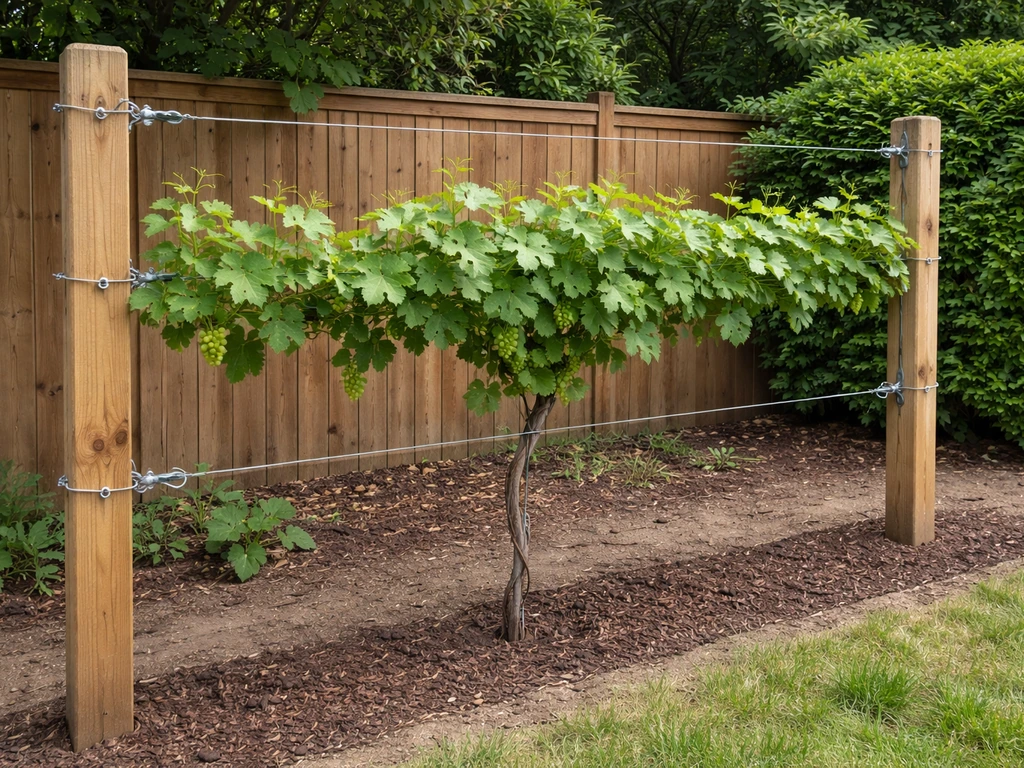
Grapes need support from day one. They're vigorous climbing vines, and without a trellis they'll sprawl on the ground, the canopy will become congested, airflow drops, and disease pressure goes up. For home growers, the simplest effective system is a two-wire trellis: a lower wire at about 3 feet and an upper wire at about 5 to 5.5 feet, strung between sturdy end posts (4x4 treated wood or metal T-posts work well) with line posts every 20 to 24 feet. This supports the high-cordon or Guyot-style training that works well for most hybrid and American varieties.
For spacing, Penn State Extension's commercial guidelines use 8-foot between-vine spacing in rows as a common standard. For home gardens, giving each vine 8 feet along the row and keeping rows at least 8 to 9 feet apart is a practical starting point. That spacing allows you to walk between rows, manage canopy, and get good airflow. If you only have room for a single row along a fence or property line, 8 feet between vines still applies.
Orient your rows north to south if possible. This gives both sides of the canopy roughly equal sun exposure through the day. It's often a compromise based on your yard's shape and slope, but if you have flexibility, north-south rows reduce shading and improve ripening.
Season-by-season care: watering, fertilizing, and pruning basics
Spring: bud break through early growth
Apply your first fertilizer application before buds start to swell. Penn State Extension ties nitrogen fertilization timing to bud break, so early spring, before you see green tissue emerging, is when to put down a balanced fertilizer or compost top-dressing. Don't over-fertilize with nitrogen: too much pushes excessive leafy growth at the expense of fruit and also creates a dense canopy that traps humidity and worsens disease. Young vines in their first two years need relatively little nitrogen; established vines need it timed right, not applied in large amounts.
Summer: managing water, weeds, and disease
Established grapevines are moderately drought-tolerant, but young vines in their first and second year need consistent moisture. Water deeply and infrequently rather than a little every day. A good soaking once a week during dry spells is better than daily shallow watering. Drip irrigation is ideal because it keeps water off the foliage, which matters a lot in humid Pennsylvania summers. If you're hand-watering, water at the base, not overhead.
Mulch around the base of young vines to retain moisture and suppress weeds. Keep mulch a few inches away from the trunk to avoid crown rot. Weed control in the first two years is worth the effort: weeds compete directly for water and nutrients when the vine is trying to establish.
Pennsylvania's humidity means fungal diseases are a real summer concern. Penn State Extension's integrated pest management guidance for grapevine fungal diseases is clear: cultural practices are necessary, and fungicides alone are not sufficient. Good airflow through the canopy (achieved through proper spacing, trellis training, and summer shoot management) is your first line of defense against black rot, downy mildew, Phomopsis, and Botrytis. Remove suckers and excess shoots to keep the canopy open. If you're growing disease-resistant varieties, you're already ahead on this front.
Dormant season: the most important pruning window
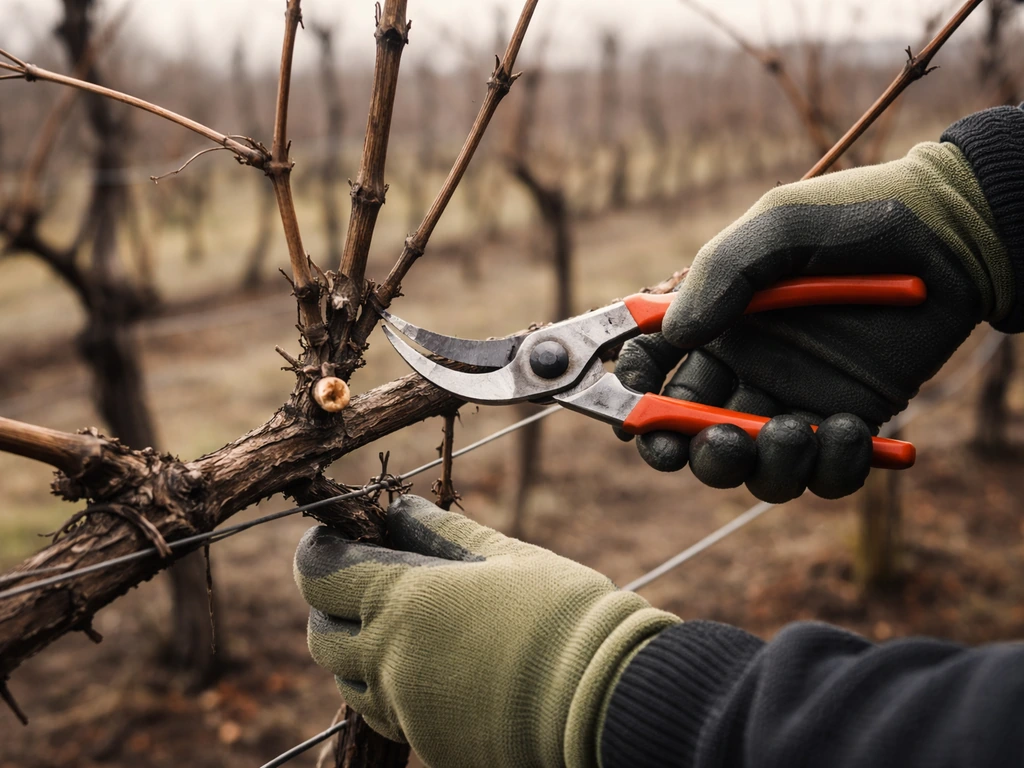
Pruning is where most beginners feel the most uncertainty, and it's genuinely the most important thing you'll do for your vines each year. The key concept is this: grapes fruit on one-year-old wood. That means the canes that grew last season, and are now dormant, are what will carry next year's fruit. Old wood does not produce fruit. So every dormant season, your job is to remove most of last season's growth and strategically keep the best one-year-old canes or spurs in the right positions on the vine structure.
Dormant pruning happens in late winter, typically February through mid-March in most of Pennsylvania, while vines are still fully dormant. Penn State Extension provides a stepwise guide to dormant pruning and training young grapevines, and if you're new to this, walking through that resource with your vines in front of you is the best way to learn. In year one, you're mostly just selecting the strongest shoot to train as the main trunk. In year two, you start establishing the cordon arms or canes. By year three, you're doing proper fruiting-cane or spur pruning and the payoff starts to show.
Harvest timeline and troubleshooting common PA problems
Most home growers in Pennsylvania see their first meaningful harvest in year three or four. Concord and many hybrids ripen in late August through September in most of PA. Warmer sites in the southeast can push earlier; cooler northern locations may need to select shorter-season varieties to guarantee full ripeness before fall frosts arrive. Taste is the best ripeness indicator: if the seeds are crunchy and brown and the fruit is sweet without harsh astringency, it's ready. Don't rush harvest based on color alone, many varieties color up weeks before they're fully ripe.
Here are the most common problems PA home growers run into and what to do about them:
- Black rot: Shows as circular brown leaf spots and then shriveled, mummified berries. Caused by a fungal pathogen that overwinters in infected fruit left on the vine. Remove mummified clusters immediately and dispose of them off-site, don't compost. Improve canopy airflow and consider a copper-based spray early in the season if you've had repeated problems.
- Downy mildew: Oily yellow spots on top of leaves with white fuzzy growth underneath. Worse in wet springs. Open canopy, avoid overhead irrigation, and choose resistant varieties if it's a recurring issue.
- Botrytis (bunch rot): Gray fuzzy mold on ripe or nearly ripe clusters, often triggered by wounds from insects or tight berry clusters after rain. Thin clusters when young to improve airflow around berries. Harvest promptly when ripe.
- Poor fruit set: Vines leafing out well but producing few or no clusters. Often caused by over-vigorous growth (too much nitrogen) or pruning that left too much or too little one-year-old wood. Calibrate fertilizer downward and revisit dormant pruning technique.
- Winter dieback: Cane tips or entire cordons dying back after hard winters. Normal for some varieties at the edge of their cold tolerance. Select hardier varieties, and delay pruning until late winter when you can see which wood survived and which is dead.
- Japanese beetles: Common in PA and will skeletonize grape leaves in midsummer. Hand-pick into soapy water early in the morning when they're sluggish, or use row cover on young vines during peak beetle season (late June through July).
If you're comparing notes with gardeners in neighboring states, Pennsylvania's situation shares some traits with New Jersey and Maryland (both warm enough for hybrids and some vinifera on good sites, both dealing with summer humidity and disease pressure) but is generally colder than both in the northern portions. New York's Finger Lakes and Hudson Valley have a similarly serious grape-growing tradition and similar disease challenges, so resources from those regions often translate well to Pennsylvania conditions. If you're asking can you grow grapes in New York, the Finger Lakes and Hudson Valley show that it can be done with the right cold-hardy varieties and solid disease management.
The honest summary: grapes in Pennsylvania are very doable for home gardeners. Start with a disease-resistant, cold-appropriate variety like Concord or a tested hybrid. Get your site right: full sun, good drainage, pH in the 5.6 to 6.4 range. Plant bare-root stock in early spring. Put up a simple two-wire trellis before the vine needs it. Learn dormant pruning in year two. Be patient through years one and two when nothing seems to be happening. By year three or four, you'll have real clusters to show for it, and once an established vine is producing, it can keep going for decades.
FAQ
Can you grow grapes in Pennsylvania in containers or a small raised bed?
Yes, but only for patio-size varieties and with a big enough container (commonly 15 to 25 gallons) and excellent drainage. Container vines still face PA winter cold, so the pot must be protected or buried to keep roots from freezing and thawing repeatedly. Expect slower growth and more frequent watering than in-ground vines, and disease pressure can be worse if the canopy stays too shaded because airflow is limited.
What grape variety should I choose if I’m in a colder northern county (near Zone 5a/5b)?
Prioritize cold-hardiness first, then disease resistance. Concord is the safest bet if you want a low-risk learning vine, but you can also look for American-origin varieties or French-American hybrids bred for winter survival. If you’re unsure, cross-check your site’s typical winter low and choose a variety known to survive those lows, not just “survive a bad winter once.”
How much sun is “full sun” in practice, and what if my yard only gets 5 to 6 hours?
For grapes, aim for at least 7 to 8 hours of direct light, especially during the warmest part of the day. With 5 to 6 hours, you may still grow vines, but ripening and sugar development often lag, and fruit quality suffers. If your yard is limited, consider training a canopy to maximize exposure (and avoid afternoon shade), but be ready for lower yields or longer time to ripen.
Do I need to cover grapes in Pennsylvania winters?
It depends on your variety and how deep you can plant the crown, plus how exposed your site is. Even hardy varieties may suffer dieback during repeated freeze-thaw cycles, especially on wind-exposed slopes or if the vine is younger. A common approach is soil mounding or wrapping young trunks for the first year or two, then reassessing each winter based on how much cane damage you see.
When should I expect fruit on my vine, and why do some vines not crop even in year three or four?
Most home growers see meaningful harvest around year three or four, but uneven training, excessive nitrogen, or poor sun can delay fruiting. Also, vines that were stressed by waterlogging or drought in the first two years may take longer to establish enough energy reserves. If you see lots of leaves but few flower clusters, check canopy density and fertilizer timing, not just pruning.
How do I tell if it’s disease pressure or poor ripening when my grapes don’t taste right?
Poor ripening typically shows uneven sweetness and astringency, often linked to insufficient sun, late harvest, or overly dense canopy. Disease shows up as spots, blight, rot, or uneven shriveling that spreads or clusters around wet, humid periods. If you notice the problems after rainy spells and they worsen quickly, assume disease and improve airflow first, then consider targeted fungicide timing for your specific disease pattern.
Is it okay to plant the grapevine next to a fence or wall?
It can work if you still meet airflow and sun needs. Avoid placing vines where rainwater runs off the roof directly onto foliage, and make sure there is room to install a trellis and maintain canopy spacing. Also, fence shade in the afternoon can reduce ripening, so prioritize a position that stays sunny through the day rather than just “south-facing.”
Can I use overhead sprinklers on grapes in humid Pennsylvania summers?
It’s not recommended. Overhead watering keeps leaves wet longer, which increases fungal risk. If you must hand-water, water at the base and early in the day, and use mulch to reduce evaporative losses. Drip irrigation tends to be the lowest-disease option because it keeps foliage dry.
What’s the biggest pruning mistake beginners make?
Keeping too much old wood and not selecting the right one-year-old canes or spurs for fruiting. Beginners often prune lightly or remove the wrong canes, which leads to weak fruiting and overcrowding. A practical check is to confirm that your retained fruiting shoots are coming from last season’s growth, since grapes fruit on one-year-old wood.
How do I manage weeds without harming the young vine?
Use a weed-suppressing mulch ring around the vine, leaving a small gap away from the trunk to prevent crown rot. In the first two years, avoid heavy competition and keep the planting row clean, but also avoid digging too close to roots. If perennial weeds like quackgrass are established, plan on deeper removal before planting and monitor early, since herbicide use near grape roots can be risky if you’re not following label directions exactly.
Can I grow grapes for wine, or do I need different grapes than Concord?
You can make wine from hybrids or Concord, but wine flavor goals matter. Concord wine tends to be “labrusca” in character, while many home wine growers prefer French-American hybrids for a more traditional range. The key decision aid is matching your variety to your intended style and your local ripening reliability, since higher-quality “vinifera-like” wines usually require better disease control and more consistent full-season ripeness.