
Yes, you can grow table grapes in Vancouver, BC, and plenty of home gardeners in the Lower Mainland already do it successfully. The catch is that Vancouver's cool, wet maritime climate demands careful variety selection and a warm microsite. Get those two things right, and you can harvest fresh grapes from your own backyard most years. Get them wrong, and you'll spend summers fighting mildew and waiting on fruit that never fully ripens. This guide walks you through exactly what works, what doesn't, and how to set yourself up for a genuinely satisfying harvest.
Best Table Grapes to Grow in Vancouver BC: Top Varieties
Marcus Whitfield
12 Aug 2026
Will table grapes actually thrive here?
The honest answer is: yes, with realistic expectations. Vancouver sits in climate zone 7/8, with roughly 225 frost-free days, an average last frost around March 28, and a first frost around November 5. That's a decent growing window on paper. The real challenge is heat accumulation. Grapes don't just need frost-free days, they need warm, sunny days to build the sugar and ripen the fruit. Vancouver's cool, overcast summers mean you'll have a lower total of growing degree days (GDD) compared to the Okanagan or even parts of Oregon. Late-ripening varieties simply won't make it here outdoors. But early to mid-season cultivars, placed on a warm south-facing wall or slope, absolutely can and do produce well. Think of it as doable with intention, not a long shot.
Vancouver's climate and what it actually means for your vines
Vancouver receives around 1,239 mm of rainfall annually (1991-2020 normals), and most of that rain falls between October and April. The summers are comparatively dry and mild, which is actually a welcome break for grape disease management. The problem is that cool, cloudy stretches in June and July slow heat accumulation right when vines are flowering and setting fruit. The Lower Mainland also has a pronounced urban heat island effect, meaning gardens in Burnaby, Vancouver proper, and South Surrey can be measurably warmer than rural stretches in the Fraser Valley or shaded valley bottoms. That urban warmth genuinely helps grapes. On the flip side, low-lying areas with heavy clay soils and poor air drainage create frost pockets and wet root conditions that stress vines. The takeaway: where you plant matters almost as much as what you plant.
From a GDD standpoint, coastal BC growers are working with a cool-season budget. PNW extension research from Oregon State University confirms that maritime cool-coast sites need cultivars that ripen in 150-180 frost-free days or fewer. That rules out wine-grape stalwarts like Muscat of Alexandria and most late Vitis vinifera varieties for outdoor cultivation, but it leaves plenty of excellent early-ripening table grape options on the table.
Is your site actually ready for grapes?
Before you order any vines, it's worth being honest about what your property can and can't offer. blank" rel="noopener noreferrer">Agriculture and Agri‑Food Canada’s interactive climate normals (ImageServer) provides national raster layers, including growing‑season GDD, frost‑day counts and frost‑free period, that can be used to map micro‑climate constraints across the Lower Mainland. Grapes are long-lived plants, 20 to 30 years with good management, so planting in the wrong spot is an expensive mistake to undo.
Where Vancouver gardens have the edge
- South-facing fences and walls in city gardens create radiant heat that extends the effective ripening season significantly.
- 225+ frost-free days means you rarely lose young growth to spring frost, unlike interior BC.
- Dry summers reduce fungal pressure during the critical ripening window in August and September.
- Urban heat island effects in Vancouver, Burnaby, and New Westminster push microclimate temperatures meaningfully higher than rural surroundings.
Where you'll need to compensate
- Heavy glacio-marine clays and alluvial peats are widespread in the Fraser Lowland and drain poorly, which invites root rot and vine stress.
- Cool, overcast Junes can reduce fruit set and slow heat accumulation right at the worst possible time.
- High autumn rainfall from October onward brings botrytis pressure just as late-ripening fruit is finishing, so early varieties are strongly preferred.
- Fraser Valley frost pockets and low-lying suburban lots can see harder late frosts than the city core.
For most urban home gardeners with a sunny south-facing fence, a raised bed or a warm patio wall, grapes are absolutely worth trying. If your garden is mostly shaded, north-facing, or sits in a soggy low spot with no drainage fix in sight, I'd start with a container on a sunny patio before committing to a permanent vine.
How to choose your variety: the trade-offs worth understanding
There are four main trade-offs to think through before you pick a cultivar. Getting clear on your priorities here will save you a lot of frustration later.
Seeded vs seedless
Seedless varieties are what most people want for fresh eating, and several seedless cultivars do ripen reliably in Vancouver. Seeded varieties like Campbell Early and Himrod's older cousins tend to be earlier, hardier, and often more disease-tolerant because many were bred for cool northern conditions. If you're growing purely for personal fresh eating and especially for kids, prioritize seedless. If you want maximum reliability in a tricky year or plan to make juice, a good seeded early-season variety is a strong hedge.
Early vs late ripening
This is the single most important decision for Vancouver. Early-ripening cultivars (late July to late August) are your bread and butter here. Mid-season varieties (September) are achievable on a warm site. Late-ripening cultivars (October and beyond) are a gamble outdoors in most Lower Mainland gardens and I don't recommend them unless you have a greenhouse or a genuinely exceptional south-facing microclimate. Oregon's experience with its own cool maritime coast is instructive here: OSU Extension explicitly advises avoiding late-ripening cultivars on the coast.
Flavour vs disease resistance
Some of the most flavourful European-type (Vitis vinifera) table grapes are also the most susceptible to powdery mildew and botrytis. In Vancouver's climate, disease resistance isn't just a nice-to-have, it's a practical necessity unless you're ready to run a regular spray program. American hybrid and interspecific varieties bred for northern cool-wet climates (like those evaluated through WSU trials in western Washington) were specifically selected to handle exactly the conditions you're dealing with. My recommendation: lean toward disease-tolerant cultivars for your first vine, especially if you prefer a low-spray approach.
Flavour type: slip-skin vs European
American-type grapes (like Concord relatives) have a slip-skin texture and a distinctive foxy flavour that's wonderful for juice or jam but not everyone's preference for fresh eating. European-type vinifera grapes have the thin skin and mild sweetness of supermarket table grapes. Interspecific hybrids split the difference. Knowing which flavour profile you're after helps narrow the list considerably.
Best seedless table grape varieties for Vancouver
These are the seedless cultivars most consistently recommended by PNW extension services and reported by coastal BC and western Washington home growers as performing well in cool maritime conditions. Early ripening and reasonable disease tolerance are the filters I've applied here. For gardeners comparing options across cool maritime climates, see a short guide on the best seedless grapes to grow in the UK for varieties and timing that often overlap with Vancouver conditions. For comparison and regional recommendations, see a short list of the best seedless grapes to grow in Michigan.
| Variety | Ripening | Disease Tolerance | Taste Notes | Notes for Vancouver |
|---|---|---|---|---|
| Himrod | Early (late July–mid Aug) | Moderate | Sweet, mild, honey-like; thin skin | Widely available at BC nurseries; reliable early crop on warm sites; some powdery mildew susceptibility so open canopy management helps |
| Interlaken Seedless | Very early (mid–late July) | Moderate | Sweet, crisp, green-gold berries; good fresh flavour | One of the earliest seedless varieties available; excellent for cool maritime sites per WSU trials in western Washington |
| Reliance | Early-mid (mid Aug) | Good | Sweet, pink-red, juicy; mild foxy notes | Bred for northern cool climates; cold-hardy and disease-tolerant; reliable producer in PNW cool-coast gardens |
| Canadice | Early-mid (Aug) | Good | Sweet, red, compact clusters; light strawberry note | Very cold-hardy; consistent performer in western Washington and coastal BC; low disease pressure under good canopy management |
| Vanessa | Mid (late Aug–early Sep) | Good | Firm, red, crisp; clean sweet flavour, minimal foxiness | Bred in Ontario for cool humid climates; good botrytis tolerance; a strong all-rounder for Vancouver |
| Somerset Seedless | Early (late July–Aug) | Good | Sweet, strawberry-pink, very mild slip-skin | Extremely cold-hardy; low disease pressure; smaller clusters but very reliable even in cooler summers |
If I had to pick just one seedless variety to start with in a typical Vancouver garden, I'd go with Interlaken Seedless or Canadice. Both ripen early enough to beat autumn rain, both handle the cool-maritime conditions well, and both are genuinely good fresh-eating grapes. Himrod is also excellent if you can get it from a local nursery (West Coast Plants in BC lists it specifically as suitable for cooler summer regions) and you're willing to do a little canopy management.
Best seeded table grape varieties for Vancouver
Seeded varieties often have a leg up in Vancouver because many of the best ones are early, cold-hardy, and bred to handle exactly the kind of cool, humid conditions the Lower Mainland delivers. If seeds don't bother you, or if you're after juice or preserves, these are worth serious consideration.
| Variety | Ripening | Disease Tolerance | Taste Notes | Notes for Vancouver |
|---|---|---|---|---|
| Campbell Early (Island Belle) | Early (late July–Aug) | Good | Blue-black, sweet-tart, classic grape flavour; mild Concord-like notes | A PNW heritage variety; one of the most proven performers in western Washington and coastal BC gardens; highly recommended by WSU extension |
| Lynden Blue | Early-mid (Aug) | Good | Dark blue, sweet, mild; pleasant fresh flavour | Named for Lynden, WA, a cool maritime community very similar to Vancouver's climate; bred for exactly these conditions; WSU-recommended |
| Buffalo | Early (late July–mid Aug) | Good | Blue-black, rich spicy-sweet; reminiscent of Concord but fruitier | Very cold-hardy; reliable even in marginal years; good for juice or fresh eating |
| Price | Very early (July) | Moderate | Blue-black, medium cluster; sweet, classic flavour | One of the earliest ripening cultivars available; useful as an insurance variety on shadier or cooler Lower Mainland sites |
| Worden | Early (early Aug) | Moderate | Large blue-black berries; rich, sweet Concord-type flavour | Cold-hardy and reliable; ripens a week ahead of Concord making it viable where Concord wouldn't fully ripen |
Campbell Early is my top seeded recommendation for Vancouver. It has decades of track record specifically in cool maritime PNW gardens, it's not fussy about soil, and it produces generous clusters even in cooler summers. Lynden Blue is a close second and worth seeking out if you want something a bit more refined in flavour.
Rootstock vs own-root vines in the Lower Mainland
Most table grapes sold in BC retail nurseries are own-root vines (grown on their own roots, not grafted). For the average Vancouver home gardener, own-root vines are perfectly fine. The main reason winemakers and commercial orchards graft onto rootstock is phylloxera resistance, and while phylloxera (a root-feeding aphid-like pest) does exist in BC, the risk in most urban Lower Mainland gardens is low, particularly on well-managed home plots that haven't previously grown commercial vines.
That said, if your soil has a history of grape growing, if you're on sandy soils with potential nematode pressure, or if you're planting on heavier poorly-drained ground, grafted vines on a riparia-derived rootstock are worth considering. Riparia Gloire and 101-14 Mgt rootstocks handle cooler, wetter soils better than most and offer good phylloxera resistance. Cornell extension guidance notes that riparia-based rootstocks are relatively tolerant of waterlogged conditions, which is directly relevant to parts of the Fraser Lowland with clay-heavy soils.
If you're buying from a local BC nursery and grafted vines aren't available in your preferred variety, don't stress about it. Start with an own-root vine, plant it on well-drained soil or a raised bed, and monitor. Many Vancouver home growers have productive own-root vines doing just fine after 10 or 15 years.
Choosing the right spot: sun, microclimate, soil, drainage and containers
Getting the site right in Vancouver is genuinely the make-or-break factor for table grapes. A mediocre variety on a great site will usually outperform a great variety on a mediocre site. Here's how to think through each element.
Sun exposure and microclimate
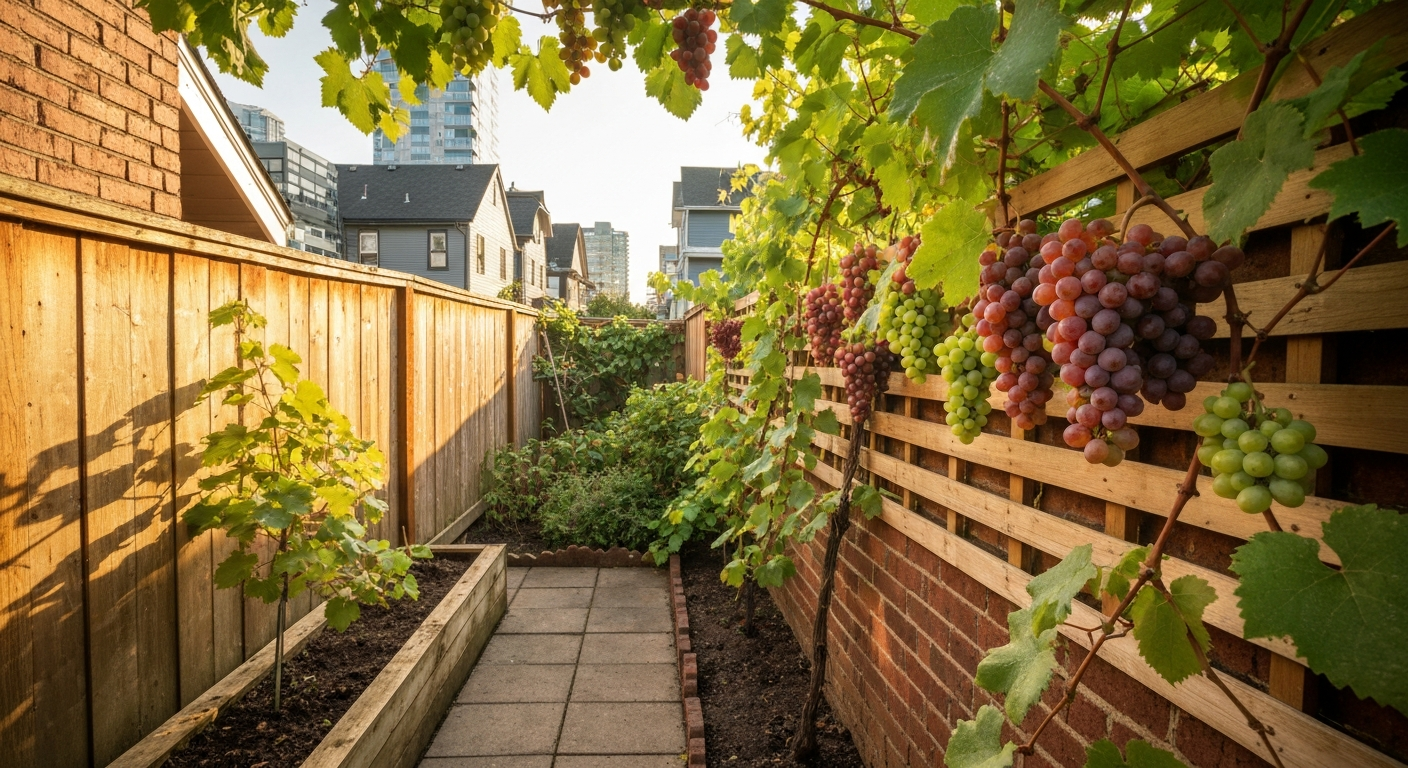
Grapes need full sun, ideally 8 hours or more of direct sunlight daily during the growing season. In Vancouver, a south-facing fence, wall, or slope is ideal because it absorbs heat through the day and radiates it back at night, creating a warmer effective microclimate. Metro Vancouver research has documented the urban heat island effect producing measurably warmer urban pockets, so a south-facing brick or concrete wall in an East Van or Burnaby backyard genuinely gives your vines a thermal advantage. Avoid planting near tall trees or structures that cast afternoon shade. North-facing and east-facing aspects are marginal at best for table grapes in this climate.
Soil and drainage
Many Lower Mainland soils are challenging for grapes. The Fraser Lowland is underlain by glacio-marine clays, alluvial silts, and organic peat deposits that restrict downward drainage significantly. Grapes hate wet feet. Standing water around roots through winter is one of the fastest ways to kill a vine or trigger crown rot. If your soil is clay-heavy, consider one of two approaches: build a raised bed at least 30-40 cm deep filled with a free-draining loam and compost mix, or plant on any natural slope where water drains away from the root zone. A simple drainage test (dig a 30 cm hole, fill it with water, and watch how fast it drains) will tell you quickly whether you need to amend before planting.
Trellis and training systems
For most urban Vancouver backyards, a single high-wire trellis at around 1.8 m (6 ft) or a vertical shoot positioning (VSP) system works well and keeps things manageable. Both allow good canopy airflow, which is critical for disease management in a wet maritime climate. If you have a pergola or archway, training a vine over it works beautifully and can double as a shade structure while producing fruit. OSU Extension's trellis guidance covers these options well and the construction is genuinely DIY-friendly. Avoid dense, tangled canopies. In Vancouver's climate, an open canopy is not just an aesthetic preference but a disease-management tool.
Growing grapes in containers
If your garden is small, shaded, or has poor soil you can't easily fix, container growing is a legitimate option. The key requirements for multi-year container production: use a pot of at least 60-80 litres (roughly a 15-20 gallon container), fill it with a free-draining loam-based mix rather than straight potting compost, attach a sturdy support structure for the vine, water and fertilize more frequently than you would an in-ground vine (containers dry out and deplete nutrients faster), and protect roots from freezing over winter by moving the pot to a sheltered spot or wrapping it if temperatures drop below about -10°C. Early-ripening, compact varieties like Somerset Seedless or Interlaken work particularly well in containers.
Planting, pruning and annual care for Vancouver's maritime climate
Planting
Plant bare-root vines in early spring (March to early April in Vancouver) once the soil is workable, or plant container-grown vines from spring through to early summer. Space vines at least 1.8-2.4 m apart on a trellis. Dig a hole wide enough to spread the roots, set the vine at the same depth it was growing (own-root) or with the graft union just above soil level (grafted), and water in well. Mulch around the base but keep mulch clear of the trunk. In the first year, focus entirely on establishing the root system, not producing fruit. Remove any flower clusters that form in year one.
Pruning
Prune during dormancy, ideally in January through to early March before bud swell. In Vancouver, late February is usually a practical sweet spot. The goal is to remove the previous year's canes and leave a controlled framework of spurs or replacement canes depending on your training system. OSU Extension pruning guidance (based on PNW maritime conditions) recommends spur pruning for most compact home systems. Summer pruning, specifically removing lateral shoots, pulling leaves from around clusters, and thinning clusters, is equally important in Vancouver because it opens the canopy to airflow and light, directly reducing powdery mildew and botrytis pressure.
Irrigation and fertilizing
Vancouver's dry summers are actually a gift for vine management. In most years, established in-ground vines need minimal supplemental irrigation from July onward. In dry summers, deep watering every 10-14 days is usually sufficient. Avoid overhead irrigation, drip lines at the base of the vine are better. For fertilizing, a light application of balanced fertilizer or compost in early spring (March) and a low-nitrogen fertilizer or potassium-focused feed in July to support ripening is usually enough. Over-feeding with nitrogen produces lush, leafy vines with poor fruit set and higher disease susceptibility.
Disease and pest management for wet maritime gardens
This is where Vancouver growers have to be proactive. The three main threats are powdery mildew, botrytis (grey mould), and birds. Downy mildew is also possible in wet spring conditions.
Powdery mildew
Powdery mildew thrives in warm days with cool nights, which is exactly what Vancouver summers deliver. The best defence is a combination of choosing tolerant varieties, maintaining an open canopy through summer leaf-pulling and lateral removal, and applying sulfur-based fungicide preventatively if you see pressure building. Spray sulfur during budbreak and repeat every 10-14 days through flowering and early berry development in high-risk years. Avoid spraying sulfur when temperatures exceed 32°C to prevent leaf burn.
Botrytis (grey mould)
Botrytis is triggered by cool, damp conditions at ripening, which is exactly what early-to-mid October in Vancouver can bring. Cluster thinning in mid-summer (removing a portion of the clusters to allow better air circulation within remaining clusters) is the single most effective low-chemical strategy. Early-ripening varieties that finish in August or early September largely sidestep the worst autumn botrytis window. If you're growing a September variety on a damp site, consider a copper-based spray at colour change as insurance.
Birds
Robins, starlings, and other birds will find your grapes before you do. Netting clusters individually or draping bird netting over the entire vine as fruit colours is the most reliable protection. Start netting when berries are about 50-70% ripe.
Phylloxera and other pests
Phylloxera exists in BC but is currently most documented in commercial wine-producing areas. Home garden risk is generally low. Check new vines carefully for galls on leaves or swollen root tissue if you have any concern. AAFC's Summerland research station actively researches grape pathogens in BC, and their resources are worth checking if you encounter anything unfamiliar on your vines.
A seasonal calendar for Vancouver table grapes
| Month | Stage | Key Tasks |
|---|---|---|
| January–February | Deep dormancy | Plan variety selection; order bare-root vines; check trellis infrastructure |
| Late Feb–early March | Pre-bud swell | Dormancy pruning; apply dormant oil spray if scale or overwintering pests present |
| March–April | Bud swell and shoot emergence | Plant bare-root vines; watch for frost on tender new shoots; first preventative sulfur spray if powdery mildew was an issue last year |
| May–June | Shoot growth and flowering | Train new shoots; remove laterals; watch for powdery mildew symptoms; hand-thin flower clusters to 1-2 per shoot on young vines |
| July | Berry set and early growth | Summer leaf-pulling around clusters; cluster thinning; drip irrigation if dry; potassium feed |
| August | Veraison and ripening (early varieties) | Harvest early varieties (Interlaken, Price, Campbell Early); continue leaf management; net against birds |
| September | Ripening (mid-season varieties) | Harvest Canadice, Vanessa, Lynden Blue; monitor for botrytis in wet years; taste-test before harvesting |
| October–November | Post-harvest and hardening off | Leaf fall; light compost top-dress; note vine performance for next year's adjustments |
| December | Dormancy | Protect container vines from hard freezes; no pruning yet |
Quick checklist before you buy your first vine
- Identify your sunniest spot: does it face south or southwest and get 8+ hours of sun in July?
- Check soil drainage: do a 30 cm hole water-drain test; plan a raised bed if drainage is slow.
- Choose an early-ripening variety: aim for cultivars that ripen by late August to mid-September.
- Pick a disease-tolerant cultivar for a low-maintenance start: Canadice, Campbell Early, or Reliance are good entry points.
- Decide between in-ground and container: containers work on sunny patios but need large pots (60-80 L minimum).
- Have your trellis or support structure ready before or at planting.
- Accept that year one is establishment: no fruit expectations until year two or three.
Where to find vines and local resources
For local nursery sourcing, West Coast Plants in BC stocks table grape varieties including Himrod Seedless and has staff familiar with cool-season PNW growing conditions. Check with other Lower Mainland garden centres in late February and March when bare-root stock arrives. Mail-order from reputable Canadian nurseries specializing in fruit vines is another reliable route if you need a specific variety not stocked locally.
For growing guidance beyond this article, the UBC Botanical Garden forums have an active community of coastal BC growers who share real-world experiences with grape varieties, including reports of varieties like Jupiter succeeding under protected and warm-microsite conditions on southern Vancouver Island. OSU Extension's publication EC-1639 (Growing Table Grapes) is the best free technical reference for cool maritime PNW conditions and covers pruning diagrams, trellis construction, and spray programs in detail. Washington State University's Fruit Handbook for Western Washington lists cultivar trial results from climates almost identical to Vancouver's and is worth downloading. If you're growing grapes in a nearby region like Oregon, the guidance for that climate overlaps substantially with what works here. For comparative climates and regional variety guidance, see where do grapes grow in australia for maps and recommendations relevant to Australian growing conditions. For specifics on cultivar recommendations, see our guide to the best table grapes to grow in Oregon.
My honest take
Vancouver is not the Okanagan, and it's not Napa. But it's also not grape-growing purgatory. Plenty of home gardeners in the Lower Mainland are quietly harvesting bowls of sweet Canadice and Campbell Early every August while their neighbours assume grapes can't possibly grow here. The formula isn't complicated: warm south-facing site, early-ripening variety, open canopy management, and a little patience through the first couple of years. Get those basics right and you'll be one of those gardeners people stop to ask about.
FAQ
Can table grapes be successfully grown in Vancouver, BC?
Yes — home gardeners in Vancouver can grow table grapes successfully if you match varieties to the short, mild maritime season and pick a warm, well‑drained micro‑site (south/southwest aspect, sheltered from cold pockets). Expect best results on heated slopes, against warm walls, under small arbors, or in large containers with good sun and airflow. See City of Vancouver and Environment Canada climate normals for local growing conditions: https://vancouver.ca/parks-recreation-culture/gardening.aspx and https://climate.weather.gc.ca/climate_normals/results_1991_2020_e.html?climate_id=1108446
Which table grape varieties are recommended for Vancouver (seedless and seeded)?
PNW‑proven, early to mid‑season varieties are safest. Good choices include: Seedless — Himrod (very early, sweet, reliable in cool summers), Interlaken Seedless (early, good flavor), Reliance (early, cold‑hardy, pink fruit). Seeded — Canadice (early, sweet), Vanessa (mid‑season, large clusters), Jupiter (mid/late but often succeeds in warm micro‑sites), Campbell Early (early, classic coastal variety). Lynden Blue and other regionally trialed selections perform well in sheltered sites. Tradeoffs: seedless are preferred for table use but sometimes less disease‑vigorous; seeded varieties often produce bigger, sweeter fruit and can be more disease‑tolerant.
How does Vancouver’s climate affect grape selection and ripening?
Vancouver’s mild, wet maritime climate gives ~225 frost‑free days but limited heat accumulation (GDD). Choose early to mid‑season cultivars that ripen with lower heat sums and avoid very late cultivars unless you have an unusually warm site (warm wall, greenhouse, high slope). Microclimate matters: urban heat islands and south‑facing slopes significantly improve ripening and disease pressure.
How do I choose the right planting site and soil for grapes here?
Pick the warmest, sunniest spot you have (minimum 6–8 hrs direct sun; more is better). Prefer well‑drained soils and avoid low hollows or clay/peat that hold water — if unavoidable, plant on raised beds or mounds. South or southwest aspects and walls that reflect heat help ripening. For containers use large pots (≥60–80 L) with free‑draining loam mixes and a sturdy trellis.
What rootstock or planting material should I use?
Use healthy, certified virus‑free vines from reputable nurseries. In wet or poorly drained soils choose rootstocks with tolerance to waterlogging (Riparia‑derived stocks) and phylloxera resistance where needed; grafted vines can be helpful for difficult soils. If unsure, ask nurseries for rootstock recommendations for coastal BC. Example vendor listing: West Coast Plants (BC): https://westcoastplants.ca/products/himrod-grape
What trellis and training systems work for small Vancouver plots?
Options: single high wire (approx. 1.8–2 m), vertical shoot positioning (VSP) for narrow rows, small pergola/arbor for home patios, or Geneva Double Curtain (GDC) for higher yield if you have space. For patios, train vines on an arbor against a south wall to maximize heat. OSU extension has practical designs and bud‑count guidance: https://extension.oregonstate.edu/catalog/ec-1639-growing-table-grapes