
Yes, you can grow grapes hydroponically, but it takes more infrastructure than most hydroponic crops and a realistic understanding of what grapevines actually need. These are big, woody, perennial plants with serious root mass, not lettuce. If you go in with the right system, the right variety, and a plan for managing dormancy and training, you can get flowering and fruit from a hydroponic grapevine. If you skip any of those pieces, you'll end up with a vigorous green vine that never fruits.
Can You Grow Grapes Hydroponically? Setup Guide

Marcus Whitfield
13 Jun 2026
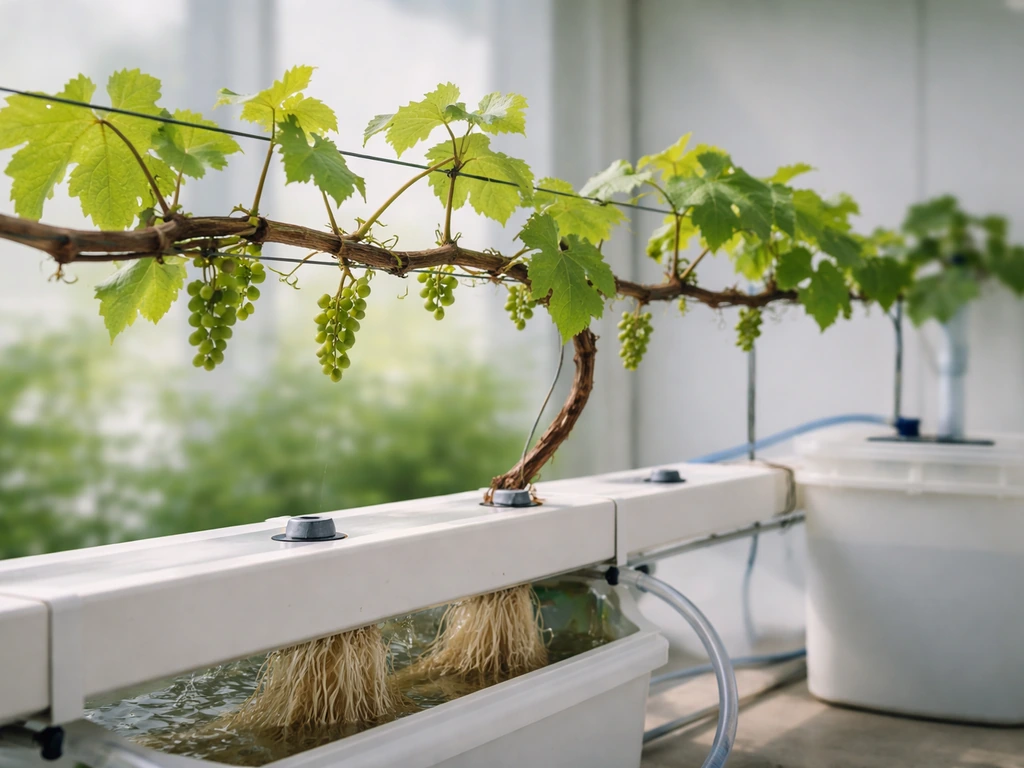
Is hydroponic grape growing really possible?
Plenty of growers have done it, particularly with table grape varieties and cold-hardy hybrids grown in controlled environments. The honest answer is that hydroponics works for grapes, but the main challenges are different from what you'd face growing tomatoes or cucumbers in a system. Grapevines develop a permanent woody structure, a large root zone, and a clear annual cycle that includes a dormancy period with specific chilling requirements. You can't treat them like a fast-cycling annual crop, and the common lightweight hydroponic setups that work beautifully for leafy greens can buckle under the physical demands of a mature vine.
That said, the payoff is real. Hydroponic grapes can be grown year-round in climates where outdoor production is impossible, allow you to dial in nutrients precisely, and let you sidestep some of the soil-borne disease pressure that plagues outdoor vineyards. If you want to know whether can you grow grapes in canada, the same ideas about cold-hardy varieties and chilling hours apply whether you grow outdoors or in a controlled setup. If you're in a region where outdoor grape growing is marginal or impossible, or if you want to extend your season, hydroponics is a genuinely viable option worth pursuing.
Choosing the right hydroponic system for grapevines
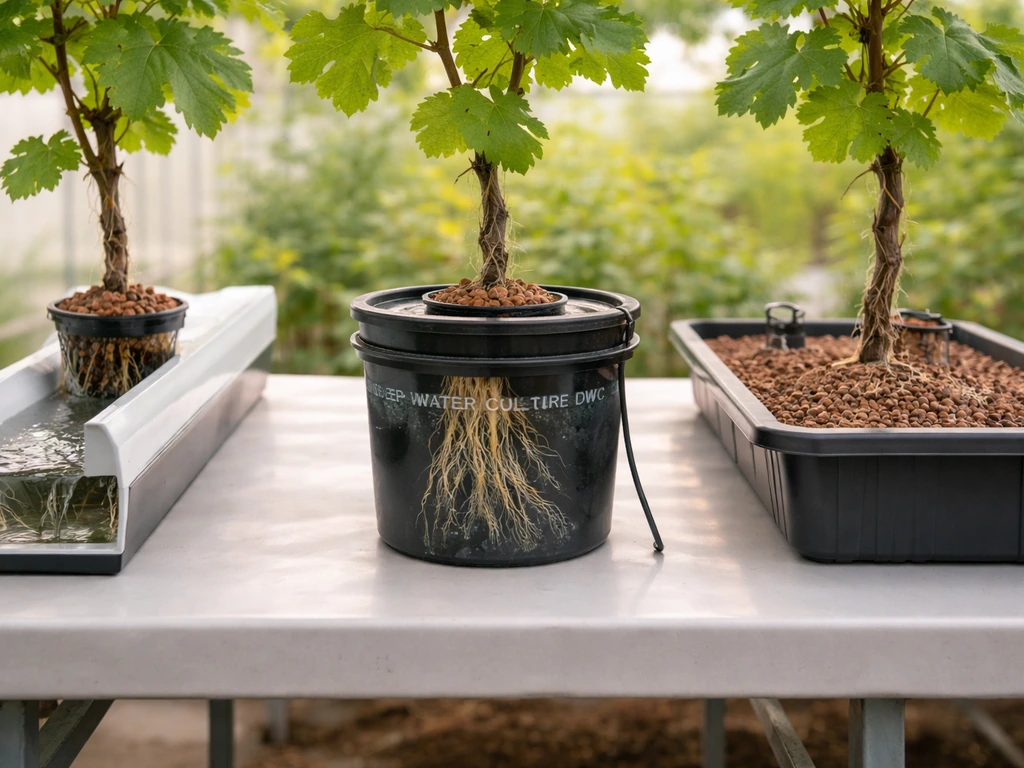
The system choice matters more for grapes than for most crops. NFT (nutrient film technique) channels and standard deep water culture (DWC) buckets are problematic for the same reason: they're designed for smaller plants with modest root systems. A mature grapevine builds roots that can choke NFT channels and overwhelm small reservoir buckets within a season or two. They also can't support the physical weight of a woody trunk and trained canopy without additional structural help.
Drip irrigation into a large growing medium is the most practical approach for home growers. Run drip lines into containers filled with perlite, coco coir, or a 50/50 blend of both, and drain to waste or recirculate through a reservoir. This gives roots space to expand, keeps the root zone well-oxygenated, and lets you scale nutrient delivery as the plant grows. Ebb-and-flow (flood and drain) systems with large growing beds also work well, provided you use a deep enough bed (at least 12 to 14 inches) to accommodate root development.
| System | Feasibility for Grapes | Main Issue | Recommendation |
|---|---|---|---|
| Drip into coco/perlite | High | Requires large containers and reservoir | Best choice for most home growers |
| Ebb-and-flow (flood and drain) | High | Needs deep, large growing beds | Good option with proper setup |
| Deep Water Culture (DWC) | Low to moderate | Root mass overwhelms buckets; oxygenation risk | Only viable with large custom reservoirs |
| NFT (nutrient film technique) | Low | Roots clog channels; no physical support | Avoid for grapevines |
| Kratky / passive | Not recommended | No oxygenation control; roots suffocate | Not suitable |
Climate and variety: the piece most people skip
Even if you're growing hydroponically indoors, your variety choice still has to match your ability to manage the vine's biological clock. Grapes are temperate plants that need a cool winter dormancy period, and most varieties have chilling hour requirements somewhere in the range of 100 to 600 hours below 45°F. Without satisfied chilling requirements, buds either won't break properly or will break unevenly, and you'll get poor flowering. If you're growing in a fully controlled indoor environment, you'll need to simulate dormancy by either moving plants to a cool garage or basement during winter, or by managing temperature artificially.
For hydroponic growers who want to grow year-round indoors, lower-chill table grape varieties and cold-hardy American or hybrid cultivars are the smart picks. Concord, Marquette, Frontenac, and similar hybrids bred for northern climates tend to have lower and more flexible chilling requirements than European Vitis vinifera varieties. Table grape hybrids selected for warm-climate production (some developed in California and Texas breeding programs) also perform well with shorter chilling periods. Avoid classic European wine grapes like Cabernet Sauvignon or Pinot Noir in hydroponic systems unless you're ready to manage very precise dormancy conditions.
Light is the other variable that determines whether you get fruit or just foliage. Grapes need a minimum daily light integral (DLI) of around 12 mol/m²/day to support good growth and fruiting. In an indoor setup, that almost certainly means supplemental lighting, either high-output LED grow lights or HPS fixtures positioned close enough to the canopy. If you're growing in a greenhouse, you may hit that target from spring through fall with natural light alone, which is why greenhouse grape growing is often a more practical route than a fully indoor basement operation. If outdoor or greenhouse growing is on your radar, that comparison is worth exploring separately.
Setting up your hydroponic system: containers, trellis, and root zone
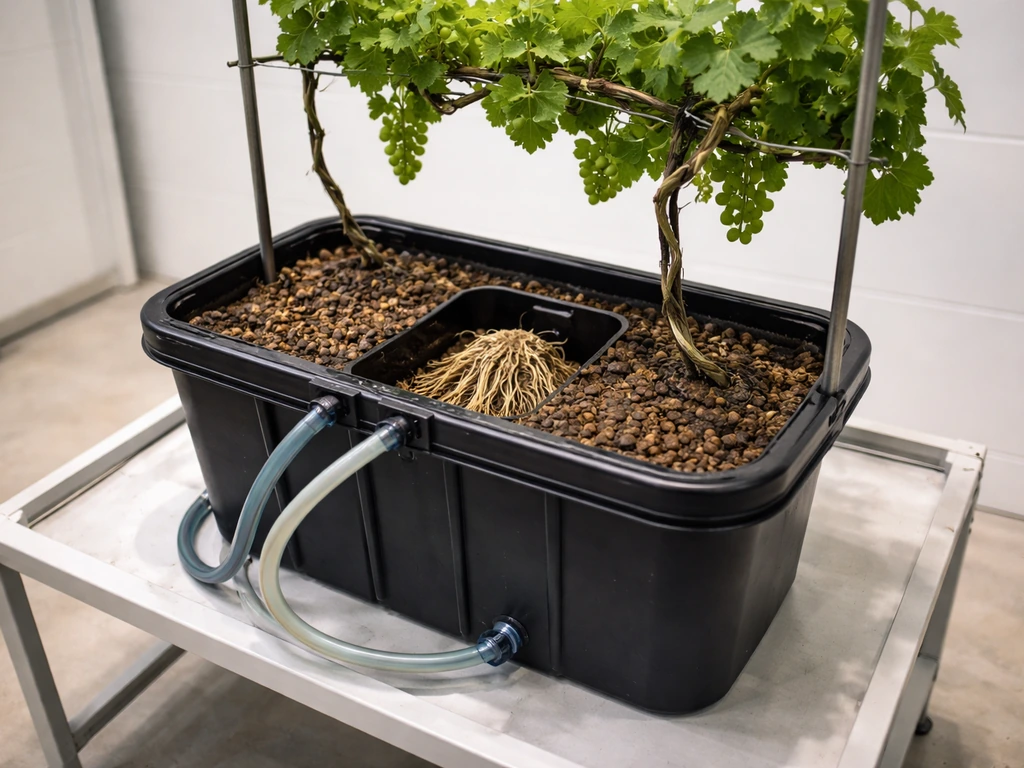
Container size and root zone management
Don't go small on containers. A minimum of 15 to 20 gallons per vine is the practical floor for long-term growing, and larger is better if you plan to keep the vine productive for multiple years. Fabric grow bags work well in drip systems because they air-prune roots and prevent circling, which can reduce root-zone oxygen and lead to disease problems. Whatever container you use, make sure drainage is excellent. Waterlogged roots are the fastest way to lose a grapevine in any system.
Root zone temperature deserves serious attention in recirculating systems. When your nutrient solution temperature climbs above about 75°F (24°C), dissolved oxygen levels drop significantly, creating conditions where Pythium root rot can take hold quickly. Root rot spreads fast in hydroponic systems and can kill a vine that took two or three years to establish. Keep your reservoir or solution temperature between 65°F and 72°F using a water chiller if needed, especially during summer months.
Trellis and structural support
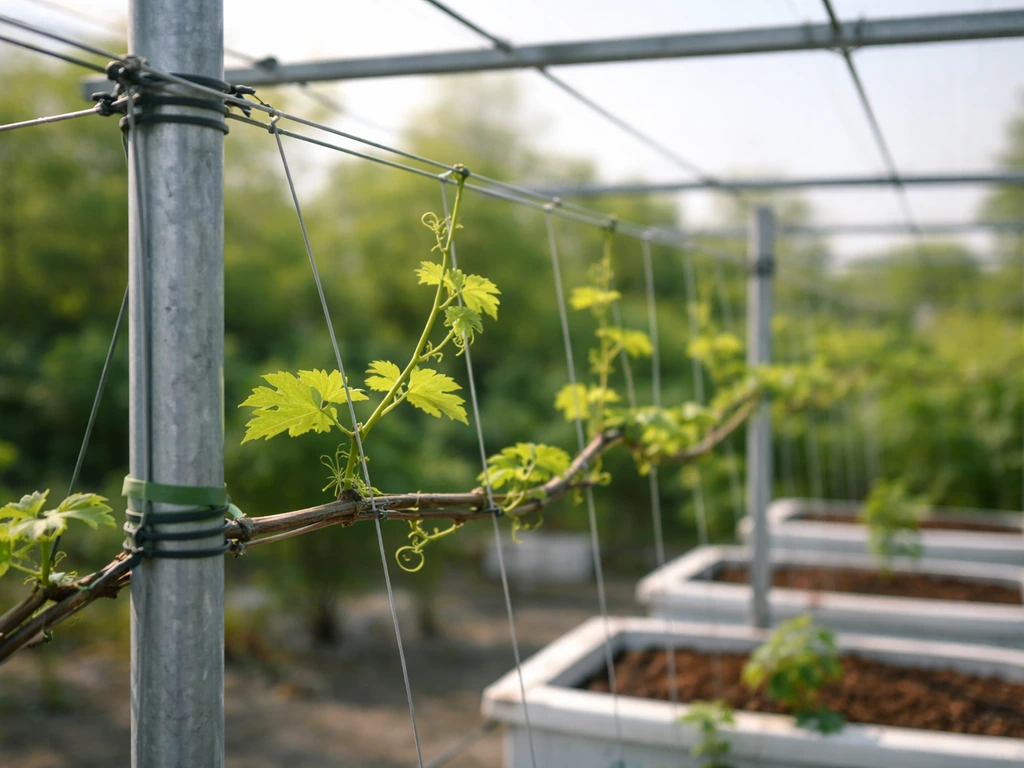
A grapevine without a trellis is an unmanageable mess. For hydroponic setups, build a vertical trellis structure directly above your containers before you plant. The simplest approach that works indoors or in a greenhouse is a two-wire horizontal system: a lower wire at about 3 feet from the container and an upper wire at 5 to 6 feet.
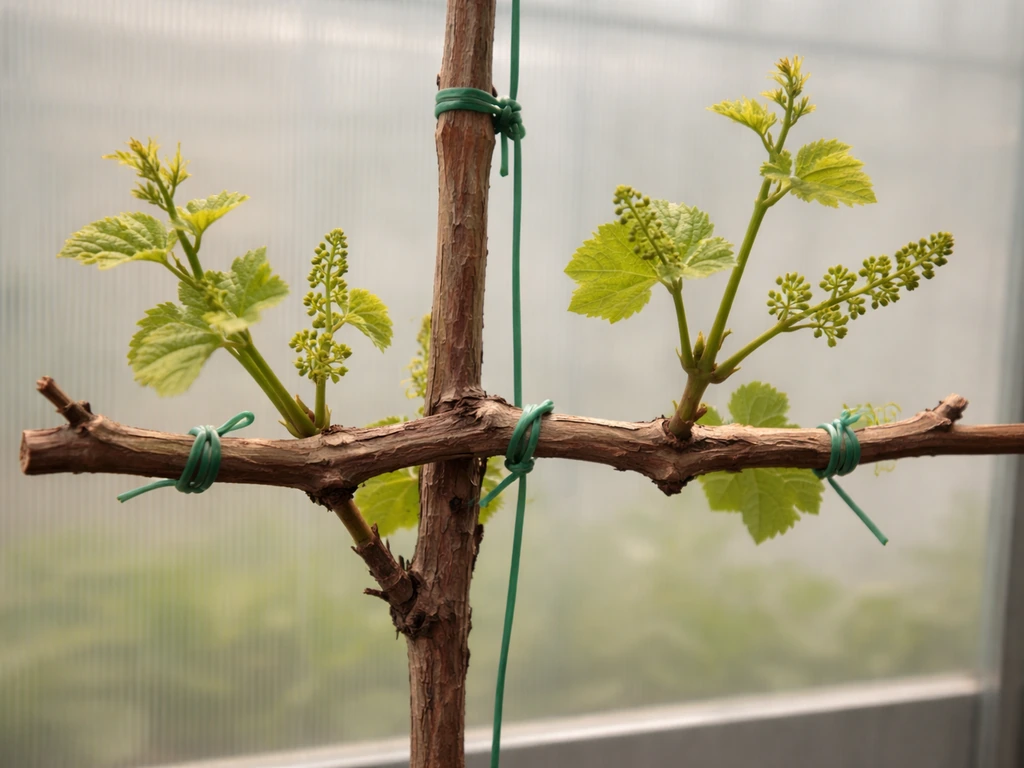
Train the main trunk straight up to the lower wire, then allow two cordons (permanent horizontal arms) to extend along it in both directions. Fruiting shoots grow upward from the cordons each season. This bilateral cordon approach is the most manageable for container and controlled-environment growing because it keeps the footprint predictable and gives you a clear framework for annual pruning.
The University of Missouri Extension notes that pruning and training are crucial, that fruiting shoots arise from buds on wood one or more years old, and that bilateral cordon training uses a trellis bilateral cordon approach.
Nutrient management: what to feed your hydroponic grapevine
Grapes are moderate-to-heavy feeders, but they're not as forgiving of over-fertilization as some crops. Getting your pH and EC dialed in is non-negotiable. Target a solution pH between 5.5 and 6.0, which keeps most macro and micronutrients available in the root zone. If pH drifts above 6.5, you'll start seeing iron and manganese deficiencies show up as yellowing between leaf veins. If it drops below 5.5, calcium and magnesium availability suffer. Check pH at minimum every two to three days, and daily during active growing periods.
For EC (electrical conductivity), start young vines at the lower end of the range, around 1.5 mS/cm, and work up to 2.0 to 2.5 mS/cm as the plant establishes and enters active vegetative growth. During flowering and fruit set, you can push toward the upper end of that range. Back off EC if you see leaf tip burn or salt crusting around the container edges. A general hydroponic grape nutrient solution during vegetative growth should target nitrogen (N) in roughly the 168 to 236 ppm range and potassium (K) in the 156 to 300 ppm range, with calcium, magnesium, phosphorus, and micronutrients balanced accordingly.
| Growth Stage | Target pH | Target EC (mS/cm) | Notes |
|---|---|---|---|
| Establishment (first season) | 5.8–6.0 | 1.2–1.5 | Use diluted nutrient solution; prioritize root development |
| Active vegetative growth | 5.5–6.0 | 1.5–2.0 | Increase nitrogen; monitor for deficiencies |
| Pre-flowering and flowering | 5.8–6.0 | 2.0–2.5 | Boost potassium and calcium; reduce nitrogen slightly |
| Fruit development and ripening | 5.8–6.0 | 2.0–2.5 | Maintain potassium high; watch for blossom end rot indicators |
| Dormancy (if induced) | N/A | Minimal or none | Reduce or stop feeding; move to cool environment |
Use a quality multi-part hydroponic nutrient formula rather than a single-part solution. A three-part formula (grow, bloom, micro) gives you the most flexibility to shift the nutrient profile across growth stages. Top off your reservoir with plain pH-adjusted water between full nutrient changes, and do a complete reservoir flush and replacement every one to two weeks to prevent salt buildup and pathogen accumulation.
Training, pruning, pollination, and getting your vine to actually fruit
The one rule about grapevine fruiting
Grapes fruit on one-year-old wood. This is the single most important fact to understand about getting a hydroponic grapevine to produce. The shoots that grew this season are what you prune back and save as fruiting wood for next season. If you prune incorrectly and remove all your one-year-old canes, you'll have zero fruit the following year regardless of how good your nutrients are. In a spur-pruned cordon system (which is the easiest for container growing), you prune each lateral shoot back to two to three buds each winter, leaving short spurs along the cordon. Those buds produce fruiting shoots the following growing season.
Annual pruning and training cycle
- Year 1: Focus entirely on establishing a strong root system and training one vertical trunk to the lower trellis wire. Remove any flower clusters that appear in year one to redirect energy into root and trunk development.
- Year 2: Allow two horizontal cordons to develop along the lower wire. Continue removing flower clusters unless the vine is very vigorous. By the end of year two, you should have a solid permanent framework.
- Year 3 onward: Allow fruiting shoots to develop from spurs along the cordons. During winter dormancy, prune each spur back to two to three buds. Tie new shoots to the upper trellis wires as they grow vertically in spring.
Pollination indoors
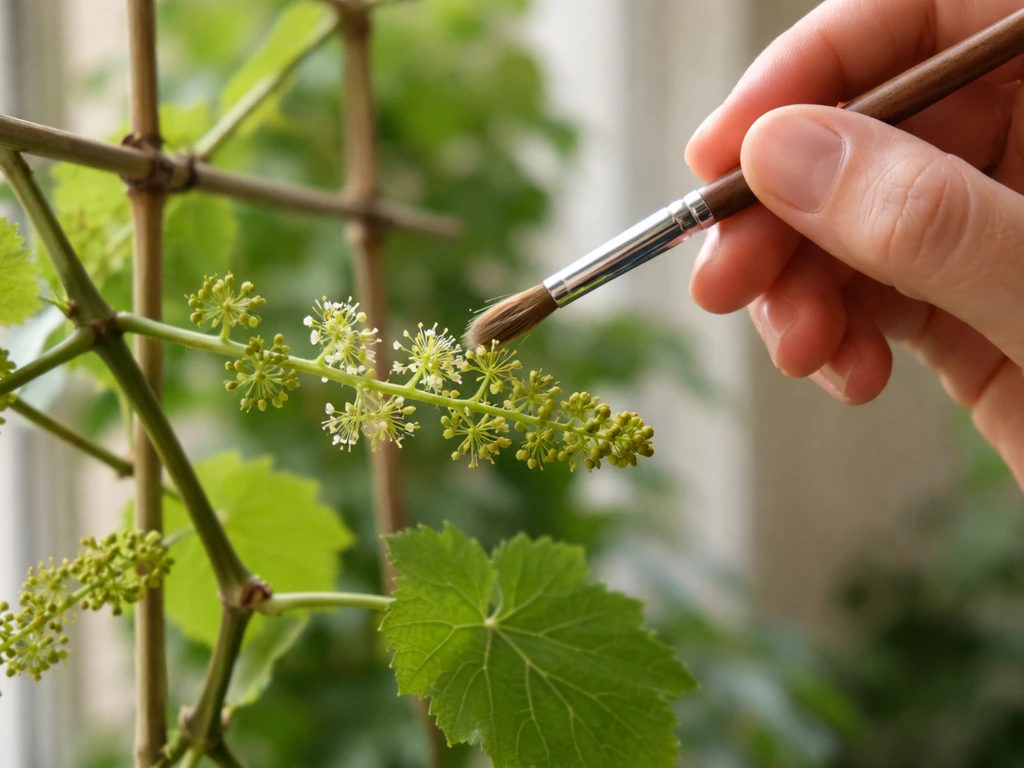
Most commercial table grape varieties and American hybrids are self-fertile, which means you don't need a second vine to get fruit. But in an indoor environment without wind or insects, you'll want to help pollination along. When flowers are open (they'll look like tiny greenish clusters with a faint scent), run a small oscillating fan near the vines to simulate air movement, or gently shake the flower clusters by hand once a day. A soft paintbrush passed lightly across open flowers also does the job. Don't skip this step indoors: poor pollination leads to small, seedy berries or fruit clusters that set poorly.
Timeline and troubleshooting
Realistic timeline from setup to first fruit
| Timeframe | What to Expect |
|---|---|
| Month 1–3 | Root establishment; slow above-ground growth is normal and healthy |
| Months 3–8 (Year 1) | Rapid vine growth; focus on trunk training; remove flower clusters |
| Year 2 | Cordon development; vine fills trellis; possibly light fruiting at end of year |
| Year 3 | First real fruit crop; spur system established and functioning |
| Year 4+ | Full production; annual pruning cycle in place; yields improve with management |
Common problems and how to fix them
- Weak or stunted growth: Usually a root zone issue. Check solution temperature (should be under 72°F), EC (may be too low at under 1.5 mS/cm), and pH (drift above 6.5 locks out iron and causes yellowing). Also inspect roots for brown sliminess, which indicates root rot.
- Yellowing leaves with green veins (interveinal chlorosis): Classic iron or manganese deficiency caused by high pH. Drop solution pH to 5.8 and add chelated iron if deficiency is severe.
- Leaf tip burn or marginal scorch: EC is too high or potassium/sodium is accumulating. Flush the system with plain pH-adjusted water and rebuild solution at a lower EC.
- No flowering or poor bud break: Most often a chilling requirement problem. The vine did not receive enough cold hours during dormancy. Move the vine to a cold environment (40 to 50°F) for 6 to 10 weeks before the growing season, or choose a lower-chill variety next time.
- Poor fruit set after flowering: Pollination failure in an enclosed space. Add an oscillating fan during bloom, and hand-pollinate daily when flowers are open.
- Brown, slimy roots (root rot): Pythium infection, almost always linked to high solution temperature, low oxygen, or poor sanitation. Lower solution temperature below 72°F immediately, increase aeration with air stones, remove affected roots, and treat with a beneficial microorganism product (Trichoderma or beneficial bacteria) or a hydrogen peroxide root drench.
- Vine grows vigorously but never fruits: Almost certainly a pruning error. Check that you're leaving one-year-old wood on the plant each winter. A vine that's been cut back to bare cords without spurs will have no fruiting buds.
Your next steps: a practical setup checklist
If you're ready to move from 'is this possible' to actually doing it, here's how to get started without wasting time or money on the wrong setup.
- Choose your variety first: Pick a table grape hybrid or cold-hardy American cultivar with a chilling requirement you can realistically satisfy (Marquette, Frontenac, Reliance, or a low-chill table grape hybrid depending on your region and indoor setup).
- Build or buy a drip system into large containers: Minimum 15 to 20 gallon fabric grow bags filled with coco coir and perlite. Set up a reservoir with a water pump, timer, and drip lines before your vine arrives.
- Install your trellis before planting: Two horizontal wire runs above the containers at 3 feet and 5 to 6 feet. Anchor this to a wall, ceiling, or freestanding frame that can handle the weight of a mature vine.
- Get your lighting sorted: Target at least 12 mol/m²/day DLI. For most indoor setups that means full-spectrum LED grow lights running 14 to 16 hours per day during the growing season.
- Source a three-part hydroponic nutrient formula and pH/EC meters: Calibrate your meters before you start and check solution pH every two to three days.
- Plan for dormancy from day one: Know where you'll put the vine for its winter chill period (a garage, basement, or outdoor covered area that stays between 32 and 50°F for 6 to 10 weeks).
- Commit to the three-year timeline: Don't expect fruit in year one, and don't be discouraged if year two fruit is minimal. Year three is when it comes together.
Hydroponic grape growing is genuinely rewarding once your system is dialed in, but it rewards patience and attention more than most crops. If you've been wondering whether grapes will work in your specific climate or region at all, that question is worth exploring alongside the hydroponic route, because your local climate zone, chilling hours, and frost-free season length all still matter even when you're growing in a controlled system. If you’re specifically asking about Calgary, you’ll also want to consider cold-hardiness and chilling hours, since outdoor conditions there can be marginal even if the growing method is hydroponic or indoors your specific climate or region. The variety you pick for your state or zone should drive your decision as much as the system design itself.
FAQ
What hydroponic systems should I avoid for grapes, even if they work for lettuce?
Avoid NFT channels and small deep-water buckets for long-term grape production. A mature vine’s permanent root mass can clog NFT flow paths and overwhelm reservoir volume quickly, and it needs a stable container plus enough oxygenation to prevent root rot as the system scales up.
How do I size the reservoir and nutrient tank for a single vine?
Plan for a much larger hold-up volume than you’d use for leafy greens. Larger reservoirs buffer pH and EC swings during hot days and after pruning or heavy flushes, and they reduce the frequency of full top-offs, which matters because grapes are sensitive to pH drift and fast changes in root-zone conditions.
Can I keep one vine producing for many years in hydroponics?
Yes, but you must treat it like a perennial with recurring sanitation and root management. Do periodic container and root-zone inspections, expect to prune and retrain each season, and plan for at least periodic media replacement or thorough flushing to reduce salt buildup and biofilm that can accumulate over time.
Do I need to replicate outdoor winter dormancy if I grow indoors?
If you use a variety with chilling requirements, you usually must provide real dormancy, not just “cooler temperatures.” If chilling is insufficient, you’ll often see weak bud break and uneven flowering. A common workaround is moving plants to an unheated but controlled cool space for the dormancy window, then returning them to production conditions.
What happens if my chilling hours are short but I still want fruit?
You can end up with poor or uneven bud break, low fruit set, or delayed flowering. The practical decision aid is to switch to lower-chill table grape varieties or cold-hardy hybrids rather than trying to “force” a high-chill European variety indoors.
How can I tell whether my pH is drifting too far without constant testing?
Test on a strict schedule during active growth, then add a monitoring habit that catches drift early: check pH after major dosing adjustments and after any temperature spikes. Also watch for trends in leaf color changes, because the earliest visible symptoms (like interveinal yellowing) usually appear after pH has already been off for a while.
Should I manage nutrients by EC alone, or use a more stage-based approach?
Use EC as a control variable, but still change the nutrient profile by growth stage. Grapes shift nitrogen demand and potassium needs through vegetative growth, flowering, and fruit set, so relying only on “keep EC at X” can lead to imbalance even when EC looks correct.
How do I prevent salt crusting in a drip-to-waste or recirculating system?
Use periodic reservoir flushing and ensure you have enough drainage or leaching fraction. If you see crusting at the container edges or root-zone media, back off EC slightly and increase the regular replacement of solution or do the full reservoir refresh more frequently than your baseline schedule.
What are the first signs of root rot in a hydroponic grapevine?
Expect early symptoms to appear as sudden wilting despite wet media, slowed growth, and off-odor or darkening roots during inspection. Because rot can progress fast once oxygen drops, it’s critical to keep solution temperature under control and to verify dissolved oxygen indirectly through stable, cool operation and healthy root appearance.
Is a fan enough for pollination indoors?
A fan helps, but confirm results on the flowers themselves. The key is timing, run airflow or gentle shaking when blossoms are actually open, then check whether fruitlets begin swelling. If clusters remain small or stay loose, add hand-pollination with a soft brush once daily during the peak window.
Can I grow grapes without a trellis if I use a compact variety?
Even compact grapevines still need training for structure, light management, and pruning accuracy. Without a trellis or wire system, cordons and fruiting shoots won’t be supported, pruning becomes inconsistent, and the canopy becomes harder to manage for adequate light and airflow.
What training/pruning mistake most commonly prevents grapes from fruiting?
Removing or overwriting the one-year-old fruiting wood. Grapes fruit on the appropriate previous season canes, so if you prune in a way that eliminates all the correct one-year laterals, you can get a full season with lots of foliage and no harvest, even if nutrients and light are ideal.
Do I need to start from seed or can I use cuttings or nursery plants?
For hydroponic grape projects, most growers start from rooted cuttings or nursery vines so the plants establish faster and you can commit to a training and trellis plan earlier. Starting from seed adds years of uncertainty in variety performance, chilling behavior, and eventual fruiting timing.