
Grapes do not grow on bushes or trees. Grapes do not grow on bushes or trees, so do grapes grow on trees is the kind of question that needs a direct answer. They do not, because do grapes grow on trees? If you're wondering whether a fig tree can grow in a vineyard too, that's a related comparison worth checking alongside how grapes need vine training and support can a fig tree grow in a vineyard. In reality, grapes grow on woody perennial vines trained to a support. They grow on woody perennial vines, and that one fact changes everything about how you set them up, support them, prune them, and eventually harvest from them. If you went into this expecting something that looks like a blueberry bush or a small fruit tree, you'll want to reset those expectations right now, before you buy a plant or dig a hole.
Do Grapes Grow on Bushes? Vine Training and Setup Guide
Grapes are vines, full stop
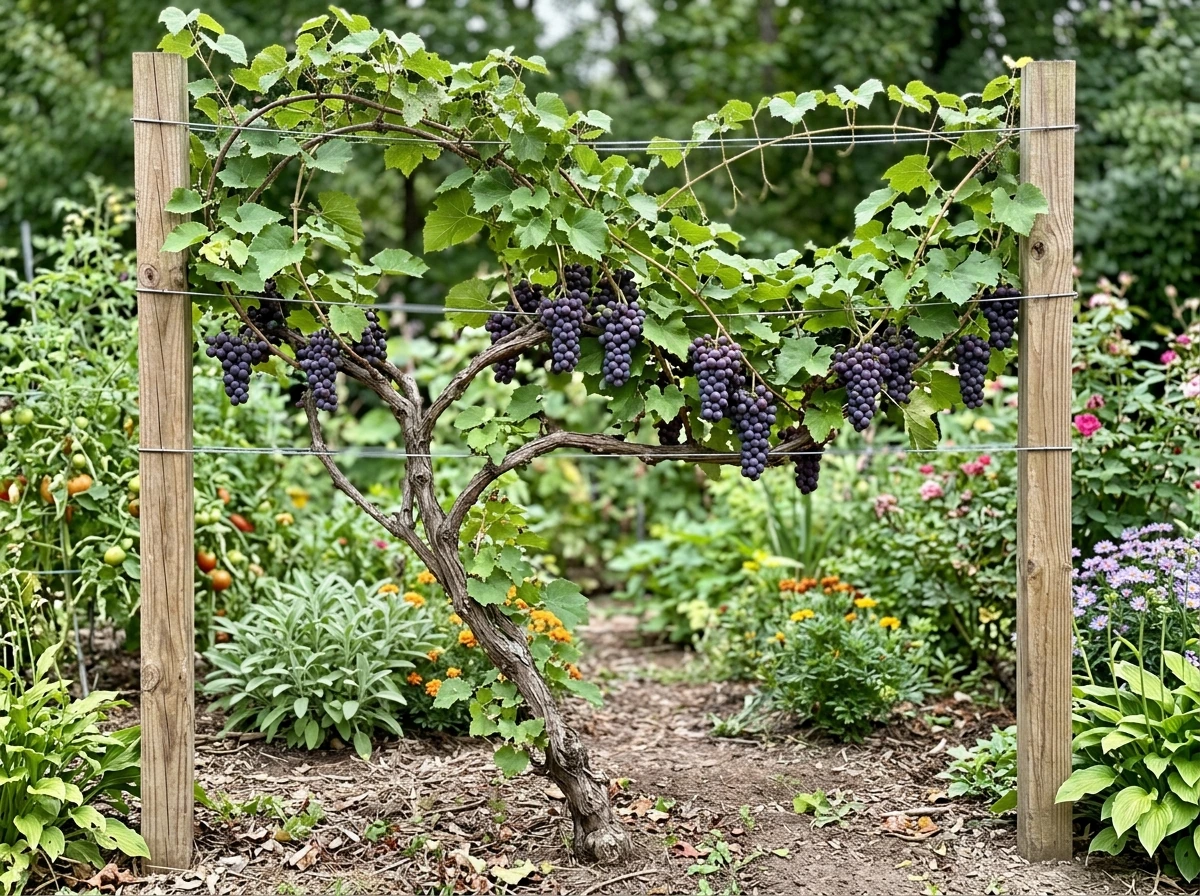
Botanically, grapes (genus Vitis) are woody perennial vines. Every season they push out new shoots, leaves, and fruit clusters from a framework of older wood that gets a little bigger and more permanent each year. That older framework, called the trunk and cordons, can eventually look almost tree-like if you let it develop for a long time, but the plant itself is still a vine at heart. It climbs, it sprawls, and if you don't give it something to grab onto and a reason to stay organized, it will just pile up on the ground or swallow whatever is nearby.
This is worth saying clearly because a surprising number of new gardeners buy a grapevine expecting something self-contained. A bush fruit like a blueberry or gooseberry stays upright on its own. A fruit tree has a rigid trunk that holds itself up. A grapevine does neither. It needs you to provide structure, and it needs you to prune it every single year to keep that structure working. Once you accept that, growing grapes at home becomes very manageable. If you're curious how grapes compare to actual trees in the garden, that's worth its own look, but for now the key point is: vine, not bush, not tree.
How grapes are actually grown: trellises, training systems, and giving your vine a job
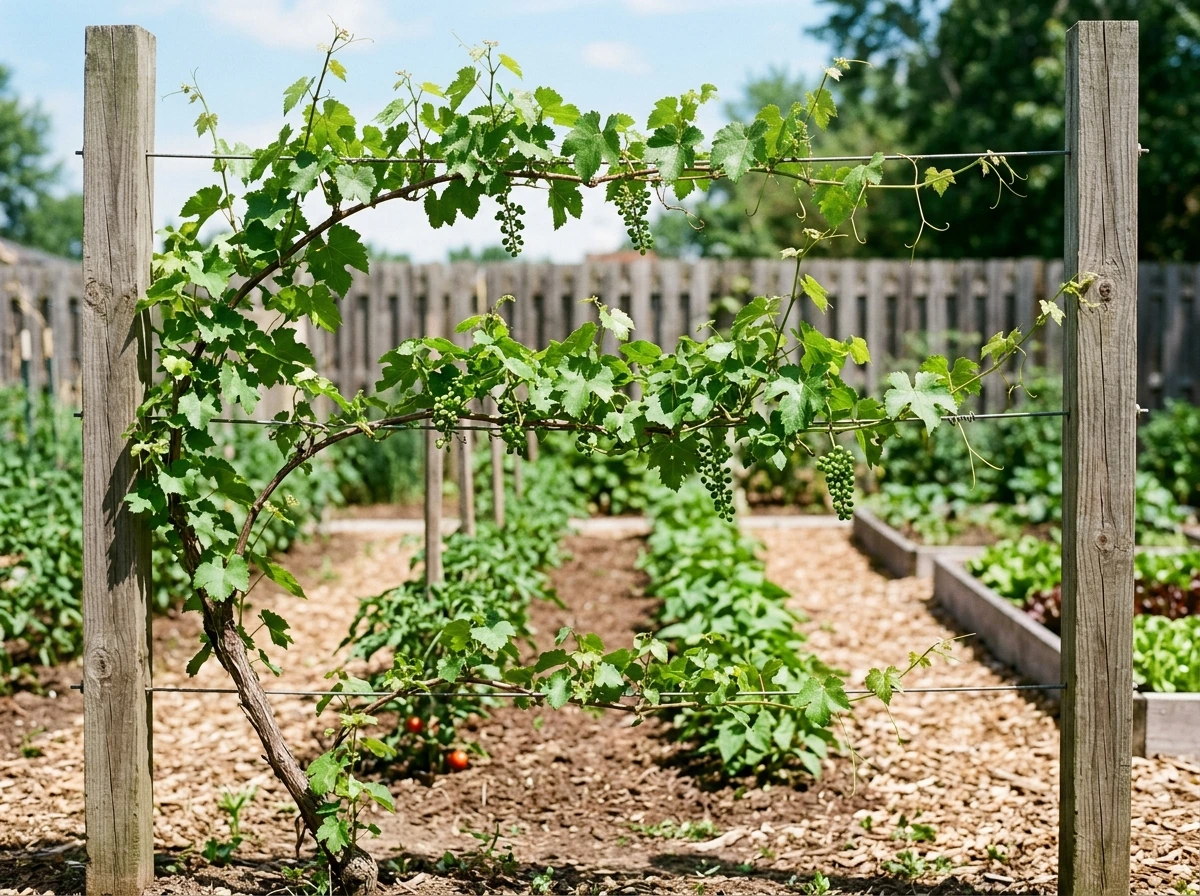
Because grapes are vines, every successful grape planting starts with a support structure. The most common setup for home gardens is a simple trellis: two or three horizontal wires strung between wooden or metal posts. You train the vine up to the top wire, then run the main lateral branches (called cordons) along it in both directions. From those cordons, shorter fruiting wood hangs down or reaches up depending on your system. That's the basic skeleton of a grape planting. UNH Extension describes a VSP (vertical shoot positioning) home vineyard training system that uses a single support wire about 30 inches above ground and pairs of catch wires above it basic skeleton of a grape planting.
There are a few named training systems you'll run into when reading extension guidance, and it helps to know what they mean before you start. The most common ones for home gardeners are:
- Bilateral cordon (also called single curtain): The vine has one trunk going up to a top wire, with two arms extending left and right. Fruiting spurs hang off those arms each season. This is probably the most widely recommended system for beginners.
- Vertical Shoot Positioning (VSP): Shoots are tucked upward between catch wires as they grow, creating a neat vertical wall of foliage. Gives good sun exposure and airflow, which matters for disease control.
- Guyot: A simpler cane-based system where you select one or two long canes from the previous year and tie them to the wire. Extension sources specifically call this an easy option for home vineyards.
- High-wire cordon: Similar to bilateral but the fruiting wood hangs downward rather than being positioned upright. Common with Concord-type grapes in the eastern US.
For a DIY trellis at home, a basic two-wire setup works well: a lower wire at about 3 feet and an upper wire at 5 to 6 feet, strung between posts set 15 to 20 feet apart. That's enough structure for most home plantings. If you're only growing two or three vines, even a sturdy fence or an existing pergola can work, as long as you still commit to annual pruning to manage the fruiting wood.
Pruning is where the vine/bush confusion creates real problems, and I'll come back to that in detail. For now, just know that grapes produce fruit on new shoots that grow from one-year-old wood. That means every year you need to decide which wood from last season stays and which gets cut off. It sounds complicated at first, but after one or two seasons of watching your vine grow, it starts to make obvious sense.
Picking the right variety for your climate
This is where the site's core message really matters: the vine habit is universal, but which vine will actually survive and produce in your yard depends entirely on where you live. Grape varieties vary enormously in cold hardiness, disease resistance, and ripening time, and buying the wrong one for your region is probably the single most common reason home grape plantings fail.
Here's a practical breakdown of the main categories:
| Type | Examples | Best Regions | Cold Hardiness | Notes |
|---|---|---|---|---|
| American (Vitis labrusca) | Concord, Niagara, Catawba | Midwest, Northeast, Mid-Atlantic | Very hardy, Zone 5 and often Zone 4 | Best choice for cold climates; excellent disease resistance; distinctive 'foxy' flavor |
| French-American hybrids | Marquette, Frontenac, La Crescent, Chambourcin | Upper Midwest, Great Lakes, parts of Northeast | Hardy, many rated Zone 4 or even Zone 3 | Wine-quality fruit with better cold tolerance than vinifera; good middle ground |
| European (Vitis vinifera) | Cabernet Sauvignon, Chardonnay, Pinot Noir | Pacific Northwest, California, parts of Southwest | Less hardy, typically Zone 6–7 minimum | Not recommended for home plantings in Ohio or similar climates without winter protection |
If you're in Minnesota, Wisconsin, or the northern Plains, look specifically at the University of Minnesota cold-climate releases like Marquette, Frontenac, or La Crescent. UMN Extension notes that most Minnesota wine grapes are trained as bilateral cordon grapevines on 2-dimensional trellises, using systems such as High Cordon or VSP Training systems for cold. These were bred for Zone 4 conditions and will survive winters that would kill most vinifera outright. If you're in Ohio, Indiana, or similar Midwest states, Concord and Niagara are proven workhorses. If you're in the Pacific Northwest or California, you have the most variety options, but you still need to match ripening time to your season length.
When you're looking at plant tags or catalog listings, check the minimum hardiness zone and the ripening window (very early, early, midseason, late). A late-ripening variety planted in a short-season climate will never fully ripen its fruit, even if the vine survives winter fine. Matching both hardiness and maturity timing to your region is the move.
Where to plant: sun, soil, drainage, and spacing
Grapes need full sun. Not partial sun, not a spot that gets sun in the morning but shade in the afternoon. Full sun means at least 6 to 8 hours of direct sunlight per day, and more is better. Sunlight is what drives sugar development and fruit ripening, so a shady location will give you weak growth and under-ripe fruit even if everything else is right. South or southwest-facing slopes are ideal because they capture the most heat across the day.
Soil requirements are less fussy than most people expect. Grapes actually prefer slightly lean, well-drained soil rather than rich loamy garden beds. The target pH is around 6.0 to 6.5, though they'll tolerate a range from about 5.5 to 7.5. What they absolutely cannot handle is persistently wet soil during the growing season. If your site has poor drainage, you'll deal with root stress and vine failure that can look like nutrient problems but is actually a drainage problem. Raised beds or planting on a gentle slope both help if drainage is an issue in your yard.
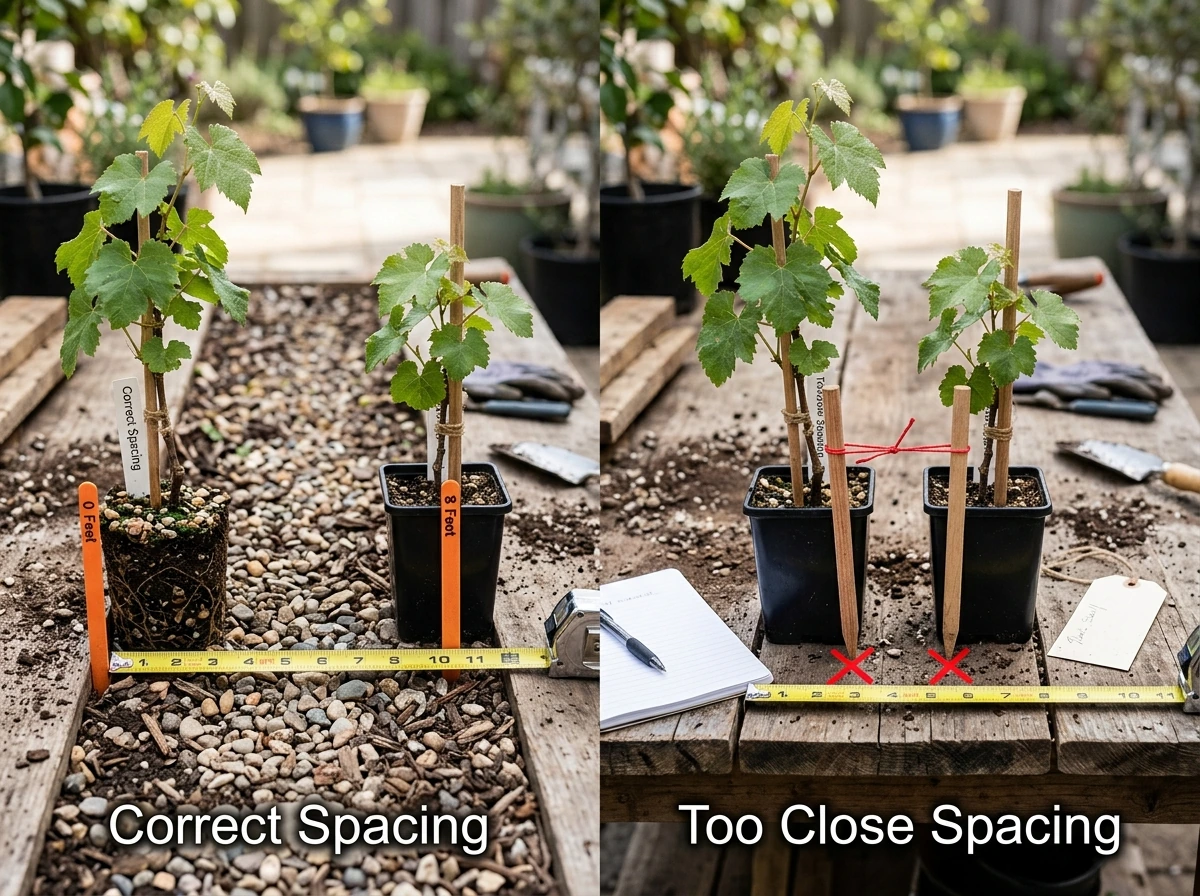
For spacing, the standard guidance for home plantings puts vines 4 to 8 feet apart within a row, with rows spaced 6 to 12 feet apart. The exact number depends on how vigorous your variety is and how much space you have. A more compact planting at 6 feet between vines and 8 feet between rows works fine for most home situations. When you plant bareroot vines (which is the most common way to buy them), set the vine so the buds are right at or just above soil level.
What to expect on the timeline to your first harvest
Here's the honest truth about timeline: you're not eating grapes the first summer. Typically, you'll see your first real harvest 3 to 4 years after planting, with some sources saying the first full crop doesn't arrive until year 4 or 5. In the first year, you're focused entirely on getting the vine established and starting to build the trunk. In year two, you begin training the cordons or canes along your trellis. By year three, you'll likely see some fruit, but you should remove most of it to let the vine put energy into root and wood development. Year four onward is when you start harvesting in earnest.
Pollination is one thing you don't need to manage. Grapes are mostly wind-pollinated, and most varieties are self-fruitful, meaning you don't need two different varieties nearby for fruit set. You don't need to hand-pollinate or time planting for cross-pollination the way you might with apples or pears. Just get the vine established, train it properly, and let the wind do its job.
Watering in the first couple of seasons matters more than most beginners realize. If you don't get consistent rainfall during any two-week window in the growing season, water deeply enough to wet the soil to about 12 inches. Don't let young vines dry out completely, but don't overwater either. Once established, grapes are surprisingly drought-tolerant, but new plantings in their first two years need consistent moisture to build the root system that will eventually support all that vine growth.
Mistakes that come from thinking grapes are bushes or trees
This is where the bush/tree misconception does real damage. If you've grown fruit trees or berry bushes before, your instincts about pruning are probably wrong for grapes, at least at first. Here are the specific mistakes to watch for:
Not pruning hard enough
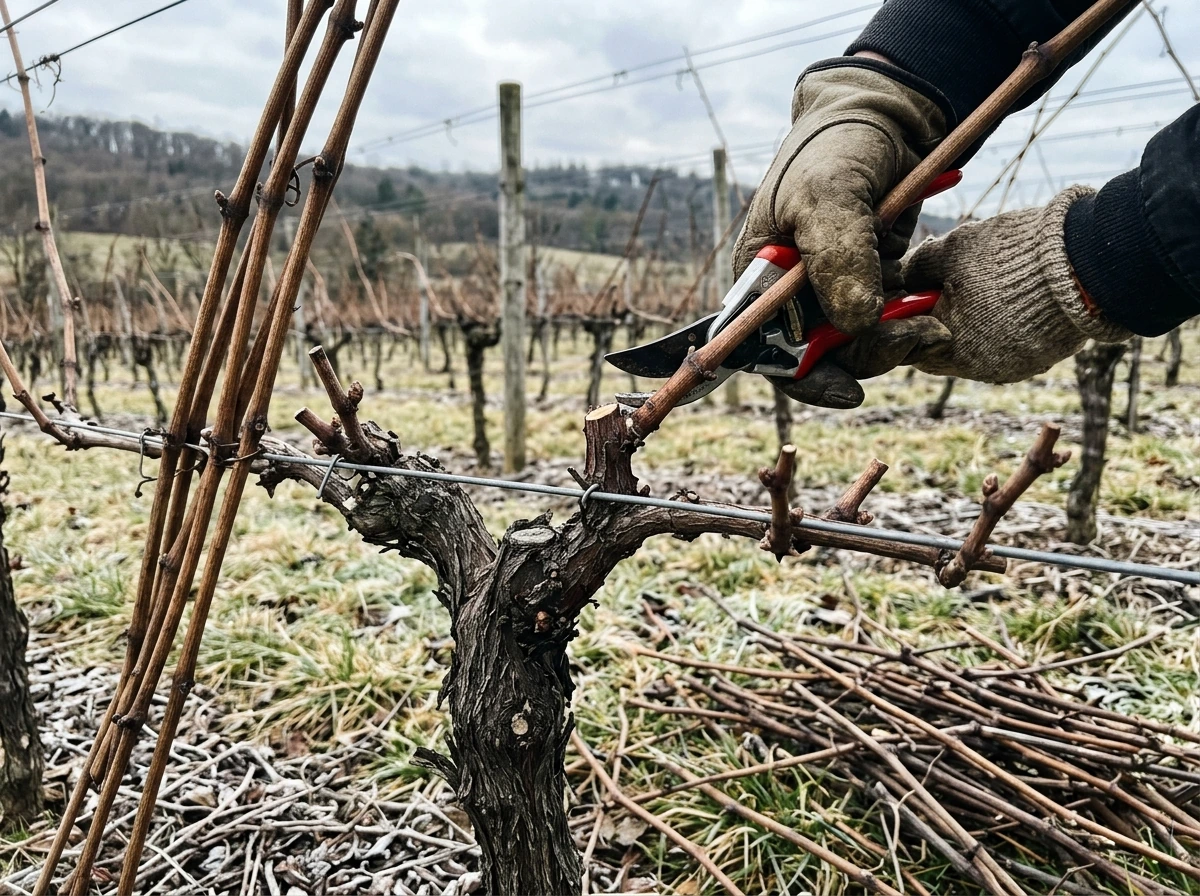
Grapes require aggressive annual pruning, and it shocks almost every first-timer. You're removing 70 to 90 percent of the previous year's growth every winter. That sounds extreme, but it's correct. Grapes produce fruit on new shoots that grow from one-year-old wood, not on old wood like a fruit tree does. If you let a grapevine grow unpruned for even two or three seasons, you end up with a tangled mass of wood, very poor fruit quality, and a vine that's nearly impossible to rehabilitate without starting over.
Skipping the trellis
Some gardeners plant a grapevine thinking it will eventually hold itself up the way a shrub does. It won't. Without support, the vine sprawls on the ground, loses airflow, gets more disease pressure, and produces poorly. Even a basic two-wire fence trellis is dramatically better than no support at all. Get your support structure in place before or the same day you plant, not later.
Misreading drainage and blaming feeding
When a grapevine struggles in wet soil, the symptoms can look like nutrient deficiency: yellowing leaves, weak growth, poor fruit set. Beginners often respond by fertilizing more, which doesn't help and can make things worse. If your vine looks sick and you've been keeping it well-watered, check whether the site is actually draining between waterings. Grapes in waterlogged soil will slowly decline no matter how much fertilizer you add.
Expecting fruit too soon
A grapevine is not an annual vegetable. If you plant in spring and expect to pick clusters by fall, you're going to be frustrated. Resist the urge to let a young vine carry a heavy fruit load in years 1 or 2. Let it build wood and roots first. The patience required in the early years directly pays off in the productivity you get once the vine matures.
Buying a beautiful-looking variety without checking hardiness
This one stings because it means losing a couple of years of work. A Cabernet Sauvignon vine might look great at the garden center in Ohio or Michigan, but it's likely to die back to the roots in its first hard winter without protection. Check the hardiness zone rating on the label against your USDA zone before you buy. If you're in Zone 5 or colder, focus on American varieties or the cold-climate hybrids developed specifically for northern gardens. The articles on this site about which grapes grow in your specific state and climate zone can help you narrow down the shortlist before you shop.
Your practical next steps
If you're starting from scratch today, here's the order of operations that actually works:
- Find your USDA hardiness zone and look up which grape varieties are rated for it. American types like Concord work across a wide range; cold-climate hybrids like Marquette or Frontenac push further north.
- Choose a planting site with full sun and good drainage. South or southwest exposure is ideal.
- Build or install your trellis before you plant. Even a simple two-wire setup will work.
- Plant bareroot vines in early spring with vines spaced 4 to 8 feet apart. Set buds at or just above soil level.
- Focus year one entirely on building one strong trunk. Remove any flower clusters that appear in year one or two.
- Begin formal training in year two, running the main lateral arms along your top wire.
- Prune hard every late winter, removing most of last year's growth and keeping only the fruiting wood and renewal positions you need for next season.
- Water deeply during dry stretches in the first two years. Once established, back off and let the vine do its thing.
Grapes are genuinely one of the most rewarding things you can grow at home, but they reward the gardeners who set them up correctly from the start. Get the support structure right, pick a variety that's honest about your climate, prune without hesitation every winter, and you'll have a vine that produces for decades. The first cluster you pick from a vine you trained yourself is worth every bit of the wait.
FAQ
If grapes are vines, can I still grow them in a container like a patio plant?
Yes, but container grapes need the same basics as in-ground vines, especially a trained framework and aggressive annual pruning. Choose a dwarf or small-growing variety, use a large pot with excellent drainage, and plan on reducing the crop heavily in the first 1 to 2 years because limited root volume makes the vine easier to overwhelm.
Do I need to cover grapevines in winter, or is the right variety enough?
The right variety helps a lot, but winter severity and wind exposure can still matter. In colder or borderline zones, consider protecting young vines (mulch around the root zone and using a lightweight cover) because dieback can happen even when the label hardiness is close to your area.
What’s the best way to tell whether my grapevine issue is drainage, sun, or pruning mistakes?
Look at leaf and growth patterns together. If the vine is in full sun but shows weak, droopy growth and persistent yellowing soon after waterings, drainage is a prime suspect. If growth is vigorous but fruit quality is poor or clusters are sparse, pruning and fruiting-wood selection are more likely. If you see no meaningful new shoots each year, the pruning schedule or vine establishment stage may be the cause.
How do I know which training system to use, two-wire trellis or something else?
For most home plantings, a simple two-wire setup is easiest to manage, especially if you expect to prune hard each winter. Choose a more complex system (like a fan or higher-wire arrangement) only if you already have space and time for consistent training, and make sure the system still gives you access to reach fruiting wood for pruning.
Can I plant multiple grape varieties together, or will they compete?
You can plant multiple varieties near each other if you have spacing for each vine and enough trellis capacity, they do not require cross-pollination. Competition usually becomes a problem when vines are crowded on the same support, which reduces airflow and makes pruning harder, so plan on separate vine spacing and predictable training lines.
Should I fertilize grapes, and when does fertilizer become a mistake?
Grapes benefit from modest feeding, but they are often harmed by heavy nitrogen because it pushes leafy growth at the expense of fruit. If you are already getting strong vegetative growth but weak fruiting, avoid increasing fertilizer and first reassess pruning, sun exposure, and whether the soil stays too wet.
Why do my grapes look like they set flowers but then the clusters fail to develop?
Common causes include insufficient sunlight, uneven moisture during early cluster development, and vine immaturity in the first few years. Also check pruning severity and which wood you left, since grapes fruit on the correct one-year-old wood, leaving the wrong shoots can lead to set that never develops into mature clusters.
Do I need to remove leaves or fruit-thin clusters for better ripening?
In many home situations, you do not need leaf stripping, but gentle cluster management can help if growth is overly dense. Instead of over-thinning, focus on annual pruning to control canopy size, improve airflow, and reduce shading, since that supports sugar development and reduces disease pressure.
What’s the safest schedule for pruning, and can I prune later in spring if I missed winter pruning?
Grapes are best pruned during dormancy, typically in winter, because that is when you can select and remove the correct proportion of last year’s growth. If you miss that window, avoid doing major restructuring during active growth, you can cause excessive bleeding and stress, and it may reduce next season’s fruiting wood selection.
How often should I water after the first two years?
Once established, grapes generally handle drought better, but they still benefit from deep watering during hot, dry stretches in the growing season. A practical approach is to water only when the soil has dried down, then soak deeply to reach root depth, instead of frequent shallow watering that encourages surface roots.