
Grape vine roots typically concentrate in the top 60 cm to 1 metre (roughly 2 to 3 feet) of soil, where about 60 to 80 percent of all root mass lives. But that is not the whole picture. When the soil profile is deep, loose and well-drained, a vine's anchoring roots can push down 3 metres or more, and in rare, completely unrestricted profiles, researchers have documented single roots exceeding 6 metres. What actually happens in your garden depends on your soil, your climate, and whether you are growing in the ground or in a container.
How Deep Do Grape Vines Grow: Root Depths, Planting & Care

Marcus Whitfield
19 Jul 2026
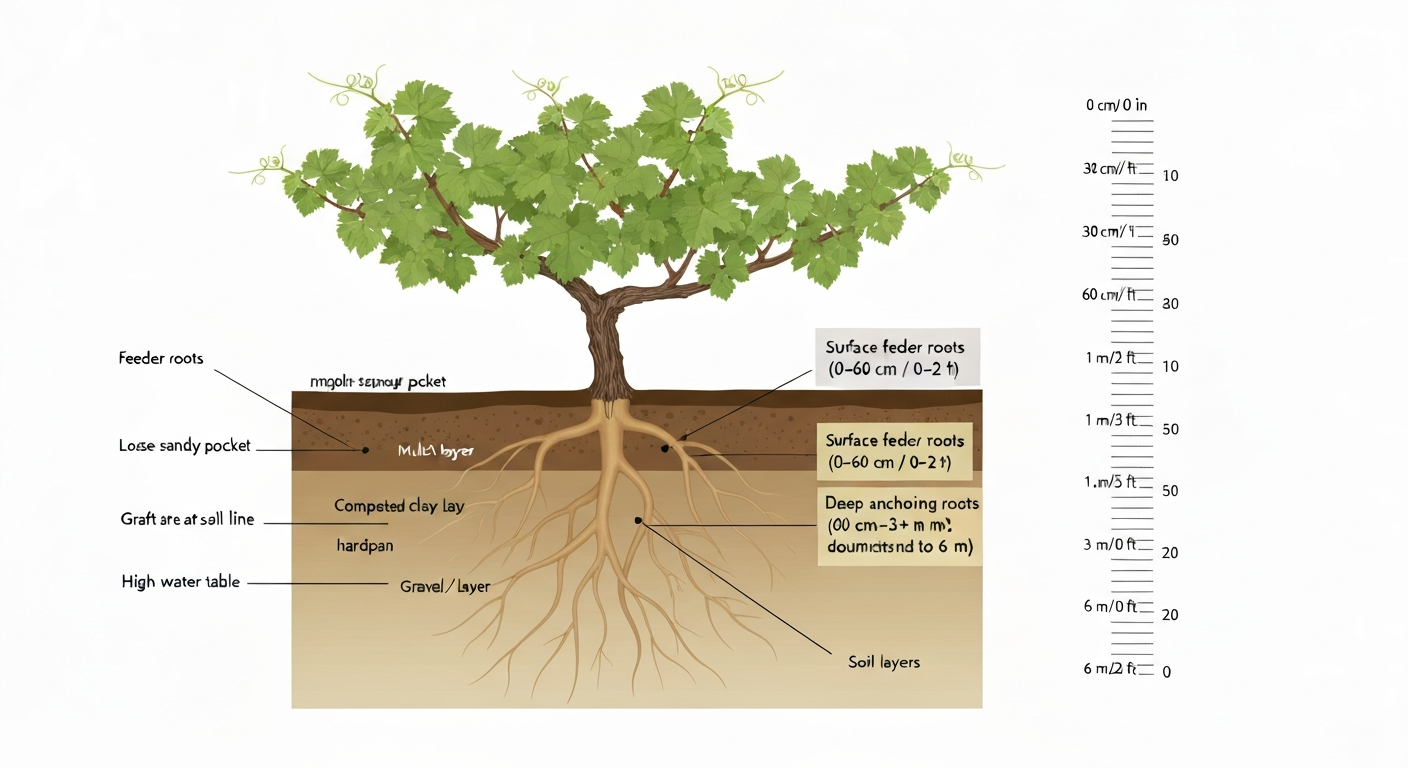
How grape vine roots are actually structured
A grapevine does not have one uniform root system. It has two functionally different layers working together, and understanding both will change how you plant, water and feed your vine.
Surface feeder roots (0 to 60 cm / 0 to 2 ft)
The fine, hair-thin feeder roots that actually absorb water and nutrients live mostly in the upper 30 to 60 cm of soil. Studies consistently show that roughly two-thirds of total root length sits in that top 60 cm zone. These are the roots that respond to rainfall, compost, fertiliser and drip irrigation. They are also the roots most vulnerable to drought, waterlogging, soil compaction and freezing temperatures. When you dig around an established vine and see a dense mat of pale, fibrous roots just below the surface, that is your nutrient engine.
Deep anchoring roots (60 cm to 6+ metres)
Below the feeder zone, a smaller number of thicker, structural roots grow downward, anchoring the vine and prospecting for deep moisture reserves. In good, open soil, these roots commonly reach 1.5 to 3 metres. In the most permissive conditions, documented depths exceed 6 metres. These deep roots are what allow an established vine in a dry climate to survive drought that would kill a shallow-rooted plant. However, soil barriers like hardpan, clay subsoil, bedrock or high water tables frequently stop them well before they reach that potential. For irrigation and nutrient planning purposes, the practical effective root zone is typically pegged at 0.6 to 1.0 metre, because that is where the action is.
What actually controls how deep your roots go
Four factors matter more than any other when it comes to how deep your particular vine will root: soil texture, climate and irrigation, variety, and rootstock. Let me walk through each one honestly.
Soil type
Sandy, loose soils offer the least resistance, so roots dive deep and spread wide. Heavy clay restricts both depth and lateral spread, particularly if there is a compacted subsoil pan. Roots will stop at an impermeable layer as reliably as if they hit concrete. Gravelly soils can go either way: fine gravel with good drainage lets roots move, but dense stone layers act like a physical barrier. The honest reality is that soil physical structure trumps rootstock genetics in most situations. You can plant the most vigorous rootstock available and still end up with a shallow root system if your subsoil is hard and airless.
Climate and irrigation method
Drip irrigation tends to concentrate roots near the emitter, keeping them relatively shallow and dense. Flood or broad sprinkler irrigation encourages roots to follow moisture deeper into the profile. In rainfed conditions, where vines must work for their water, roots push deeper by necessity. This is part of why dryland-farmed vines in places like the Rhône Valley or parts of California develop such impressive deep root systems. In wetter climates, including much of the UK, vines do not need to reach as deep to find moisture, so they often root shallower by default.
Variety and rootstock
Own-rooted vines (not grafted) and vines on vigorous rootstocks like 1103 Paulsen or 110 Richter tend to develop more aggressive, deeper root systems. Rootstocks with Riparia parentage, such as 101-14 or 3309C, tend toward shallower, denser, more fibrous root systems. SO4 and Kober 5BB fall somewhere in between and are popular in European and UK settings because they suit heavier soils. These rootstock differences are real, but they play second fiddle to soil conditions. A 110R vine in tight clay still will not root as deeply as an SO4 vine in well-drained loam.
Root depth by soil condition: what to realistically expect
| Soil Condition | Typical Rooting Depth | Practical Notes |
|---|---|---|
| Deep sandy / sandy loam | 1.5–3.0 m (5–10 ft) | Roots spread wide and deep; drought tolerance high; watch for nutrient leaching |
| Fertile loam | 0.9–1.5 m (3–5 ft) | Best all-round depth for productivity; effective root zone ~1.0 m |
| Heavy clay (no pan) | 0.5–0.9 m (1.5–3 ft) | Slower root development; drainage improvement needed; lateral spread limited |
| Compacted or hardpan subsoil | 0.3–0.6 m (1–2 ft) | Roots stop at the layer; break pan before planting if possible |
| Waterlogged / high water table | 0.2–0.5 m (8 in–1.5 ft) | Root rot risk high; raised beds or tile drainage essential |
| Shallow over bedrock/shale | 0.3–0.6 m (1–2 ft) | Fissures may allow some penetration; vine stress likely in dry summers |
Planting in the ground: exact dimensions that work
The planting hole is the one chance you get to give your vine a good start, so it is worth getting the dimensions right. The goal is not a massive excavation, it is a properly sized opening with loosened soil walls so young roots can escape easily.
Bare-root vines
Dig a hole about 30 cm (12 inches) deep and 45 to 60 cm (18 to 24 inches) wide. The Oregon State University Extension guide Growing Table Grapes, Oregon State University Extension recommends planting vines in holes about 12 in (30 cm) deep, with loosened backfill and the top roots just below the soil surface Growing Table Grapes — Oregon State University Extension (home/small-scale guide). That gives you room to spread the roots outward without bending or circling them. Set the vine so the top roots sit about 5 to 10 cm (2 to 4 inches) below the soil surface. If your vine is grafted, keep the graft union at least 5 cm (2 inches) above the final soil level. Burying the graft union invites the scion to root on its own, which defeats the purpose of the rootstock entirely.
Grafted vines from a nursery
Follow the same hole dimensions as bare-root. The critical detail with grafted vines is that graft union position. In cold-climate states and UK gardens, some growers are tempted to bury the graft union to protect it from frost. Unless you are in an exceptionally cold zone (USDA Zone 5 or below) and doing this deliberately to encourage scion rooting as a survival strategy, keep it above ground. Match the planting depth to the original nursery depth indicated by the soil line mark on the stem.
Container vines
Set the vine at exactly the same depth it was growing in the pot. No deeper, no shallower. Loosen the outer edges of the rootball gently if roots are circling. Dig the hole at least 2 to 3 times the width of the container and the same depth, then backfill with the native soil you dug out. Do not add a layer of gravel at the bottom of the hole thinking it will improve drainage, it actually creates a perched water table that keeps the root zone wetter. Fill around the rootball with native soil, firm it gently, and water deeply immediately after planting.
- Bare-root: 30 cm (12 in) deep, 45–60 cm (18–24 in) wide, roots spread flat
- Grafted: same dimensions, graft union kept 5+ cm above final soil level
- Container transplants: same depth as pot, hole 2–3x wider than rootball
- No fertiliser in the planting hole — it can burn young roots
- Backfill with native soil only, firm gently, water thoroughly to collapse air pockets
- Install your trellis or support post at planting time, not after
Growing in containers: pot sizes that actually support a vine
Container growing is completely viable, especially for patio gardeners, UK gardeners wanting to grow under glass or in a sheltered spot, or anyone testing a variety before committing to an in-ground planting. For specific information on growth rates for grapevines grown in pots in the UK, see how fast do grape vines grow in the UK in pots (internal resource ID 76afd3f3-b227-4669-bf30-e85827aef73e). The limiting factor is almost always pot volume. Most people start in pots that are too small and then wonder why their vine looks stressed.
| Vine Age / Use | Minimum Volume | Recommended Depth | Recommended Diameter |
|---|---|---|---|
| Year 1 (establishment) | 10–15 L (3–4 gal) | 30 cm (12 in) | 30 cm (12 in) |
| Year 2–3 (training) | 30–40 L (8–10 gal) | 35–40 cm (14–16 in) | 35–40 cm (14–16 in) |
| Long-term / permanent | 60–80 L (15–20 gal) | 40–50 cm (16–20 in) | 45–60 cm (18–24 in) |
| UK patio / fruiting vine | 60–100 L (15–25 gal) | 45–50 cm (18–20 in) | 50–60 cm (20–24 in) |
One vine per container, always. I have seen people try to grow two vines in a single large tub to save space, and it never ends well, the roots compete, the vines stress each other and yield drops for both. Use a good quality loam-based compost (John Innes No. 3 in the UK is a reliable choice) rather than lightweight peat-based mixes, which dry out too fast and compress over time. Ensure the pot has drainage holes you can actually see working after watering.
How root depth changes the way you water and feed
Shallow roots need water more frequently but in smaller volumes. Deep roots can go longer between irrigations but need each watering to reach down into the soil properly. The practical rule is to irrigate to the depth where most of your roots live, which is typically 60 cm in well-watered gardens, 80 cm in drier or water-limited gardens, and 1.0 metre in rainfed or dryland settings. You find that depth by digging a simple soil pit or pushing a probe rod into the soil after watering, when it stops sliding easily, that is the dry zone below the wetted front.
Frequent, shallow watering is one of the most common mistakes I see home gardeners make with grapes. It trains roots to stay near the surface, which makes the vine more vulnerable to heat stress and drought. Instead, water deeply and less often, allowing the soil surface to dry between irrigations. For in-ground vines, a thorough deep watering every 7 to 14 days in summer (adjusting for your climate and rainfall) is a better rhythm than a light daily sprinkle. Container vines need much more attention, check soil moisture daily in summer and water when the top 3 to 5 cm feels dry.
For feeding, because feeder roots live in the top 60 cm, surface-applied fertiliser and compost are effective. Work granular fertiliser into the top few centimetres in early spring, or apply as a liquid feed once growth starts. Avoid heavy nitrogen application in late summer, which promotes soft growth that is vulnerable to frost.
Root depth and winter protection by climate zone
The depth at which roots sit is directly connected to how vulnerable they are to freezing. In USDA Zones 5 and 6 (cold winters, down to -15 to -23°C / 5 to -10°F), fine feeder roots in the top 15 to 30 cm are genuinely at risk from hard freezes, particularly in bare or sandy soil. In Zones 7 and above, and in most of the UK (roughly equivalent to Zones 7 to 9), root system damage from soil freezing is rare but not impossible during exceptional winters.
Mulching for root protection
A 10 to 15 cm (4 to 6 inch) layer of mulch applied over the root zone in autumn is the single most effective step for cold-climate gardeners. Straw, wood chips, or shredded leaves all work well. Pull the mulch back slightly from the trunk to prevent crown rot, but cover a circle at least 60 to 90 cm (2 to 3 feet) out from the vine. This insulates the top 30 cm of soil where feeder roots concentrate, and it makes a measurable difference in root survival during hard freezes.
Frost heave
In Zones 5 and colder, frost heave (where repeated freeze-thaw cycles physically push newly planted vines up out of the ground) is a real risk in the first one to two winters. Planting at the right depth and mulching heavily helps. Press any heaved vines back down in early spring before growth starts. Established vines with a developed root system are much less susceptible.
UK-specific guidance
UK gardeners face a different challenge: less extreme cold but more persistent damp. Waterlogged winter soil is harder on grape roots than frost in many UK locations. Raised beds or mounded rows (10 to 20 cm above surrounding grade) improve drainage, protect roots from sitting in cold water and improve spring soil warming. Pot-grown vines in the UK should be moved to a sheltered, frost-free position (an unheated greenhouse or shed) during the coldest months, as container roots have no soil mass around them to buffer temperatures.
Troubleshooting common root problems
Shallow rooting and poor establishment
Symptoms: vine wilts quickly in heat, growth is weak after year 2, roots visible at the soil surface. Causes: frequent shallow watering, compacted subsoil, or a restrictive planting hole. Fix: switch to deep, infrequent watering immediately. If compaction is the issue, use a soil probe or narrow spade to break up a ring of compacted soil 30 to 60 cm out from the vine. Top-dress with compost and mulch to encourage downward root growth.
Compaction
Heavy foot traffic, repeated rototilling or use of heavy equipment near vines creates a hard layer that roots cannot penetrate. Diagnosis: push a steel rod into the soil, if it stops abruptly at a consistent depth, you have a compaction layer. Fix: subsoil with a fork or broadfork to a depth of 40 to 50 cm before planting, or apply gypsum and compost over time to improve structure around established vines.
Waterlogging
Grapes are genuinely intolerant of standing water. If water pools for more than 24 to 48 hours after rain, you will see yellowing leaves, poor vigour and eventual root rot. Fix: install French drains or tile drainage before planting, or build raised rows at least 20 cm above the natural grade. In containers, ensure drainage holes are clear and never leave pots sitting in saucers of water.
Root rot (Phytophthora, Armillaria)
Wet, poorly drained soils are the primary driver of Phytophthora root rot. Armillaria (honey fungus in the UK) can attack roots in soils where infected tree stumps remain. Both cause rapid vine decline. Prevention is far easier than cure: well-drained soil, correct planting depth, and avoiding soil amendments that stay wet. Phytophthora-tolerant rootstocks (some Ruggeri selections) offer modest resistance but are not a substitute for good drainage.
Restricted pots
A pot-bound vine is easy to diagnose: roots emerging from drainage holes, very rapid drying out after watering, stunted new growth, or leaves dropping early. Fix: repot in early spring into a container one size larger, handling roots gently and refreshing the compost. A vine that has been in a too-small pot for several years will take a full growing season to recover its vigour after repotting.
Vine height, growth rate and how to manage it
People often think about root depth in isolation, but it directly connects to what happens above ground. A vine with a well-established deep root system will grow faster, produce more vigorously and handle drought stress better than one with a restricted root zone. Typically, a well-sited grapevine will put on 1 to 3 metres (3 to 10 feet) of new cane growth per season in ideal conditions. In its first two years, growth is slower because the plant is investing energy into root development. By years 3 and 4, assuming healthy soil and good root depth, above-ground growth accelerates noticeably.
In terms of overall vine height, a trained grapevine on a standard trellis typically reaches 1.5 to 2.5 metres (5 to 8 feet) at the top wire, though the canes themselves can extend considerably further if not pruned. For specific details on typical vine heights and trellis recommendations, see our guide on how tall do grape vines grow. Container-grown vines and UK patio varieties tend to grow more slowly and stay more compact, a pot-grown vine might put on 60 to 120 cm (2 to 4 feet) per year. Annual pruning is what keeps height manageable and channels the plant's energy into fruit rather than endless cane extension.
Yield expectations: grapes per vine and per acre
Let me be honest about yield numbers, because there is a lot of optimistic generalisations floating around. A mature, well-managed grapevine (years 4 to 7 and beyond) in good soil can produce anywhere from 2 to 12 kg (roughly 5 to 25 pounds) of fruit per vine depending on variety, training system, climate and management. For a quick estimate of cluster counts and average berries per cluster, see our guide on how many grapes grow on a vine. Table grape varieties often produce more generously than wine grape varieties under home garden conditions. Wine grape varieties, particularly those grown for quality, are frequently pruned to limit yield intentionally.
At a small-vineyard or per-acre scale, typical yields range from 2 to 8 tons per acre (roughly 4 to 18 tonnes per hectare) for wine grapes, with the low end representing quality-focused or cool-climate production and the high end representing volume-focused commercial table grape operations. For practical conversions to vines-per-acre and expected total production, see how many grapes can you grow in 1 acre. Home gardeners with 10 to 20 vines in good soil can realistically expect 20 to 100 kg of fruit in a good year by year 5 or 6, though this varies enormously by variety and season. Rooting depth matters here because deeper roots mean better water and nutrient access during the critical fruit development period.
When to expect your first harvest
I always tell new grape growers to think in three-year blocks. In year 1, you are establishing roots, do not let the vine fruit at all, remove any flower clusters that appear. In year 2, you can allow a very small crop (maybe one or two clusters per vine) to test ripening and flavour, but the priority is still building root depth and trunk structure. By year 3, most vines will produce a modest but real first harvest. Full production, meaning the vine performing at close to its potential, typically arrives between years 5 and 7.
This timeline is not just about patience, it directly reflects root development. A vine that is allowed to overcrop in year 2 or 3 diverts energy away from root establishment, and you pay for it in years 4 and 5 with a vine that is weaker and less productive than it should be. Let the roots grow first. The fruit follows.
| Year | Root Development | Expected Yield | Key Task |
|---|---|---|---|
| Year 1 | Primary root system establishing | None (remove all clusters) | Build trunk, establish roots |
| Year 2 | Roots extending to 30–60 cm | Minimal (1–2 clusters max) | Train main arms, continue root development |
| Year 3 | Feeder root zone well established | Light crop (0.5–2 kg/vine) | First real harvest, assess variety performance |
| Years 4–5 | Root zone reaching 60–100 cm | Moderate (2–5 kg/vine) | Refine pruning, start yield management |
| Years 6+ | Full depth reached for site conditions | Full crop (5–12 kg/vine typical) | Maintain, prune, optimise |
Choosing varieties and rootstocks for your soil and region
Root depth potential is one input into variety and rootstock selection, but it works alongside climate hardiness, disease resistance and intended use. Here is a practical decision framework.
Rootstock selection by soil type
- Sandy, dry, drought-prone soils: 110 Richter or 1103 Paulsen, both deep-rooting and drought tolerant
- Fertile loam with moderate moisture: SO4 or 3309 Couderc, well-balanced vigour and rooting density
- Heavy clay or wet soils: Kober 5BB or 420A, tolerant of poorer drainage and higher soil moisture
- Shallow or chalk soils (common in parts of UK and Europe): 41B, bred specifically for alkaline, shallow chalk soils
- Own-rooted (no rootstock): appropriate in phylloxera-free areas only, common for muscadines in the southeast US
Variety selection by climate
- Cool climates (USDA Zones 5–6, UK): Pinot Noir, Chardonnay (wine); Interlaken, Reliance (table); cold-hardy hybrids like Marquette, Frontenac, Crimson Pearl
- Temperate climates (Zones 6–8, most of England and Wales): Merlot, Riesling, Sauvignon Blanc (wine); Muscat, Seyval Blanc
- Warm climates (Zones 7–9): Cabernet Sauvignon, Syrah, Grenache, Muscat of Alexandria (table)
- Hot, humid southeast US: Muscadine varieties (Carlos, Noble, Supreme) — resistant to Pierce's Disease, which kills European varieties
- Pacific Northwest (Oregon, Washington): Pinot Gris, Riesling, Gewürztraminer; avoid late-ripening varieties in shorter seasons
A quick reality check: if you are in a humid climate (high-rainfall southeast, mid-Atlantic states, or wet parts of the UK), disease resistance should be your primary variety criterion, ahead of flavour preference. A beautiful Cabernet Sauvignon vine that spends every summer fighting downy mildew and black rot will produce less and require more inputs than a disease-resistant hybrid that suits your conditions. Root depth is only as useful as the vine above it is healthy.
Your practical next steps: from assessment to first harvest
Here is where to start if you are planning your first planting or troubleshooting an existing vine. Work through these steps in order, skipping the soil assessment is the most common way gardeners end up replanting after year 3.
- Assess your soil: dig a test pit 60 to 90 cm deep. Note where texture changes, where roots from existing plants stop, and whether you hit a hard layer, rock or standing water. This tells you your realistic effective root zone before you plant anything.
- Test soil drainage: fill your pit with water and time how quickly it drains. If 30 cm of water takes more than 3 to 4 hours to drain, you have a drainage problem to solve before planting.
- Check your hardiness zone: match your USDA zone (or UK equivalent) to cold-hardy varieties and suitable rootstocks. This is non-negotiable — planting a Zone 8 variety in Zone 5 without cold protection will fail.
- Choose your rootstock based on your soil assessment above, not just habit or nursery availability.
- Prepare your site: break up any compaction layers, improve drainage if needed, and work compost into the top 30 cm. Do not add fertiliser to the planting hole.
- Plant at the right depth: 30 cm deep, 45–60 cm wide for bare-root or grafted vines; match pot depth for container transplants; keep graft union above soil.
- Install your trellis or support at planting, not later — disturbing roots to post-drive is an unnecessary setback.
- Mulch the root zone with 10 to 15 cm of organic mulch in the first autumn, kept back from the trunk.
- Water deeply and infrequently from the start — train those roots downward from day one.
- Resist fruiting the vine in year 1, limit to 1 to 2 clusters in year 2, and build to a full crop progressively from year 3 onward.
- Pot growers: start in a 10 to 15 L pot, repot annually until you reach a permanent 60 to 80 L container; move to shelter in winter in Zone 7 and below or in the UK.
Seasonal care checklist at a glance
| Season | Root Zone Focus | Above-Ground Task |
|---|---|---|
| Late winter / early spring | Check for frost heave, press back any lifted vines | Prune before bud break; apply balanced fertiliser |
| Spring (bud break to flowering) | Begin deep watering schedule; probe soil to confirm wet depth | Train new shoots; remove suckers from below graft union |
| Summer (fruit development) | Water to 60–80 cm depth; check for wilting signs of shallow roots | Manage canopy for airflow; remove excess clusters if overcropped |
| Autumn (harvest to leaf fall) | Apply mulch 10–15 cm deep after harvest | Harvest fruit; reduce watering; prepare for dormancy |
| Winter (dormancy) | Mulch maintains soil temp; check drainage in wet climates | Move potted vines to shelter; inspect trellis and stakes |
Grapes are genuinely rewarding to grow once the roots are established and you have matched your variety to your conditions. The first three years ask for patience and restraint. After that, a well-rooted vine in the right soil and climate will repay you with decades of fruit. Get the depth right from the start, and everything else becomes much easier.
FAQ
How deep do grapevine roots typically grow in home garden soils?
Most vine roots (especially the fine feeder roots) concentrate in the upper soil layers. Expect roughly 60–80% of root length/mass in the top 0.5–1.0 m (about 1½–3 ft), with a large portion within the top 30–60 cm (1–2 ft). A small fraction of roots may go deeper where soil is deep and unimpeded, but for practical gardening the effective root zone is usually 0.5–1.0 m.
Can grape roots grow much deeper than 1 m? When does that happen?
Yes. In deep, freely drained sandy profiles with no compacted layers or bedrock, some roots (especially structural roots) can extend several meters; field reports show rare roots >6 m in unconstrained soils. However, those deep roots are a small proportion of total root length and rarely relevant for routine watering or fertiliser decisions in home gardens.
How do soil type and physical barriers affect rooting depth?
Soil texture, compaction, hardpans, stony subsoils and shallow bedrock are the main controls. Sandy, well‑drained deep soils permit deeper and wider root systems. Heavy clay, compacted layers or rock typically confine most roots to upper horizons (often <1 m). If you suspect a restrictive layer, dig a test pit to check depth and plan accordingly.
How does irrigation method change where roots grow?
Irrigation strongly shapes root distribution. Broad wetting (flood, furrow, or large wetted zones) encourages deeper and more lateral roots. Localized drip concentrates roots in the wetted zone—shallower but denser near emitters. For deeper rooting use less frequent, larger-volume irrigations that wet a deeper soil profile.
What planting-hole dimensions should I use for in-ground vines?
For single home or hobby vines: dig a hole at least as deep as the rootball (do not plant deeper than pot depth) and 2–3× the rootball width. Practical numbers: 30 cm (12 in) deep and 60–90 cm (24–36 in) wide for typical container vines; use a deeper/wider hole if soil is heavy or you need to loosen a restrictive layer. Keep the graft union above the final soil level.
What container size is suitable for growing grapes long-term?
For a single container-grown vine you should use a large pot to give adequate root volume and winter buffering: aim for ≥15–20 gallons (~60–80 L), roughly 40–60 cm (16–24 in) diameter and 40–50 cm (16–20 in) deep. Larger containers improve yield potential and reduce watering frequency.