
Winemaking grapes grow best between roughly 50°F and 95°F (10°C–35°C) during the active growing season, with the sweet spot for ripening sitting around 77°F–86°F (25°C–30°C) on most days. For more detailed guidance on how grapes are grown, start with climate and site conditions that match the variety you want to plant. You also need at least 150 to 180 frost-free days per year, a winter cold enough to push vines into dormancy, and somewhere in the range of 1,500 to 2,500 growing degree days (GDD, base 50°F) accumulated between budbreak and harvest. That temperature window and GDD range is basically what separates a site where wine grapes will thrive from one where they'll struggle to ripen or just die over winter.
Grapes Used for Winemaking Grow Best Between Key Temps
Marcus Whitfield
8 Jul 2026
The temperature range that actually matters
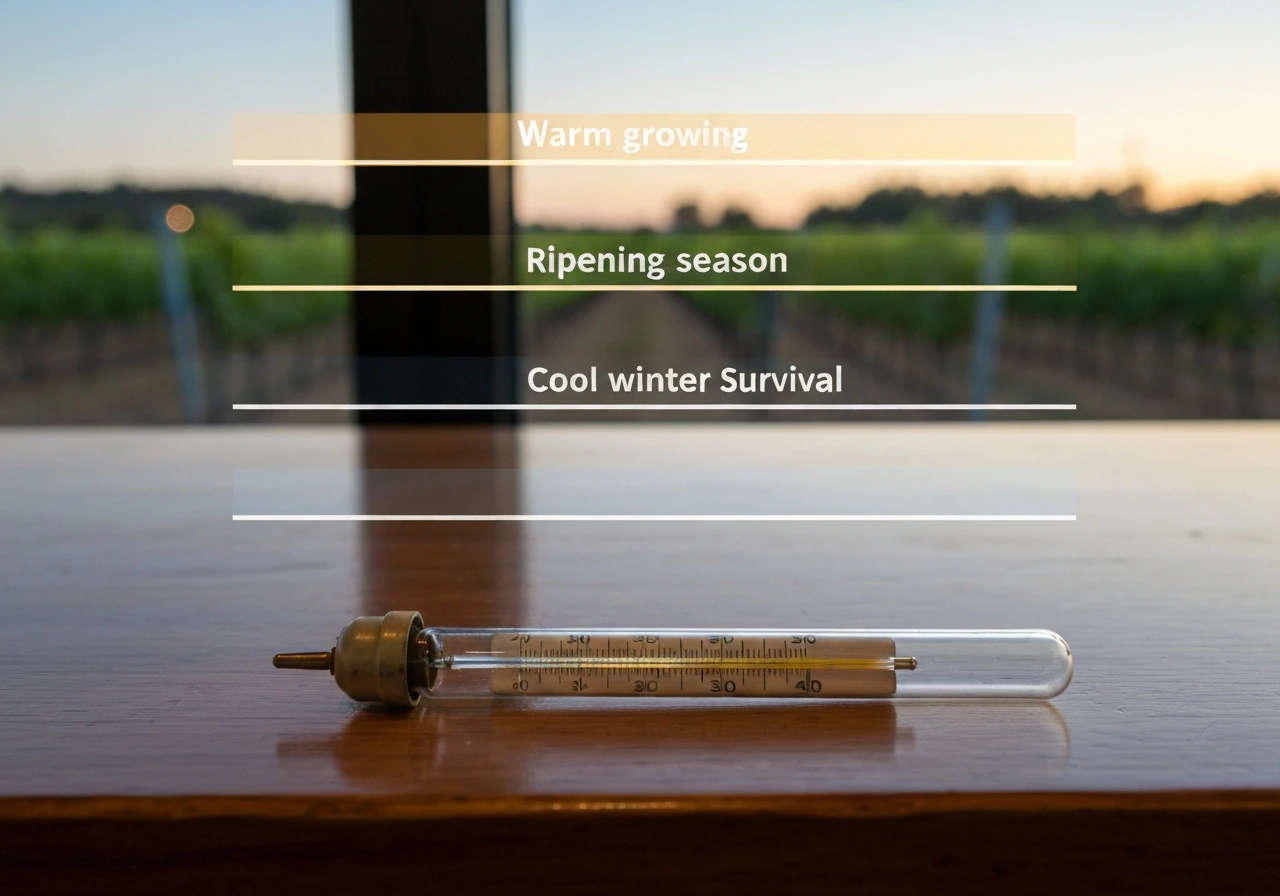
When people ask what temperature winemaking grapes grow best between, they're really asking about three separate windows: the growing season warmth that ripens fruit, the winter cold that vines need (and can survive), and the frost dates that bookend your season.
Growing season warmth is measured in GDD. Washington State University Extension calculates GDD for grapes using a base temperature of 50°F, meaning only the heat above that threshold counts toward ripening. Most classic European winemaking varieties (Vitis vinifera) like Cabernet Sauvignon, Chardonnay, and Riesling need somewhere between 1,500 and 2,500 GDD to fully ripen, depending on the variety. Early-ripening whites need less; late-ripening reds need more. If your region doesn't accumulate enough heat between your last and first frost, the fruit won't ripen properly regardless of how healthy the vine looks.
Winter cold is the other side of the equation. Vines need a cool dormancy period to reset, but there's a hard limit. Penn State Extension puts it plainly: if your site hits -10°F five or more times per decade, or -15°F three or more times per decade, it's not suitable for standard vinifera production. Below those thresholds, you're looking at cold-hardy hybrid varieties instead. Budbreak in Vitis vinifera typically kicks in when consistent daytime temperatures reach around 50°F (10°C), so a late warm-up in spring can delay the whole season.
Frost risk at both ends of the season is what growers lose sleep over. A late spring frost after budbreak can wipe out an entire year's crop. Luckily, grapevines carry secondary and tertiary buds as backup, but those produce far less fruit. A hard freeze in early fall before harvest can be even more damaging since there's no recovery option at that point.
What 'grow best' looks like by region and hardiness zone
The classic winemaking grape regions of the world (Napa, Burgundy, Tuscany, Rioja) mostly sit in USDA-equivalent zones 7–9. In the United States, that means coastal California, the Pacific Northwest, parts of the Mid-Atlantic, and the warmer corners of the Southeast are natural fits for Vitis vinifera. But that doesn't mean you're out of luck in cooler zones.
| USDA Zone | Winter Low | Vinifera Suitability | Best Bet for Wine Grapes |
|---|---|---|---|
| Zone 4 (e.g., Minnesota, northern Michigan) | -20°F to -30°F | Not suitable | Cold-hardy hybrids: Marquette, Frontenac, La Crescent |
| Zone 5 (e.g., Ohio, Illinois, upstate NY) | -10°F to -20°F | Very limited; best sites only | Hybrids + cold-tolerant vinifera on protected slopes |
| Zone 6 (e.g., Pennsylvania, Virginia, Missouri) | 0°F to -10°F | Possible on good sites | Riesling, Cabernet Franc, Chambourcin, Vidal Blanc |
| Zone 7 (e.g., NC, TN, parts of TX) | 0°F to 10°F | Good for most vinifera | Cabernet Sauvignon, Merlot, Chardonnay, Viognier |
| Zone 8–9 (e.g., CA, OR, WA valleys) | 10°F to 20°F+ | Excellent | Full range of classic vinifera varieties |
Ohio State University Extension specifically flags zones 5b and 6 in Ohio as zones where vinifera is only viable on the best sites, and recommends hybrids for most growers there. University of Minnesota Extension takes it further, noting its cold-climate breeding program has developed wine grape varieties rated for zone 4 and warmer. If you're in the Upper Midwest, those Minnesota-developed varieties like Marquette and Frontenac are genuinely your best path to making wine from your own vines, not a consolation prize.
Illinois, which spans zones 5a through 6b, is a good example of a split-zone state. In the southern half you can attempt cold-tolerant vinifera on a well-chosen site. In the northern half, French-American hybrids and cold-hardy American varieties make more practical sense. The University of Illinois Extension makes exactly this distinction when advising growers across the state.
Sun, soil, slope, and drainage: the non-negotiables
Temperature and zone tell you whether grapes can survive your winters. If you're looking for the answer to the where grapes grow crossword clue, start by matching your site and zone to what the vine can realistically handle. Site conditions tell you whether they'll actually thrive and produce wine-quality fruit. Get these wrong and even a perfect climate won't save you.
Sunlight
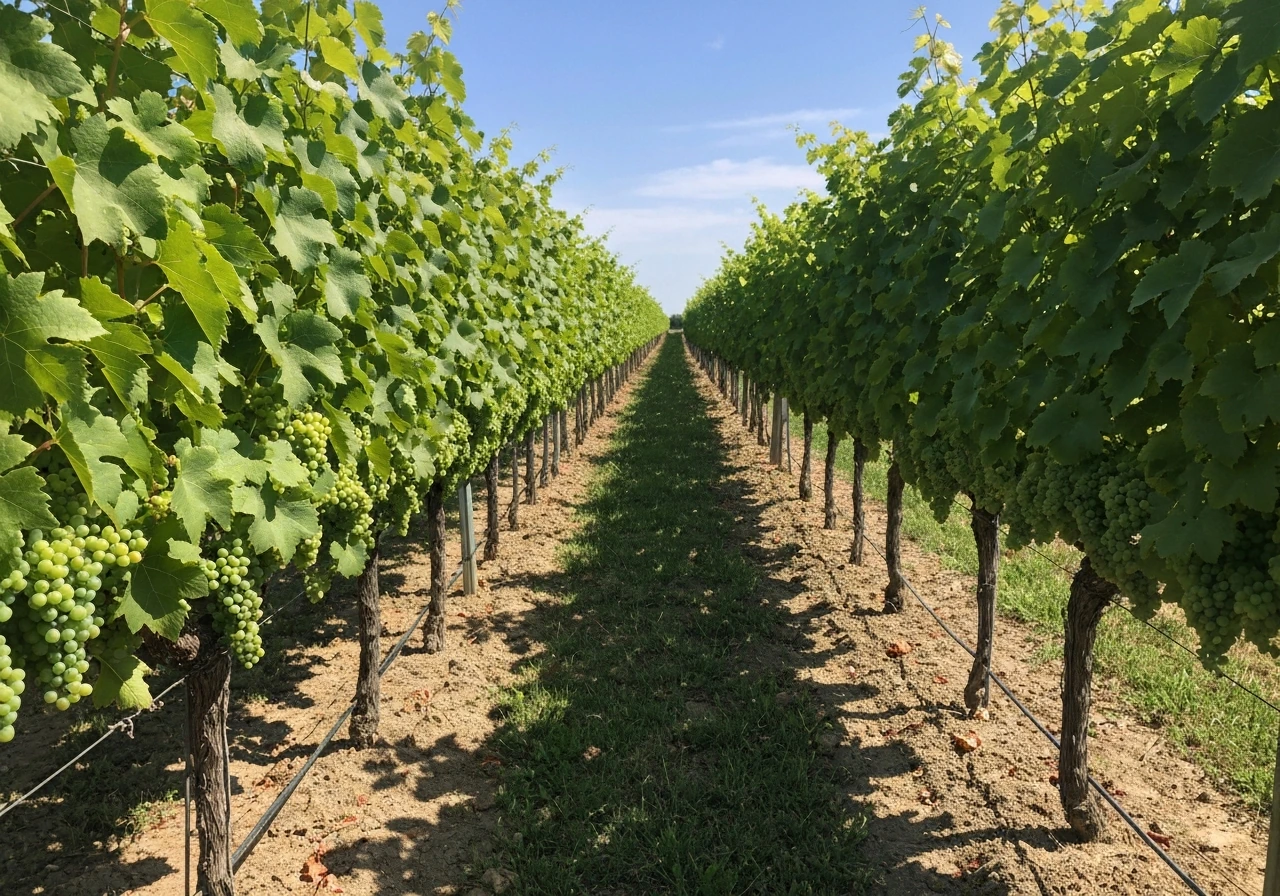
Full sun is non-negotiable for winemaking grapes. UC Marin Master Gardeners (UC ANR) recommends a minimum of seven to eight hours of direct sunlight per day. Penn State Extension specifically connects full sun to the vine's ability to properly ripen fruit and develop complete flavors, which is exactly what you're after if wine is the goal. Partial shade produces green, vegetal, underdeveloped fruit. Plant on the sunniest part of your property and don't let trees or structures shade the rows during the afternoon.
Soil pH and drainage
Winemaking grapes, especially Vitis vinifera, actually prefer a slightly alkaline to neutral soil. Penn State Extension notes vinifera can grow in soils with a pH of 7.0 or slightly higher, which surprises a lot of gardeners used to acid-loving fruit crops. A pH range of 6.0 to 7.0 works well for most wine grapes, with vinifera varieties leaning toward the higher end of that range.
Drainage is where many home vineyard projects fail quietly. Grapes absolutely need well-drained soil. Oklahoma State University Extension is blunt about it: grapes require full sunlight and well-drained soils, full stop. Roots sitting in saturated soil are vulnerable to rot, disease, and cold injury. If your site has drainage issues, raised beds or a slope can help, but you need to solve the problem before you plant.
Slope and cold-air drainage
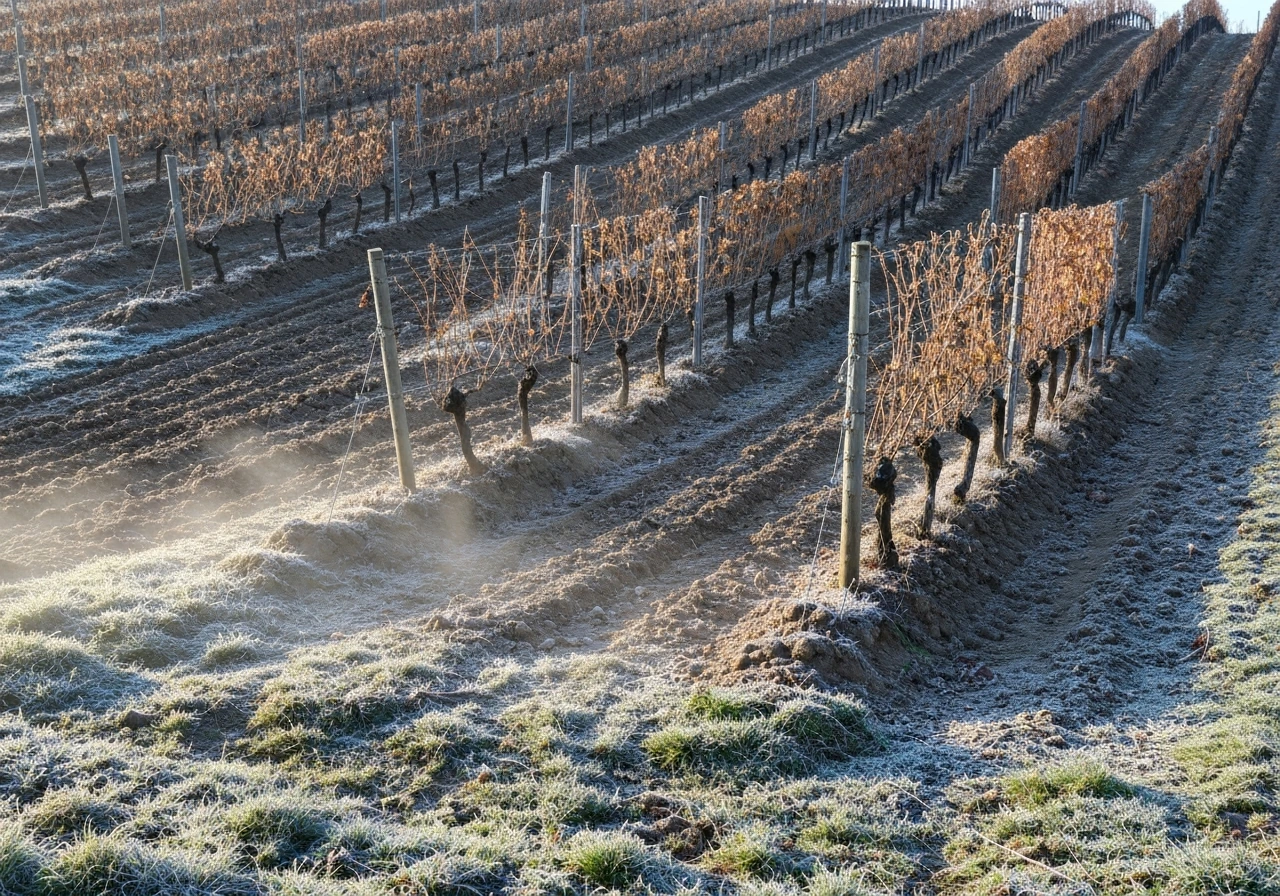
A gentle slope does two important things: it improves soil drainage and it lets cold air flow away from your vines on frosty nights. Cold air is dense and settles in low spots and against obstacles. Penn State Extension and NC State Extension both emphasize this point: good air drainage dramatically reduces frost damage risk. NC State specifically warns against obstacles at the bottom of a slope (shrubbery, windbreaks, buildings) that can trap cold air and turn a manageable frost into a crop-killing freeze. A mid-slope position on a south or southeast-facing hillside is the classic ideal for good reason.
Vineyard basics: variety, training, and spacing
Picking a winemaking variety that actually matches your climate
Before you fall in love with a particular grape variety, check whether it can ripen in your GDD window. If you're also planning berries like grapes and strawberry can grow best in similar warm-season conditions, pay attention to frost-free days and sun exposure. Cabernet Sauvignon needs a long, warm season and is a poor choice for zone 5. Riesling and Cabernet Franc are significantly earlier-ripening and are your best vinifera bets in the Mid-Atlantic and cooler parts of the Northeast. In zones 4–5, you're likely looking at cold-hardy hybrids, and that's not a bad thing. Varieties like Marquette, Frontenac, La Crescent, and Vidal Blanc were developed specifically for wine production in cold climates and can yield genuinely good results.
One thing worth understanding: OSU Extension notes that European (Vitis vinifera) varieties are less cold-hardy than American varieties as a general rule. That's the trade-off. Vinifera tends to produce the classic wine flavors most people are chasing, but hybrids survive winters that would kill vinifera outright. Michigan State University Extension provides guidance on how climate, soil, and site factors influence vine vigor and vineyard establishment success cold-hardy hybrids survive winters that would kill vinifera outright. In colder states, hybrids are often the only realistic path to making wine at home.
Training systems for home winemakers
The most practical training system for home winemakers is vertical shoot positioning (VSP). University of Minnesota Extension and University of New Hampshire Extension both describe VSP as the standard two-dimensional trellis design, where shoots grow upward between catch wires above a fruiting wire. It keeps the canopy open for sunlight and airflow, both of which directly affect fruit quality and disease pressure. For a home vineyard, a basic VSP setup with two to three wire levels and sturdy end posts is all you need to get started.
Spacing depends on vine vigor and your site, but a common home-vineyard starting point is 6 to 8 feet between vines in a row, with rows 8 to 10 feet apart. University of Minnesota Extension notes that trellis spacing is tied to vine vigor, and it also advises planning final post height to reflect installation depth and expected canopy height. This gives each vine enough room to develop without overcrowding the canopy. Tighter spacing requires more aggressive pruning to manage; wider spacing means you'll need more land for the same yield.
Whether you use cane pruning or spur pruning depends partly on variety and partly on regional convention. Penn State Extension notes that cane pruning is increasingly common for wine grapes in the eastern US, while spur pruning has its place in certain regions. For most home growers, cane pruning with two to four fruiting canes and renewal spurs is a reliable approach that most extension resources walk you through step by step.
Growing season timing: from budbreak to harvest
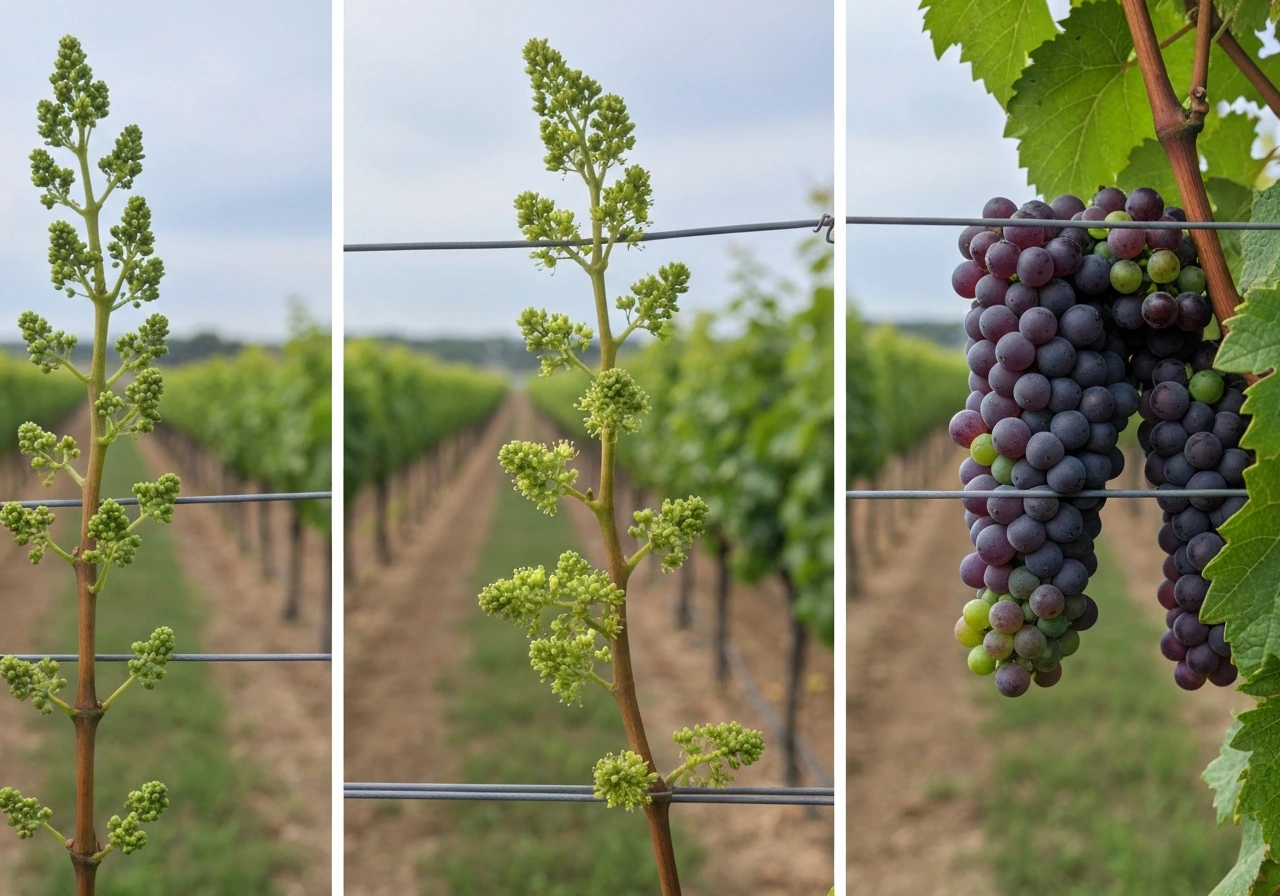
Here's the rough timeline you're working with for most winemaking grapes:
- Budbreak: When consistent daytime temps reach around 50°F. In most of the US, this happens between late March and early May depending on your zone.
- Bloom: Typically 6 to 9 weeks after budbreak, usually in late May or June. This is when fruit set happens and frost is still a risk.
- Veraison (color change and sugar accumulation): Roughly 40 to 50 days after bloom. This is when berries soften, change color, and start building sugars.
- Harvest: 30 to 70 days after veraison, depending on variety and your target Brix (sugar level). Early-ripening white varieties may be ready by late August in warm years; late reds can push into October or November in longer-season climates.
- Total season length: From budbreak to harvest, count on 150 to 180 days for most wine grapes, with enough heat accumulation (1,500–2,500 GDD) within that window.
That GDD requirement is why ripening time, not just winter survival, can be the real limiter in marginal climates. Even if your vines make it through winter just fine, a cool summer with insufficient heat accumulation means the grapes never fully ripen. They'll be high in acid and low in sugar, and the wine will show it. This is the point that often gets missed: surviving winter is only half the battle. Do red and green grapes grow on the same vine? In many cases, yes, because grape color is determined mainly by the variety, not by the training system or site conditions. The growing season needs to be warm enough and long enough to actually finish the job.
How to match your state and zone to the right variety
Here's a practical decision flow for figuring out what will actually work where you live:
- Find your USDA hardiness zone. This is your starting filter. Zone 7 and warmer gives you the most options. Zone 5 and colder narrows things significantly toward hybrids.
- Check your average last spring frost and first fall frost dates. Count the frost-free days between them. You need at least 150, and 180+ is better. Your local extension office or the USDA's plant hardiness zone map will have this.
- Look up your region's historical GDD accumulation (base 50°F). Your state extension service likely has this data. If your area regularly hits 1,800–2,000 GDD, you can ripen most wine grapes. Below 1,500 GDD, focus on early-ripening varieties only.
- Check Penn State's cold threshold test: does your site hit -10°F five or more times per decade? If yes, Vitis vinifera is risky. Plan for cold-hardy hybrids instead.
- Look up your state extension service's recommended wine grape varieties. OSU (Ohio), UMN (Minnesota), University of Illinois, Penn State, and NC State all have variety-specific guides tailored to their state's zones. These are far more useful than general national lists.
- Evaluate your specific site for slope, drainage, and sun before finalizing variety choice. A good site in a marginal zone beats a poor site in a good zone every time.
If you're in a colder state like Minnesota, Montana, or northern Michigan, resources like Montana State University's small farms program and UMN Extension's cold-climate grape program are specifically designed for your situation. They've done the hard work of testing varieties at low temperatures so you don't have to learn those lessons the expensive way.
One more thing worth knowing: where your grapes grow (the type of site, the slope, the microclimate) can matter as much as your broader region. Two vineyards in the same county can have meaningfully different frost dates and heat accumulation based on elevation and cold-air drainage. Site scouting is real work, but it's the kind of homework that pays off every season for years.
FAQ
What if my region hits the temperature range, but the growing season is very short (early fall frost)?
Use GDD plus frost dates together. If your first fall frost typically arrives before your variety’s heat requirement is met, you may need an earlier-ripening cultivar or a site that warms faster (south-facing slope, higher elevation with better air flow) rather than relying on the general temperature range alone.
Do grapes need to be kept near 77°F–86°F all season to ripen?
No. That range is a typical target for ripening progress, but vines also benefit from warm days and some cooler nights. What matters most is cumulative heat above the base temperature (GDD), not hitting one steady temperature every day.
How do I calculate growing degree days (GDD) for my exact location instead of using regional averages?
Use your local weather station data and compute GDD with base 50°F, budbreak-to-harvest window in mind. Many growers approximate the start at budbreak timing they observe onsite, because a local warm spring can shift budbreak earlier than nearby averages.
If my winter lows are below -10°F sometimes, can I still grow standard vinifera by using protection?
Protection can help with buds and trunks during individual events, but it does not change long-term winter hardiness. If your decade frequency crosses the thresholds mentioned for vinifera unsuitability, switching to cold-hardy hybrids and planning for cold-air drainage is usually the safer decision than relying on blankets or heaters.
What frost dates matter more, spring or early fall?
Spring frosts are critical right after budbreak because damaged buds reduce yield. Early fall frosts can be even more limiting because harvested recovery options are limited and unripe fruit cannot “catch up,” so prioritize ensuring your variety finishes ripening before the first hard freeze.
Does choosing a grape variety solve temperature issues by itself?
Variety choice helps, but site physics still matter. A variety that matches your GDD may still fail if the vineyard sits in a frost pocket, gets shaded after noon, or has saturated soil that harms roots and slows growth.
Can grapes tolerate partial shade and still make wine?
Partial shade often delays ripening and increases underdeveloped flavors. If shade is unavoidable, reassess the planting orientation and pruning to maximize direct afternoon light, and consider site relocation if consistent 7 to 8 hours of sun cannot be achieved.
What soil pH should I aim for if I want to grow vinifera?
A practical target is near neutral, with vinifera tending to do better closer to the higher end (around 7 or slightly above). It’s worth soil testing before planting, because adjusting pH is not instant and can take multiple seasons depending on amendments used.
How can I tell if my soil drains well enough for grapes before planting?
Do a percolation test or observe seasonal behavior after storms. If water stands for long periods or you see soggy ground during late winter or spring, assume drainage is inadequate and plan raised rows or a slope-based location before you invest in vines.
Is planting mid-slope always best, or are there exceptions?
Mid-slope is often ideal for cold-air drainage, but exceptions happen with wind exposure, soil depth, and sun access. Always check that the specific row location still gets full sun and does not funnel cold air into the row from nearby obstacles.
Do red and green grapes have different temperature needs?
The color is primarily variety-driven, but ripening requirements can still differ because cultivars have different GDD needs. If two varieties look similar in the nursery but ripen at different times, match them to your heat accumulation rather than assuming color equals temperature tolerance.
If my vines survive winter but fruit stays high-acid, what’s the likely cause?
Most commonly, insufficient heat accumulation. Confirm that your site has enough GDD between your last and first frost for that cultivar, then review sunlight exposure and canopy management, since dense canopies can reduce effective ripening even when weather averages look warm.
How does training system (like VSP) affect temperature and ripening?
Training mainly changes canopy openness and airflow, which influences how much fruit gets direct sun and how quickly berries ripen. If you are short on heat, prioritizing maximum light interception through VSP and careful shoot positioning can improve ripening efficiency without changing the local climate.