
Zone 10 is one of the best climates in the country for growing grapes, but only if you pick varieties built for heat, low chill hours, and the specific disease pressures that come with warm, sometimes humid conditions. The varieties that shine here include Florida-bred muscadines like Carlos and Noble, table grapes like Flame Seedless and Thompson Seedless in the desert Southwest, heat-tolerant wine grapes like Grenache and Tempranillo in southern California and Arizona, and low-chill hybrids like Black Spanish (Lenoir) for coastal Texas. Get the variety right, address your soil and rootstock, and grapes in Zone 10 are genuinely achievable for a home gardener.
Best Grapes to Grow in Zone 10: Top Varieties & Tips
Marcus Whitfield
6 Aug 2026
Why Zone 10 is actually a great place to grow grapes
Most gardening content treats grapes as a cool-climate crop, which leads a lot of Zone 10 gardeners to assume they're out of luck. That's not accurate. Grapes originated in warm Mediterranean climates, and many cultivars are genuinely built for the conditions Zone 10 throws at them: long, hot growing seasons, mild winters, and almost no frost risk. The challenge in Zone 10 isn't cold damage or a short season. It's the opposite: insufficient winter chill to break dormancy properly, intense summer heat that can sunburn fruit, and in humid subregions like south Florida, a disease environment that punishes the wrong variety quickly.
What Zone 10 gives you that colder zones (Zones 5 through 8, for instance) simply cannot offer is a growing season that can stretch 9 to 10 months or more, with harvest starting as early as May in the desert Southwest. Gardeners in Zones 5 or 6 are working around a narrow window between late frost and early fall cold; in Zone 10 you're managing heat and moisture, which is a different but very solvable set of problems. If you've already looked into what grapes grow in Zone 9 nearby, Zone 10 shares many of those same principles but requires an extra layer of attention to chill hour accumulation and disease-resistant varieties.
Understanding Zone 10 climate: what your vines are dealing with
Heat tolerance and growing degree days
USDA Zone 10 covers areas where average annual minimum temperatures stay between 30°F and 40°F (-1.1°C to 4.4°C), meaning frost is rare to non-existent. In practice, Zone 10 includes places like the Coachella Valley and low-elevation desert zones of southern California and Arizona, the southern tip of Florida (Zone 10a and 10b), coastal areas of Hawaii, and parts of coastal southern Texas. These locations accumulate enormous heat during summer. PRISM Climate Group, Oregon State University provides high-resolution gridded climate normals and temperature/precipitation datasets useful for mapping growing-degree days, chill hours, and monthly humidity proxies in Zone 10 PRISM Climate Group — Oregon State University. The Coachella Valley, for example, routinely sees 100°F-plus days from June through September, while south Florida brings high heat paired with near-constant humidity.
For grapes, heat during the growing season is largely a positive, driving sugar accumulation and flavor development. The real concern is extreme heat spikes above 105°F, which can sunburn berry clusters and shut down photosynthesis. Desert growers in Arizona and the Coachella Valley should plan for afternoon shade cloth or east-facing rows that give clusters shade during the hottest part of the day.
The chill hour problem and how to work around it
This is the single biggest limiting factor for grapes in Zone 10. Most classic European wine grape varieties (Vitis vinifera) require 900 to 1,500 chill hours (hours below 45°F) to break dormancy properly and set fruit uniformly. Zone 10 typically delivers somewhere between 100 and 400 chill hours depending on subregion, with coastal south Florida at the low end and desert Arizona foothill zones at the higher end. Research comparing dormancy models suggests the Dynamic (Chill Portions) model is actually more reliable than simple chill-hour counting in warm-winter climates, where alternating warm and cool nights make raw hour counts misleading. For practical purposes, focus on varieties rated at 100 to 300 chill hours and treat anything above 500 as risky in Zone 10.
Humidity and disease pressure
Zone 10 splits into two very different disease environments. In dry desert subregions (the Coachella Valley, low-elevation Arizona), the low humidity dramatically reduces fungal pressure, which means powdery mildew and downy mildew are manageable with minimal spray schedules. In humid subregions, particularly south Florida and coastal Texas, disease pressure is intense. Pierce's disease, caused by Xylella fastidiosa and spread by sharpshooter leafhoppers, is widespread in California and Florida and is effectively fatal to susceptible Vitis vinifera varieties. Florida's summer rainy season also creates near-ideal conditions for downy mildew, Botrytis, and black rot. Choosing resistant varieties isn't optional in these areas, it's the foundation of your entire plan.
Site and soil requirements for warm-climate grape growing
Grapes in Zone 10 need the same fundamentals as grapes anywhere, but a few factors are amplified. Full sun is non-negotiable: aim for at least 8 hours of direct sunlight daily. In desert sites, an east-to-west row orientation protects clusters from the harshest afternoon sun. Good air circulation becomes critical in humid subregions because stagnant air prolongs leaf wetness and invites fungal disease. Avoid planting in low spots where cold or humid air settles.
Soil drainage is probably the most important site factor in Zone 10. Grapes hate wet feet, and in areas with clay soil or high water tables (common in parts of south Florida), roots sitting in saturated soil invite root rot and decline. Raised beds or bermed planting rows are a practical solution in these situations. Target a soil pH of 6.0 to 6.5. Florida's sandy soils are naturally low in organic matter and nutrients, so incorporating compost at planting and committing to a regular fertilization schedule matters more here than in richer soils. In Arizona, soils can be alkaline (pH 7.5 to 8.5) and may need sulfur amendments to bring pH down before planting.
In Arizona and inland southern California, Phymatotrichopsis omnivora (cotton root rot) is a real concern on alkaline desert soils. University of Arizona Extension research identifies this fungal pathogen as capable of killing established grapevines quickly, and there's no effective chemical cure once it's in the soil. Avoiding sites with a history of cotton or susceptible hosts and choosing resistant rootstocks are your main defenses.
Choosing grape types for Zone 10: an overview of your options
Zone 10 gardeners have four realistic categories of grapes to work with, and the right choice depends heavily on your specific subregion.
- Table grapes (Vitis vinifera): Varieties like Flame Seedless, Thompson Seedless, Perlette, and Black Monukka do well in low-humidity desert Zone 10 (Coachella Valley, low-elevation Arizona). They need low chill hours (100 to 200), good drainage, and benefit enormously from overhead trellising that shades clusters. These are the grapes California's desert wine regions were built on.
- Wine grapes (Vitis vinifera): Heat-tolerant Mediterranean varieties like Grenache, Tempranillo, Mourvedre, and Muscat of Alexandria perform in dry Zone 10 sites. They require the same low-humidity desert conditions as the table varieties above. Trying to grow classic cool-climate wine grapes (Pinot Noir, Riesling, Chardonnay) in Zone 10 will frustrate you.
- Muscadine grapes (Vitis rotundifolia): These are the go-to choice for humid Zone 10, especially south Florida. Muscadines are native to the southeastern U.S. and are naturally resistant to Pierce's disease, most fungal diseases, and nematodes. UF/IFAS research confirms varieties like Carlos, Noble, Ison, Triumph, and Fry as reliable performers in Florida Zone 10. They taste different from European grapes (thicker skin, musky flavor, seeds in most varieties), but they're genuinely productive and low-drama in difficult climates.
- Heat-tolerant hybrids: Black Spanish (Lenoir), Blanc Du Bois, and Orlando Seedless are hybrid varieties developed specifically for warm, humid climates. Blanc Du Bois has Pierce's disease resistance and works well in coastal Texas and Florida. Black Spanish is widely grown in Texas with minimal spray requirements. These are worth serious consideration if you want something closer to a conventional wine or table grape in a tough climate.
Top recommended grape varieties for Zone 10
| Variety | Type | Why it suits Zone 10 | Harvest timing | Season length |
|---|---|---|---|---|
| Flame Seedless | Table (V. vinifera) | Low chill (100–150 hrs), thrives in dry desert heat, large red seedless clusters | Late May to June (desert CA/AZ) | ~120 days from budbreak |
| Thompson Seedless | Table (V. vinifera) | Very low chill, heat-tolerant, dual-purpose (fresh + raisin), widely adapted in Coachella Valley | June to July (desert) | ~130 days from budbreak |
| Perlette | Table (V. vinifera) | Earliest ripening of the desert table grapes, low chill, pale green seedless clusters | Late May (desert CA/AZ) | ~110 days from budbreak |
| Black Monukka | Table (V. vinifera) | Very low chill, semi-seedless, excellent in dry Zone 10, good disease tolerance in low humidity | July (desert CA/AZ) | ~130 days from budbreak |
| Carlos | Muscadine (V. rotundifolia) | Pierce's disease immune, high yield, self-fertile, proven in FL Zone 10 by UF/IFAS trials | July to August (FL) | ~90–100 days from bloom |
| Noble | Muscadine (V. rotundifolia) | Pierce's disease immune, deep bronze/black fruit, self-fertile, excellent fresh and for juice/wine | August to September (FL) | ~90–100 days from bloom |
| Ison | Muscadine (V. rotundifolia) | Self-fertile, large black fruit, very productive in humid subtropical conditions | August to September (FL/TX coast) | ~95 days from bloom |
| Blanc Du Bois | Hybrid | Pierce's disease resistant, white wine grape, suited to FL and coastal TX humid Zone 10 | June to July (FL/TX) | ~100–110 days from budbreak |
| Black Spanish (Lenoir) | Hybrid | Pierce's disease tolerant, deep red wine/juice grape, long-proven in hot humid TX conditions | July to August (TX) | ~110–120 days from budbreak |
| Grenache | Wine (V. vinifera) | Extremely heat-tolerant, low disease pressure in dry sites, thrives in desert AZ/CA | August to September (desert) | ~140 days from budbreak |
| Tempranillo | Wine (V. vinifera) | Heat-adapted Spanish variety, good color and structure, performs in dry Zone 10 desert elevations | August (AZ high desert Zone 10) | ~135 days from budbreak |
| Muscat of Alexandria | Wine/Table (V. vinifera) | Very low chill requirement, aromatic, dual-purpose, long history in Coachella Valley and FL | July to August | ~125 days from budbreak |
Rootstock selection: a Zone 10 detail you can't skip
Rootstock matters in every grape-growing climate, but in Zone 10 it can be the difference between a thriving vine and a dead one within two seasons. Three specific challenges drive rootstock choice in warm climates: nematodes, salinity, and in Arizona, cotton root rot.
Root-knot nematodes (Meloidogyne species) are pervasive in sandy Florida soils and in California's desert regions. Own-rooted vines on susceptible species are highly vulnerable. The rootstock Harmony and Freedom were developed specifically for high-nematode California conditions and are widely used in the Coachella Valley. Dogridge (Vitis champinii) offers strong nematode resistance and is popular in Texas and Florida for muscadine and hybrid plantings. Salt is a factor in irrigated desert soils (California, Arizona) where water quality can be marginal, and Ramsey (Salt Creek) rootstock handles salinity better than most alternatives. For cotton root rot risk in Arizona, there are no fully resistant rootstocks currently available, so site avoidance and good drainage are your primary tools.
Muscadines in Florida are often grown on their own roots successfully because Vitis rotundifolia is naturally nematode-tolerant. For Vitis vinifera varieties in Florida (which I'd generally advise against outside of a very dry microclimate), grafted stock onto a nematode-resistant rootstock is essential. When sourcing vines, look for certified, virus-tested planting material. State certification and clean‑plant regulatory frameworks (example: Washington Administrative Code for grape registration/certification) formalize requirements for certified mother/foundation stock and are precedents to cite when describing how home gardeners can source certified, virus‑free vines State regulatory frameworks such as WAC 16‑462 — Grape registration/certification formalize requirements for certified mother and foundation stock and clean‑plant material.. UC Davis Foundation Plant Services maintains certified foundation stock and sets the standard for clean-plant certification in California. Certified material costs a bit more, but starting with a virus-infected vine that underperforms for years is a far more expensive mistake.
Trellis and training systems for Zone 10
The heat in Zone 10 changes how you think about canopy management. In cool climates, you want maximum sun exposure on leaves and fruit. In Zone 10, especially in desert environments, you often want a larger canopy that shades the fruit zone to prevent sunburn and reduce berry temperature.
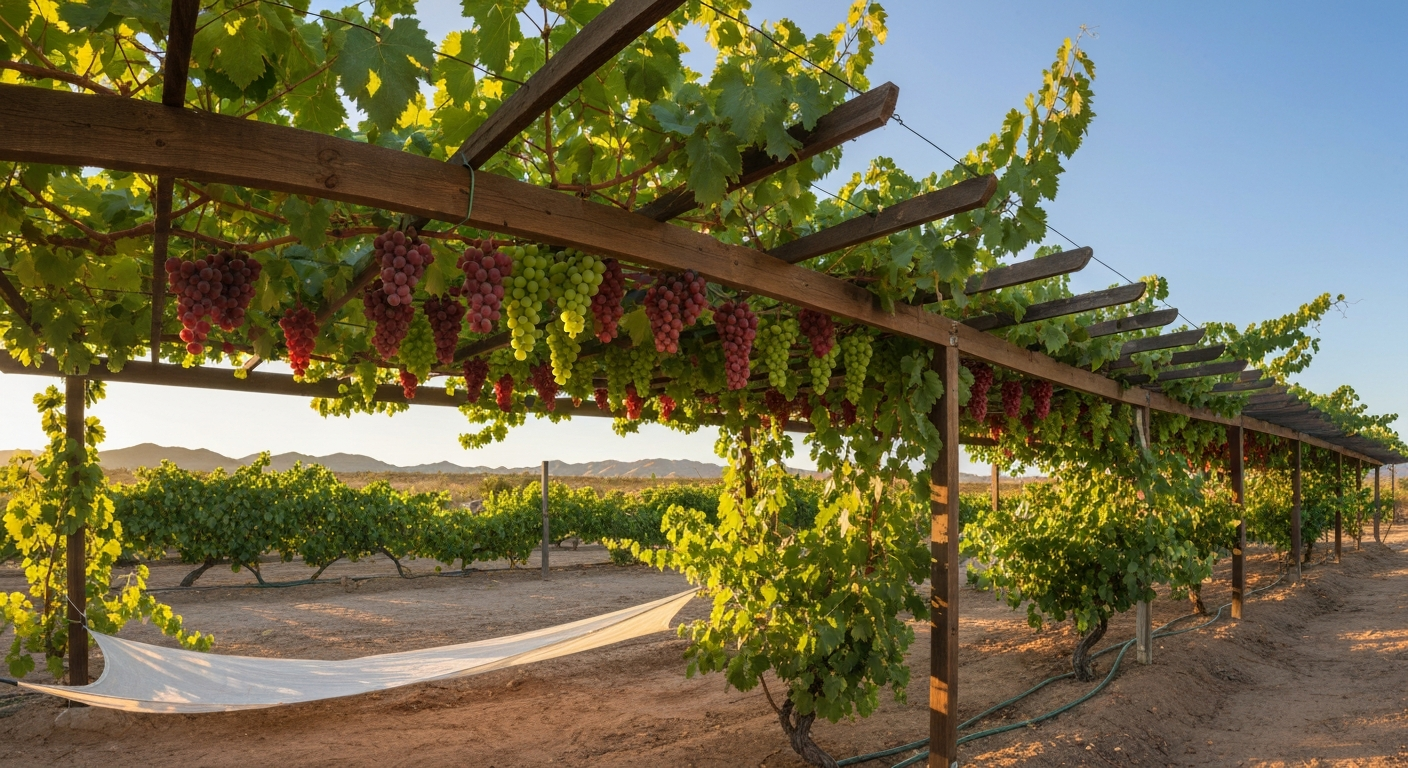
For desert table and wine grapes, an overhead pergola or T-trellis with a wide cross-arm (4 to 6 feet) is common and effective. This creates a canopy that shades clusters while still allowing air movement. The traditional Coachella Valley approach of growing table grapes on overhead trellises with 8-foot posts and a dense horizontal canopy is directly adapted to managing extreme heat. Row spacing of 10 to 12 feet between rows and 6 to 8 feet between vines within rows is a workable standard for most Zone 10 home setups.
For muscadines in Florida and coastal Texas, a single-wire overhead trellis at 5 to 6 feet (called the bilateral cordon system) is the standard UF/IFAS-recommended approach. The vines are trained to two permanent cordons running in opposite directions from the trunk, with fruiting spurs hanging down. Muscadines grow vigorously and need the space, so plan for a minimum 10-foot spacing between vines on the wire and 12 feet between rows.
Planting in Zone 10: timing, hole prep, and first-year care
When to plant
Zone 10 planting timing flips the conventional wisdom. In cold-climate zones (Zones 5 through 7), you plant in early spring after frost risk passes. In Zone 10, bare-root vines can go in the ground from November through February, taking advantage of cooler soil temperatures and reduced transplant stress. Container-grown vines can be planted almost any time from fall through early spring, but avoid planting into the heat of summer (May through September) in desert regions. In south Florida, the dry season (November to April) is the ideal planting window.
Hole preparation and planting depth
Dig your planting hole at least 18 to 24 inches deep and 18 inches wide. In Florida's sandy soils, mix in 2 to 3 gallons of quality compost to improve water and nutrient retention. In Arizona's alkaline soils, work sulfur into the surrounding area at the rate recommended by a soil test result to start adjusting pH. Plant the vine at the same depth it was growing in the nursery container, with the graft union (if grafted) at least 2 inches above soil level to prevent scion rooting into nematode-susceptible ground. Firm the soil gently, water deeply to eliminate air pockets, and set your drip emitters at planting.
Mulch and first-year establishment
A 3- to 4-inch layer of wood chip or straw mulch around the base of each vine (pulled 2 inches back from the trunk) is one of the single most useful things you can do in Zone 10. It moderates soil temperature, reduces moisture loss between irrigations, and suppresses weeds. In desert sites, this can reduce soil surface temperatures by 20°F or more, which is significant for root health on young vines. In Florida, avoid mulch piled against the trunk, as it can harbor fungal pathogens in the humid environment. Keep young vines consistently moist (not saturated) during the first summer, but let the soil approach dryness between irrigations once they are established heading into their second season.
Irrigation and fertilization in a hot climate
Drip irrigation is the right system for Zone 10 grapes in almost every situation. It delivers water directly to the root zone, avoids wetting foliage (which reduces fungal disease risk), and can be easily managed to regulate vine vigor. In desert regions, summer water demand is high: established vines may need 4 to 8 gallons per day per vine during peak summer heat, guided by local evapotranspiration (ET) data. UC Davis viticulture irrigation research emphasizes scheduling irrigation based on ET replacement rather than calendar timers, and local ET data from CIMIS (California Irrigation Management Information System) or your county extension office is worth finding and using.
Florida's muscadines and hybrids benefit from a balanced fertilization program. UF/IFAS guidance recommends applying a complete fertilizer (something like 8-8-8 or 10-10-10) at planting and through the first few seasons in split applications, starting lightly and increasing as the vine matures. Tissue testing in the third year and beyond is the most accurate way to identify deficiencies. Florida's sandy soils are notoriously low in potassium and magnesium, and deficiencies in these elements show up as interveinal chlorosis. Adding magnesium sulfate (Epsom salt) as a foliar spray or soil drench is a common and effective correction. Avoid heavy nitrogen fertilization in the weeks leading up to harvest, as it can reduce fruit quality and delay color development.
Pruning schedule for Zone 10 vines
Grapes in Zone 10 don't experience the hard dormancy that cold-climate vines do, but they still need annual dormant pruning to control growth and maintain productivity. In desert regions (California, Arizona), prune in late December through January when the vine is as dormant as it's going to get. In south Florida, the traditional pruning window is October through December, targeting a time when growth has slowed after the summer rainy season.
Muscadines are pruned differently from European bunch grapes. Because they fruit on new growth from spurs on permanent cordons, you prune back each spur to 3 to 5 buds during dormancy. For V. vinifera table and wine grapes, cane pruning (retaining 2 to 4 canes of 8 to 12 buds each) or spur pruning depending on variety is standard. In the first two years, the goal is establishing the permanent trunk and cordon framework rather than maximizing fruit production. Be patient here: removing flower clusters in year one is genuinely worth doing because it directs energy into root and trunk development.
Pests and diseases to watch for in Zone 10
The disease and pest picture in Zone 10 varies dramatically by subregion, but here are the most important threats to understand before you plant.
| Problem | Regions affected | Varieties at risk | Management approach |
|---|---|---|---|
| Pierce's disease (Xylella fastidiosa) | All of FL, coastal CA, Gulf Coast TX | All V. vinifera; most susceptible | Plant only resistant varieties (muscadines, Blanc Du Bois, Black Spanish); control sharpshooter leafhopper vectors |
| Powdery mildew | All regions, worse in CA/AZ with warm nights | V. vinifera most susceptible | UC IPM's disease model/risk index guides spray timing; sulfur and potassium bicarbonate fungicides; improve airflow |
| Downy mildew | Humid subregions (FL, coastal TX) | V. vinifera and hybrids | Use resistant varieties; apply copper-based fungicides preventively during rainy season; avoid overhead irrigation |
| Root-knot nematodes | Sandy soils in FL and CA desert | Own-rooted V. vinifera most vulnerable | Plant on resistant rootstocks (Harmony, Freedom, Dogridge); soil fumigation before planting if severe |
| Cotton root rot (Phymatotrichopsis) | Alkaline soils in AZ and west TX | All Vitis species | Avoid sites with history of susceptible hosts; good drainage; no reliable chemical control |
| Grape berry moth / leafhoppers | All regions | All varieties | Monitor with pheromone traps; kaolin clay applications; spinosad for organic management |
| Botrytis (bunch rot) | Humid FL during rainy season | Dense-clustered varieties | Choose open-cluster varieties; prune for airflow; fungicide applications at bloom |
Pierce's disease deserves special emphasis. If you are in coastal California, south Florida, or the Gulf Coast of Texas and you plant a susceptible Vitis vinifera variety, you will likely lose that vine within 2 to 5 years regardless of how well you manage it otherwise. UC IPM's Pierce's disease resources clearly document the regional incidence and the spread via blue-green sharpshooter leafhoppers. The practical answer is to plant resistant varieties from the start. No spray program reliably controls Xylella fastidiosa once it's in the vine.
Zone 10 by state: what this means where you live
Southern California (Coachella Valley and low deserts)
This is table grape country. The Coachella Valley produces a significant share of the nation's commercial table grapes precisely because Flame Seedless, Thompson Seedless, and Perlette love the combination of intense heat and almost zero rainfall. Pierce's disease pressure exists but is managed partly by the dry conditions slowing vector populations. Your main jobs are drip irrigation (water quality and salinity management matters here), overhead trellis construction for heat management, and nematode-resistant rootstock selection. Home gardeners in the Indio-to-Banning corridor can reasonably grow 3 to 5 productive table grape vines on a pergola and harvest from late May through July.
Southern Florida (Miami-Dade, Broward, Collier counties)
Muscadines and hybrids only. I'm not trying to be discouraging, but V. vinifera in south Florida's Zone 10b is almost always a failed experiment due to Pierce's disease, nematodes, and fungal disease from summer humidity. The good news is that Carlos, Noble, Ison, and Blanc Du Bois are genuinely productive and UF/IFAS has decades of cultivar trial data confirming this. Soil amendments for nutrient-poor sandy soils, a full drip irrigation setup, and a preventive copper fungicide program during the rainy season (June through September) are your baseline. Expect your first real harvest in year 3.
Southern Arizona (Tucson, Yuma, and low-elevation desert)
Low-chill table and wine grapes do well in Arizona's dry Zone 10 conditions. Grenache, Tempranillo, and Muscat varieties are proven performers. The Arizona-specific concerns are alkaline soil (pH testing and sulfur amendment before planting), cotton root rot on certain soil types (University of Arizona Extension's research on Phymatotrichopsis is the definitive reference here), and summer monsoon humidity in July and August that temporarily elevates fungal disease risk. Drip irrigation with good salinity management is essential. Harvest typically runs from late June through September depending on variety.
Coastal southern Texas (Rio Grande Valley, Gulf Coast)
Texas Zone 10 is humid, Pierce's disease is present, and V. vinifera is risky without resistant rootstock. Blanc Du Bois and Black Spanish (Lenoir) are the mainstays here and have decades of performance data in Texas conditions. Muscadines also do well along the Gulf Coast. Texas A&M AgriLife Extension is a good local resource for variety updates and regional spray guides. The summer rainy season in south Texas creates similar challenges to Florida, so fungal disease management and airflow in the canopy are priority concerns.
Hawaii
Hawaii is Zone 10 to 13 depending on elevation and island, and grape growing here is genuinely unusual. Low-chill table varieties have been grown experimentally at certain elevations, and some research from the University of Hawaii has tested muscadines and hybrids. Challenges include unique pest pressures and highly variable soils depending on island and elevation. The higher elevations of Maui and the Big Island (where it cools more in winter) tend to give better results than true coastal lowland sites. I'd treat Hawaiian grape growing as an experiment with modest expectations rather than a reliable production garden unless you've researched your specific microclimate carefully.
How Zone 10 compares to cooler zones
It's worth putting Zone 10 in context because the differences are big enough to change almost everything about variety selection and management. Gardeners in Zones 5 and 6 are dealing with 1,000 or more chill hours, a growing season of 150 to 180 frost-free days, and a primary disease concern of black rot and Botrytis during cool, wet springs. If you're wondering can you grow grapes in Zone 5, see our guide on can you grow grapes in Zone 5 for specific varieties and timing. If you're curious which varieties perform best in colder climates, see the guide to the best grapes to grow in Zone 6 for variety recommendations and chill-hour considerations. Zone 7 and 8 sit in the middle, with enough chill for many standard V. vinifera varieties but enough summer heat to ripen them well. Zone 9 is the transition: chill hours start to become limiting, Pierce's disease becomes a serious factor in California and the South, and muscadines start making more sense alongside low-chill vinifera. For recommendations on varieties suited to cooler areas, see our guide to the best grapes to grow in Zone 7.
In Zone 10 you're working with 100 to 400 chill hours, a 9-to-10-month growing season, and either desert aridity or subtropical humidity. The variety swap is significant: the Concord, Niagara, and Marquette that a Zone 5 or 6 gardener grows are not your grapes. Your grapes are Flame Seedless, Carlos, Blanc Du Bois, and Grenache, depending on where you live within Zone 10. For gardeners in slightly cooler areas, see our guide to the best grapes to grow in Zone 8b for suitable variety recommendations. The upside is that your growing season is longer, frost is almost never a problem, and you can achieve harvests that cold-climate gardeners simply cannot.
Your decision checklist before you plant
- Confirm your USDA hardiness zone and subzone (10a or 10b) using the official USDA zone map, and identify your specific climate type: dry desert or humid subtropical.
- Count your average annual chill hours (hours below 45°F from November through February). Your county extension office or local NWS office can help with this.
- Research Pierce's disease presence in your county. If you are in coastal California, Florida, or the Gulf Coast of Texas, plan to grow only resistant or immune varieties.
- Test your soil before planting: pH, organic matter, nematode pressure (through a nematology lab), and basic nutrient levels. Results will drive rootstock choice and soil amendments.
- Choose your variety category: muscadines for humid Zone 10 (FL, coastal TX), low-chill table or wine grapes for dry desert Zone 10 (CA, AZ), or heat-tolerant hybrids for the in-between situations.
- Select an appropriate rootstock if planting grafted vines: Harmony or Freedom for high-nematode desert soils, Dogridge for Florida and Texas, own roots acceptable for muscadines.
- Source certified, virus-tested planting material from a reputable nursery. UC Davis Foundation Plant Services certifies California material; look for state-certified stock in Florida and Texas.
- Plan your trellis before planting: overhead pergola or wide T-trellis for desert table/wine grapes, bilateral cordon single-wire system for muscadines.
- Install drip irrigation before or at planting. Set up for ET-based scheduling if possible, or plan to monitor soil moisture regularly during summer.
- Commit to a two-year establishment period before expecting significant fruit production. Remove flower clusters in year one and focus on canopy and root development.
FAQ
What primary climate and weather data sources are required to characterize USDA Zone 10 subregions accurately?
Use NOAA/NCEI 30‑year climate normals and supplementary normals for temperature, frost dates and heat‑event frequency; PRISM gridded climate normals for high‑resolution temperature and precipitation; local Cooperative Observer (COOP) station records for recent extremes; and evapotranspiration (ETo) products (FAO/ASCE or local extension) to design irrigation. These datasets let you map growing‑season length, degree‑days, chill accumulation and humidity proxies across Zone 10 areas (southern CA, FL, AZ, coastal TX, HI).
Which chill models and peer‑reviewed research should be used to handle low‑chill calculations and cultivar recommendations in warm winters?
Cite the Dynamic Chill Portions model (recommended in recent reviews) and comparative studies of Weinberger (chill hours), Utah and Dynamic models (e.g., MDPI 2021 review and related Can. J. Plant Sci. articles). Use peer‑reviewed papers to justify using Chill Portions in mild winters, and include example calculations or links to chill calculators for local stations/PRISM grids.
What authoritative extension and cultivar trial sources should I consult for variety recommendations (table, wine, muscadine, hybrids) for Zone 10?
Use UF/IFAS cultivar publications for Florida (HS401, HS100), NC State muscadine cultivar lists and AG‑94 Muscadine Production Guide, UC ANR/UC Davis variety and regional trial reports for California and Mediterranean climates, and state extension trial reports (Arizona, Texas) where available. Include peer‑reviewed cultivar performance trials and regional variety lists to support each recommendation.
Which sources provide pest, disease and IPM guidance tailored to warm/humid Zone 10 conditions?
Primary IPM references: UC Statewide IPM (UC ANR) grape pages (powdery mildew risk index, cultural and spray timing), UC IPM Pierce’s disease resources, UF/IFAS disease fact sheets for Florida, and regional extension disease bulletins (e.g., Univ. of Arizona on root rots). Also use university disease models (UC ANR powdery mildew model) and peer‑reviewed epidemiology literature for vector‑borne diseases (Xylella). Cross‑reference pesticide labels and resistance‑management guidelines when recommending chemical options.
What rootstock, certification and nursery references are necessary for recommendations on clean planting material and rootstock selection?
Reference UC Davis Foundation Plant Services (FPS) for certified, virus‑tested scion/rootstock options and certification procedures; state certification rules (example WAC 16‑462) as models; and extension/rootstock trial reports that evaluate Nemaguard, Freedom, 1103P, 101‑14 and other rootstocks under warm soils and pathogen pressure. Include soil pathogen risk sources (Univ. of Arizona for Phymatotrichopsis) when advising rootstock/site matches.
What irrigation, soil and fertility research should inform Zone 10 best practices?
Use UC Davis Viticulture & Enology irrigation management materials (ET‑based scheduling, microirrigation design), UF/IFAS fertilization and tissue‑test guidelines for Florida, and state extension soil testing and nutrient management publications. Also draw on peer‑reviewed studies of heat stress, fruit quality and irrigation timing for grapes in warm climates to recommend irrigation volumes, timing, and fertigation strategies for home vineyards.