
The best grape plant for you is the one matched to your climate, your intended use, and the space you actually have. A Concord vine thrives in zone 5 but sulks in zone 9. A muscadine grape produces abundantly in a Georgia backyard but dies in a Minnesota winter. Before you dig a single hole, knowing your USDA hardiness zone, your frost dates, and whether you want fruit for the table, for juice, or for wine narrows a confusing list of hundreds of varieties down to a handful that will actually work for you.
Best Grape Plants to Grow: Climate-Based Guide for Gardeners
Marcus Whitfield
26 Jul 2026
What this guide will help you decide
I've talked to enough first-time grape growers who bought a beautiful-looking vine at a big-box store, planted it with enthusiasm, and then watched it struggle or die because it wasn't suited to their region. This guide is designed to prevent exactly that. We'll walk through a simple decision flow to identify your climate type, then match varieties to your intended use (eating, juice, wine, or just a gorgeous pergola). After that we'll cover everything practical: site prep, trellis systems, year-one care, realistic time-to-harvest expectations, container growing, pests and diseases, and where to find local help. Whether you're in a cold northern zone or a hot southern state, by the end you'll know exactly what to plant and how to get started.
Quick decision flow: match your situation before you buy
Think of this as a five-question filter. Work through each one and you'll arrive at a short, region-appropriate variety list instead of staring blankly at a nursery catalog.
- Climate and zone: What is your USDA hardiness zone? Zones 3–5 demand cold-hardy hybrids. Zones 6–7 can grow most American hybrids and some European vinifera. Zones 8–9 in the Southeast are muscadine territory. Zones 9–10 in California, Texas, and the Southwest suit warm-climate vinifera and PD-resistant hybrids.
- Season length: Count your frost-free days. Fewer than 150 days? Stick to early-ripening cultivars like Marquette or Somerset Seedless. More than 200 days? You have room for late-ripening vinifera or muscadines.
- Disease pressure: Is Pierce's disease (PD) present in your area? PD is caused by the bacterium Xylella fastidiosa, spread by sharpshooter insects, and it is a death sentence for most vinifera in the Deep South and parts of California. If you're in a PD zone, choose resistant varieties or muscadines. Does your region have high humidity and fungal pressure (black rot, downy mildew, powdery mildew)? Disease-resistant varieties save enormous effort.
- Space and training setup: Do you have a full row (15–20 feet minimum between vines), a single-post spot in a raised bed, a pergola, or just a large container on a patio? Your space determines what trellis system is realistic and which compact or vigorous varieties fit.
- Intended use: Are you eating fresh, juicing, making wine, or simply covering a fence? Each use has different variety priorities, which we'll cover in detail below.
Assess your site before choosing a variety
Your USDA hardiness zone is the starting point. The USDA updated the Plant Hardiness Zone Map in 2023, and it's the standard reference for cold-hardiness of perennial plants. You can look it up by zip code at the USDA website in about thirty seconds. The zone tells you the average annual extreme minimum temperature your site experiences, which is the single biggest factor in whether a grapevine survives winter. If you're in zone 4, a standard Vitis vinifera vine like Cabernet Sauvignon will die to the ground (or outright) without extraordinary protection. That's not a challenge worth accepting when University of Minnesota-bred cold-hardy hybrids like Marquette or Frontenac exist specifically for your zone.
Beyond cold hardiness, heat accumulation matters for ripening. Viticulture researchers use growing degree days (GDD) to quantify the warmth a site accumulates through the season, and PRISM climate data is widely used in extension resources and vineyard planning tools for exactly this purpose. A site that accumulates 2,500 GDD (base 50°F) from May to October can ripen Marquette or Frontenac. A site with 3,500+ GDD suits Cabernet Franc or Zinfandel. If you're not sure of your GDD, your local Cooperative Extension office or tools like Cornell's NEWA platform can provide PRISM-based estimates for your location.
Frost dates are just as important as zone. A late spring frost in zone 6 can wipe out newly emerged shoots in April, setting your vine back weeks. An early fall frost in zone 5 can catch late-ripening cultivars before the fruit finishes. Match your variety's days-to-maturity to your actual frost-free window, not just your zone number.
Finally, assess your disease environment honestly. If you garden in the humid Southeast or mid-Atlantic, fungal diseases like black rot, downy mildew, and powdery mildew are near-constant threats. If you're in coastal California south of the San Francisco Bay, Pierce's disease pressure is high. Disease-resistant varieties (more on those below) aren't a compromise: in high-pressure environments they're the smart choice, and Cornell's Disease-Resistant Grape Breeding program has been centralizing performance and resistance data specifically for growers navigating these decisions.
Choose by intended use: what matters for each purpose
Grapes grown for eating fresh (table grapes) are selected for thin skins, large berries, mild seeds (or seedlessness), and sweetness. Grapes grown for juice prioritize heavy yield, high sugar content, and strong flavor, which is why Concord dominates the commercial juice market. Wine grapes need specific acid-to-sugar balance, tannin structure, and aromatic complexity that most table varieties lack. Ornamental vines are chosen for vigor, attractive foliage, or interesting fruit color, with production quality being secondary.
| Use | Key variety priorities | Traits to look for | Examples |
|---|---|---|---|
| Table/eating | Seedless or few seeds, large berries, sweet, thin skin | Early ripening, mild flavor, attractive clusters | Himrod, Reliance, Vanessa, Somerset Seedless, Carlos (muscadine) |
| Juice | High yield, strong flavor, high sugar | Thick skin tolerable, clusters should be large | Concord, Niagara, Fredonia, Noble (muscadine) |
| Wine | Acid-sugar balance, tannin, aroma complexity | Zone-appropriate, disease-resistant preferred | Frontenac, Marquette, Chambourcin, Traminette, Cabernet Franc |
| Ornamental | Vigor, attractive foliage or fruit, shade coverage | Fast growth, minimal pest pressure acceptable | Vitis coignetiae, Crimson Glory vine, any vigorous hybrid |
One thing worth saying here: if you want to eat fresh grapes from your own backyard, don't plant Concord expecting supermarket table grape results. Concord is an outstanding juice and jelly grape with a distinctive foxy flavor that some people love fresh and others find overwhelming. If fresh eating is your priority, look at the table varieties section further down. The topic of best grapes to grow for eating specifically deserves its own deep dive, and we cover that elsewhere on this site.
Space and training decisions
A single grapevine in-ground can eventually cover 50–100 square feet of trellis, so space planning upfront saves frustration. For a backyard row, standard spacing is 6–8 feet between vines on a trellis and 10–12 feet between rows, as outlined in the Midwest Grape Production Guide. For a single vine on a post or arbor, you can manage with much less. Espalier (training flat against a wall or fence) works beautifully in small urban gardens and makes spray application easier. Pergola training lets vigorous vines shade a patio and produce fruit overhead, though it's harder to manage disease spray coverage. High-wire cordon and vertical shoot positioning (VSP) trellises are the most common commercial and backyard systems, and we'll walk through each below.
For compact spaces, choose naturally compact or moderately vigorous varieties. Somerset Seedless, Pixie (a newer container-suited selection), and Canadice are on the smaller end of the vigor spectrum. Avoid planting a high-vigor variety like Concord or a muscadine in a small raised bed: they'll either take over or be perpetually frustrated by insufficient root space.
Container vs. in-ground: when each makes sense
Growing grapes in containers is genuinely viable, not just a consolation prize for gardeners without yard space. I've grown Reliance seedless in a 25-gallon fabric pot on a north-facing deck and gotten a small but real harvest by year three. Containers make sense when you rent (portability matters), when your soil is poorly drained or heavily compacted, when you want to overwinter a tender vinifera variety in a cold garage, or when a patio is your only growing space.
That said, containers have hard limits. A vine in a 15-gallon pot will be permanently root-restricted, reducing both yield and longevity. Go with 20–30 gallons minimum for a productive vine, and plan to repot or root-prune every 2–3 years. Container vines dry out faster than in-ground vines: in summer you may need to water every 1–2 days. They also freeze faster in winter because the roots have less insulating soil mass around them. In zones 6 and colder, move container vines into an unheated garage or shed once dormant to protect roots from temperatures below 10°F.
The best varieties for containers are compact, moderate-vigor types. We cover container-specific variety picks and full pot-growing technique in the best grapes to grow in pots guide on this site, but the short list includes Somerset Seedless, Reliance, Canadice, Pixie, and smaller muscadine types. Avoid planting Concord, Frontenac, or any high-vigor wine grape in a container: the vine will fight you for its entire life.
Variety recommendations by climate and use
Cold-hardy varieties for short seasons (Zones 3–5)
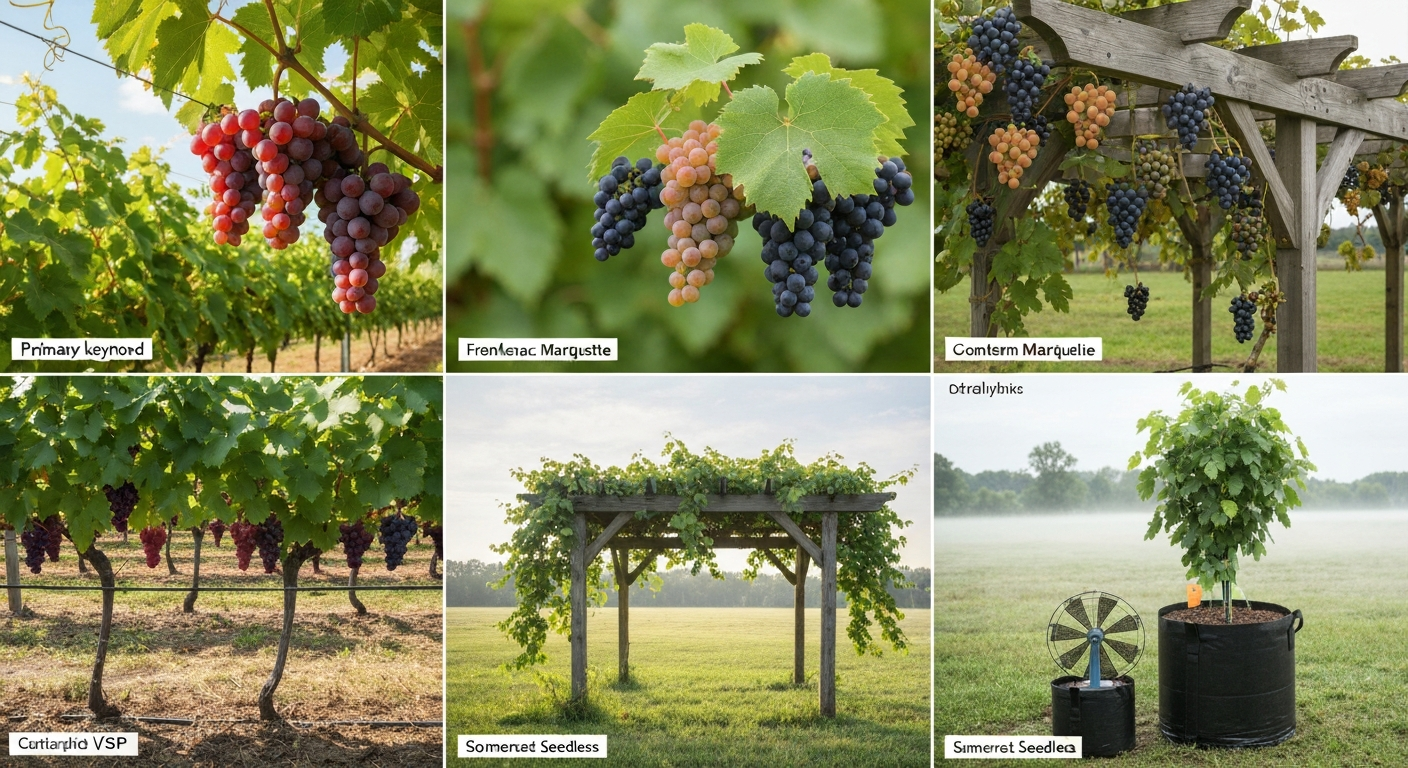
The University of Minnesota's grape breeding program is the single most important development in cold-climate viticulture in the last thirty years. Their releases are specifically designed for zones 3–5 and can survive temperatures down to -30°F or lower with proper site selection. Frontenac (red wine, high acid, good disease resistance) and Frontenac gris (a pink-fruited mutation of the same, good for white wine) have been widely planted across the upper Midwest and Canada. Marquette is a newer release with better Cabernet-like structure and good cold hardiness to about -26°F. La Crescent produces an aromatic white wine and tolerates zone 4 winters well. Itasca is the program's most recent widely-released white, with crisper acidity and excellent winter hardiness. For table grapes in cold climates, Somerset Seedless (zone 4) is an early-ripening, seedless red berry that's genuinely pleasant for fresh eating, and UMN extension recommends it as one of the few table varieties suited to Minnesota.
- Frontenac: wine/juice, zone 3–7, ripens early-mid September, high disease resistance
- Frontenac gris: white/rosé wine, zone 3–7, early-mid September, same disease resistance as Frontenac
- Marquette: red wine, zone 4–7, mid September, excellent disease resistance
- La Crescent: white wine, zone 4–7, late August to early September, good disease resistance
- Itasca: white wine/table, zone 4–7, late August, outstanding disease resistance
- Somerset Seedless: table, zone 4–8, mid August, moderate disease resistance
Warm-climate varieties for long seasons (Zones 7–10, non-PD areas)
In zones 7–10 where Pierce's disease is not a significant pressure (much of the Pacific Northwest, higher-elevation Southwest, and parts of the mid-South), you have the widest variety choice. Vitis vinifera cultivars like Cabernet Sauvignon, Merlot, Zinfandel, Chardonnay, and Pinot Noir all perform in appropriate microclimates. Oregon State University extension notes that vinifera in the PNW should often be grafted onto phylloxera-resistant rootstock, particularly in soils where phylloxera or nematodes have been present. For table grapes in warm climates, Thompson Seedless, Flame Seedless, and Crimson Seedless are proven backyard producers in California's Central Valley and similar climates. Black Muscat and Muscat of Alexandria produce stunning aromatic fruit for fresh eating and simple home wine.
Muscadines and native southern types (Zones 7–9)
If you garden in the Southeast and you haven't tried muscadines (Vitis rotundifolia), you're missing the grape that was practically born for your conditions. Muscadines are highly tolerant of heat, humidity, and the diseases that destroy most bunch grapes in the South. They are naturally resistant to Pierce's disease and produce reliably once established. University of Georgia Extension identifies Carlos (bronze, perfect-flowered, self-pollinating) and Noble (black, perfect-flowered) as two of the most broadly adapted and widely planted muscadine cultivars for home gardens. Grapes | UGA Cooperative Extension documents that Carlos (bronze) and Noble (black) are commonly planted, broadly adapted muscadine cultivars and notes muscadines generally fruit reliably with lower management than many bunch grapes in USDA zones 7–9. Noble makes excellent juice and wine; Carlos is pleasant for fresh eating and juice. One important note: some muscadine varieties are female-flowered only and require a perfect-flowered pollinator planted within 50 feet. Always check the flower type before purchasing. Muscadines typically begin producing meaningful harvests in years 2–3 after planting, which is faster than most bunch grapes.
Best for eating fresh (table grapes, all zones)
For fresh eating, you want seedless or nearly seedless berries, sweetness, and thin enough skins to be pleasant to bite into. In zones 5–7, Reliance (seedless, red, zone 5–9) is one of the most recommended backyard table grapes in the country: it's disease-resistant, sweet, and ripens in late August. Himrod (seedless, golden, zone 5–8) produces large clusters of sweet, early-ripening fruit and has excellent fresh flavor. Canadice (seedless, red, zone 5–8) is another reliable producer. In warmer zones, Flame Seedless and Thompson Seedless outperform the northern types. Across all zones, fresh eating is a separate topic deep enough for its own full discussion, which you'll find in the best grapes to grow for eating article elsewhere on this site. For a deeper dive on table varieties, see our guide to the best grapes to grow at home.
Best for wine and juice
For juice, Concord is the undisputed standard in zones 4–7. Its strong, distinctive flavor translates beautifully to juice and jelly, it's disease-resistant, and it produces reliably even with minimal management. Niagara (white/green) is Concord's counterpart for white juice. For wine, your zone determines everything. In the north, Frontenac, Marquette, and Chambourcin (zones 5–9) are proven performers. In zones 6–8 across the Midwest and mid-Atlantic, Chambourcin (red), Traminette (white, zone 5–8), and Vidal Blanc (white, zone 5–8) are workhorse wine grapes with good disease resistance. In warmer zones, Cabernet Franc (more cold-hardy than Cab Sauvignon, zone 6+) and Viognier (zone 6–9) produce excellent results. For Pierce's disease zones, Lenoir (Black Spanish) and Blanc du Bois are two of the better PD-tolerant wine options in the South.
Best for containers and compact spaces
Compact vigor is the main criterion here. Somerset Seedless, Reliance, Canadice, and Pixie are the most commonly recommended container varieties. These can be kept to a manageable 4–6 feet of shoot growth per season with regular pinching and work well on a single post or small fan trellis. I've found Reliance particularly forgiving in containers: it tolerates some dryness better than most and still produces sweet fruit even when slightly root-restricted. Avoid Concord, Frontenac, and muscadines in containers: they have root systems that want to spread 10+ feet and will be perpetually unhappy in a pot.
Quick-reference variety comparison table
Use this table as a starting point, not the final word. Disease resistance ratings are general: your local disease pressure and management practices matter. Ripening times are approximate for mid-latitude sites and shift earlier in hotter climates and later in cool ones. A zone 5 gardener in Minnesota should lean heavily toward UMN-bred varieties; a zone 8 Southeast gardener should prioritize the muscadine and PD-resistant entries.
| Variety | Zone | Best use | Disease resistance | Ripening time | Notes/limitations |
|---|---|---|---|---|---|
| Concord | 4–7 | Juice, jelly | Good | Late Sept–Oct | Strong foxy flavor; not ideal for fresh eating or wine |
| Frontenac | 3–7 | Red wine, juice | Excellent | Early–mid Sept | High acid; needs blending or malolactic for wine balance |
| Marquette | 4–7 | Red wine | Excellent | Mid Sept | Best cold-climate red wine grape; lower acid than Frontenac |
| La Crescent | 4–7 | White wine | Good | Late Aug–early Sept | Aromatic; can overripen quickly; watch harvest timing |
| Itasca | 4–7 | White wine, table | Excellent | Late Aug | Crisp, clean; one of the better cold-climate whites |
| Somerset Seedless | 4–8 | Table, container | Moderate | Mid Aug | Small berries; excellent for northern home gardens |
| Reliance | 5–9 | Table, container | Good | Late Aug | Seedless; one of the best all-around backyard table grapes |
| Himrod | 5–8 | Table | Moderate | Early Aug | Excellent flavor; somewhat susceptible to powdery mildew |
| Canadice | 5–8 | Table, container | Good | Late Aug | Seedless red; tends to overcrop; thin clusters at bud break |
| Chambourcin | 5–9 | Red wine | Very good | Late Sept | Excellent in humid climates; good color and structure |
| Traminette | 5–8 | White wine | Very good | Late Sept | Gewürztraminer character; widely planted in Midwest |
| Vidal Blanc | 5–8 | White wine, ice wine | Good | Oct | Thick skin helps with late harvest; widely adaptable |
| Cabernet Franc | 6–9 | Red wine | Moderate | Early–mid Oct | More cold-hardy than Cab Sauv; excellent in zones 6–8 |
| Muscadine (Carlos) | 7–9 | Table, juice | Excellent (PD) | Aug–Sept | Self-fertile; tough skin; best in Southeast |
| Muscadine (Noble) | 7–9 | Juice, wine | Excellent (PD) | Aug–Sept | Black fruit; high anthocyanins; great for juice/wine |
| Blanc du Bois | 7–10 | White wine | Good (PD) | July–Aug | Best PD-tolerant white for Gulf Coast/South Texas |
| Thompson Seedless | 8–10 | Table, raisins | Moderate | Aug–Sept | Needs long hot season; classic California table grape |
| Flame Seedless | 7–10 | Table | Moderate | July–Aug | Crisp, sweet; excellent for hot climates; needs heat |
Planting basics and first steps
Site selection is the decision that's hardest to undo. Grapes want full sun: at least 6–8 hours of direct sun per day, with 8+ hours ideal. Avoid low-lying frost pockets where cold air drains and collects on spring nights. A gentle south- or southwest-facing slope is ideal because cold air drains away and the slope captures extra solar radiation. Soil drainage matters enormously: grapes tolerate a wide pH range (5.5–7.0 is ideal) but absolutely will not tolerate standing water. If your soil is clay-heavy or poorly drained, build up a raised bed or mound, or choose a different spot.
Soil prep before planting is worth doing right. Have your soil tested through your local Cooperative Extension for pH and nutrient levels before you add anything. Adjust pH if needed: lime to raise, sulfur to lower. Work in compost to improve drainage and organic matter, but don't over-fertilize at planting. Excess nitrogen in year one drives leafy growth at the expense of root establishment.
For in-ground planting, dig a hole 12 inches deep and 12 inches wide. Set the vine so the graft union (the knobby joint on grafted vines) sits 2–4 inches above the soil surface. On own-rooted vines, plant so the crown is at or slightly below soil level. Firm soil around roots and water thoroughly. Space vines 6–8 feet apart on a trellis row. Install your trellis posts before or at planting: trying to drive posts around an established vine is frustrating. A temporary stake at planting (a 4-foot bamboo cane works fine) supports the first-year shoot while you build your permanent trellis.
Trellis and training systems explained
The two main pruning systems are cane pruning and spur (cordon) pruning, and your variety should largely dictate the choice. OSU Extension notes that some varieties produce best from one-year-old canes (cane pruning), while others fruit reliably from shorter spurs left on permanent arms (cordon/spur pruning). Concord, Marquette, and most American hybrids are typically cane-pruned. Many vinifera and some hybrids like Chambourcin do well spur-pruned on a bilateral cordon system.
The high-wire cordon system is the simplest for home gardeners: a single wire at 5–6 feet, two permanent arms extending left and right from the trunk, and fruiting spurs or canes renewed each winter. Vertical shoot positioning (VSP) uses two to four wires at staggered heights to keep shoots growing upward, improving air circulation and sun exposure. VSP is slightly more work to maintain but produces excellent disease management results in humid climates. A pergola or arbor system is beautiful and works for eating grapes, but makes dormant pruning difficult because you're working overhead, and spray coverage for disease is harder to achieve evenly.
Year one care and realistic time-to-fruit expectations
Here's the honest truth about grape timing: you will not get a significant harvest in year one or year two. Oklahoma State Extension is direct about this: most grapevines produce their first meaningful harvest in the third season. The first two years are entirely about root establishment and framework building. In year one, your entire job is to establish a healthy root system and grow a straight, strong trunk. If the vine flowers in year one, remove those flower clusters. I know it's tempting to let them develop. Don't. The energy diverted to fruit in year one steals from root development and sets the vine back. Penn State's Backyard Grape Growing guidance makes exactly this recommendation: remove flowers during the establishment year.
In year two you'll train the permanent arms (cordons or canes) along your trellis. A small token harvest is possible but should still be limited. By year three, a well-established vine in a good site should give you your first real taste of what it can do. By years four and five, a healthy vine hits something close to mature production. Muscadines are an exception: UGA notes they often begin producing in 2–3 years after planting, somewhat ahead of most bunch grapes.
Annual pruning and training calendar
Dormant pruning is the most important annual task, and the timing varies by region. In zones 3–6, prune in late winter just before bud swell, typically late February to late March depending on location. Wait until the worst cold is past: pruned canes are slightly more cold-sensitive than unpruned ones. In zones 7–9, late January to mid-February is more typical. Prune aggressively: it feels wrong at first, but most experienced growers leave only 10–20% of the previous season's wood. Leaving too much wood is one of the most common beginner mistakes and leads to overcrowded, disease-prone canopies.
Summer management involves shoot thinning in May/June (remove excess shoots at the base and choose the best-positioned ones to train), leaf removal around clusters after fruit set to improve air circulation, and hedging long shoots in midsummer to keep the canopy manageable. Don't hedge too early or too aggressively: the leaves are your solar panels. The goal is light and air in the fruit zone, not a bare vine.
Watering, mulching, and fertilizing
Established in-ground vines are more drought-tolerant than most fruit plants, but young vines in their first two years need consistent moisture. Water deeply once or twice a week in dry weather during the first two growing seasons, delivering 1–1.5 inches of water per week. After establishment, most regions only need supplemental irrigation during extended dry spells. In arid western climates, drip irrigation at the base is the most efficient approach and keeps foliage dry, which reduces fungal disease.
Mulch 2–3 inches deep around the base (keeping mulch away from the trunk) to retain moisture, suppress weeds, and regulate soil temperature. Organic mulch like wood chips or straw works well. Fertilize conservatively: in the establishment years, a light application of balanced fertilizer (10-10-10) in early spring is enough. Signs of nitrogen deficiency include pale yellow-green leaves and slow growth. Signs of excess nitrogen include lush, overly leafy growth with poor fruit set and high disease susceptibility. A soil test every 2–3 years keeps you calibrated.
Container-growing specifics
For container vines, drainage is everything. Use a potting mix that drains freely: a blend of high-quality potting soil with 20–25% perlite works well. Avoid straight garden soil in pots; it compacts and stays waterlogged. Water when the top 1–2 inches of the mix feel dry, which in summer heat may mean daily watering. A drip emitter or self-watering insert significantly reduces the maintenance burden. Fertilize container vines monthly during the growing season with a balanced liquid fertilizer at half strength: they don't have the soil volume to buffer nutrients the way in-ground vines do.
In zones 6 and colder, move dormant container vines to an unheated but frost-protected space (garage, basement, unheated shed) after leaf drop. The goal is to keep roots above 10–15°F. The vine needs cold dormancy but not root-killing freeze. Check moisture monthly in storage and water lightly if the soil has dried out completely. Bring pots back outside after the last hard freeze date in spring.
Pests and diseases: what to watch for and how to manage them
The three most common fungal diseases in home vineyards are black rot (causes circular leaf spots with black borders and mummified fruit), powdery mildew (white powdery coating on young shoots and fruit), and downy mildew (yellowish oily spots on upper leaf surface with fuzzy gray-purple growth beneath). All three are manageable with a combination of disease-resistant varieties and basic spray programs. The single most effective non-spray tool is canopy management: a well-opened canopy with good air circulation and sun penetration dramatically reduces fungal pressure.
Pierce's disease deserves special mention for southern and some western growers. UC IPM identifies sharpshooter leafhoppers as the primary vectors of Xylella fastidiosa, the PD bacterium, and there is currently no cure for an infected vine. USDA-ARS is actively breeding PD-resistant table and wine grape germplasm, but for now the best strategy in high-PD areas is to choose naturally resistant or tolerant varieties (muscadines, Blanc du Bois, Lenoir) and to remove any infected vines promptly to reduce bacterial spread. USDA‑ARS and cooperating scientists have active breeding and research projects aimed at developing Pierce’s disease‑resistant table and wine grape germplasm and identifying genetic markers for PD resistance Breeding Pierce’s disease resistant table and raisin grapes and the development of markers for additional sources of resistance | USDA ARS.
Phylloxera (a root-feeding insect) is largely invisible until a vine starts declining for no apparent reason. WSU Extension emphasizes that in phylloxera-prone soils (much of the western US and replanted vineyard ground across the country), grafting vinifera or hybrid vines onto phylloxera-resistant rootstocks is the durable long-term solution. Several land-grant extensions including OSU recommend selecting rootstocks not just for phylloxera resistance but also for nematode tolerance and vigor management appropriate to your soil type.
- Black rot: prune and destroy affected wood; fungicide applications from bud break through fruit set; choose resistant varieties
- Powdery mildew: open canopy management; sulfur-based fungicides before and after bloom; kaolin clay in hot climates
- Downy mildew: copper-based sprays; avoid overhead irrigation; good airflow in the canopy
- Pierce's disease: plant PD-resistant or tolerant varieties in endemic areas; remove infected vines promptly
- Japanese beetle: hand-pick in small gardens; kaolin clay provides some deterrence; row cover on young fruit clusters
- Phylloxera: use resistant rootstock in known-infested soils; buy certified, clean nursery stock
Cold-climate winterizing and warm-climate heat/drought tips
In zones 3–5, site selection is your best winterizing tool. A slight slope that drains cold air away from the vine, proximity to a south-facing wall, or a windbreak to the north can keep a zone 5 site acting more like zone 6. For marginally cold-hardy vinifera vines in zone 6, you can mound soil over the graft union in late fall and remove it in spring. In the coldest climates (zones 3–4), some growers wrap trunks with burlap or specialized vine insulation blankets, and in extreme cases actually bury young vines in a shallow trench under straw and soil for the winter. This is labor-intensive but can protect very valuable vines through zone 3 winters.
In hot, dry climates (zones 8–10, especially inland California, Texas, Arizona), summer heat and drought are the limiting stresses. Drip irrigation on a timer is not optional: it's the foundation of a functional hot-climate vineyard. Apply irrigation in the early morning to minimize evaporation. Mulch heavily (3–4 inches) to keep soil moisture stable. In extreme heat events above 105°F, young vines may need temporary shade cloth. Choose heat-tolerant rootstocks and drought-adapted varieties when possible.
Buying and sourcing vines: what to look for
The best vine purchase you can make is certified, disease-free stock from a reputable nursery. Certified vines have been tested and propagated from pathogen-free mother vines, which means you're not importing latent viruses or fungal problems into your garden. Penn State Extension specifically recommends purchasing clean, nursery-propagated bare-root or container vines rather than accepting divisions from neighbors' gardens, however well-intentioned. A neighbor's vine may harbor viruses that have no visible symptoms but reduce your vine's productivity for decades.
For grafted vines, check that the rootstock matches your soil type and phylloxera/nematode pressure. OSU and other land-grant extensions publish rootstock selection guides for their regions. Mail-order nurseries that specialize in grapes (like Double A Vineyards, Lon Rombough's legacy catalog, or regional specialty nurseries) often carry a wider variety selection than local garden centers, and their stock is typically well-labeled and properly sized. When bare-root vines arrive by mail, inspect roots immediately: they should be moist, firm, and have at least 3–4 healthy roots. Soak bare-root vines in water for 12–24 hours before planting.
Where to get local help
University Cooperative Extension is the most underused resource in home grape growing. Every state has one, and most have viticulture or small-fruit specialists who can tell you which varieties have actually performed in your county's conditions, what pest and disease problems to expect this season, and where to find reputable local nurseries. Cornell's CALS program, OSU Extension, UMN Extension, UGA Cooperative Extension, Penn State Extension, and WSU Extension all publish free, research-backed grape growing guides specific to their regions. These are worth reading before you ever buy a vine.
Local and regional grape and wine associations are another excellent resource. Many state grape growers' associations host field days where you can visit working vineyards, ask questions of experienced growers, and see how different varieties and trellis systems perform in your region's actual conditions. The American Wine Society and numerous state-level wine grape councils also publish grower resources. A single afternoon at a local vineyard field day is worth more than a week of internet research.
Starter checklist: planting your first grapevine
Use this as your go/no-go checklist before you order vines. Each item is something that, if skipped, tends to cause the beginner frustrations I hear about most often.
- Look up your USDA hardiness zone using your zip code on the 2023 USDA PHZM website
- Count your average frost-free days (last spring frost to first fall frost) from local weather records or your extension office
- Decide your primary use: eating fresh, juice, wine, or ornamental
- Check Pierce's disease risk and general fungal disease pressure for your region with your local extension service
- Choose 1–3 regionally appropriate varieties from this guide or your extension's recommendations — start with one variety and one vine if you're a true beginner
- Select your site: full sun (8+ hours), well-drained soil, good cold-air drainage, away from low frost pockets
- Get a soil test and amend pH if needed before planting
- Install trellis posts and at least a single top wire before or at planting day
- Order certified, disease-free bare-root or container stock from a reputable nursery
- Plant at the correct depth (graft union above soil), water in thoroughly, and install a temporary stake
- Remove any flower clusters in year one — resist the temptation to let them develop
- Mark your calendar: first significant harvest is realistically year 3, full production by years 4–5
- Contact your local Cooperative Extension office for region-specific pest, disease, and variety follow-up
Growing grapes at home is one of the most rewarding things you can do in a backyard garden, but it rewards the gardeners who start with the right variety in the right spot more than it rewards the ones who work the hardest. Spend fifteen minutes figuring out your zone, your frost dates, and your intended use, and you've already made the most important decisions. Everything else is just tending something that genuinely wants to grow.
FAQ
Which grape varieties are best for my USDA hardiness zone and climate type?
Match variety to your zone and season length: - Zones 3–5 (short, cold winters): choose cold‑hardy hybrids from breeding programs (e.g., Frontenac, Marquette, La Crescent, Itasca) or other UMN releases. Vitis vinifera rarely survives without burial/insulation. - Zones 6–7 (temperate/mid‑Atlantic, Midwest fringe): many hybrids and some vinifera (depending on winter extremes and site). Consider disease‑resistant hybrids (e.g., Baco, Vidal for juice/wine; Somerset Seedless for tables where adapted). - Zones 7–9 (warm temperate to subtropical): vinifera and hybrids do very well; muscadines (Vitis rotundifolia) excel in the Southeast (zones 7–9). - Hot, low‑rain regions (Mediterranean/California): most vinifera varieties for wine/table are appropriate but choose clones and rootstocks for drought and phylloxera risk. Use local growing‑degree‑day (GDD) and extension recommendations to refine choices for your microclimate.
How should I decide between planting for table grapes, juice, wine or ornamental use?
Decide by intended use and management tolerance: - Table (fresh eating): prioritize seedless or pleasant‑flavored cultivars, thin clusters and manage bird protection; examples: seedless hybrids or specific local table cultivars. - Juice/processing: choose high‑yielding, disease‑tolerant cultivars (e.g., Vidal, Concord in some areas). - Wine: select varieties matched to local climate and ripening window (cool climates: cool‑climate hybrids or certain vinifera like Riesling; warm climates: Cabernet, Syrah, Zinfandel). - Ornamental (screen/arch): pick vigorous, disease‑tolerant vines (e.g., muscadines or rootstock‑backed vines) and expect irregular fruiting unless trained and pruned. Factor in pruning style, time to ripen, disease pressure and required trellis system when choosing.
Which grape varieties are recommended specifically for small spaces or container growing?
Look for compact, early‑ripening and manageable vines with low vigor: - Select table or dual‑purpose varieties labeled suitable for containers (some seedless hybrids and early‑ripening European hybrids). - Rootstock‑grafted vines or naturally lower‑vigor cultivars reduce excessive growth. - Use 15–25 gallon (or larger) containers, high quality potting mix with good drainage, consistent irrigation, and an upright single‑stem training to a small arbor or trellis. Container grapes fruit later and need more frequent watering and fertilizer; choose disease‑resistant varieties for easier care.
What are reliable cold‑hardy grape varieties for zones 3–5?
Cold‑hardy, tested options from university breeding programs: - Frontenac, Frontenac gris (UMN) — wine/table hybrids, very cold‑hardy. - Marquette (UMN) — red wine hybrid with PD tolerance and good cold hardiness. - La Crescent, Itasca — aromatic white hybrids for cool climates. - Regionally selected table grapes (e.g., Somerset Seedless in some northern areas). These are bred for winter survival and disease tolerance; consult local extension for site‑specific performance.
Which varieties are best for the Southeast and muscadine‑friendly climates?
Muscadines (Vitis rotundifolia) are ideal for the Southeast (roughly USDA zones 7–9): - Common reliable cultivars: Carlos (bronze), Noble (black). - Advantages: native adaptation, lower relative disease pressure, less pruning intensity, reliable production in warm, humid summers. For bunch grapes in the Southeast, pick varieties rated for Pierce’s disease resistance and local extension recommendations.
How do I match rootstock and grafting choices to phylloxera, replant and soil issues?
Select rootstocks based on local phylloxera risk, nematode presence, soil vigor and desired vigor control: - In known phylloxera areas or replant sites, plant grafted vines on phylloxera‑resistant rootstocks recommended by local extension (WSU, OSU and state guides provide lists). - Pick rootstocks that confer nematode tolerance or control scion vigor for heavy or poor soils. - If unsure, ask a local extension or reputable nursery for rootstock recommendations for your county/soil type.