
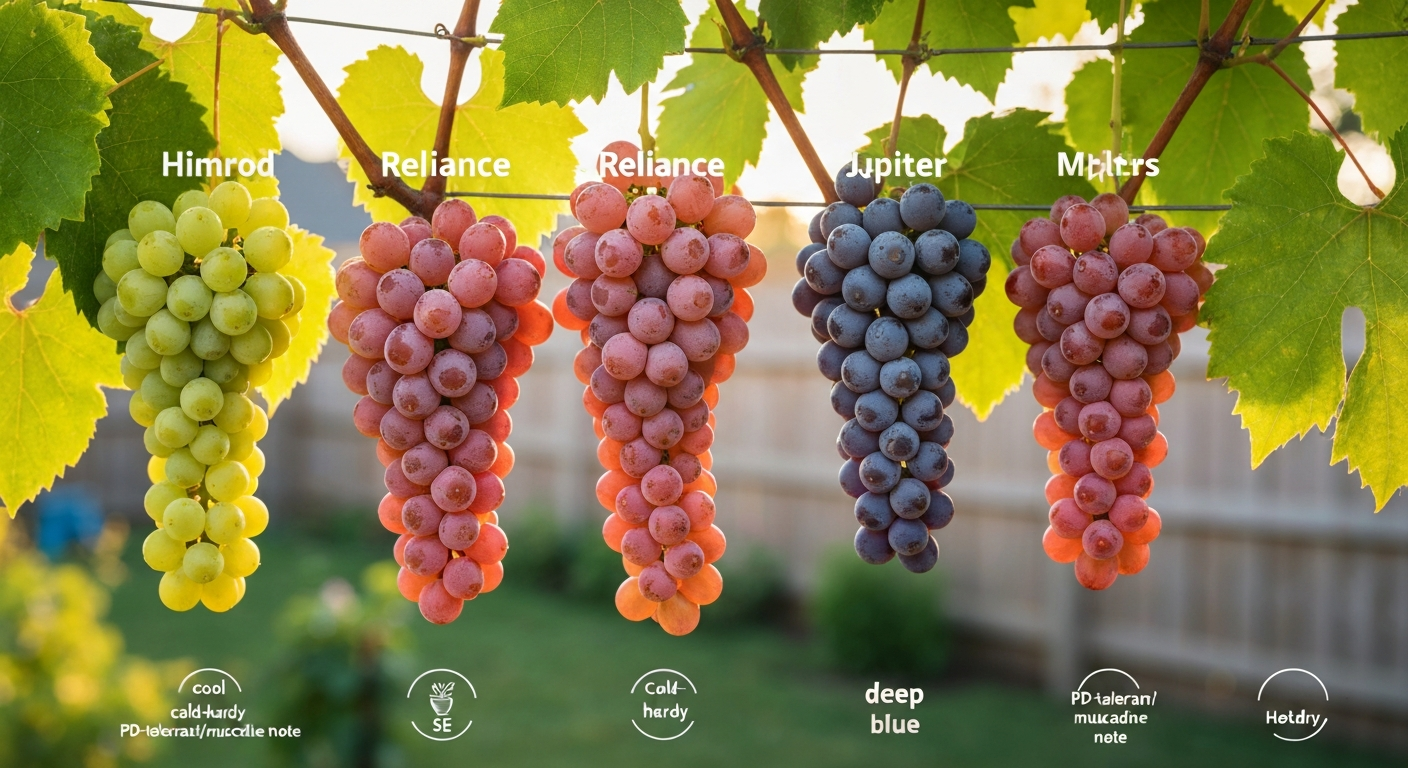
The best seedless table grapes for most home gardeners are Himrod (cool climates), Reliance (cold-hardy and forgiving), Jupiter and Mars (warm, humid Southeast), and Flame Seedless or Thompson Seedless (hot, dry regions like California and Australia). Which one is actually best for you depends almost entirely on your climate zone, your frost dates, and how much disease pressure your garden sees. Get that match right and you can reliably harvest eating-quality, seedless clusters from a backyard vine. Get it wrong and you'll fight a losing battle for years.
Best Seedless Table Grapes to Grow: Top Varieties by Climate
Marcus Whitfield
21 Jul 2026
What this guide covers and who it's for
This guide is for home gardeners who want to eat fresh grapes off the vine, not make wine. If you're standing in the garden center staring at a rack of bare-root vines with names you've never heard, or if you've tried growing grapes before and ended up with mildew-covered clusters you couldn't eat, this is for you. I'm going to walk you through the varieties that actually perform in real home gardens, the ones that come from university breeding programs with documented disease tolerance and cold hardiness, not just nursery marketing copy. You'll find region-specific picks for cool northern states, the warm and humid Southeast (including North Carolina, Georgia, and Arkansas), and hot, dry climates including California and Australia. I'll also cover site setup, seasonal care, and the handful of disease and pest problems that end most home-garden grape projects before they get going.
Will seedless table grapes actually grow in your state?
The honest answer is: probably yes, but not all varieties. Grapes are remarkably adaptable plants, but seedless table-quality cultivars have narrower climate requirements than wine grapes or muscadines. Before you buy a single vine, run through this quick checklist. It will save you a lot of frustration.
The climate checklist
- Frost-free window: You need at least 150 frost-free days for early-ripening seedless varieties, and 180+ days for mid-to-late types like Thompson or Crimson Seedless.
- Winter hardiness: Most Cornell-bred seedless varieties (Himrod, Canadice, Glenora) survive to around -10°F to -15°F (USDA Zones 5–8). Vinifera types like Flame and Thompson are only reliably hardy to about 10°F (Zone 7 and warmer, or with protection).
- Summer heat: Vinifera table grapes need long, warm, low-humidity summers to hit their sugar and texture targets. Cool, wet summers will leave them under-ripe and disease-riddled.
- Disease pressure: If you're in a humid climate (most of the eastern United States), you need varieties with documented resistance to powdery mildew, downy mildew, and black rot. Vinifera types have almost none.
- Pierce's Disease risk: If you're in the Deep South, coastal Southeast, or Gulf Coast, Pierce's Disease (spread by sharpshooter leafhoppers) will kill most bunch-grape cultivars within three to five years. Muscadines and PD-tolerant hybrids are your only reliable options in those areas.
- Chill hours: Most table-grape cultivars need 100–500 chill hours (below 45°F), which is easy to achieve in most of the continental US but can be a factor in subtropical South Florida and low-elevation tropical areas.
Simple region rules at a glance
| Region / Climate | Suitable Grape Type | Avoid |
|---|---|---|
| Cool North (Zones 5–6): MN, WI, MI, NY, PA, New England | Cold-hardy Cornell seedless (Himrod, Canadice, Reliance) | Vinifera table grapes (Flame, Thompson) |
| Mid-Atlantic / Upper South (Zones 6–7): NC piedmont, VA, TN, AR, KY | UA-bred hybrids (Jupiter, Mars), some Cornell types; disease resistance essential | Vinifera without a very dry site |
| Deep South / Coastal SE (Zones 7b–9a): GA coast, FL, Gulf Coast | Muscadines (Carlos, Noble), PD-tolerant hybrids (Blanc du Bois) | Most bunch grapes including UA hybrids in high-PD zones |
| Hot, dry West (Zones 7–10): CA, AZ, NM, NV, interior WA/OR valleys | Vinifera seedless (Flame, Thompson, Crimson, Autumn Crisp) | Disease-resistant hybrids (not needed, but won't harm anything) |
| Australia: warm interior, subtropical QLD | Vinifera seedless (Flame, Thompson, Crimson, Sweet Celebration) | Cold-hardy hybrids (unnecessary; may under-perform in heat) |
If you're in North Carolina, the situation depends heavily on where in the state you are. The mountain regions can support Cornell-style cool-climate varieties. The piedmont and coastal plain are better suited to University of Arkansas hybrids with solid disease packages. The far southeastern corner near the coast carries real Pierce's Disease risk, which tips the scale toward muscadines. Georgia gardeners face a similar gradient, with the northern mountains more forgiving than the coastal plain. Gardeners in Arkansas sit squarely in the zone where the UA-bred varieties shine. See a practical list of the best table grapes to grow in Arkansas for UA-recommended varieties and growing tips.
How to choose the right variety: flavor, texture, maturity and disease resistance
I always tell gardeners to pick their variety the same way they'd pick any other food crop: start with what you actually want to eat, then filter by what will survive in your yard. For table grapes, that means thinking through four things.
Flavor and texture
Table grapes split roughly into two texture camps. Vinifera-type varieties (Flame, Thompson, Crimson, Jupiter) have firm, crisp, meaty flesh with a neutral-to-sweet flavor and thin skin. These are the grapes you buy at the grocery store. American-type and hybrid varieties (many Cornell and UA releases) can lean toward softer flesh, and some have slip-skin texture (the skin slides off the pulp) with a distinctly 'foxy' or grape-juice-like Concord flavor. If you grew up eating Concord grapes, you might love that. Many people trying to replicate store-bought table grapes will be disappointed. Himrod, Glenora, and the UA's Jupiter are notable exceptions that get reasonably close to a firm, mild, store-quality eating grape even in eastern climates.
Days to maturity and matching to frost dates
Table-grape varieties are labeled early (roughly 140–155 days from budbreak), mid-season (155–170 days), and late (170–190+ days). Early varieties like Himrod, Canadice, and Mars ripen in August in the mid-Atlantic, which means they finish well ahead of fall frosts even in Zone 5–6. Late varieties like Crimson Seedless and Thompson need a long, warm season and really only hit their best quality in USDA Zone 7 and warmer with hot summers. If your last spring frost is May 15 and your first fall frost arrives September 30, you have roughly 138 frost-free days. That rules out anything but the earliest cultivars and means you need to pay close attention to the days-to-maturity numbers in the variety table below.
Disease resistance
This is the single most important selection factor for humid-climate gardeners and one that gets almost no attention in popular gardening media. In the eastern United States, the main fungal threats are powdery mildew, downy mildew, black rot, and Botrytis bunch rot. V. vinifera cultivars are highly susceptible to all of them. If you live east of the Rockies and insist on growing Flame Seedless, you will spray fungicides every 7 to 14 days through the growing season. University of Arkansas and Cornell varieties were specifically bred for fungal tolerance, and many require significantly less spraying. That matters a lot in a home garden where ease of management is part of the value.
Season-length expectations: early, mid and late varieties
Matching a variety's ripening window to your local frost-free calendar is the mechanical key to getting edible fruit. Here's how to think about it practically. Look up your average last spring frost date and your average first fall frost date. Count the days between them. That's your available growing window. Then subtract about 30 days as a buffer at each end for the vine to break dormancy, establish the season's growth, and harden off in fall. What's left is your effective ripening window.
| Ripening Class | Approx. Days Budbreak to Harvest | Typical Harvest Window (Zone 6) | Good Candidate Varieties |
|---|---|---|---|
| Early | 140–155 days | Late July – mid August | Himrod, Canadice, Mars, Reliance |
| Mid-season | 155–170 days | Mid August – early September | Jupiter, Glenora, Neptune, Flame Seedless (warm Z7+) |
| Late | 170–190+ days | September – October | Thompson Seedless, Crimson Seedless, Autumn Crisp, Sweet Celebration |
If you're in a short-season climate like the Upper Midwest or the Appalachian highlands, stick to early varieties. Himrod and Canadice will reliably produce for you. In Arkansas, Georgia, and the Carolinas piedmont, the season is long enough for mid-season varieties, and the UA-bred Jupiter is a particularly good fit. In hot California valleys and the Australian interior, the long, warm season is actually an asset: you can grow late-season varieties like Crimson Seedless and get that firm, crisp, store-quality eating grape that just isn't achievable in shorter or wetter climates.
Top seedless table grape varieties: ranked overview
The table below ranks 12 of the most widely recommended seedless table-grape varieties for home gardens by overall eating quality and garden reliability, combining flavor/texture scores from Cornell, UA and OSU trial data with disease tolerance and adaptability ratings. This is not a ranking of raw flavor alone, a variety that tastes great but dies of mildew every year scores lower in a home-garden context than a reliable producer with very good flavor.
| Variety | Climate Zones | Cold Hardiness | Disease Resistance | Days to Harvest | Flavor / Texture Notes |
|---|---|---|---|---|---|
| Jupiter | Zones 6–9 (Southeast, mid-South) | To about 0°F | Good (UA breeding) | ~155 days (mid-season) | Blue-black, firm, mild Muscat flavor, raisin-free, low slip-skin |
| Himrod | Zones 5–8 (cool/temperate) | To -15°F | Moderate (some mildew susceptibility) | ~145 days (early) | Yellow-green, loose clusters, honey-like flavor, Cornell's top-rated |
| Reliance | Zones 4–8 (widest adaptation) | To -15°F | Good | ~145 days (early) | Pink-red, mild strawberry flavor, soft flesh; best cold-hardiness of all seedless types |
| Mars | Zones 6–9 (Southeast) | To -5°F | Very good (UA breeding) | ~140 days (early) | Blue, medium clusters, mild labrusca flavor, slip-skin; disease-tolerant workhorse |
| Canadice | Zones 5–8 (cool/temperate) | To -10°F | Good | ~145 days (early) | Red, tight clusters, sweet, low acid; Cornell-bred, reliable in cool gardens |
| Glenora | Zones 5–8 (cool/temperate) | To -15°F | Good | ~148 days (early-mid) | Blue-black, firm flesh, mild flavor, good fresh-eating quality; Cornell release |
| Neptune | Zones 6–9 (Southeast/transition) | To 0°F | Good (UA breeding) | ~155 days (mid-season) | White/green, firm, crisp, mild; nearest to a store-quality white grape in humid climates |
| Flame Seedless | Zones 7–10 (hot, dry climates) | To about 10°F | Low (vinifera) | ~150 days (early-mid) | Red, crisp, crunchy, sweet-tart; the classic California table grape; needs dry summer |
| Thompson Seedless (Sultanina) | Zones 7–10 (hot, dry) | To about 10°F | Low (vinifera) | ~165–175 days (mid-late) | Green/gold, soft-firm, neutral sweet; excellent for fresh eating and drying; needs long heat |
| Crimson Seedless | Zones 7–10 (hot, dry) | To about 15°F | Low (vinifera) | ~175–185 days (late) | Red, very firm, crisp, mild; store-quality eating grape; needs long, hot season |
| Autumn Crisp | Zones 7–10 (hot, dry) | To about 10°F | Low (vinifera) | ~180 days (late) | Green, extremely firm, high sugar, spicy-sweet; excellent in California, AZ, warm AU |
| Carlos (Muscadine) | Zones 7–9 (Deep South, coastal SE) | To about 0°F | Excellent (PD-tolerant) | ~155 days (mid-season) | Bronze, small clusters, musky-sweet, slip-skin; essential for PD-risk zones |
Best seedless grapes for cool climates
Cool climates, think USDA Zones 5 and 6, the Great Lakes, northern Appalachians, New England, the Pacific Northwest, actually grow excellent table grapes as long as you choose varieties with cold hardiness and early ripening. Cornell University's fruit breeding program at Geneva, New York has produced the best lineup for this purpose.
- Himrod: Cornell calls it the most successful table grape they've ever released, and in my experience it earns that. Large, loose clusters with golden-yellow berries and a genuine honey-like sweetness. It ripens early (mid-to-late August in Zone 6) and handles cold to about -15°F. The one caveat is some powdery mildew susceptibility — keep the canopy open and stay on top of early-season monitoring.
- Reliance: If you're in Zone 4 or a very cold part of Zone 5, Reliance is your most reliable bet. It's survived winters to -15°F in trials and still produces. The flavor is mild and slightly strawberry-like, the flesh is softer than a store grape, but it's dependably productive. A great starter vine for anyone nervous about trying grapes.
- Canadice: A compact-growing red seedless with sweet, firm-enough berries and tight clusters. Cold-hardy to about -10°F, early-ripening, and better disease resistance than most Cornell types. The clusters can overcrop and the berries become smaller without thinning, so pinch off a portion of clusters in the first two years.
- Glenora: Blue-black berries with firm flesh and mild, pleasant flavor. A little later than Himrod but still early enough for most Zone 5–6 gardens. Cold-hardy to -15°F. One of the better-looking varieties for fresh table presentation.
- Everest Seedless: A newer Cornell release with good cold hardiness and improved disease resistance compared to older cultivars. Worth sourcing if you can find it — expect firmer texture and slightly later ripening than Himrod.
Best seedless grapes for warm, humid climates
Warm, humid climates, the Southeast, mid-South, and lower mid-Atlantic, are where grape growing gets complicated. The heat and humidity together drive aggressive fungal disease pressure and, in the south, Pierce's Disease. The University of Arkansas breeding program at Fayetteville has done more to solve this problem than anyone else, releasing a series of interspecific hybrids specifically selected for this environment. University of Arkansas trial/release documents list maturity dates, disease tolerance notes, and fruit-type (slip-skin vs non-slip-skin) for UA cultivars including Mars, Jupiter, Neptune, Faith, Joy, Gratitude, and Hope (blank" rel="noopener noreferrer">High Tunnel Grapes: Establishment (NCAT summary of University of Arkansas table grape cultivars and trial notes)). These are the varieties that make sense in Arkansas, Tennessee, the Georgia mountains and piedmont, and the NC piedmont and foothills. For specific recommendations tailored to Georgia's climate and regions, see our guide on the best seedless grapes to grow in Georgia.
- Jupiter: My top pick for warm, humid home gardens. It's a blue-black, mid-season berry with genuinely good eating quality — firm, mild, with a hint of Muscat flavor and very low slip-skin character. UA trials show solid tolerance to most common fungal diseases. Cold-hardy to about 0°F and productive under proper training. If you're in Arkansas, central Georgia, or the NC piedmont, start here.
- Mars: An early-season blue seedless that ripens before most disease pressure peaks, which partly explains its disease-tolerant reputation. The flavor is mild labrusca — it will remind some people of grape juice — and the texture is slip-skin, which not everyone loves. But it's incredibly reliable and productive in the Southeast, and the early ripening means you get fruit before summer disease pressure builds.
- Neptune: The best white/green seedless option in humid climates. Firm, crisp berries with mild flavor that comes closer to a store-bought green table grape than almost anything else you can grow east of the Rockies. Mid-season maturity, good disease tolerance from the UA program. If you want a green seedless in Georgia or Arkansas, Neptune is the answer.
- Faith: A newer UA release with excellent disease tolerance and good fresh-eating quality. Red-berried, mid-to-late season, firm flesh. A solid option if you want something beyond the original UA releases and can source it.
- Blanc du Bois: Technically a wine grape, but worth mentioning for gardeners in the coastal Southeast and southern Florida. It carries significant Pierce's Disease tolerance and can survive where most bunch grapes fail. If you're in coastal Georgia or the Carolinas low country, this may be your best non-muscadine option.
For the Deep South and coastal Southeast where Pierce's Disease is endemic, muscadines are the honest answer. Carlos (bronze) and Noble (black) are the most widely grown seedless or near-seedless muscadine types and are fully PD-tolerant. They have a distinctly different flavor from bunch grapes, sweet, musky, thick-skinned, but they're genuinely productive and low-maintenance in that environment. Gardeners in coastal Georgia and the Carolinas coastal plain should give them serious consideration.
Best seedless grapes for hot, dry and subtropical climates
Hot, dry climates, California's Central Valley, the inland Southwest, and the warm interior regions of Australia, are actually ideal for the classic vinifera table grapes that you see in grocery stores. Low humidity removes fungal disease from the equation almost entirely, and the long warm seasons give late-ripening cultivars the 180+ days they need to reach full sugar and the firm, crisp texture that makes them satisfying to eat.
- Flame Seedless: The entry-level recommendation for California and similarly dry climates, and deservedly so. Crisp, crunchy, red berries with sweet-tart flavor, early-to-mid season ripening, and vigorous vines. It doesn't need much disease management in a dry climate. Widely available as nursery stock and well-documented in home-garden settings.
- Thompson Seedless (Sultanina): The foundational California table grape and still one of the best for fresh eating. Neutral-sweet, green-gold, soft-to-firm berries on long elegant clusters. It needs a long, hot season to develop full sugar (165–175 days), so it works best in Zones 8–10 with hot summers. Also excellent for drying into raisins if you have surplus production.
- Crimson Seedless: A late-season red with very firm, crisp, mild berries — one of the closest home-garden options to premium supermarket grapes. Needs 175–185 days and consistent heat. Best in Zone 8b and warmer, full California valley conditions, or warm Australian interior regions.
- Autumn Crisp: A newer variety with extraordinary texture — exceptionally firm and crunchy with high sugar and a slight spice note. Late-ripening (around 180 days), best in Zone 8–10. If you're in a hot, dry climate and want something a step above Thompson or Flame in eating quality, this is worth seeking out.
- Sweet Celebration: A relatively new commercial seedless type making its way into home-garden nurseries in warm climates. Red, large-berried, crisp, high sugar. Performs well in California and warm Australian conditions with a similar season requirement to Crimson.
Australian gardeners in Queensland, coastal New South Wales, and warm Western Australia grow essentially the same vinifera palette as California. Flame Seedless, Thompson, and Crimson are all well-established in Australian home gardens. The one adjustment to make in subtropical Queensland is timing: the season structure is different, and some growers force two crops per year through cane management. In cooler-elevation parts of southeastern Australia (Victoria, Adelaide Hills), earlier-ripening options like Flame or even some cold-hardy hybrids become relevant.
Setting up your site: sun, soil, spacing and trellis
Every extension guide I've worked from agrees on the basics, and I've watched them prove true repeatedly: get the site wrong and no variety will save you. Grapes need a minimum of six to eight hours of direct sun daily, and more is better, the highest, sunniest spot in your yard is always the right choice. Avoid frost pockets (low areas where cold air drains and pools). The soil needs to drain freely: grapes tolerate poor, lean soil surprisingly well, but they cannot tolerate waterlogged roots. Loamy sand to clay-loam is the ideal range; if you have heavy clay, raise the planting bed or install drainage before you plant.
Spacing matters more than most beginners think. On a standard two-wire trellis with a training system like vertical shoot positioning (VSP), most varieties need six to eight feet between vines in the row and eight to ten feet between rows. Vigorous cultivars on a divided canopy system (Geneva Double Curtain or Scott Henry) need up to twelve feet. Crowded vines have poor airflow, which drives fungal disease, and shading that reduces fruit quality. Install your posts and trellis wires at planting, trying to retrofit a trellis around established vines is genuinely difficult.
Trellis and training options for home gardens
- Vertical Shoot Positioning (VSP): Two to four horizontal wires at different heights, with shoots trained upward. Best for moderate-vigor varieties in small gardens. Good light exposure, easy to spray and harvest.
- High Cordon (single wire): One wire at about five to six feet, with a permanent cordon trained along it and shoots hanging downward. Simple, low-maintenance, and good for vigorous varieties.
- Geneva Double Curtain (GDC): A divided canopy with two parallel cordons on a wide cross-arm. Maximizes yield and airflow for very vigorous varieties. Best when you have space and a vigorous cultivar like Himrod or Jupiter.
- Pergola / Arbor: Common in backyard settings. Fine aesthetically, but the dense canopy traps humidity and makes disease management difficult. I'd only recommend it in dry climates.
Planting and the first three years
Plant bare-root vines in late winter to early spring, as soon as the soil is workable and the risk of severe freezes has passed. Container-grown vines can go in from spring through early summer. Dig a hole wide enough to spread the roots without bending them, set the graft union (if present) just above soil level, and backfill with native soil, don't amend the planting hole with compost or fertilizer, which can cause the roots to stay in the amended zone rather than spreading. Water thoroughly and mulch to conserve moisture.
The first year is about root establishment, not fruit. Resist the urge to let the vine fruit, remove any flower clusters that form. Train a single strong shoot vertically to your first wire. Year two, establish your cordon or cane structure. Year three, you can allow a modest crop. Full production in a properly managed home-garden vine comes in years four and five. I know it feels slow, but vines that are properly trained and not over-cropped early outperform rushed ones for the next two decades.
Annual care: pruning, canopy management, irrigation and fertilizer
Pruning
Grapes fruit on one-year-old canes, wood that grew last summer. That single fact drives everything about pruning. Prune in late winter while the vine is still dormant (after the coldest temperatures have passed but before budbreak). Remove the majority of last year's growth, leaving either short two-to-three-bud spurs (spur pruning) or longer six-to-twelve-bud canes (cane pruning), depending on your training system and variety. Spur pruning suits naturally spurred varieties; cane pruning suits varieties with poor fruitfulness at basal nodes (like Himrod). If you're not sure, cane pruning is generally safer for table grapes. The rule of thumb from OSU extension: leave roughly 20 to 40 buds per vine in the first years of full production, adjusted up or down based on vine vigor.
In-season canopy management
Once shoots emerge, thin to one shoot per node and remove any suckers from the trunk. When shoots reach about 12 inches, tuck them into the trellis wires. Before and at veraison (when berries start changing color), remove leaves around the cluster zone to improve airflow and light penetration, this single practice reduces Botrytis and bunch rot more than almost any spray program. In humid climates, also remove any dried or damaged clusters immediately rather than leaving them on the vine as an inoculum source.
Irrigation
Drip or micro-irrigation is the most efficient and effective delivery method. Place emitters at the base of each vine, two emitters per vine on sandy soils, one on heavier soils. In most humid eastern climates, established vines may not need supplemental irrigation except in drought. In dry western and Australian climates, irrigation is essential from budbreak through veraison. Avoid overhead sprinklers, which wet the foliage and canopy, driving fungal disease.
Fertilizer and soil nutrition
Do a soil test before you plant and every three to four years after. Adjust pH to 6.0–6.5 (slightly acidic) if needed. Established vines have modest nitrogen needs, over-fertilizing produces excessive vegetative growth at the expense of fruit quality. A light application of a balanced fertilizer in early spring, guided by your soil test results, is usually sufficient. If your shoots are growing less than 12 inches in a season, that's a signal the vine may need more nitrogen. Foliar and tissue testing can refine this further if you want to get precise.
Pest and disease management
Disease management is where most eastern home-garden grape projects succeed or fail. The big four threats in humid climates are powdery mildew, downy mildew, black rot, and Botrytis bunch rot. In the Southeast, you also deal with grape berry moth and Japanese beetles. The right variety choice reduces but rarely eliminates your management workload.
Fungal diseases
- Powdery mildew: White powdery coating on leaves, shoots and berries. Critical infection window is from budbreak through bloom. In dry western climates, monitor closely but spray is often minimal. In humid eastern climates with susceptible varieties, begin sulfur or potassium bicarbonate sprays at 1-inch shoot growth and rotate fungicide groups to avoid resistance.
- Downy mildew: Yellow 'oil spots' on upper leaf surface, white fuzzy growth underneath. Common in the East from bloom onward. Remove infected leaves promptly. Copper-based or systemic fungicides at bloom and post-bloom are the first line of defense.
- Black rot: Brown circular lesions on leaves and shriveled, mummified berries. Remove all mummified fruit from the vine and from the ground — this is the primary inoculum source. Fungicide applications from budbreak to three weeks post-bloom are most critical.
- Botrytis bunch rot: Grey mold on berries, especially in tight clusters. Leaf removal around clusters before veraison is the most effective cultural practice. Remove infected clusters immediately.
Pierce's Disease
If you're in a high-PD-risk area (coastal Southeast, Gulf Coast, central and southern California), there is no spray solution. The bacterium Xylella fastidiosa, spread by sharpshooter leafhoppers, is fatal to V. vinifera and most hybrid bunch grapes within a few years. The only practical strategy is to grow resistant varieties: muscadines in the Southeast, or PD-tolerant hybrids like Blanc du Bois. I've seen gardeners in coastal Georgia lose entire plantings of Concord-type grapes within three years. Don't fight biology, match the variety to the disease pressure.
Harvesting and storing your table grapes
Table grapes don't continue to ripen after harvest the way tomatoes or pears do. Pick them when they're ripe, not before. The clearest signal is flavor: taste a berry from the middle of the cluster. If it's sweet, the acid has softened, and the skin has thinned to where it isn't bitter or tough, the whole cluster is ready. Color change alone is not reliable, red varieties can color up two to four weeks before they're actually sweet. For green varieties, a slight yellowing of the skin and softening of the seeds (visible if you cut a berry) are better indicators than color.
Once harvested, table grapes hold best at 32°F with high humidity (90–95%). In a standard home refrigerator (typically 37–40°F), intact clusters in a perforated plastic bag will last one to two weeks. Don't wash the grapes until just before eating, moisture on the skin accelerates mold and softening. For surplus production, seedless table grapes freeze well: lay individual berries on a sheet pan, freeze solid, then transfer to bags. Frozen grapes are excellent eaten slightly thawed as a snack, and they're also perfectly good for juice or baked goods.
Quick troubleshooting
| Problem | Most Likely Cause | Fix |
|---|---|---|
| Berries are sour and won't sweeten | Not enough heat units, or harvested too early | Wait longer before harvesting; choose an earlier-ripening variety next season |
| Clusters have mummified or rotted berries | Black rot or Botrytis; mummified fruit left on vine | Remove all infected and mummified clusters; open canopy by leaf removal; apply fungicides earlier next season |
| White powder on leaves and shoots | Powdery mildew | Apply sulfur or potassium bicarbonate spray; improve airflow by shoot thinning |
| Yellow oil-spot lesions on leaves | Downy mildew | Remove infected leaves; apply copper fungicide; improve drainage and airflow |
| Vine growing vigorously but producing little fruit | Over-fertilizing, under-cropping in early years, or poor bud fruitfulness at pruning | Reduce nitrogen; increase bud count at pruning; switch to cane pruning if spur-pruning a variety with poor basal fruitfulness |
| Vine declines and dies 2–4 years after planting in the Southeast | Pierce's Disease | Replace with muscadines or PD-tolerant hybrids; avoid replanting susceptible varieties in the same site |
Your next steps: a short action checklist
- Identify your USDA hardiness zone and count your average frost-free days between last spring and first fall frost.
- Assess your disease pressure: if you're in a humid climate east of the Rockies, prioritize disease-tolerant varieties. If you're in a high-PD-risk coastal or Deep South zone, go with muscadines or PD-tolerant hybrids.
- Choose your variety using the ranked table above, cross-referenced with your climate zone. One variety to start, planted well, beats three varieties planted poorly.
- Test your soil before planting and adjust pH to 6.0–6.5.
- Choose your highest, sunniest, best-draining site. Install trellis posts and wires before you plant.
- Plant in early spring; remove all flowers in year one; train a single shoot to your first wire.
- Plan your canopy management and disease spray calendar before the season starts — reactive spraying after infection is far less effective than prevention.
- Taste-test for ripeness rather than relying on calendar dates or color change alone.
Growing seedless table grapes at home is genuinely achievable once you stop trying to grow the wrong variety in the wrong place. Whether you're in the NC mountains, the Georgia piedmont, the Arkansas river valley, or a dry California backyard, there's a cultivar that was bred or selected specifically for your conditions. The gardeners I've seen succeed with grapes are not the ones who fight their climate, they're the ones who read the research, pick the right variety, and then focus on giving that vine a well-managed site and consistent annual care.
FAQ
Which seedless table grape varieties are best for cool-climate home gardens?
Choose early-to-mid ripening, cold-hardy seedless cultivars developed for cool regions: Himrod (very reliable, honeyed flavor), Lakemont (large, sweet clusters), Canadice (red/rose seedless), Glenora and Everest Seedless. These varieties set and ripen well in shorter seasons and have good cold tolerance and eating quality.
Which seedless varieties are best for warm, humid Southeastern U.S. (home gardens in NC, GA, AR)?
Prefer Southeastern-bred hybrids with resistance to fungal diseases and summer heat: University of Arkansas releases (Mars, Jupiter, Neptune, Faith, Joy) and Blanc du Bois for PD tolerance. Muscadines (for true subtropical/warm-humid pockets) such as Carlos and Noble are recommended when Pierce’s disease risk or extreme humidity is present.
Which varieties work best in hot, dry climates and subtropical regions (California, interior Australia, northern Australia)?
In long, warm seasons, classic commercial seedless vinifera/near-vinifera perform best: Thompson (Sultanina), Flame Seedless, Crimson Seedless, Autumn Crisp and newer crisp-table varieties (e.g., Sweet Celebration). These produce high sugar and crisp texture where heat accumulation is high and disease pressure is lower.
What rules should I use to pick the right seedless variety for my backyard?
Follow these rules: match variety chill/heat requirements and days-to-maturity to your local season length; prefer disease-tolerant cultivars if you live in humid or high‑disease areas; choose slip‑skin vs non‑slip based on flavor preference; select vigor-appropriate varieties for your planned trellis/training system; and avoid PD-susceptible V. vinifera in high Pierce’s disease risk zones.
Will grapes grow in my state? How do I decide quickly?
Check three local factors: 1) Frost-free season length (is it long enough for the variety’s days-to-maturity?), 2) Major disease/pest pressure (humid states need disease-tolerant types), and 3) Pierce’s disease risk (if high, use muscadines or PD‑tolerant hybrids). If you’re in NC/GA/AR, choose UA hybrids, Blanc du Bois or muscadines; if in cool northern states, choose Cornell cool-climate seedless; if hot/dry, choose long-season commercial seedless vinifera hybrids.
What are the essential planting site and setup requirements for seedless table grapes?
Site essentials: full sun (6–8+ hours), high/airy location (avoid frost pockets), well‑drained loam or loamy sand with good organic matter, pH near 6.0–6.8. Install a permanent trellis at planting (posts and wires) sized for the training system. Space vines 6–10 ft apart depending on vigor, and provide drip irrigation. Pre-plant soil test and amend per recommendations.