
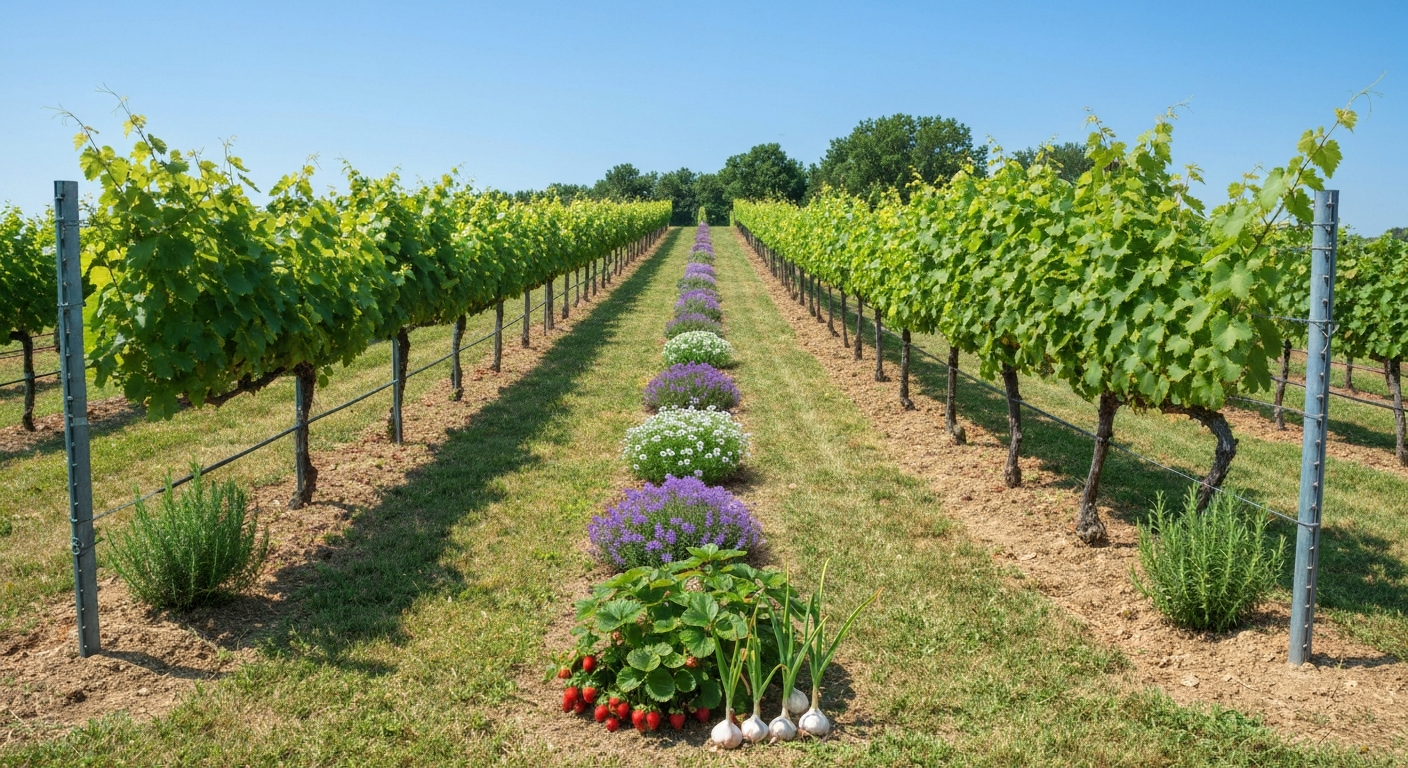
You can grow a surprisingly wide range of plants alongside grapevines: herbs like rosemary, basil, and chives; flowers like sweet alyssum, phacelia, and marigolds; legumes like hairy vetch and clover; groundcovers like creeping thyme and strawberries; and vegetables like bush beans and lettuce. The key is matching companions to your climate zone, keeping competitive plants out of the under-vine strip, and understanding what each companion is actually doing for your vines. Get that right and you'll have a healthier vineyard floor, more beneficial insects, better soil, and less weeding. Get it wrong and you'll lose vigor, invite disease, or accidentally poison your vines (yes, black walnut will do that).
What Can You Grow With Grapes: Top Companions & Plans by Climate Zone

Marcus Whitfield
13 Aug 2026
Quick answer: what grows well with grapes
Here is the fast version for gardeners who want to get started. Plant herbs and flowers in the inter-row spaces or at the vineyard perimeter. Keep the under-vine strip (roughly 18 to 24 inches either side of the trunk) either mulched, bare, or planted with only the lowest-competition groundcovers. Use legume cover crops as a winter or shoulder-season rotation, not a permanent under-vine planting. Avoid fennel, brassicas as permanent plantings, and anything in the Juglans family within 50 to 80 feet of your vines.
- Herbs: rosemary, chives, basil, hyssop, oregano
- Flowers: sweet alyssum, phacelia, marigolds, borage, nasturtium
- Legumes and cover crops: hairy vetch, crimson clover, buckwheat, field peas
- Groundcovers: creeping thyme, strawberries, low fescue mixes
- Vegetables: bush beans, lettuce, garlic, onions
- Avoid: fennel, black walnut, tall brassicas as permanent plants, aggressive grasses under the vine
Why companion planting actually helps grapevines
Grapevines are long-lived and slow to establish, so the vineyard floor has a lot of time to either work for you or against you. Good companion choices do five practical things: they attract and sustain beneficial insects that prey on grape pests; they fix nitrogen or cycle nutrients the vines can use; they suppress weeds before they become expensive problems; they hold the soil on slopes and reduce runoff; and they improve soil structure over time. None of these benefits are magic, and some are more reliable than others depending on where you garden.
Pest control through beneficial insects
Flowering companions like buckwheat, phacelia, and sweet alyssum consistently bring in more parasitoid wasps, hoverflies, and predatory beetles. USDA and SARE-funded vineyard trials confirmed that these insectary plants increase natural-enemy visitation. The honest caveat, though, is that measurable reductions in actual pest levels were inconsistent across sites and seasons. Landscape context matters: if you are one small vineyard in a sea of monoculture, the benefit is real but modest. If you are in a region with diverse surrounding habitat, insectary companions can make a more noticeable difference. Either way, the cost is low and the downside is nearly zero, so I always recommend them.
Soil health and nitrogen cycling
Cover crops, especially legumes, can meaningfully reduce your fertilizer inputs. Cornell research in New York vineyards showed that cover crops reduced nitrogen leaching and improved soil infiltration compared to bare-soil or herbicide-only treatments. Hairy vetch in a good stand can contribute roughly 120 to 150 pounds of nitrogen per acre when terminated at peak biomass, according to SARE data. For a home gardener with a few rows, that translates to real savings on fertilizer. Just account for timing: if your legume cover crop is adding nitrogen, reduce your spring fertilizer or fertigation rate accordingly. Washington State University extension guidance notes that grapevine nitrogen removal at harvest ranges from about 10 to 60 pounds per acre depending on variety and crop load, so you do not need massive nitrogen inputs in most home vineyard situations.
Weed suppression and erosion control
A dense cover crop or low groundcover in the inter-row spaces shades out weeds far better than bare soil. On sloped sites, living mulches and cover crops reduce runoff and hold topsoil during rain events, which is especially relevant if you are in a humid eastern region or the Pacific Northwest where winter rains can erode bare vineyard rows quickly. Research on under-vine vegetation confirms it can genuinely mitigate the impact of excessive precipitation. The trade-off is water competition during dry periods, which I will get into in the spacing and irrigation section.
Herbs that work beautifully with grapevines
Herbs are my first recommendation for new grape growers because they are low risk, multi-purpose, and most of them are drought-tolerant once established, which means they compete minimally with vines for water. Plant them in the inter-row zones or along the trellis ends, not directly under the vine canopy where air circulation matters for disease management.
| Herb | Main benefit | Best placement | Climate notes |
|---|---|---|---|
| Rosemary | Repels some aphids and whitefly; attracts pollinators | Inter-row or row ends | Hardy to about Zone 7; use as annual in colder zones |
| Chives | Deters aphids and Japanese beetles; mild allium compounds | Under-vine edge (not directly at trunk) | Hardy to Zone 3, suits cold-climate vineyards including Canadian regions |
| Basil | Repels thrips and some moths; attracts pollinators | Inter-row, warm zones only | Frost-tender; Zone 9-11 perennial, annual everywhere else |
| Hyssop | Attracts beneficial wasps; reportedly deters grape moth | Inter-row or trellis perimeter | Hardy to Zone 3, excellent for northern and high-altitude vineyards |
| Oregano | Ground-level pollinator habitat; low water needs | Under-vine edge as low groundcover | Hardy to Zone 4-5, good for Mediterranean-climate vineyards |
| Lemon balm | Attracts bees; may confuse some pest insects via scent | Inter-row borders | Hardy to Zone 4 but can spread aggressively; monitor it |
A quick note for gardeners in cold climates like Alberta or Ontario: chives and hyssop are genuinely hardy companions that will survive Canadian winters and come back reliably every year. If you’re asking "can you grow grapes in Canada," the short answer is yes, with cold-hardy varieties and the right site you can successfully grow grapes in many parts of Canada. For gardeners in Calgary, see our guide on can you grow grapes in Calgary for variety choices and site-specific advice. They are some of the best low-maintenance options for cold-climate vineyards growing varieties like Marquette, Frontenac, or other cold-hardy hybrids.
Flowers for pollinators and natural pest control
Flowering companions are where the research is most active, and also where expectations need to be calibrated. The benefit to beneficial insect populations is real and well-documented. The benefit to actual pest control in your canopy is variable. That said, a vineyard with diverse flowering strips is a more resilient system than a bare-floor vineyard, and most of these plants cost very little to establish.
Top flowering companions and how to use them
- Sweet alyssum (Lobularia maritima): low-growing, prolific, attracts hoverflies and parasitoid wasps all season; plant in inter-row strips or around trellis posts; reseeds readily in Zones 5-10
- Phacelia (Phacelia tanacetifolia): one of the best-researched insectary plants for vineyards; bloom timing is excellent for early-season beneficials; grows fast from seed and suits both Mediterranean and humid eastern climates; German vineyard trials confirmed parasitoid increases though canopy pest reductions were inconsistent
- Marigolds (Tagetes spp.): double duty as nematode suppressors and pollinator plants; research going back to the 1970s confirms marigolds can reduce root-knot nematode populations in vineyard soils; plant as a dense inter-row annual in nematode-prone soils, especially in warm Zone 7-10 regions
- Buckwheat (Fagopyrum esculentum): fast-growing summer annual that flowers in about 6 weeks; excellent for filling bare soil quickly, feeding beneficials, and smothering weeds; SARE and USDA vineyard trials used it as a primary insectary crop; terminate before it sets seed if you do not want it spreading
- Borage: self-seeding annual that attracts bees and predatory insects; use in inter-row spaces but monitor spread
- Nasturtium: can act as a trap crop for aphids (aphids colonize nasturtium rather than vines); good inter-row or row-end planting in Zones 4-11 as an annual
- Lavender: excellent perennial for Mediterranean climates and Zone 5+ gardens; very low water demand; strong pollinator attractor around trellis ends
Timing matters with flowering companions. The goal is to have something in bloom from early spring through late summer to cover the full pest-activity window. Combine phacelia (early) with buckwheat (midsummer) and sweet alyssum (continuous) to keep beneficials present throughout the season. In greenhouse grape systems, where the pest-predator balance is even more critical because natural immigration is limited, these insectary companions become especially valuable in adjacent beds or in the greenhouse itself.
Legumes and cover crops for soil improvement
Legume cover crops are one of the highest-value investments you can make in a young vineyard. They do the hardest soil-building work: fixing atmospheric nitrogen, adding organic matter when you terminate them, improving water infiltration, and reducing the need for synthetic fertilizer inputs. The catch is management: you need to terminate them at the right time and place them correctly to avoid competing with your vines.
Best legume and cover crop options
| Cover crop | Nitrogen contribution | Best use in vineyard | Termination timing | Climate fit |
|---|---|---|---|---|
| Hairy vetch | ~120-150 lb N/acre in good stand | Inter-row winter annual; mow-and-throw under vines in spring | Before or at early bloom, before vines need N | Zones 4-9; cold-hardy, suits humid east and Pacific NW |
| Crimson clover | Moderate N; strong pollinator value | Inter-row or as permanent low cover in wetter zones | Mow at peak flower to preserve N and reduce seed set | Zones 6-9; less cold-hardy than hairy vetch |
| White clover | Lower N; very persistent | Permanent inter-row groundcover in irrigated or wet climates | Mow regularly; do not plant under-vine in dry climates | Zones 3-9; one of the most cold-tolerant legumes |
| Field peas | Good N; fast biomass | Spring or fall cover in cool climates; good for Canadian vineyards | Terminate at flowering | Zones 3-7; cool-season only |
| Buckwheat (non-legume) | No N fixation but excellent weed suppression | Summer gap-filler; smothers weeds fast | Before seed set | Zones 4-11 as summer annual |
| Mustard (non-legume) | Biofumigant properties; suppresses some soil pathogens | Rotation crop in inter-row; do not use under-vine long-term | Incorporate before flowering | Zones 5-9; cool-season annual |
One approach I really like for home vineyards is the 'mow-and-throw' method described in UC IPM guidance: you grow hairy vetch or crimson clover in the inter-row, then mow it and let the clippings fall into the under-vine strip as a natural mulch. You get nitrogen cycling, organic matter, and weed suppression all in one pass. It is not perfect, and in humid climates the mulch layer can increase disease pressure by raising humidity under the canopy, but in drier regions it is an elegant low-input strategy.
Groundcovers and living mulches under the vine
The under-vine zone is the most contested real estate in your vineyard. Grapevine roots are remarkably deep and wide, capable of penetrating more than 6 meters in favorable soils, so they will compete with almost anything you plant directly at the base. That said, a well-chosen low groundcover can suppress weeds, reduce erosion, and moderate soil temperature without causing serious yield losses, as long as you are not in a water-limited environment.
Research on under-vine vegetation confirms it can reduce vine vigor and sometimes yield, and that water competition rather than nitrogen competition is usually the culprit. In irrigated vineyards or regions with reliable summer rainfall (the humid east, the Pacific Northwest, Ontario), this is manageable. In drier zones (interior California, Arizona, parts of New Mexico), keep the under-vine strip mulched rather than planted.
Groundcover options by situation
- Creeping thyme: excellent under-vine herb-groundcover hybrid; drought-tolerant, aromatic, very low growing; suits Zones 4-9 and is one of the few plants I am comfortable recommending close to the vine trunk in well-drained soils
- Strawberries: classic vineyard companion; practical double crop; keep them 12-18 inches from the trunk; work best in Zones 3-8 with adequate moisture; avoid in very dry unirrigated sites
- Tall fescue or fine fescue blends: permanent inter-row sod that is mown regularly; reduces erosion; well-documented in Ontario and New York extension trials; keep mown short to reduce humidity; do not use directly under-vine in dry climates
- Chicory: deep-rooted, drought-tolerant, brings up subsoil minerals; Washington State trials found it had relatively little effect on vine pruning weight compared to other cover crops, making it one of the safer inter-row options; biennial so manageable
- Native low wildflower mixes: trialed in Ontario (OMAFRA/ONfruit projects) for both weed suppression and pollinator value; region-specific seed mixes designed for local conditions work better than generic wildflower packets
Vegetables you can grow with grapes
Intercropping vegetables with grapevines is most practical in the first few years before the vines fully establish. Once your canopy closes and roots are deep and wide, shade and root competition make most tall vegetables impractical directly under the trellis. But shorter, early-season vegetables can work well in the inter-row space, especially in home gardens where you want to maximize productive use of space while your young vines mature.
Vegetables that pair well
- Garlic and onions: allium compounds may deter some fungal pathogens and insects; low-growing and non-competitive; plant in fall for spring harvest; one of the most consistently recommended vegetable companions in vineyard literature
- Bush beans: nitrogen-fixing annuals that stay low; good in young vineyard rows in Zones 4-9; harvest before the vine canopy closes; avoid pole beans that might climb the trellis
- Lettuce and spinach: short-season crops that do well in the dappled shade under young vines in spring; bolt quickly in summer heat so plant early and harvest before June in warm zones
- Radishes and turnips: rapid-cycling brassicas that break up compacted soil and add organic matter quickly when tilled in; WSU trials found turnips had little effect on vine pruning weight, making them relatively safe inter-row options
- Cover-crop mixes with vegetables: some gardeners grow a mix of edible greens (kale, mustard greens) as a winter cover crop that they harvest lightly and then incorporate as green manure in spring
One vegetable to be careful with is corn. It gets tall, casts shade, and draws the same insects (Japanese beetle) that damage grapevines. Keep it well away from the vineyard. Squash and cucumbers can also sprawl into the vine row and create a humidity trap at ground level, which is a disease risk in humid climates.
Plants to keep away from grapevines
This section matters as much as the list of good companions. Planting the wrong thing near grapevines can cause real, lasting damage: competition, disease, or direct chemical toxicity. I have seen gardeners lose established vines to juglone damage after not realizing a neighbor's walnut tree root zone extended into their vineyard.
| Plant to avoid | Why it is a problem | Safe distance or alternative |
|---|---|---|
| Black walnut (Juglans nigra) and related Juglans spp. | Produces juglone, a chemical toxic to grapevines; Penn State extension lists grapes among juglone-sensitive plants; damage can come from roots, leaf litter, or recently removed stumps | At least 50-80 feet from vine root zone; test soil before planting near stumps |
| Fennel (Foeniculum vulgare) | Allelopathic to many plants including grapes; inhibits growth of nearby plants through root exudates; also attracts beneficial insects but the growth-inhibition risk outweighs the benefit | Keep fennel well outside the vineyard; at least 2-3 rows away |
| Tall brassicas as permanent plantings | Biofumigant properties useful in rotation but can harbor clubroot and other diseases; tall types shade canopy and compete aggressively if not managed; become a host for harlequin bugs in warm regions | Use as a terminated winter annual only, not permanent planting |
| Aggressive grasses (bermudagrass, johnsongrass, quackgrass) | Extremely competitive for water and nitrogen; difficult to eliminate once established under vines; root competition documented as the main cause of vine vigor reduction in cover-crop trials | Use non-aggressive fescue blends or mow-managed cover crops instead |
| Corn | Tall; shades vines; attracts Japanese beetle and European corn borer, both grape pests; allelopathic residues reported | Keep outside the vineyard entirely |
| Nightshades (Solanum spp., including potato and tomato) | Can share fungal and viral diseases with grapevines (downy mildew relatives, mosaic viruses); best kept well separated, especially in humid climates where disease pressure is high | Keep at least 20-30 feet away; never plant in the vine row |
Soil management choices also affect disease pressure in ways that are not always obvious. Research comparing tillage, compost, and living cover crops found meaningful differences in airborne fungal spore communities and disease incidence across vineyards. A dense, wet mulch layer under the canopy can increase powdery mildew, downy mildew, or Botrytis risk, particularly in humid eastern climates. If you are in a region where fungal disease is already your biggest challenge, keep the under-vine strip drier and more open, and avoid anything that traps humidity.
Planting logistics: timing, spacing, water, and nutrients
Getting the timing and placement right is where companion planting either works or becomes a headache. Here are the practical rules I follow and recommend.
Timing companions to your vine's growth stage
In the first one to two years after planting vines, keep the under-vine strip as weed-free as possible and do not establish permanent companions yet. Young vines are establishing their root systems and cannot afford significant competition. Inter-row companions are fine from Year 1. From Year 3 onward, once vines are established, you can introduce under-vine edge groundcovers carefully. Cover crops for inter-row spaces can be seeded in early fall or early spring depending on whether you want a winter annual or summer annual species.
Spacing rules to live by
- Keep a clear 18-24 inch strip on each side of the vine trunk as a minimum bare or mulched zone
- Plant inter-row companions at least 24 inches from the vine row edge, ideally centered in the inter-row space
- Tall companions (over 18 inches) should stay outside the trellis end posts to avoid shading the canopy
- Perennial groundcovers like creeping thyme can be placed closer (12 inches from trunk) once vines are fully established, in irrigated or humid sites only
- Insectary flower strips work best at the vineyard perimeter or in dedicated inter-row strips rather than scattered randomly
How companions change your irrigation and fertilizer needs
This is the part most gardeners do not think about until something goes wrong. Cover crops and groundcovers use water, and in dry seasons or unirrigated sites, that competition can reduce vine vigor and yield. Research on under-vine vegetation confirmed that yield declines were more often due to water competition than nitrogen competition. If you add cover crops, monitor vine water stress more closely and be prepared to irrigate more in dry spells. In drip-irrigated systems, place your drip emitters to serve the vines specifically rather than watering inter-row companions as well.
On the fertilizer side, legume cover crops mean you should reduce your applied nitrogen. A good hairy vetch stand terminated in early spring can provide the equivalent of a significant portion of your vine's seasonal nitrogen need. WSU's vineyard nutrient guidance recommends accounting for legume credits when budgeting fertilizer. For a home gardener with a few rows, this might mean skipping a spring nitrogen application entirely in a year with good vetch cover. Excess nitrogen from over-fertilizing on top of a legume credit produces excess shoot growth, makes canopy management harder, and increases disease susceptibility.
Region-specific timing notes
| Region / Climate Zone | Cover crop seeding window | Companion establishment notes | Key cautions |
|---|---|---|---|
| Cold climates: Zones 3-5 (Manitoba, Alberta, Ontario, northern US) | Legumes: mid-spring after last frost; fall-hardy mixes by late August | Use cold-tolerant companions: chives, hyssop, white clover, field peas; perennial herbs overwinter well here | Short season means less time to establish; prioritize cold-hardy species; avoid late-season plantings that won't establish before frost |
| Humid eastern US and Ontario: Zones 5-7 (New York, Pennsylvania, Michigan, Virginia) | Fall: hairy vetch, crimson clover; Spring: buckwheat, phacelia from late April | Disease pressure is higher; avoid dense under-vine mulch; space companions to allow good air circulation | Fungal disease risk is real; research shows soil cover affects airborne fungal communities; keep canopy open |
| Pacific Northwest: Zones 7-9 (Washington, Oregon) | Fall cover crops by October; spring insectary strips from March-April | WSU trials show chicory and buckwheat least competitive; ryegrass reduces vigor noticeably; choose carefully | Wet winters favor cover crop establishment but also disease; terminate before vine budbreak |
| Mediterranean / warm dry: Zones 8-10 (California, southern Arizona) | Fall legumes after harvest; summer insectary annuals after spring irrigation | Water competition is the main risk; keep under-vine strip dry; use drought-tolerant herbs and flowers inter-row | Do not plant water-demanding groundcovers under-vine in unirrigated blocks; marigolds useful for nematode management in these soils |
| Warm humid: Zones 7-9 (Southeast US, Texas Gulf Coast) | Spring and fall cover crop windows; avoid establishment in midsummer heat | Nematode pressure is often high here; marigolds are a priority companion; use solarization before vineyard establishment if nematodes are present | Pierce's disease zone: vine health is paramount; keep competition low in early years; prioritize disease-resistant varieties before worrying about companions |
Special situations: greenhouse and hydroponic grapes
If you are growing grapes in a greenhouse or a hydroponic system, the companion planting logic shifts considerably. If you want a focused answer to the question can you grow grapes in a greenhouse, see the dedicated guide on that topic for practical tips and considerations. In a greenhouse, natural predator immigration is limited, so insectary companions planted inside the structure (in pots or ground beds) become more important for maintaining biological control of spider mites and aphids. Sweet alyssum and basil in pots near the vine base can sustain predatory midge populations. Borage works well in ground-bed greenhouse situations. The humidity management concern is heightened in greenhouse environments, so avoid any dense groundcover that traps moisture around the vine trunk.
In hydroponic grape systems, traditional companion planting does not directly apply to the root zone, but companion plants in adjacent beds or in the same growing space can still provide pest-control and pollination benefits. If you want details on methods and considerations for soilless culture, see guidance on can you grow grapes hydroponically. The focus shifts to managing the aerial environment: insectary flowering plants near the vines attract and sustain beneficial insects, and aromatic herbs can disrupt pest host-finding. Keep the hydroponic reservoir isolated from any potential allelopathic root exudates from companions.
A simple companion planting plan by zone
If you want a starting template, here is what I would plant depending on where you are. These are not exhaustive plans, just solid starting points based on what I have seen work consistently across different growing environments.
Cold climate plan (Zones 3-5, including Canadian vineyards)
- Inter-row: seed white clover or field peas in spring as a permanent or annual nitrogen-fixing groundcover; mow regularly
- Under-vine edge (from Year 3+): plant chives at 18-inch offset from trunk; they will naturalize and come back every year
- Insectary strip: sow buckwheat in midsummer when soil is warm; it flowers fast and feeds beneficials through late summer
- Perennial herbs at row ends: hyssop survives cold winters and blooms reliably every year
- Avoid any non-hardy perennials that need winter protection; keep the system simple and self-maintaining
Humid eastern plan (Zones 5-7)
- Inter-row: hairy vetch seeded in early fall; mow and throw into under-vine strip in spring before vine budbreak
- Summer insectary: buckwheat and sweet alyssum seeded after vetch termination; stagger rows for continuous bloom
- Under-vine: keep as bare mulch or use creeping thyme very cautiously; prioritize air circulation over groundcover density
- Nematode management: interplant marigolds in blocks where nematode pressure is known or suspected
- Avoid: dense mulch layers in high-humidity periods; anything that restricts air movement under the canopy
Dry Mediterranean and warm western plan (Zones 8-10)
- Inter-row: fall-seeded legume mix (crimson clover plus phacelia) for winter and spring ground cover; terminate by April
- Under-vine: organic mulch only in unirrigated blocks; no groundcover plants unless drip-irrigated
- Summer companions: drought-tolerant herbs and lavender at row ends; buckwheat in irrigated zones only
- Nematode focus: dense seasonal marigold planting in the inter-row before vineyard establishment if root-knot nematodes are present
- Avoid: any water-demanding groundcover under-vine without dedicated drip irrigation to the vine
Your next steps
Start with one category of companion, not all of them at once. If you are in a cold climate, plant chives and seed white clover in your inter-row this season and see how it goes. If you are in a drier zone, try a fall legume cover crop and a buckwheat insectary strip in summer. The learning curve is in reading your specific site: watching where water pools, where weeds dominate, where pest pressure appears first, and which companions actually establish and thrive in your soil. Companion planting in a vineyard is iterative, not a one-time installation. Once you have your grape variety choices and climate figured out, building out your companion planting system is one of the most satisfying and productive investments you can make in your vineyard's long-term health. For practical guidance on selecting varieties and basic growing steps, see our 'can you grow grapes' guide for beginners.
FAQ
Quick answer: what can you grow with grapes in a home vineyard or backyard trellis?
Short: plant low‑competitive perennial groundcovers, insectary/flowering annuals, nitrogen‑fixing legumes, aromatic herbs, and select vegetables in the trellis row while avoiding deep, aggressive roots or high‑water competition. Choose species and spacing based on your climate, rootstock vigor and water regime. Properly managed covers can provide pollinators, natural‑enemy habitat, soil protection and weed suppression; mismanaged covers can compete for water, change canopy microclimate, or increase disease risk.
Evidence‑based list: which companion plants are good choices (herbs, flowers, legumes, groundcovers, cover crops, vegetables)?
Herbs: rosemary, thyme, oregano, lavender (low water, pest repellent, pollinators). Flowers/Insectaries: buckwheat, phacelia (Phacelia tanacetifolia), sweet alyssum, borage, coriander — attract natural enemies and pollinators but benefits vary by site. Legumes/green manures: hairy vetch, crimson clover, field pea for N fixation and soil building (credit N when terminated). Groundcovers/low perennials: white clover, thyme, chamomile, low sedges or native mixes for weed suppression and erosion control. Cover crops/annuals: annual ryegrass or oats (erosion control, structure), mustard or radish (biofumigation/soil improvement), buckwheat (rapid summer bloom and weed smother). Vegetables (select): shallow‑rooted, low‑water crops like salad greens, herbs, onions near trellis edges — avoid heavy feeders or high‑water vines within under‑vine strips.
Which plants should I avoid near grapevines?
Avoid deep, competitive trees/shrubs (black walnut/Juglans species — juglone toxicity), aggressive grasses or rhizomatous perennials (bamboo, quackgrass) and tall, water‑hungry crops that compete for moisture (maize/large squash in dry climates). In wet/humid regions, avoid dense understories that trap humidity and increase powdery/downy/botrytis risk. Also avoid species known to host vineyard pests or nematode vectors unless you have a clear suppressive strategy.
What functions do companion plants provide in vineyards?
Main functions: pest regulation (attract natural enemies and distract pests), pollinator provisioning (for nearby crops), soil improvement (N from legumes, organic matter from covers), weed suppression (mulch effect, canopy shading), erosion control and infiltration improvement (covers reduce runoff), and microclimate modulation (shade and humidity alteration). Effectiveness is context‑dependent (phenology, landscape, scale).
How should I time planting, spacing, irrigation and fertilizer when interplanting with grapes?
Timing: establish permanent covers in the first dormant season after planting or wait until vines are 1–2 years old to avoid early competition. For annual insectaries/green manures, time sowing to match flowering or termination before budburst/rapid canopy growth. Spacing: keep an inner under‑vine strip (0.5–1 m) of reduced competition around trunks for mechanical access; plant covers in the row middle and inter‑row. Irrigation: match supplemental irrigation to vine needs — in water‑limited regions avoid high‑water covers; use drip zones focused on the vine row and isolated lateral watering for interplants. Fertilizer interactions: credit N from legumes when budgeting fertilizer (regional credit varies — often substantial at good biomass), and reduce additional N if cover crops provide N; avoid heavy N that increases vine vigor and disease risk. Monitor soil moisture and nutrient tests annually and adjust.
What are the main disease and root‑competition cautions?
Disease: dense undergrowth can increase humidity and airborne fungal inoculum; flowering strips should not create persistent wet foliage near trunk/canopy. Management (mowing, timed termination) prevents microclimate problems. Root competition: grape roots can be deep and plastic but young vines are vulnerable; under‑vine living mulches often reduce vegetative growth and yield in water‑limited sites. Water competition is the most common mechanism for yield decline; reduce risk by delaying establishment, selecting low‑water covers, and keeping a competition‑free trunk zone.