
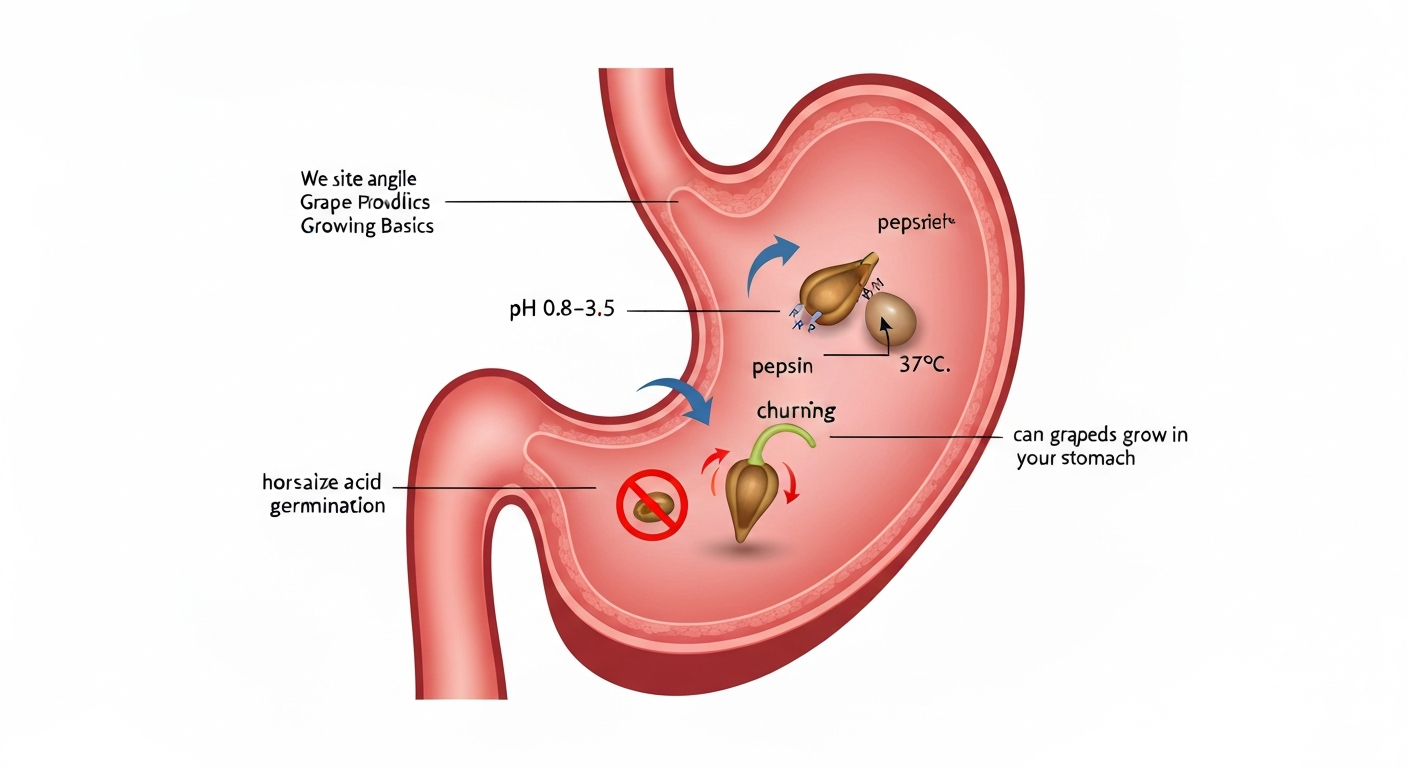
No, grape seeds cannot grow in your stomach. The human digestive tract is one of the most hostile environments imaginable for a seed: stomach acid sits at a pH of roughly 0.8 to 3.5 when fasting, proteolytic enzymes like pepsin attack organic matter aggressively, and the mechanical churning would physically damage any seed trying to imbibe water and swell. On top of that, grape seeds need cold, moist stratification at around 4°C (39°F) for 60 to 140 days just to break dormancy before they can even think about germinating. Your gut is warm, airless, and acidic, almost the exact opposite of what a grape seed requires. The old childhood warning about a vine growing out of your belly button is pure myth.
Can Grape Seeds Grow in Your Stomach? Myth & Safety

Marcus Whitfield
25 Jul 2026
Can grape seeds grow in your stomach? The short verdict
The answer is a firm no, and it is not even a close call biologically. There is no documented case in medical literature of a seed germinating inside a human stomach and developing into a plant. Systematic reviews of gastrointestinal seed/bezoar case reports confirm seeds can form obstructing masses (phytobezoars) but do not document seeds germinating into plants inside the stomach or intestinal lumen as a recognized clinical phenomenon A systematic review (Gastrointestinal Seed Bezoars: A Systematic Review of Case Reports and Case Series — Cureus) confirms seeds can form obstructing phytobezoars but reports no cases of seeds germinating into plants inside the gastrointestinal tract.. It simply does not happen, and understanding why is actually pretty interesting if you care about growing grapes for real.
Why grape seeds can't germinate inside the human digestive tract
Seeds need three basic conditions to germinate: water, oxygen, and a suitable temperature. Grape seeds add a fourth hurdle: dormancy must be broken first, usually by exposure to cold, moist conditions over many weeks. Your digestive system fails on almost every count.
Your stomach is intensely acidic, with a lumen pH that typically hovers between 0.8 and 3.5 when you haven't eaten recently. Even after a meal temporarily buffers that acidity, conditions quickly return to hostile. Pepsin and other proteolytic enzymes are working constantly to break down organic material, and the stomach's muscular walls churn contents vigorously. This environment degrades the seed coat, which is the protective layer a grape seed relies on to survive long enough to germinate.
Oxygen is another problem. Germination is an aerobic process: the embryo needs oxygen to fuel cellular respiration as it begins to grow. The digestive tract is largely anaerobic. Even if somehow the acid and enzymes didn't destroy the seed, the embryo would be starved of oxygen well before it could do anything useful.
Then there is the dormancy issue specific to grapes. Vitis species have physiological dormancy built into their seeds. Growers use cold, moist stratification at roughly 4°C for 60 to 140 days, or treatments like gibberellic acid or scarification, to unlock germination. Your body temperature stays at a steady 37°C (98.6°F). That is nowhere near the cold stratification temperature grape seeds need, and there is no mechanism inside you to replicate the seasonal chill of winter. Research published in 2025 confirms that even under controlled laboratory conditions with specific chemical treatments, getting reliable grape seed germination requires carefully managed protocols. Your stomach is not a laboratory.
It is worth noting that some seeds do survive passage through animal digestive tracts, this is actually a seed-dispersal strategy called endozoochory. Studies of frugivores (fruit-eating animals) show gut passage sometimes increases germination rates in certain plant species by scarifying the seed coat. But those effects depend heavily on the specific plant, the animal, gut retention time, and the seed coat's thickness and chemistry. Results from bird or mammal frugivores do not translate neatly to humans, and even in those cases the seeds germinate outside the body after excretion, not inside the gut.
What actually happens when you swallow a grape seed
Most swallowed grape seeds pass through the digestive system largely intact but functionally destroyed as potential plants. They travel from the stomach into the small intestine and then the large intestine, and are excreted within roughly 24 to 72 hours depending on your individual gut transit time. The seed coat may protect the embryo from being fully digested, which is why you sometimes notice seeds in stool, but the combination of acid exposure, enzyme activity, and absence of oxygen during that journey is more than enough to render the embryo non-viable.
For the vast majority of healthy adults, swallowing a few grape seeds during a snack is a complete non-event. The seeds go in, the seeds come out, and nothing grows anywhere in between.
Health and safety: when swallowing seeds does become a concern
While germination is not a real risk, there are a few genuine medical situations worth knowing about.
Choking and airway obstruction
The more immediate danger from small, hard seeds is choking, particularly in young children and older adults. If a seed is aspirated into the airway rather than swallowed, it can lodge in the bronchi or trachea. Seeds can swell after absorbing moisture, making removal more difficult over time, and they can trigger inflammation and granulation tissue. This is an airway foreign-body emergency, not a stomach-germination problem, but it is a real one.
Phytobezoars and intestinal obstruction
In rare cases, seeds and seed fragments can accumulate in the stomach or intestines and form a compacted mass called a phytobezoar. This case report documents multiple large persimmon phytobezoars causing gastric outlet obstruction, illustrating how seed‑based bezoars can produce clinically significant gastric obstruction An unusual case of gastric outlet obstruction caused by multiple giant persimmon phytobezoars — BMJ Case Reports. This is documented in medical literature with seeds like persimmon and sunflower, and it is more likely in people with prior gastric surgery, poor chewing ability, or motility disorders. Grape seeds are small enough that this is a very low risk in healthy people eating normal amounts, but if you or someone in your household has any of those risk factors, it is worth keeping in mind and worth discussing with a doctor.
Toxicity
Common grape seeds (Vitis vinifera and related species) are not considered toxic to humans in normal quantities. Authoritative poison-control sources treat accidental swallowing of a small number of grape seeds as a non-toxic event. If you have any concern about a specific plant's seeds, or if a large quantity was swallowed, the US Poison Help line is 1-800-222-1222, and webPOISONCONTROL.org provides online guidance.
A note on pets
Grapes and raisins are a different story for dogs and cats. The actual fruit (and by extension anything made from it) is associated with acute kidney injury in dogs, and the mechanism is not fully understood. Seed swallowing aside, keep grapes away from your pets entirely and contact a veterinarian or the ASPCA Animal Poison Control Center (888-426-4435) if your pet eats any part of the grape plant.
When to seek emergency care
Get medical help if someone is choking, having difficulty breathing, experiencing persistent abdominal pain or vomiting after swallowing seeds, or showing any signs of intestinal obstruction. For non-urgent questions about seed ingestion, Poison Help (1-800-222-1222) is your best starting point.
Should parents worry? Practical tips for kids who swallow seeds
Kids swallow grape seeds all the time and are fine. The biology above applies equally to children: seeds cannot germinate inside the stomach, and grape seeds are not toxic. The real concern for young children is choking risk. The American Academy of Pediatrics flags whole grapes as a choking hazard for children under five because of their round, smooth shape, not because of the seeds specifically. The recommendation is to cut grapes in half or quarters lengthwise before serving to young kids.
- Cut grapes lengthwise (not crosswise) into quarters for children under 5.
- Supervise mealtimes with toddlers and young children.
- Consider buying seedless grape varieties for snacking with young kids — it removes one variable even if seeds alone aren't the primary hazard.
- If a child is coughing, gagging, or struggling to breathe after eating grapes, treat it as a choking or aspiration emergency and call 911 or your local emergency number.
- For questions about non-emergency ingestion, call Poison Help at 1-800-222-1222 — they are fast, free, and calm.
No need to panic about the occasional swallowed seed. Just cut grapes appropriately and supervise young eaters.
So you actually want to grow grapes from seed
Since you now know seeds can't sprout inside you, let's talk about what it actually takes to grow a grape vine from seed outside, in the garden. If you're wondering 'are grapes easy to grow', the short answer is: it depends on variety, climate, and whether you start from seed or cuttings. I have done it, and I will be honest: it is a slow, unpredictable process that most home gardeners should think carefully about before committing to.
The big trade-off: seed vs. cutting
The core issue with seed propagation is genetic variability. Grapes cross-pollinate enthusiastically, which means seeds from a Concord grape do not reliably produce a Concord vine. You might get something interesting, or you might get something vigorous but nearly useless for eating or winemaking. Commercial growers and most serious home gardeners propagate grapes vegetatively, through hardwood cuttings, specifically because cuttings are genetically identical to the parent plant. You get exactly the variety you started with, and you get it producing fruit in roughly two to three years instead of the four to seven years seed-grown vines typically take.
| Method | Time to First Fruit | True to Variety? | Cost | Skill Level | Best For |
|---|---|---|---|---|---|
| Seed | 4–7 years | No (genetic variability) | Very low | Moderate to high | Breeding experiments, curiosity, rootstock trials |
| Hardwood cutting | 2–3 years | Yes | Low | Beginner-friendly | Home gardens, reliable production |
| Purchased bare-root vine | 2–3 years | Yes | Moderate | Easiest | New gardeners wanting a head start |
If your goal is to produce fruit you can eat or make wine with, cuttings or purchased vines from a reputable nursery are almost always the better path. If you are experimenting, breeding, or just curious about the process, seeds are genuinely interesting to work with, just go in with realistic expectations.
How to actually germinate grape seeds: a step-by-step guide
If you are set on growing from seed, here is the process that works. I will walk through each stage with the specifics that matter.
Step 1: Collect and clean seeds
Start with fresh seeds from ripe grapes. Seeds from dried fruit (raisins) or commercially processed grapes are usually not viable. Squeeze or scoop the seeds out and rinse off all the pulp, leftover flesh encourages mold and can inhibit germination. Spread seeds on a paper towel and let them air-dry for a day or two before proceeding.
Step 2: Test viability
Drop your cleaned seeds into a glass of water. Seeds that sink are more likely to be viable; seeds that float are often empty or damaged. This is not a perfect test, but it quickly eliminates obvious duds.
Step 3: Scarification (optional but helpful)
Grape seeds have a relatively hard seed coat that can slow water uptake. Lightly scuffing the seed coat with fine sandpaper or a nail file, a process called scarification, can improve imbibition. Be gentle: you want to thin the coat slightly, not damage the embryo inside. Some growers skip this step and rely solely on stratification, which also works.
Step 4: Cold, moist stratification
This is the critical step and the one most people skip, which is why their seeds fail. Place your seeds in a small zip-lock bag with a moist growing medium, damp peat moss, damp vermiculite, or even a moist paper towel all work. The medium should be damp but not wet enough to squeeze water out. Seal the bag and put it in your refrigerator at around 4°C (39°F). Leave it there for a minimum of 60 days, and ideally 90 to 140 days for better results. Check the bag every couple of weeks to make sure the medium hasn't dried out and to look for early sprouting. If you see a seed starting to crack or show a tiny root, it is ready to plant even if you haven't hit the full stratification period.
Step 5: Sowing
Once stratification is complete, sow seeds about 1 cm (half an inch) deep in small pots or seed trays filled with a well-draining seed-starting mix. One seed per small pot is ideal so you don't have to disturb roots later. Water gently, cover with a clear plastic dome or plastic wrap to retain humidity, and place in a warm spot at around 20 to 25°C (68 to 77°F). A heat mat set to this range speeds things up noticeably.
Step 6: Early care
Keep the growing medium consistently moist but not waterlogged. Once seedlings emerge, remove the plastic dome and move pots to a bright spot with at least six hours of direct light per day, or under grow lights. Thin-stemmed, pale seedlings are a sign of insufficient light, grape seedlings need sun even from the earliest stages. Pot up into larger containers once seedlings have two to three true leaves, and begin a dilute liquid fertilizer routine after the first true leaves appear.
Timing, timelines, and troubleshooting
The best time to start stratification is late fall, so your seeds complete their cold period in time for indoor sowing in late winter or early spring, and seedlings can go outside after your last frost date. In practical terms: collect seeds in September or October, start stratification in November, sow in late February or March, and transplant outdoors in May or June depending on your climate zone.
| Stage | Typical Timing | Duration |
|---|---|---|
| Seed collection and cleaning | September to October | 1–3 days |
| Cold moist stratification (refrigerator) | November to February | 60–140 days at ~4°C |
| Indoor sowing and germination | Late February to March | 2–6 weeks for sprouting |
| Seedling growth indoors | March to May | 6–10 weeks |
| Outdoor transplant | After last frost (varies by zone) | Ongoing first growing season |
| First meaningful fruit production | Year 4 to 7 from seed | Multi-year commitment |
Common problems and how to fix them
- Seeds not sprouting after stratification: Extend stratification by another 3 to 4 weeks. Some cultivars need up to 140 days. Check that your refrigerator is actually close to 4°C — many run slightly warmer.
- Mold in the stratification bag: The medium was too wet. Remove affected seeds, rinse them, and restart in fresh damp (not wet) medium. Adding a tiny pinch of powdered sulfur to the medium can help prevent mold.
- Leggy, pale seedlings: Not enough light. Move to a sunnier windowsill or add a grow light 6 to 8 inches above the seedlings for 14 to 16 hours per day.
- Seedlings damping off (stems collapsing at soil level): Caused by fungal pathogens in overly wet conditions. Improve drainage, reduce watering frequency, and ensure good air circulation around seedlings.
- Very low germination rate: Normal for grapes. Even well-stratified seeds from good sources often germinate at 30 to 60%. Start more seeds than you need.
- Seedlings stalling and looking yellow: Time for dilute fertilizer. A half-strength balanced liquid feed every two weeks usually kicks them back into growth.
Climate, variety, and where seed-grown grapes fit in
One thing I want to flag for readers who are genuinely planning to grow grapes: where you live matters enormously, and seed-grown vines add an extra layer of uncertainty because you cannot know exactly what variety you are growing until the vine fruits. Can grapes grow in the desert? Read more about cultivating grapes in arid, hot climates to learn which varieties and irrigation strategies work best. For detailed guidance on varieties and techniques suited to cold areas, see can grapes grow in cold climates. If you are in a challenging climate, a short-season northern state, a hot desert region, or somewhere with heavy clay or rocky soil, starting with a known, proven variety via cuttings or a purchased vine gives you a much better shot at success than gambling on seed genetics.
Cold-hardy varieties like Marquette, Frontenac, and Valiant are specifically bred for northern climates and are widely available as rooted cuttings from mail-order nurseries. Muscadine varieties dominate in the Southeast for good reason, they handle heat, humidity, and disease pressure that would destroy European vinifera. American hybrids like Concord and Niagara perform across a broad middle range of the country. If you are curious about which varieties are proven performers in your specific state or hardiness zone, that is exactly the kind of question worth researching before you commit years to a vine from an unknown seed.
Soil conditions matter too. Grapes are famously adaptable but they are not infinitely forgiving. If you want detailed guidance on what environment do grapes grow in, read our page on ideal grape-growing conditions. They handle surprisingly poor soils better than many crops, which is part of their appeal for home gardeners with imperfect growing conditions. But soggy, waterlogged soils are genuinely problematic for root health, and extremely compacted rocky ground can limit establishment even in a drought-tolerant vine. If you're concerned about drainage, see can grapes grow in wet soil for more on how grapes perform in waterlogged conditions. For more on how well grapevines handle rocky or compacted ground, see can grapes grow in rocky soil. Sun exposure is the real non-negotiable: grapes need at least six to eight hours of direct sun daily to ripen fruit properly, regardless of how you propagated them. See “Do grapes need a lot of sun to grow?” for detailed guidance on light requirements and site selection.
Whether you are troubleshooting a specific soil type, figuring out if your state's climate can support viticulture, or just deciding whether grapes are worth the effort in your backyard, the growing conditions and variety selection questions deserve just as much attention as the germination process itself. Getting those decisions right upfront is what separates a productive backyard vineyard from a disappointing multi-year experiment.
FAQ
Can grape seeds grow in your stomach?
No — it’s extremely unlikely. The human stomach is highly acidic, contains digestive enzymes and strong mechanical churning that destroy or damage seeds, and conditions (temperature, oxygen, substrate and dormancy cues) do not favor germination. Medical literature and case reviews document seed bezoars and retained foreign bodies but not plants sprouting inside people.
Why don’t seeds germinate inside the digestive tract?
Germination requires water, oxygen, a suitable temperature range and often dormancy‑breaking cues (cold stratification or scarification). The stomach provides low oxygen, fluctuating/unsuitable temperatures, very low pH and enzymes (e.g., pepsin) plus mechanical grinding — all hostile to intact seed germination and embryo growth.
Could a seed survive gut passage and later germinate after being excreted?
Some plant species’ seeds can survive passage through animal guts and later germinate; effects depend on seed coat thickness, chewing, gut residence time and species. However, human digestion usually damages many seeds, and there is no reliable evidence that grape seeds commonly survive human gut passage to germinate after excretion.
Are there any documented cases of seeds sprouting inside people?
No credible medical or botanical literature documents seeds germinating into plants inside the human stomach or intestines. Case reports describe phytobezoars (masses of undigested plant material) and seed‑related obstructions, but not in‑body plant growth.
If I accidentally swallow grape seeds, should I be worried?
For most healthy adults, swallowing a few grape seeds is not harmful. They generally pass through the digestive tract and are excreted. Exceptions: choking risk in small children, large‑quantity ingestion, or ingestion of known toxic seeds. If you have symptoms (choking, breathing difficulty, persistent abdominal pain, vomiting, signs of obstruction) seek emergency care. For non‑emergencies, contact your regional poison center (US: 1‑800‑222‑1222).
Can swallowed seeds cause other health problems?
Yes—seeds and fibrous fruit matter can form phytobezoars in susceptible people (prior gastric surgery, motility disorders, poor mastication) and cause obstruction. Seeds can also be aspirated into airways, causing respiratory problems. These are medical issues of obstruction or foreign bodies, not germination.