
Grapes start growing (budbreak) anywhere from late February in warm California valleys to late April or early May in the Upper Midwest and Northeast. From there, the vine moves through leaf development, flowering, fruit set, veraison, and harvest over roughly 150 to 210 days, landing harvest between August and October in most U.S. climates. Your exact months depend on your hardiness zone, your site's heat accumulation, and the variety you're growing, but that framework covers the overwhelming majority of home gardeners in temperate North America.
What Month Do Grapes Grow: Month-by-Month Guide
Marcus Whitfield
17 Jul 2026
How to use this guide
This guide is written for home gardeners and hobbyists trying to figure out whether grapes will work in their yard and, if so, when to expect each stage. It's not aimed at commercial producers running laboratory-grade phenology models. You'll find a month-by-month seasonal overview, a breakdown of each growth stage and its timing cues, a region-by-region table showing approximate budbreak and harvest months, and a practical walkthrough for using your local last-frost date and growing-degree days (GDD) to build your own calendar. Two numbers matter most throughout this guide: your last spring frost date (available from NOAA's Climate Normals for thousands of U.S. stations) and your seasonal GDD accumulation above 50°F (10°C), which is the standard base temperature used in grape phenology models across U. A peer-reviewed review, Cold Hardiness Dynamics and Spring Phenology: Climate‑Driven Changes and New Molecular Insights Into Grapevine Adaptive Potential (Frontiers in Plant Science), discusses temperature-driven grape phenology and the routine use of a 10°C (50°F) base in thermal-time (GDD) models. S. extension services. If you're in India, I've included a dedicated section on regional timing there too, since the season runs almost backwards compared to North America.
Month-by-month: what a temperate grapevine is doing all year
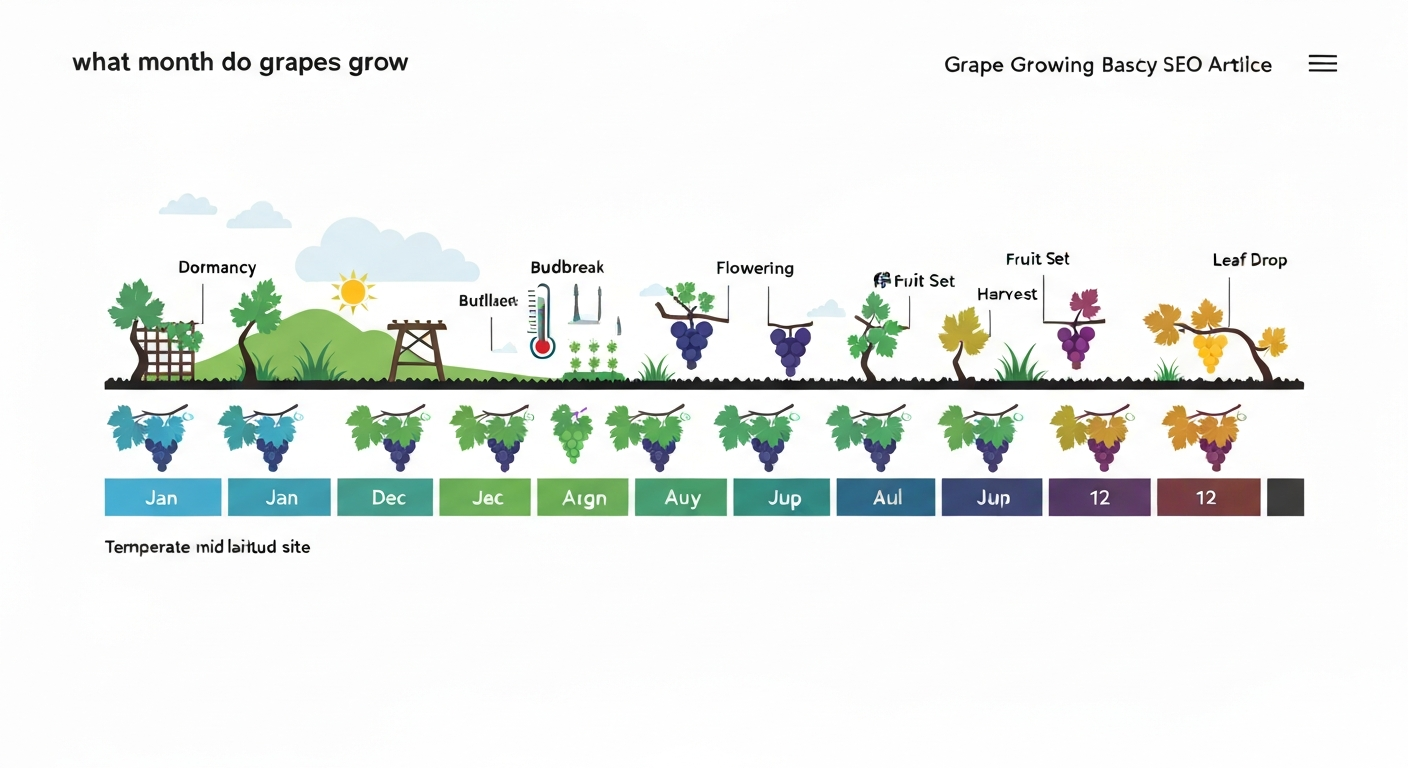
Before diving into regional differences, it helps to see the whole year at a glance. The timeline below reflects a typical mid-latitude temperate site, think Ohio, central Pennsylvania, or the Willamette Valley in Oregon, where winters are cold enough for full dormancy but summers are warm enough to ripen most hybrid and some vinifera varieties.
| Month | What the vine is doing | Key task for the gardener |
|---|---|---|
| January | Deep dormancy; canes and buds cold-hardened | Best time for dormant pruning in most climates |
| February | Still dormant in most zones; sap begins moving in Zone 7+ and California | Finish pruning before budbreak; check trellis |
| March | Budbreak starts in warm zones (Zone 7–9); bleeding (sap flow) visible at cut canes | Watch for late frost risk; hold off planting bare-root in cold zones |
| April | Budbreak in Zones 5–6; shoot growth begins; leaves unfurling | Plant bare-root vines; apply first fungicide if disease pressure is high |
| May | Rapid shoot growth; flowering begins in warm zones; leaf canopy filling in | Shoot positioning and tucking; monitor for powdery mildew |
| June | Flowering and fruit set across most zones; small green berries forming | Thin shoots; ensure good air circulation around clusters |
| July | Berry development (lag phase); berries hardening; veraison starts in warm zones | Irrigation management; leaf-pulling around clusters |
| August | Veraison (color change and sugar accumulation) across most zones; harvest begins in hottest sites | Monitor Brix (sugar) and flavor; reduce irrigation |
| September | Peak harvest month for most U.S. varieties; Concord and many hybrids come in now | Harvest; sanitize equipment; watch for botrytis if rains arrive |
| October | Late-season vinifera harvest in cool zones; leaves yellowing | Harvest late varieties; apply post-harvest fungicide if needed |
| November | Leaf drop; vine goes dormant; carbohydrates stored in wood | Mow cover crop; apply dormant spray if needed |
| December | Full dormancy; canes hardening off | Plan pruning; order new vines for spring |
The six stages of grape growth and when they actually happen
Every grapevine goes through the same sequence each year. The months shift depending on where you live, but the order never changes. Here's what each stage looks like and what triggers it.
Budbreak: the season officially starts
Budbreak is when you first see swollen, woolly buds pushing out of the cane. In Sacramento, UC Master Gardeners document typical budbreak in late February. In Washington State, WSU viticulture extension reports budbreak ranging from mid-February at low elevations to April in cooler, higher-elevation sites. In the Midwest and Northeast, Michigan, Ohio, Pennsylvania, expect budbreak in April, sometimes extending into early May in Zone 5. Budbreak is triggered by accumulated warmth after dormancy, not by calendar date, which is why using GDD (explained below) is more reliable than watching the calendar.
Leaf growth and shoot development: April through June
Once buds break, shoots extend rapidly and leaves unfurl along them. This is the fastest-growing phase of the vine's year, shoots can elongate several inches per week under warm, humid conditions. By the time flowering starts, a well-managed vine will have a substantial canopy in place. This is also the phase covered in detail when people ask when grapevine leaves and shoots first appear, and it's worth knowing exactly where on the vine those leaves emerge, I'll cover that anatomy in the next section.
Flowering: May in warm zones, June in cooler ones
Grape flowers are small, self-fertile, and not showy, you'll notice a faint sweet smell and tiny green flower caps dropping. UC Davis documentation places California valley flowering in May. In the Pacific Northwest, Oregon State University's wine-grape production guide (using the BBCH/Eichhorn-Lorenz scale) puts bloom in May as well, though June is common in cooler sites. In the Midwest and Northeast, Michigan State Extension reports bloom running May into June. Flowering is sensitive to cold and rain, a wet, cold bloom period is one of the main causes of poor fruit set.
Fruit set: June, give or take a few weeks
Fruit set follows flowering by one to two weeks. The fertilized flowers form tiny green berries and the cluster starts to take shape. At this point, berries are hard and very tart, they're essentially all seeds and skin. The vine is now fully committed to carrying a crop, so this is a good moment to assess cluster load and consider dropping excess clusters if you want better quality fruit.
Veraison: the most exciting week in the grape calendar
Veraison is when berries soften, change color (red/black varieties turn purple; green varieties turn translucent yellow-green), and start accumulating sugar rapidly. In Sacramento and San Joaquin Valley sites, UC Master Gardeners document veraison in July to August. Washington State WSU extension reports July to August veraison timing. In the Midwest and Northeast, veraison typically runs July into August, occasionally stretching later in cooler years or on late varieties. Once veraison starts, you're typically 4 to 8 weeks from harvest depending on variety and climate.
Harvest: August through October depending on everything
Harvest is the payoff, and it varies more than any other stage. In California's warmest valleys, early varieties like Thompson Seedless can come in during August. Chardonnay in cooler California sites often ripens August into early September. Cabernet Sauvignon in California typically runs September into October. In Washington State, WSU extension reports harvest running mid-September through October. In the Lake Erie and Northeast regions, Cornell and Penn State extension note that Concord, the classic American juice and jelly grape, typically peaks in September, while vinifera varieties in those same regions may push into September and October. An early-season variety like Marquette or Frontenac in Minnesota might hit in late August; a late vinifera in a Finger Lakes site might not come in until mid-October.
Where leaves and shoots actually form on the vine
A lot of new grape growers stare at a dormant vine in March and wonder where, exactly, the growth is going to come from. Here's the short version: leaves and shoots emerge from buds, and buds sit at nodes, the slightly swollen joints spaced along each cane. When you prune, you're deciding which nodes (and therefore which buds) will be the launch points for this year's growth. In spur pruning, you leave short two-to-three-node stubs called spurs along a permanent cordon. In cane pruning, you keep longer one-year-old canes (typically eight to twelve nodes each) and remove most of the others.
In spring, each retained bud pushes out a shoot. That shoot carries leaves, tendrils, and, if the bud is a fruitful one on a productive cane, one or two small flower clusters. The first few nodes from the base of a cane are often less fruitful than the middle nodes, which is why spur pruning works better for some varieties (like Chardonnay or Concord) and cane pruning works better for others. When you're watching a vine come out of dormancy, look for the woolly bud caps swelling at each node along the cane, that's your first sign that the growing season has started. The timing of that moment and which months it falls in is covered in detail in guides focused specifically on when grape vines start to grow and when grape vines grow their first leaves of the season.
How your climate and site shift the timeline
Hardiness zones set your outer limits
USDA hardiness zones tell you how cold your winters get, which is the primary constraint on which varieties you can grow at all. European vinifera varieties (Cabernet, Chardonnay, Pinot Noir) generally need Zone 6 or warmer to survive without special protection. American native varieties (Concord, Niagara) and cold-hardy hybrids (Marquette, Frontenac, La Crescent) can handle Zone 4 and sometimes Zone 3. But hardiness zones don't tell you how hot your summers are, how long your growing season is, or how many heat units you accumulate, all of which determine whether a variety will actually ripen.
Chill hours: what the vine needs to wake up properly
Chill hours are the accumulated hours of temperatures between roughly 32°F and 45°F (0–7°C) during dormancy. Grapes generally need between 150 and 500 chill hours depending on variety, though most temperate-climate varieties fall in the 200–400 hour range. Without sufficient chilling, buds break unevenly or not at all, this is a real problem in subtropical climates like coastal Florida or low-elevation areas in Hawaii. If you're in the Deep South or a subtropical zone, you'll want to look specifically at low-chill varieties developed for those conditions.
Growing-degree days: heat accumulation is the real engine
GDD (growing-degree days) measure heat accumulation above a base temperature. For grapes, U.S. extension services and Cornell's NEWA platform use a base of 50°F (10°C) as the standard. Each day you add the average temperature minus 50°F to your running total. If the average temperature is 70°F, you accumulate 20 GDD that day. If it's 48°F, you accumulate zero. The Winkler classification system, the standard U.S. viticultural heat-summation framework, developed at UC Davis by Amerine and Winkler, divides California wine regions into five zones (Region I through V) based on April-to-October GDD accumulation above 50°F. Region I sites accumulate fewer than 2,500 GDD; Region V sites accumulate more than 4,000 GDD. Extension services in North Carolina, Washington, and the Northeast use the same GDD/50°F base to match varieties to sites.
Microclimates matter more than you'd think
A south-facing slope warms faster in spring and accumulates more heat through summer than a flat site at the same elevation just a quarter-mile away. A site near a large body of water moderates both spring frosts and fall temperatures, extending the effective season. PRISM Climate Group data (Oregon State University) shows just how dramatic these micro-scale differences can be, temperature normals can shift significantly within a single county. Present and future Köppen‑Geiger climate classification maps at 1‑km resolution (Beck et al., Scientific Data 2018) can be used to map viticultural climate categories such as Mediterranean, temperate, continental, and subtropical. If you're on a frost-prone low spot, your effective season might be two to three weeks shorter than a neighbor on slightly higher ground. Choosing your site well is arguably more important than choosing your variety.
Region-by-region timing: budbreak and harvest months at a glance
| Region / Location | Climate Type | Typical Budbreak | Typical Harvest | Notes |
|---|---|---|---|---|
| California (Sacramento/San Joaquin Valley) | Mediterranean / Hot | Late February – March | August – September | Early budbreak; long hot season; wide variety range |
| California (Napa/Sonoma, coastal valleys) | Mediterranean / Moderate | March | September – October | Chardonnay Aug–Sep; Cab Sep–Oct; fog moderates heat |
| Pacific Northwest (Washington State) | Continental / Moderate | Mid-Feb – April (site-dependent) | Mid-September – October | WSU documents wide range by elevation and variety |
| Pacific Northwest (Oregon, Willamette Valley) | Marine / Cool | March – April | September – October | Pinot Noir dominant; cool season extends hang time |
| Midwest (Michigan, Ohio, Indiana) | Continental / Cold | April – early May | August – October | Concord typically September; cold-hardy hybrids Aug–Sep |
| Northeast (New York Finger Lakes, Pennsylvania, NJ) | Continental / Cold | April – May | September – October | Lake effect moderates frost; vinifera possible in protected sites |
| Southeast (Virginia, North Carolina, Tennessee) | Humid Subtropical | March – April | August – September | High humidity; disease pressure high; Muscadine thrives |
| Deep South (Georgia, Alabama, Mississippi) | Humid Subtropical / Warm | February – March | July – August | Muscadine and low-chill varieties; limited vinifera options |
| Texas Hill Country | Semi-arid / Hot | March – April | August – September | Hot, dry summers favor vinifera with irrigation |
| Upper Midwest / Great Plains (Minnesota, Wisconsin) | Continental / Very Cold | Late April – May | August – September | Cold-hardy hybrids only; Marquette, Frontenac, La Crescent |
| India: Maharashtra (Nashik/Sangli) | Semi-arid / Subtropical | ~October (after pruning) | January – March | Counter-season harvest; two crops per year possible |
| India: Karnataka, Andhra Pradesh | Semi-arid / Tropical | ~September – October | December – February | Thompson Seedless dominant; warm winters enable early harvest |
Using your last-frost date and GDD to predict your personal grape calendar
This is the practical part. You don't need a spreadsheet or a degree in agronomy, just two pieces of information and a few minutes. Here's how to build your own month-by-month grape calendar.
- Find your average last spring frost date. The most reliable source is NOAA's NCEI Climate Normals (1991–2020), available free online for thousands of U.S. stations. Search for the station nearest your garden and look for the 50% probability last-frost date in spring. This is the date by which there's an equal chance the last frost has passed.
- Find your average first fall frost date from the same source. The window between your last spring frost and first fall frost is your basic frost-free growing season. Grapes need at least 150 days; 180+ days is much more comfortable for most varieties.
- Start accumulating GDD from April 1 (or from your last-frost date if it falls after April 1). Use the formula: GDD per day = (daily high + daily low) ÷ 2, minus 50°F. Any day with an average below 50°F contributes zero. Cornell's Climate Smart Farming GDD calculator does this automatically if you input your location.
- Map stages to GDD thresholds. Budbreak in many varieties occurs after about 50–100 GDD have accumulated from January 1. Flowering typically follows at roughly 250–400 GDD from budbreak. Veraison in many cultivars arrives somewhere around 1,000–1,400 GDD from budbreak. Harvest typically falls between 1,300 and 1,900+ GDD from budbreak depending on variety — early ripeners are at the lower end, late-season vinifera at the higher end.
- Check whether your site accumulates enough total GDD for your target variety. Early-ripening cold-hardy hybrids like Marquette typically need around 1,200–1,400 GDD (base 50°F) from budbreak to harvest. Mid-season vinifera like Chardonnay need roughly 1,400–1,600 GDD. Late varieties like Cabernet Sauvignon typically need 1,600–1,900+ GDD. If your site doesn't accumulate enough heat before your first fall frost, that variety won't ripen reliably.
- Adjust for your microclimate. Add 50–100 GDD if you're on a south-facing slope with good solar exposure. Subtract if you're in a low frost pocket or heavily shaded site.
Variety timing: early, mid-season, and late ripeners
One of the most practical decisions you'll make is choosing a variety that matches your climate's heat budget. I've watched gardeners in Zone 5 try to grow Cabernet Sauvignon and get green, unripe clusters year after year. The fix is almost always choosing an earlier-ripening variety, not trying to coax more heat out of the site.
| Ripening Group | Example Varieties | Typical U.S. Harvest Window | Best-Fit Regions |
|---|---|---|---|
| Very early (table/juice) | Himrod, Lakemont, Einset Seedless | Late July – August | Zone 5–9; Midwest, Northeast, South |
| Early-mid (cold-hardy hybrid) | Marquette, Frontenac, La Crescent, Itasca | August – early September | Zone 4–6; Upper Midwest, Great Plains, Northeast |
| Mid-season (American native) | Concord, Niagara, Catawba | September | Zone 5–7; Great Lakes, Northeast, Mid-Atlantic |
| Mid-season (vinifera) | Chardonnay, Pinot Gris, Sauvignon Blanc | Late August – September | Zone 6–8; Pacific Northwest, California, Virginia |
| Late (vinifera) | Cabernet Sauvignon, Merlot, Syrah | September – October | Zone 7–9; California, Pacific Northwest, Texas |
| Muscadine | Carlos, Noble, Ison | August – September | Zone 7–9; Southeast, Deep South |
| Low-chill subtropical | Black Spanish (Lenoir), specific hybrids | July – August | Zone 8–10; Gulf Coast, Florida, Hawaii (select sites) |
Frost, late freezes, and when your vine is most vulnerable
Frost risk doesn't disappear the moment your vine pushes buds, if anything, that's when it gets most dangerous. A dormant cane can survive temperatures of -10°F to -20°F in cold-hardy varieties, but once a bud has broken and a shoot is two to three inches long, even a light frost at 28°F to 30°F can kill that shoot and the flower clusters inside it. Here's how risk changes through the season:
| Growth Stage | Frost Kill Temperature (approximate) | Risk Window | Simple Protection Options |
|---|---|---|---|
| Dormant cane (winter) | Varies by variety: -10°F to +5°F for vinifera; -20°F to -30°F for hardy hybrids | December – February | Choose cold-hardy varieties; bury canes in very cold zones |
| Budbreak (swollen bud) | Around 28°F to 30°F | March – May depending on zone | Delay pruning to slow budbreak; overhead irrigation; row covers |
| Shoot elongation (1–3 inches) | 28°F to 32°F; very susceptible | April – May in most zones | Frost cloth or row covers overnight; wind machines; site selection on elevated ground |
| Flowering | 32°F damages flowers | May – June | Same as above; avoid frost-prone low spots |
| Berry development | 28°F to 30°F damages berries | June – July | Row covers; wind machines in commercial operations |
| Veraison and ripening | 28°F damages ripening clusters | August – October | Monitor forecast closely; harvest before predicted hard frost if near ripeness |
One practical trick: delay your dormant pruning as long as possible in spring. Unpruned vines break bud slightly later than pruned vines, which can push budbreak past the worst of your late-frost window. In Michigan and Pennsylvania, extension services routinely recommend this delay-pruning approach for exactly this reason. It's not a perfect solution, but it's free and requires nothing more than patience.
On the other end of the season, an early fall frost before your grapes have reached full ripeness is one of the most discouraging things that can happen. This is where variety selection loops back again: if your first fall frost typically arrives in early October and you're trying to ripen a late vinifera variety, you're gambling every single year. Choosing a variety that's reliably ripe by mid-September in your zone removes that gamble entirely.
Grapes in India: a completely different calendar
If you're reading this from India or curious about Indian grape timing, the whole season is essentially inverted compared to North America. In Maharashtra's Nashik and Sangli districts, India's most important grape-growing regions, vines are pruned in September or October, which triggers the equivalent of budbreak and new shoot growth. Harvest in these subtropical, semi-arid zones typically peaks from January through March, with Nashik's export-quality Thompson Seedless hitting peak harvest in that January-to-March window. Karnataka and Andhra Pradesh follow a similar pattern, with harvest running December through February in many areas. The subtropical climate and two-crop-per-year potential make Indian viticulture very different from temperate systems, and the variety choices, dominated by Thompson Seedless and a handful of export-quality table grapes, reflect those conditions. For a detailed exploration of the Indian grape season, the seasonal patterns by region are covered specifically in the guide on which season grapes grow in India.
Is your yard actually viable? A quick self-check
Before buying vines, run through these four checkpoints. I've seen plenty of gardeners skip this step and end up frustrated, so I'll be honest: not every yard is a good grape yard, and knowing that upfront saves a lot of time and money.
- Frost-free season: Do you have at least 150 days between last spring frost and first fall frost? Check NOAA's Climate Normals for your nearest station. If yes, you can likely ripen at least early-season varieties. If no, grapes are very difficult without selecting extremely early ripeners or cold-hardy varieties specifically bred for short seasons.
- GDD accumulation: Does your location accumulate at least 1,200–1,400 GDD (base 50°F) between budbreak and your first fall frost? Cornell's Climate Smart Farming GDD tool can estimate this. If yes, cold-hardy hybrids and some American natives are viable. If you accumulate 1,600+ GDD, mid-season vinifera become realistic.
- Winter cold: Are you in Zone 6 or warmer? If yes, vinifera varieties are a possibility with good site selection. Zone 5 and colder strongly favors cold-hardy hybrids. Zone 4 and colder means your choices are limited to the most cold-tolerant varieties (Marquette, Frontenac, Itasca).
- Chill hours: Are you in a subtropical or tropical climate (Zone 9–10, Florida, Hawaii, South Texas, coastal Southern California)? If yes, standard temperate varieties may fail to break dormancy properly. You'll need to seek out low-chill cultivars or accept irregular performance.
Your next steps
Once you know your zone, your frost dates, and your rough GDD budget, the path forward is pretty clear. If you're in the planning stage, the most valuable things you can do right now are: look up your NOAA last-frost date, run a quick GDD estimate for your area using Cornell's Climate Smart Farming tools, and match that heat budget to one of the variety groups in the table above. If you're already growing and trying to understand why your vine is ahead of or behind schedule, the GDD framework explained here will answer most of those questions. For deeper dives into specific timing questions, like exactly when to expect those first leaves to appear, when vines wake up in spring, or how the season differs by region, the related guides on when grape vines start to grow and when grapevine leaves emerge in spring cover those details step by step. For another relevant comparison, see when do grape vines start to grow. For a focused look at leaf placement and growth habits, see our guide on where do grape leaves grow. If you also grow citrus, see the related guide on when do grapefruits grow for timing and care specific to grapefruit trees. For a concise overview of timing across climates, see the guide on what season does grapes grow.
FAQ
Quick answer: In what month(s) do grapes grow and produce fruit for home gardeners?
Grapevines begin active growth (budbreak and leafing) in late winter to spring and progress to flowering, fruit set, veraison (color change/sweetening) and harvest through summer into fall. Typical month ranges: budbreak: Feb–May, flowering: Apr–Jun, fruit set: May–Jul, veraison: Jul–Aug, harvest: Aug–Oct in temperate/Mediterranean climates. In cool/continental climates these stages shift 4–8 weeks later; in subtropical/warm climates they occur earlier or extend longer. Exact months depend on local climate, variety and site.
How do those month ranges change by broad climate type (Mediterranean, temperate, continental, subtropical)?
Mediterranean (e.g., coastal California): budbreak Feb–Mar, flowering Apr–May, veraison Jul–Aug, harvest Aug–Sep. Temperate maritime/Pacific Northwest: budbreak Mar–Apr, flowering May, veraison Jul–Aug, harvest Sep–Oct. Continental/cool (Midwest, Northeast): budbreak Apr–May, flowering May–Jun, veraison Jul–Aug, harvest Sep–Oct (often later). Subtropical/warm (parts of India, southern U.S. warm zones): budbreak Jan–Feb or earlier, flowering Mar–May, veraison May–Jul, harvest can occur in winter months or spread across many months depending on local practice.
What are typical month windows for U.S. regions and selected states?
General U.S. guidance: Pacific Coast (CA north to OR): budbreak Feb–Apr, bloom Apr–May, veraison Jul–Aug, harvest Aug–Sep (coastal CA may ripen earlier). Pacific Northwest (WA, OR inland/colder sites): budbreak Mar–Apr, bloom May, veraison Jul–Aug, harvest Sep–Oct. Midwest/Northeast (MI, NY, PA, OH, New England): budbreak Apr–May, bloom May–Jun, veraison Jul–Aug, harvest Sep–Oct. Southeast (NC, GA): budbreak Mar–Apr, bloom Apr–May, veraison Jun–Jul, harvest Aug–Sep. These are typical windows; microclimate and variety shift timing.
What about India—when do grapes grow and ripen there?
In major Indian table‑grape districts (Maharashtra: Nashik, Sangli), commercial seasons commonly concentrate harvest in cooler months; many export cultivars (e.g., Thompson Seedless) are harvested or peak Jan–Mar after a winter/early‑spring growing cycle. Local timing varies with elevation, irrigation and cultural practice; some Indian regions produce grapes on schedules that differ from temperate patterns, often coordinated to avoid monsoon or leverage cool dry months for export quality.
What exactly are the vine growth stages and the month-by-month seasonal timeline gardeners should expect?
Phenology summary by stage: budbreak (buds swell, green tips) — late winter to spring (Feb–May depending on region); leaf growth and shoot extension — immediately after budbreak through late spring; flowering (small clusters and open flowers) — spring (Apr–Jun); fruit set (berries form) — shortly after flowering (May–Jul); berry development/lag phase — late spring–early summer; veraison (color change, sugar accumulation) — mid to late summer (Jul–Aug); ripening/harvest — late summer to fall (Aug–Oct) in temperate climates or shifted earlier/later by region and variety. Month-by-month progress varies with local temperatures and cultivar heat requirements.
How can I predict local timing using frost dates, chill hours and growing‑degree days (GDD)?
Use three measurable factors: 1) Last spring frost date: average last frost gives earliest safe budbreak window—buds that break before your last frost risk can be killed. 2) Chill hours (winter accumulation) influence dormancy release—insufficient chill can delay or erratic budbreak (important in warm/humid subtropical areas). 3) Growing‑degree days (GDD, commonly base 50°F / 10°C for grapes) predict accumulated heat from budbreak to stages like veraison/harvest. Practical steps: look up your station's average last frost (NOAA/PRISM or local extension), check local chill-hour maps if in a marginal warm area, then track GDD accumulation using local extension/online calculators (Cornell NEWA, state tools) and compare to variety heat‑requirements. Many extension guides and online GDD tools will estimate bloom and harvest dates for your location.