
Grape leaves grow at the nodes along every shoot on the vine, and geographically they can grow almost anywhere on earth as long as you match the right variety to your climate. On the plant, each leaf attaches at a node, which is the slightly swollen joint you can see along a green shoot. Between any two nodes is an internode, a plain stem segment where no leaves ever form. Geographically, grapevines producing healthy leaf canopies show up in USDA zones 3 through 10 across the United States, across Mediterranean Europe, in subtropical India, in humid southeastern states, and in the Southern Hemisphere, because breeders have now developed varieties adapted to nearly every temperate and warm climate on the planet.
Where Do Grape Leaves Grow: Vine, Climate, Months, Care

Marcus Whitfield
22 Jul 2026
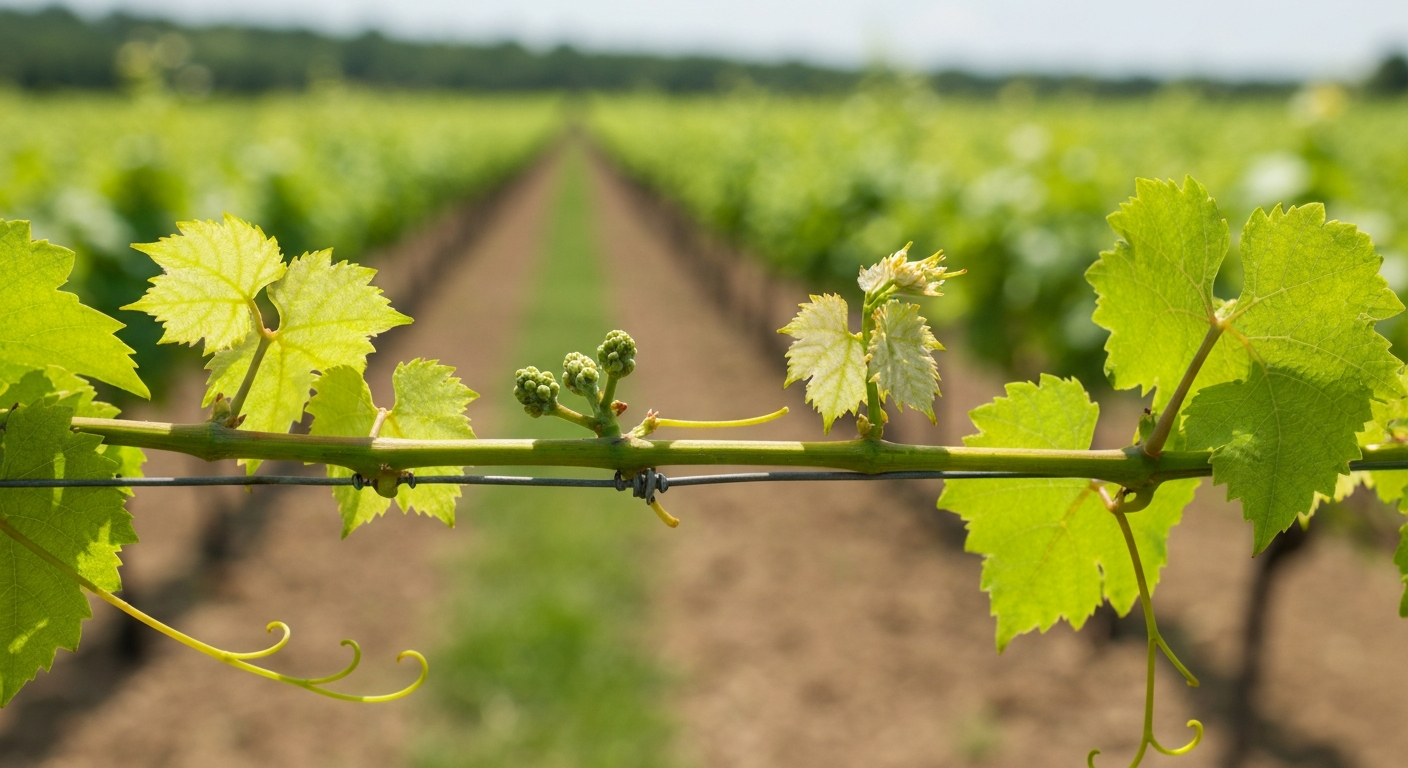
How grape leaves actually form on the vine
Every grapevine shoot is built from repeating units called phytomers. Each phytomer is one node plus one internode. The node is where everything interesting happens: a leaf attaches there, an axillary bud sits in the leaf's armpit, and tendrils, flower clusters, or lateral shoots also originate from nodes. The internode is just the stretch of stem between two nodes, and nothing grows out of it. So if you look at a grapevine shoot in midsummer, every single leaf you see is positioned at a node, and the bare stem between leaves is an internode. That structure is consistent from basal bud to shoot tip.
Those leaves do not appear out of nowhere in spring. They are pre-formed. Each dormant compound bud sitting at a node through winter already contains the primordia for roughly 12 to 16 leaves, plus early floral primordia for the following season. The bud is essentially a compressed, pre-built shoot waiting for the right temperature signal to expand. That signal is budbreak, the moment when green leaf tissue first pushes through the bud scales and becomes visible. In viticultural phenology, this corresponds to BBCH stage 07 (also called E-L stage 4), and it marks the true start of the vine's annual growth cycle.
Once budbreak happens, shoot elongation is rapid. The internode stretches, the next node emerges, and a new leaf unfurls, then the next, and so on up the shoot. Early in the season the basal leaves (those from the lowest nodes on the cane) are actually the oldest and often the largest by the time you look at them in May or June. Shoot growth rate, and therefore internode length, speeds up with warm temperatures and slows in heat stress or drought. Long internodes mean leaves are spaced further apart, which matters for light interception later.
One detail worth knowing if you're managing your vines: basal buds (bud position 1, closest to the cane base) and distal buds (further out toward the tip) differ in cold hardiness and fruitfulness. Research shows these vary by cultivar and by how autumn temperatures fluctuated during hardening. This is why pruning cuts and bud counts matter: which buds you leave determines where shoots, and therefore leaves, emerge the following spring.
When leaves appear: a seasonal and monthly calendar across climates
Budbreak timing is driven by two temperature processes: first, the vine needs to satisfy a winter chilling requirement (accumulated hours below a threshold, typically around 7°C / 45°F), and second, it needs enough spring warmth (forcing temperatures) to push growth. Together these mean that geography and microclimate determine when you first see leaves each year. For more on timing and regional differences, see when do grape vines start to grow. For a quick seasonal and monthly calendar showing when do grape vines grow leaves across different climates, see the guide below. Here is how that plays out across the major grape-growing climates. For related timing of a different fruit crop, see when do grapefruits grow. For a month-by-month guide to when grapes grow in different climates, see what month do grapes grow. For more on timing, see our guide on what season does grapes grow.
| Climate type | Region examples | Typical budbreak / leaf-out | Leaf season ends (dormancy) |
|---|---|---|---|
| Temperate (mild) | Willamette Valley OR, central France, coastal CA | Late March to mid-April | October to November |
| Mediterranean (warm, dry) | San Joaquin Valley CA, Coachella Valley CA, Napa | Coachella: Jan–Feb; San Joaquin: ~March; Napa: March–April | October to November |
| Cold continental (northern US) | Minnesota, upstate New York, Michigan UP | Late April to mid-May | September to October |
| Subtropical (NW India plains) | Punjab, Haryana, western UP | First week of March (post-dormancy budbreak) | November to December |
| Hot tropical (central-west India) | Nashik, Sangli, Solapur (Maharashtra) | No full dormancy; double-pruning system; major harvest March–April | Vines managed year-round |
| Southern Hemisphere temperate | South Australia, Victoria, Tasmania | SA/Vic: late August–September; Tasmania: October–November | April to May (SH autumn) |
The India situation is worth a moment because it surprises a lot of readers. In the subtropical northwest (Punjab, Haryana), vines do go dormant, temperatures drop enough to fulfill chilling requirements, and budbreak happens in early March, similar to mid-latitude temperate regions. But in the hot tropical Nashik region, which produces the bulk of India's commercial wine grapes, vines never fully shut down. Growers there use a double-pruning system: a first pruning to force uniform budbreak and manage the growth cycle, and a second pruning to set the fruiting shoots. Harvest concentrates around March and April. If you're growing grapes in India and wondering about the leaf cycle there, the answer genuinely depends on which agro-climatic zone you're in. See a short guide on in which season grapes grow in India for regional timing and harvest months across the major agro‑climatic zones.
Leaf timing by USDA hardiness zone: what the zones mean for your vine
USDA Plant Hardiness Zones are based on average annual extreme minimum temperatures, and they are the most practical starting screen for deciding whether a grape variety can survive winter in your location. The 2023 updated USDA map is the current reference. But zones only tell you about cold survival, not about heat accumulation, humidity, or disease pressure. Think of your zone as the first filter, then layer on your frost dates and summer climate on top of that.
| USDA Zone | Avg. min. temp (°F) | Leaf-out timing (approx.) | Practical implication for grape growers |
|---|---|---|---|
| Zone 3 | -40 to -30 | Mid to late May | Only cold-hardy hybrids (Frontenac, Marquette, Itasca) survive; short season, select early-ripening varieties |
| Zone 4 | -30 to -20 | Early to mid-May | Cold-hardy hybrids still needed; Minnesota-bred cultivars bred specifically for this zone |
| Zone 5 | -20 to -10 | Late April to early May | Hybrids and some V. labrusca cultivars (Concord, Niagara) are reliable; some vinifera possible on sheltered sites |
| Zone 6 | -10 to 0 | Mid to late April | Broader variety options; cold-hardy hybrids and V. labrusca recommended; vinifera risky without winter protection |
| Zone 7 | 0 to 10 | Early to mid-April | Vinifera becomes viable on well-chosen sites; Chambourcin, Cabernet Franc, Traminette perform well |
| Zone 8 | 10 to 20 | Mid-March to early April | Wide vinifera range possible; heat and humidity management become key concerns |
| Zone 9–10 | 20 to 40 | January–March depending on location | Vinifera thrives; chilling may be insufficient for some varieties; muscadine viable in humid SE parts of zone 8–9 |
One thing I want to be honest about: late spring frosts are often a bigger immediate threat to young leaves than winter cold is to the dormant vine. NOAA and regional climate center tools (like the Midwestern Regional Climate Center) publish county-level median last spring freeze dates. If you're in zone 5 and your last frost date is May 10, a vine that leafs out April 25 has real exposure. That's not a reason to avoid grapes, it's a reason to choose varieties with a slightly later budbreak or to have row cover ready.
Matching grape types to your climate
There are four main categories of grapes you'll encounter as a home grower, and each has a distinct climate home. Vitis vinifera performs best in warmer, drier Mediterranean and warm‑temperate sites (commonly USDA zones ~7–10), while cold‑hardy interspecific hybrids and North American species (V. riparia, V. labrusca, V. aestivalis) are recommended for cooler inland/northern USDA zones (zones 3–6) Vitis vinifera performs best in warmer, drier Mediterranean and warm‑temperate sites (commonly USDA zones ~7–10), while cold‑hardy interspecific hybrids and North American species (V. riparia, V. labrusca, V. aestivalis) are recommended for cooler inland/northern USDA zones (zones 3–6).. Knowing which group fits your zone saves you a lot of frustration. I've seen people in Minnesota try to grow Cabernet Sauvignon outdoors and wonder what went wrong in January. And I've seen people in Georgia growing Concord grapes that struggle with Pierce's disease every summer when muscadines would thrive with almost no intervention.
| Grape type | Primary species | Best USDA zones | Climate strengths | Key limitations |
|---|---|---|---|---|
| European wine grapes | Vitis vinifera | 7–10 (variety dependent) | Low humidity, warm-dry summers, mild winters; classic wine styles | Cold-tender below roughly -5°F; disease-susceptible in humid climates |
| American grapes | V. labrusca, V. aestivalis, V. riparia | 4–7 core range | Cold-hardy, tolerates humid summers better than vinifera; familiar flavors (Concord, Niagara) | Foxy flavor profile not for everyone; V. labrusca susceptible to Pierce's disease in deep South |
| Cold-hardy hybrids | Interspecific (MN bred, French hybrids) | 3–6 (some to zone 3) | Bred for extreme cold; moderate disease resistance; wine-quality fruit | Some have lower yield; less widely available as plants; newer variety catalog |
| Muscadine | Vitis rotundifolia | 7–10 in Southeast US | Heat and humidity tolerant; excellent Pierce's disease resistance; low spray needs | Thick skins; distinct flavor; not cold-hardy below about 0°F; requires cross-pollination in some varieties |
The University of Minnesota's breeding program has done genuinely impressive work for cold-climate growers. Varieties like Frontenac, Frontenac Gris, La Crescent, Marquette, and Itasca are rated for zones 3 to 4, and they've been tested extensively in northern vineyard conditions. If you're in the upper Midwest and thought grapes were not for you, these are worth a serious look. On the other end of the country, muscadine varieties like Carlos, Magnolia, and Noble are the backbone of home vineyards across the Carolinas, Georgia, Mississippi, and Louisiana. Their leaves emerge with the same spring flush as other grapes, and they put on vigorous canopies through the humid southeastern summer when a vinifera vine would be struggling with downy and powdery mildew.
Choosing varieties for your state or zone: a decision path
The decision process doesn't need to be complicated if you work through it in the right order. Here's the sequence I use when helping someone figure out whether grapes will work in their backyard and, if so, which ones.
- Look up your USDA hardiness zone using the 2023 USDA map and your zip code. This tells you your winter low-temperature range.
- Find your average last spring frost date and first fall frost date from NOAA or your local extension service. This gives you your frost-free growing season length.
- Assess your summer climate: is it hot and dry (western US, inland), warm and humid (southeast, mid-Atlantic), or cool and wet (Pacific Northwest coast, Great Lakes)? Humidity level affects disease pressure more than almost anything else.
- Rule in or out grape types based on zone and climate: cold-hardy hybrids for zones 3–5, V. labrusca types for zones 4–7, muscadines for zones 7–10 in the humid Southeast, vinifera for zones 7–10 in drier climates.
- Check your state's cooperative extension service for regionally tested variety lists. These are the most reliable recommendations because they reflect local disease pressure, heat accumulation, and frost patterns that a national list can't fully capture.
- Consider your chilling hours if you're in a warm zone (8–10). Some vinifera varieties need 800–1,200 hours below 45°F; in mild winters these buds may break unevenly or be delayed. Low-chill varieties exist for warm climates.
- Narrow to two or three varieties and start small, two to four vines. Establish those before scaling up.
A note on frost and disease as the two most likely failure points: late spring frosts kill young leaves on any grape variety, so timing matters regardless of zone. For disease, humid-summer states like North Carolina, Tennessee, Arkansas, and Missouri face heavy pressure from black rot, downy mildew, and powdery mildew. In those climates, disease-resistant hybrids (Chambourcin, Traminette, Norton/Cynthiana) or muscadines dramatically reduce your spray program compared to vinifera. I've grown Cabernet Franc in zone 7 Virginia and spent a lot of time spraying. Neighbors growing Norton in the same county spray far less and get more consistent crops. Worth knowing going in.
Picking the right site to get healthy leaves
Even the right variety in the right zone can underperform on a poor site. Grape leaves need direct sun to photosynthesize efficiently, and the vine's entire energy system runs through that leaf canopy. Here's what I look for when siting a home vineyard.
- Full sun, at least 6 to 8 hours of direct sun daily. South- or southeast-facing aspects maximize morning sun, which dries dew off leaves quickly and reduces fungal disease.
- Good air drainage. Cold air sinks, so avoid frost pockets at the base of slopes. A slight slope or elevated position lets cold air drain away from young shoots during spring frosts.
- Well-drained soil. Grapevines tolerate a wide range of soil types but will not thrive in waterlogged conditions. Roots sitting in water promote crown rot and root diseases. Raised beds or berms help on flat, clay-heavy sites.
- Soil pH between 5.5 and 6.5. Moderately acidic soils suit most grape species. If you're above pH 7.5, vine nutrient uptake (especially iron and manganese) becomes impaired, which shows up as pale, chlorotic leaves.
- Wind protection without air stagnation. A windbreak on the prevailing wind side reduces shoot breakage in spring, but the site still needs airflow through the canopy to reduce humidity and dry leaves after rain.
- Access to irrigation for the establishment period. Even drought-tolerant varieties need consistent moisture in their first two seasons while roots develop.
Microclimate matters enormously, and it's one reason grapes can succeed in surprising locations. A south-facing wall in a zone 6 garden can create zone 7 or even zone 8 conditions against the masonry. Growers in the UK and the US Northeast have been exploiting this for centuries. If you have a sheltered, sun-baked south-facing wall, that's often the best place for a vinifera variety that your zone map would otherwise rule out.
Planting and first-year care: building your leaf canopy from day one
The goal of your first growing season is not fruit. It's roots and leaves. The more healthy leaf area a young vine builds in year one, the stronger the root system it develops heading into winter, and the faster it reaches full production in years three and four. Everything you do in year one should serve that goal.
Plant bare-root vines in early spring, as soon as the soil is workable and frost risk is declining for your area. Container-grown plants can go in a little later. Space vines 6 to 8 feet apart for most training systems, or 8 to 10 feet for muscadines, which are more vigorous. Dig a hole wide enough to spread roots without circling, set the graft union (on grafted vines) above the soil surface, and backfill with the native soil. Resist the urge to add compost or fertilizer directly into the planting hole as this can burn young roots.
After planting, cut the vine back to two or three buds. I know that feels brutal on a plant you just paid for and carefully installed, but it forces early energy into roots rather than top growth. You'll still get shoots, and those shoots will put out leaves, and those leaves will feed the roots through photosynthesis all season. Keep the soil consistently moist for the first six weeks. Once roots are established, the vine is surprisingly drought tolerant, but that first month is critical.
As shoots grow, select the single strongest one and tie it loosely to a stake. Remove other shoots at the base. This is training, not just tidying. You're building one central trunk, and every leaf on that selected shoot is contributing carbohydrates to root development. Let it grow as tall as possible through the first season without tipping or pinching. By late summer you should have a shoot 3 to 5 feet long with a full complement of leaves. That's a successful first year.
Training systems (VSP, high cordon, GDC, pergola) and pruning choices (spur vs. cane) determine where shoots originate in subsequent years, which in turn determines where leaves are distributed across the canopy. Cane pruning renews the fruiting wood each year from longer canes, and leaves emerge all along those canes. Spur pruning keeps short spurs on a permanent cordon, and shoots and leaves emerge from those fixed points. Neither is universally better, but understanding that pruning physically controls leaf placement helps you make sense of canopy management decisions as your vine matures.
Water consistently through your first season, aiming for 1 inch per week during dry stretches, delivered at the root zone rather than overhead. Overhead watering wets the leaves and increases disease pressure. A simple drip line or soaker hose at the base is ideal. By the end of year one, your vine should be hardening off its canes as days shorten and temperatures drop, preparing those buds for next spring's leaf-out, and the cycle starts again.
FAQ
Quick answer: Where do grape leaves grow?
Grape leaves grow at the nodes along shoots; each node bears a leaf, an axillary bud (which can produce next season’s shoot or flowers), and often tendrils. Geographically, grape leaves (vines) grow wherever the vine species/variety is suited to the local climate—from warm Mediterranean zones (common for Vitis vinifera) to colder zones where cold‑hardy hybrids and native species are used. Use your USDA hardiness zone and local extension guidance to pick suitable grape types.
How do leaves form on the vine (plant anatomy and growth stages)?
Vine shoots are built from repeating phytomers: each phytomer contains a node (where the leaf attaches) and an internode (stem segment between nodes). Leaves, tendrils, flowers or lateral shoots originate at nodes; leaves do not form on internodes. Dormant compound buds at nodes contain next season’s primordia (often 12–16 leaves and floral parts). Budbreak—when green leaf tissue first appears—marks the start of the new season’s leaf and shoot growth.
When do grape leaves appear (budbreak/leaf‑out) across seasons and months?
Timing follows local climate and variety. In temperate Northern Hemisphere regions budbreak commonly occurs March–May; in warmer Mediterranean sites (e.g., parts of California) it can be earlier (January–March in warm microclimates). In the Southern Hemisphere (Australia) median budburst is around September, with warm low‑elevation areas earlier. In India, schedules vary by agro‑climatic zone: some subtropical zones see budbreak around early March, while hot tropical regions (e.g., Nashik) may have reduced dormancy and different pruning/harvest calendars. Budbreak timing is driven by chilling fulfillment and spring warming.
Which climates, states and USDA zones support grape leaf growth and what species suit each zone?
- Mediterranean/warm temperate (USDA ~7–10): Vitis vinifera and many wine table varieties perform well in warm, dry sites (California, parts of Pacific Northwest, Mediterranean climates). - Cool/cold climates (USDA zones 3–6): cold‑hardy interspecific hybrids and native species (e.g., Frontenac, Marquette, La Crescent from breeding programs) are recommended (northern U.S., upper Midwest). - Southeastern U.S./Coastal Plain: muscadine grapes (Vitis rotundifolia) tolerate heat, humidity and regional diseases (NC, SC, GA, AL, MS, parts of FL, LA, TX). Use the USDA Plant Hardiness Zone map as an initial filter and then consult local extension for variety lists matched to your county microclimate.
How do variety type and cultivar choice affect leaf timing and survival?
Varieties differ in chilling requirement, budbreak date, vigor, and cold tolerance. V. vinifera often needs milder winters and is less winter‑hardy; cold‑hardy hybrids/native species are bred for lower extreme minimum temperatures and later budbreak in spring. Muscadines are adapted to hot, humid southeastern climates. Choose varieties recommended by local extension or regional variety selectors for your USDA zone and region to match leaf timing, frost risk and disease pressure.
How does pruning and training change where leaves appear on the vine?
Pruning and training determine which buds are retained and therefore where shoots and leaves will originate. Spur pruning (short spurs on cordons) concentrates shoots near the cordon and produces a more even, lower canopy. Cane pruning renews long one‑year canes so shoots (and leaves) originate from those canes spread along the trellis. Training systems (VSP, Geneva Double Curtain, pergola, high cordon) change shoot density and vertical placement of leaves and are used to manage light interception, airflow and fruit zone microclimate.