Red and green grapes do not naturally grow on the same vine. Every vine produces one berry color determined by its genetics, specifically which version of the VvMYBA gene it carries. So if you want both colors in your garden, you need to plant separate vines, choose one of the rare bicolored cultivars, or use grafting. There are a couple of quirky exceptions involving natural mutations, but those are curiosities rather than something you can reliably plan around.
Do Red and Green Grapes Grow on the Same Vine? Home Garden Guide
Marcus Whitfield
24 Jul 2026
Can red and green grapes grow on the same vine?
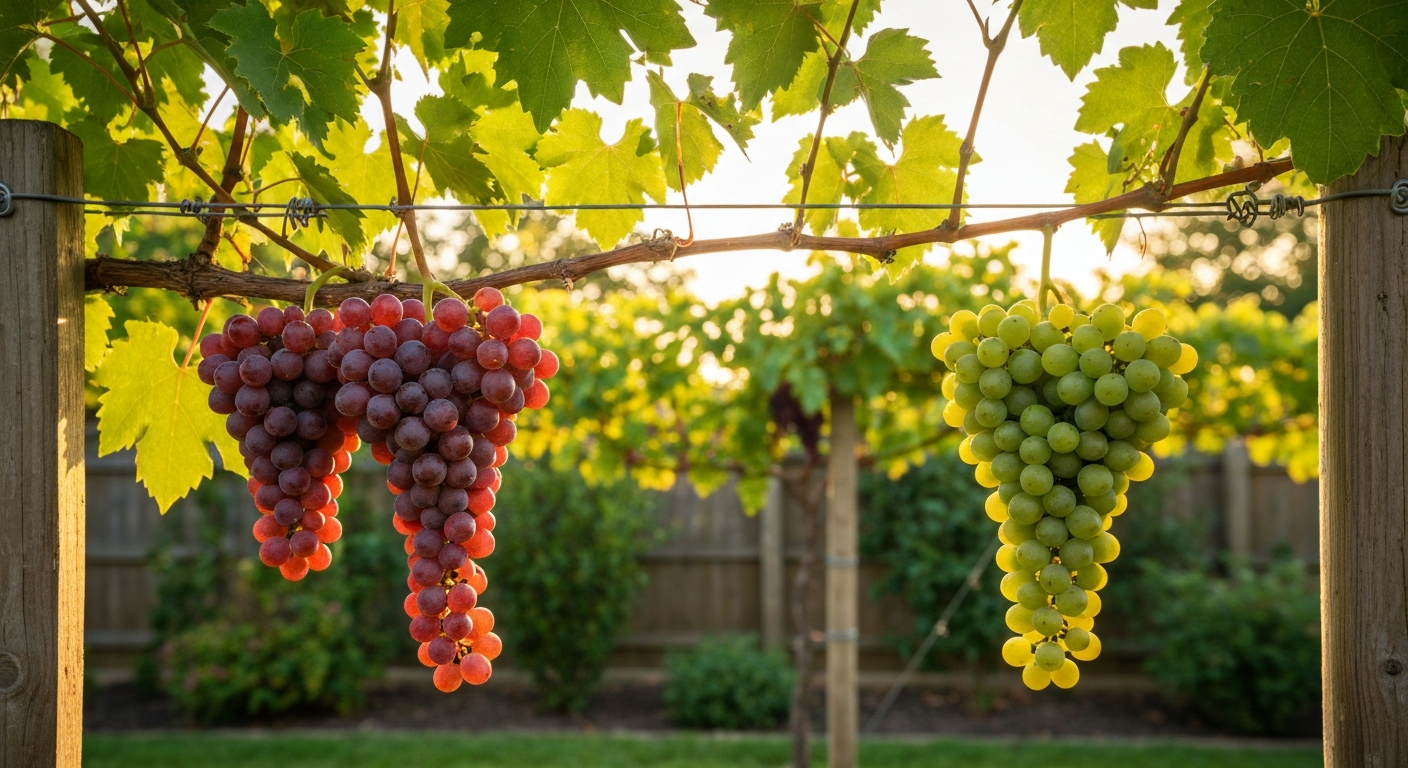
The straightforward answer is no, not under normal circumstances. A single grape vine produces fruit in one color category because that color is locked into the vine's DNA at the genetic level. That said, I've had gardeners ask me this after seeing unusual clusters with a mix of colors at harvest, and there's actually a real (if rare) explanation for that, which I'll get to shortly. But as a baseline rule for planning your home vineyard: one vine, one color.
The practical upside is that getting both colors in a home garden is genuinely easy. You just need a couple of vines and enough space, which most backyard setups can accommodate. The more interesting question, especially if you're working with limited space or a tricky climate, is which varieties to choose and how to manage them well.
How grape color actually works
Grape berry color comes down to one gene family: VvMYBA, particularly two members called VvMYBA1 and VvMYBA2. Studies show the VvMYBA gene cluster (notably VvMYBA1 and VvMYBA2) controls berry skin color: functional alleles activate UFGT and the anthocyanin pathway, while loss‑of‑function alleles produce white/green berries VvMYBA gene cluster (VvMYBA1 and VvMYBA2) controls berry skin color. When these genes are functional, they switch on an enzyme called UFGT, which triggers the anthocyanin pathway. Anthocyanins are the pigments that give red, purple, and blue-black grapes their color. When the genes are switched off, the berry skin stays green or pale yellow, which is what we call white or green grapes.
What silences those genes in most white grape cultivars is a retrotransposon (a mobile genetic element) called Gret1, which inserted itself into the promoter region of VvMYBA1 thousands of years ago. That insertion essentially blocks the gene from being read, so no anthocyanins are made and the berry stays pale. Different combinations of working and non-working versions of VvMYBA1 and VvMYBA2 explain the full color spectrum you see in cultivated grapes, from pale green through pink, rosé, red, and all the way to deep purple-black. It's a surprisingly elegant system sitting on chromosome 2.
What this means practically: the vine's color is set the moment it's propagated. You can't prune, fertilize, or water a green grape vine into producing red fruit. The genetics don't change based on how you grow it.
Natural color mutations, sports, and bicolored varieties
Here's where it gets a little more interesting. Grapevines occasionally undergo what are called somatic mutations or bud sports, where a single bud changes its genetic makeup slightly and grows into a shoot that behaves differently from the rest of the vine. Sometimes that change affects berry color. The classic example is the Pinot family: Pinot Noir, Pinot Gris, and Pinot Blanc all arose as independent somatic mutations of one another. Pinot Gris has grayish-pink berries, Pinot Blanc is essentially white, and Pinot Noir is dark purple. They are genetically nearly identical, yet produce very different-colored fruit, because the mutation happened in specific cell layers of the shoot tip.
These cell-layer-specific changes are called periclinal or sectorial chimeras. A vine that's a chimera can sometimes produce clusters that are partially one color and partially another, because different layers of the berry skin are producing (or not producing) pigment. It's genuinely striking when it happens, and it's the real biological explanation behind those unusual mixed-color clusters people occasionally notice. However, chimeras are unstable and unpredictable. They're not something you can deliberately engineer in a home garden, and any cuttings you take from a chimeric vine may or may not carry the mixed trait. Many commercially important new cultivars have been selected from stable bud sports over viticulture history, but those breeders were working with large populations and a lot of patience.
There are a handful of cultivars with naturally bicolored or variegated fruit, like certain selections that consistently show green and pinkish-red sectors on the same cluster. These are uncommon and may not be readily available from most nurseries, but if aesthetic variety on a single vine is your goal, it's worth asking a specialty grape nursery about chimeric or bicolored selections.
Viticultural practices that affect what color fruit a vine produces
The most important thing to understand here is that grafting does not change a vine's berry color. When you graft a scion (the fruiting top part) onto a rootstock, the scion keeps its own genetic identity completely. The rootstock can influence vigor, drought tolerance, resistance to phylloxera (the root louse that devastated European vineyards in the 19th century), nutrient uptake, and even ripening timing to a degree. Researchers have confirmed that rootstock-scion interactions can shift sugar levels, acid balance, and mineral composition of the berry. But the rootstock cannot turn a Chardonnay (green) scion into a Pinot Noir (red) one. The color alleles stay with the scion.
Training system, pruning method, and canopy management affect fruit quality and yield significantly, but they don't alter color genetics either. Pruning and Training Grapes in the Home Vineyard (UNH Cooperative Extension fact sheet) recommends cane versus spur pruning and several trellis systems (VSP, Guyot, Munson/Geneva curtain variants), with the system choice driven by cultivar, climate, winter hardiness, and whether you manage vines by hand or machine. What they do change is how well the vine ripens its fruit, how well sunlight penetrates the canopy (which matters for color development in red varieties), and how susceptible the vine is to disease. These are all things we'll cover because they directly affect which color varieties you can successfully grow in your region.
Growing separate varieties side by side is the most practical approach for home gardeners. Two vines spaced 6 to 8 feet apart on the same trellis system is achievable in most backyards. You can train a green table grape on one side and a red seedless variety on the other, and manage them with the same pruning schedule if you choose varieties with similar vigor.
Three ways to get both red and green grapes in your home garden
- Plant multiple vines: The simplest and most reliable approach. Choose one red and one green cultivar suited to your climate zone and plant them on the same trellis or on separate posts. Most mature vines need 6 to 8 feet of horizontal space, so a standard 16-foot run of trellis can comfortably support two vines of different colors. Select varieties with similar vigor and pruning needs so management stays straightforward.
- Choose a bicolored or chimeric cultivar: A small number of varieties produce clusters with mixed or variegated coloring due to the chimeric cell-layer differences described above. These are rare and not always available at big-box nurseries, but specialty viticulture suppliers and university extension plant services sometimes carry them. This option gives you visual interest on one vine, though the flavor profile will be that of a single variety.
- Graft two scions onto one rootstock: Advanced but genuinely effective. You can graft scions from a red variety and a green variety onto the same rootstock so both grow from the same trunk. Each scion retains its own color genetics. This approach requires grafting skill and some patience in the first two years, but it's a legitimate technique used in commercial orchards and curious home gardens alike. Worth attempting if space is your primary constraint.
How climate zone and season length shape your color choices
This is where I'd encourage you to slow down and think carefully before ordering plants. Grape color is genetically fixed, but whether a vine thrives in your location depends entirely on climate. For a quick reference on where grapes grow, see the entry titled "where grapes grow crossword clue.". The USDA Plant Hardiness Zone Map gives you a starting point: it tells you the average annual minimum winter temperature, which determines whether a vine survives cold seasons. For a regional guide to where grapes grow, see the planting zones and site-selection resource. But for grapes, growing season length matters just as much. Grapes need a reliable frost-free window of roughly 150 to 180 days for most European (Vitis vinifera) varieties, and some of the thick-skinned warm-climate types need even more. Grapes used for winemaking grow best between 150 and 180 frost-free days.
In Zones 3 through 5 (think Minnesota, Wisconsin, upstate New York, northern New England), winters are the main challenge. Many classic European vinifera varieties won't survive without heavy protection or simply won't make it at all. Cold-hardy American and hybrid cultivars bred for exactly these conditions are your best bet. They reliably come in both red and green (or more accurately, blue-black and greenish-gold), so you still have color options. In Zones 6 through 8, you get much more variety choice. The Pacific Northwest, mid-Atlantic, and most of the Midwest's warmer pockets fall here, and both vinifera and hybrid varieties perform well. Zones 9 and 10 (California's Central Valley, the desert Southwest, coastal Florida) suit warm-climate vinifera and Muscadine types, with the caveat that very high summer heat can stress some delicate varieties.
Season length is just as practical a concern as cold hardiness. A variety rated for Zone 5 hardiness might still fail in a garden that only gets 130 frost-free days because it never fully ripens. Always cross-check both the hardiness zone and the variety's days-to-harvest when selecting plants. Extension offices in your state are genuinely useful here, and they're free.
Varietal examples by region
The table below gives a practical regional breakdown. These aren't exhaustive lists, but they represent reliable performers that home gardeners in each region have grown successfully. I've tried to include at least one red and one green option per region so you can see that both colors are available wherever you are.
| Region / Climate | Hardiness Zones | Red/Dark Variety | Green/White Variety | Notes |
|---|---|---|---|---|
| Cold-hardy North (Upper Midwest, northern New England) | 3–5 | Marquette, Frontenac, Concord | La Crescent, Frontenac Gris, Niagara | Bred for -20°F to -30°F winters; short seasons of 130–160 days; disease resistance a priority |
| Cool/Temperate (Mid-Atlantic, Great Lakes, Pacific Northwest) | 5–7 | Chambourcin, Merlot (PNW), Cabernet Franc | Vidal Blanc, Riesling (PNW/NY), Seyval Blanc | Vinifera viable in warmer pockets; hybrid blends offer disease resistance |
| Warm/Mediterranean (California, Arizona, inland South) | 8–10 | Cabernet Sauvignon, Zinfandel, Syrah | Chardonnay, Thompson Seedless, Muscat of Alexandria | Heat units (GDD) drive ripening; table vs wine variety choice matters for harvest timing |
| Southeastern US (Gulf Coast, Carolinas, Tennessee) | 7–9 | Noble Muscadine, Ison Muscadine | Carlos Muscadine, Dixie Land Muscadine | Muscadines (Vitis rotundifolia) are the regional standard; resistant to Pierce's Disease and high humidity |
A note on Muscadines for southeastern readers: these are not just a compromise option for a difficult climate, they're genuinely excellent grapes that happen to be superbly adapted to heat, humidity, and the bacterial disease Pierce's Disease that kills most European varieties in the Deep South. If you're in Georgia, Alabama, Mississippi, or the Carolinas, Muscadines are where I'd start your planning.
Cold-hardy varieties worth knowing
Marquette is probably the most impressive cold-hardy red developed in recent decades. It was bred at the University of Minnesota, tolerates temperatures down to about -34°F, and produces a wine-quality berry with good tannin structure. On the green side, La Crescent is a standout: it's aromatic, complex, and genuinely enjoyable as both a fresh-eating grape and a white wine grape. Both are available from several northern nurseries and are well-documented by extension programs in Minnesota and Wisconsin.
Disease resistance in humid climates
Powdery mildew, downy mildew, black rot, and Botrytis bunch rot are the diseases that defeat most home gardeners before their vines even hit peak production. In humid climates (most of the eastern US), choosing varieties with built-in resistance is one of the most important decisions you'll make. Chambourcin, Vidal Blanc, Seyval Blanc, and the entire Minnesota-bred series (Marquette, Frontenac, La Crescent) all carry meaningful resistance. Relying on European vinifera varieties in a humid mid-Atlantic summer without a solid spray program is a recipe for frustration.
Wine grapes vs table grapes: color choice and ripening needs
This distinction matters a lot when you're selecting which red and green varieties to pair in your garden. Table grapes and wine grapes are bred for completely different goals, and that shapes not only flavor but harvest timing, disease management, and how much effort the vine demands.
Table grapes are picked when they're sweet, firm, and pleasant to eat fresh. A common maturity benchmark is reaching at least 16 degrees Brix, which is the sugar content measured by a refractometer. Varieties like Thompson Seedless (green), Flame Seedless (red), and Concord (blue-black, technically for fresh eating and juice) are bred for exactly this. They typically have thinner skin, larger berries, and less of the tannic grip you want in a wine grape.
Wine grapes are harvested at higher Brix levels and with specific acid and phenolic profiles in mind. Still white wines often target around 20 to 24 degrees Brix, and red wine grapes might be harvested anywhere from 22 to 26 degrees Brix depending on the style. That means wine grapes need a longer, warmer hang time on the vine, which in turn means your climate needs to reliably deliver enough heat and a long enough season to get them there. If you're in Zone 5 or cooler, wine grapes require careful variety selection for that reason alone.
| Feature | Table Grapes | Wine Grapes |
|---|---|---|
| Harvest Brix target | ≥16°Brix | ~20–26°Brix (style-dependent) |
| Berry size | Larger, often seedless | Smaller, usually seeded |
| Skin thickness | Thin to medium | Thicker (more tannin, color) |
| Season length needed | Shorter (suits cooler climates) | Longer (suits warmer climates) |
| Flavor goal | Sweet, fresh, mild | Complex, structured, fermentable |
| Cold-hardy options | Concord, Niagara, Reliance | Marquette, Frontenac, Chambourcin |
| Warm-climate options | Thompson Seedless, Muscat | Cabernet Sauvignon, Zinfandel, Syrah |
For most home gardeners, the honest advice is to start with a table grape variety that suits your zone, because the eating reward comes sooner and the management requirements are more forgiving. Once you've got one or two vines producing reliably, adding a wine grape variety if your climate supports it is a natural next step. If you're also growing strawberries or other small fruits in nearby beds, table grapes make good companions in terms of harvest timing and bed management. For guidance on where grapes and strawberry can grow best in your area, consult the regional planting recommendations that match your USDA zone and season length.
Practical care rules of thumb for home gardeners
Regardless of whether you're growing red or green varieties, a few fundamentals apply across the board. Getting these right matters far more than any other detail.
- Plant in full sun: grapes need at least 7 to 8 hours of direct sunlight daily. This drives sugar development in the berry and helps dry the canopy after rain, which reduces disease pressure.
- Prune hard every dormant season: most home gardeners under-prune. A mature vine produces far better fruit if you remove 80 to 90 percent of the previous year's growth. Cane pruning (leaving long canes with 8 to 15 buds) suits many varieties; spur pruning (leaving short spurs of 2 buds) works well for varieties with fruitful basal buds.
- Train to a trellis from year one: a simple two-wire VSP (Vertical Shoot Positioning) trellis is sufficient for most home situations. Set posts at 8-foot intervals and run two wires, one at about 3 feet and one at 5 feet.
- Don't fertilize heavily: over-fertilizing (especially with nitrogen) produces lush foliage and poor fruit. A light balanced fertilizer in early spring is usually enough. Soil testing every few years keeps you honest.
- Watch for disease early in the season: powdery mildew and black rot both establish early. Scouting weekly from shoot emergence through veraison (when berries start to color) and treating with approved fungicides or sulfur-based sprays at the first sign of trouble prevents the cascade that ruins a harvest.
- Protect from birds as harvest approaches: bird netting over clusters is the single most effective tool against the majority of harvest losses in home gardens. Put it on two to three weeks before expected harvest.
- Be patient with establishment: most vines don't produce a meaningful crop until year three. Year one and two are investment years. Resist the urge to let the vine fruit heavily early, as it weakens the long-term root system.
Quick decision guide: space, goals, and what to plant
If you're trying to decide whether to pursue both red and green grapes and how, here's how I'd frame the decision based on what I hear from home gardeners most often.
- Limited space (under 20 feet of trellis): Choose one variety that suits your climate best. Trying to cram two vigorous vines into too little space means both suffer. Pick based on your eating preference (fresh eating vs juice vs small-batch wine).
- Moderate space (20 to 40 feet of trellis): Two vines of different colors is realistic and manageable. Choose one variety per color with similar vigor and compatible pruning needs.
- Aesthetic priority (looks of the garden matter): Consider a bicolored or chimeric cultivar if you can source one, or train a red and a green variety on the same arbor structure for a visually striking display.
- Disease pressure is your main concern: Prioritize disease-resistant hybrids over visually appealing but vulnerable vinifera. A vine that consistently produces healthy fruit beats a prestige variety that requires intensive spraying.
- You want to make wine: Match variety to your climate's heat accumulation, check that your season is long enough for the variety to hit target Brix, and consider that most wine grapes need at least Zone 6 conditions for reliable results with vinifera.
The core takeaway from all of this is that color choice is straightforward once you understand the genetics, but variety choice is where real planning pays off. Red and green grapes can absolutely coexist in a home garden. They just need to be on separate vines that are well-matched to where you live and how much time you want to invest. Start with your climate zone, then narrow by purpose (fresh eating, juice, or wine), and then pick your colors. That order of priorities saves a lot of frustration.
FAQ
Do red and green grapes grow on the same vine?
Generally no. A vine’s fruit color is set by the scion’s genetic makeup and the cell layers in its growing tip, so a single vine normally produces berries of one color. Mixed-color clusters can occur only when a somatic mutation, sectorial chimera or bud-sport creates a genetically different tissue sector on the same vine; those are exceptions rather than the rule.
How do grape skin colors arise genetically?
Berry skin color is controlled by genes that turn on the anthocyanin pigment pathway. Functional alleles at the berry-color locus activate pigment production (red/black grapes); loss-of-function alleles or insertions that silence those genes produce white/green (non‑pigmented) grapes. Different combinations of these alleles and layer-specific mutations create the range from green to pink to red to dark purple.
What are somatic mutations, bud-sports and chimeras, and can they make one vine bear both colors?
Somatic mutations (bud-sports) are changes that happen in a cell or group of cells of the vine and can be propagated by cuttings. A sectorial chimera is when only certain cell layers carry the mutation. These events can produce stable color variants or bicolored clusters on the same vine, but they are relatively uncommon and usually identified and propagated as separate cultivars if useful.
Can grafting be used to get red and green grapes on one plant?
No. Grafting joins a rootstock and a scion but does not change the scion’s DNA. The scion keeps its original berry-color genes, so grafting cannot convert a white scion into a red one. To have different colors you must plant different scions (separate vines) or use a vine that is already bicolored due to a mutation.
How can I get both red and green grapes in my home garden?
Options: 1) Plant multiple vines of different cultivars (one red, one green). 2) Choose a naturally bicolored cultivar or known sport (rare but available for some varieties). 3) Propagate a desirable bud-sport if you discover one and it’s stable. Grafting different scions onto separate trunks can allow two varieties on one root system, but each scion will still produce its own color.
Which grape varieties suit different climates (warm vs cool) and common home-garden hardiness zones?
Warm climates: table varieties like Flame Seedless, Thompson Seedless (for warm sites), and wine varieties like Grenache, Tempranillo, and Cabernet Sauvignon. Cool climates: Concord (cold-tolerant Vitis labrusca), Vidal Blanc (hybrid), Riesling and Pinot Noir (cool-climate wine grapes). Check local hardiness and chilling requirements—choose cultivars rated for your USDA zone or regional extension recommendations.