
Grapes grow exceptionally well in Israel. The country's Mediterranean climate, long sunny summers, and well-drained hillside soils are almost tailor-made for both table and wine grapes. If you are a home gardener in Israel, or somewhere with a comparable hot, dry-summer climate, you have a genuine advantage over growers in humid or frost-prone regions. That said, Israel is not one single climate. The coast, the hills, the Galilee highlands, and the Negev desert all behave differently, and the variety and management approach that works brilliantly in the Judean Hills can struggle in the Jordan Valley. Getting those details right is what this guide is about.
How Do Grapes Grow in Israel: A Practical Guide for Gardeners
Marcus Whitfield
8 Aug 2026
Israel's climate zones and what they mean for grape growing
Israel's Meteorological Service classifies the country into three broad Köppen zones: Mediterranean (coastal and northern highlands), semi-arid (much of the central and southern interior), and arid (the Negev and Arava). All three can support grapes, but they ask different things of the grower.
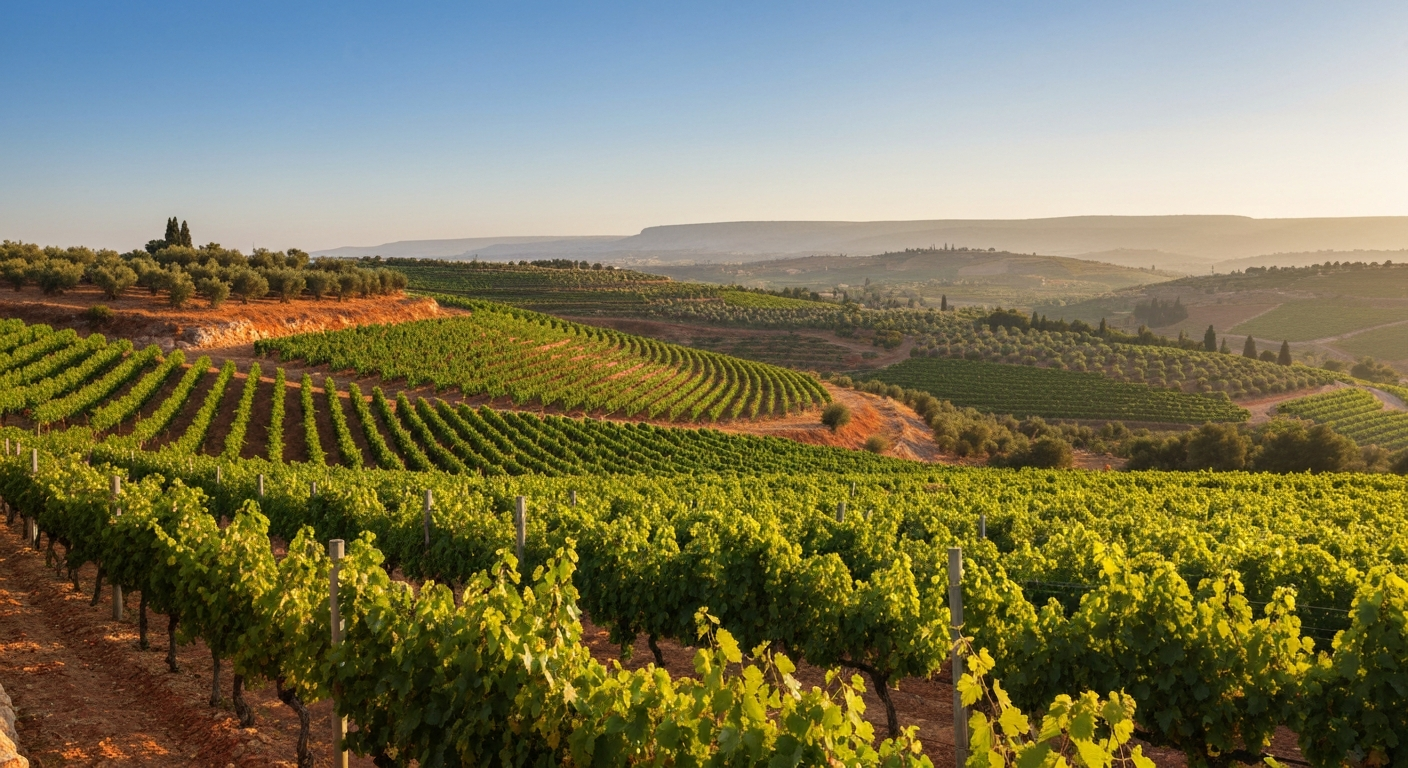
The Mediterranean zone covers the coastal plain, the Sharon and Jezreel valleys, the Carmel ridge, the Galilee, and the Golan Heights. Winters here are mild and wet, summers are hot and dry, and the diurnal temperature range increases sharply as you gain elevation. This is the heartland of Israeli viticulture and where most home gardeners will find the easiest path to success.
The semi-arid zone takes in the foothills of the Judean and Samarian hills, the northern Negev, and parts of the Jordan Valley. Annual rainfall drops below 300 mm, summers are hotter and longer, and irrigation becomes non-negotiable. Vines still perform well here with the right rootstock and a drip system, but heat stress and salinity management step up in importance.
The arid Negev and Arava are the most demanding. Rainfall can be under 50 mm a year, summer temperatures regularly exceed 40°C, and soils tend toward limestone, loess, or even sandy desert profiles. Commercial vineyards do operate here (the Negev Highlands around Mitzpe Ramon have produced award-winning wines), but success depends almost entirely on irrigation infrastructure, rootstock selection, and variety choice. For home gardeners, this is achievable but requires more investment upfront.
Which parts of Israel reliably support grapes at home
Let me be direct about where things are straightforward and where they get harder. The most reliable zones for home grape growing are the Judean Hills (roughly 500 to 800 metres elevation, limestone and terra-rossa soils), the Upper and Central Galilee, and the Golan Heights. All three combine Mediterranean rainfall with cooler nights driven by elevation, giving you the diurnal swing that builds sugar and aroma in berries without pushing vines into heat stress. Frost is possible at higher elevations in the Golan and Upper Galilee, particularly between December and February, but it rarely damages established dormant vines.
The coastal plain and Sharon region are very workable. The maritime influence keeps temperatures moderate, but summer humidity is higher than inland, which raises powdery and downy mildew pressure. Ventilation in your trellis design and a proactive spray program matter more here than in drier inland sites.
The Jordan Valley and Arava floor are the most challenging for a hobbyist. Extreme summer heat, minimal chill hours in warmer sections, and high irrigation water salinity all compound each other. That said, early-season table grapes can actually be a strategic advantage here: vines in the Jordan Valley can ripen as early as May, well ahead of the rest of the country.
Recommended grape varieties for Israeli conditions
Variety choice is the single biggest decision you will make. Picking the wrong cultivar for your microclimate adds years of frustration. Below is a practical matching of varieties to the main Israeli growing zones.
| Zone | Best Table Grape Varieties | Best Wine Grape Varieties | Notes |
|---|---|---|---|
| Coastal plain / Sharon | Superior (Sugraone), Thompson Seedless, Crimson Seedless | Chardonnay, Sauvignon Blanc | High humidity; choose disease-resistant where possible; good ventilation critical |
| Judean Hills (500–800 m) | Red Globe, Big Pearl, Superior | Cabernet Sauvignon, Merlot, Syrah | Terra-rossa soils; excellent diurnal range; reliable quality for both table and wine |
| Upper Galilee / Golan Heights | Crimson Seedless, Red Globe | Cabernet Sauvignon, Chardonnay, Merlot, Sauvignon Blanc | Coolest zone; best for premium wine cultivars; watch for late spring frost at elevation |
| Jordan Valley / Arava (desert floor) | Superior, Thompson Seedless | Syrah, local heat-tolerant varieties | Early harvest advantage; extreme heat limits wine quality; salinity management essential |
| Negev Highlands (600–1,000 m) | Superior, Crimson Seedless | Cabernet Sauvignon, Syrah | Desert climate with cool nights; drip irrigation required; excellent for adventurous growers |
The Volcani Center (ARO) has been breeding and trialing newer seedless table grape cultivars specifically adapted to Israeli conditions. Big Pearl is one example developed to extend the harvest window beyond traditional varieties. If you have access to a local nursery stocking ARO-released or Hazera-listed varieties, those are almost always better bets than generic European cultivars imported without climate testing.
Israel also sits close enough to the Mediterranean's ancestral grape belt that classic French and Italian wine varieties perform here in a way they simply cannot in the humid climates of West Africa or Southeast Asia. If you have read about growing grapes in high-humidity countries like Ghana, Nigeria, or Malaysia, the challenges there are very different from Israel's: those climates struggle with continuous fungal pressure and lack of dormancy, problems that Israeli growers face only in a milder form on the coast.
Rootstock selection: matching to your soil and water
Phylloxera (Daktulosphaira vitifoliae) is present in Israel, and the EPPO database confirms it. The EPPO Global Database lists Daktulosphaira vitifoliae (VITEVI) as present in Israel [Daktulosphaira vitifoliae (VITEVI) [Datasheet] | EPPO Global Database](https://gd.eppo.int/taxon/VITEVI/datasheet). That means grafted vines on phylloxera-resistant American rootstocks are the standard approach for most home gardeners, not just a commercial precaution. Own-rooted vines in sandy soils have some natural protection, but anywhere with loam or clay, the risk is real enough to graft.
Beyond phylloxera, the big variable in Israel is salinity. A significant proportion of Israeli irrigation uses treated wastewater or brackish water, both of which carry salinity loads that accumulate in the root zone over time. Israeli research, including pot trials comparing Paulsen 1103, Richter 110, and SO4 under NaCl irrigation, has shown clear differences in how rootstocks handle chloride accumulation. The practical takeaway for home gardeners is this: if your irrigation water is saline or recycled, rootstock choice is a performance issue, not a formality.
| Rootstock | Drought Tolerance | Salinity Tolerance | Lime / Alkaline Soil Tolerance | Best For |
|---|---|---|---|---|
| 1103 Paulsen (1103P) | High | Moderate–High | Moderate | Semi-arid, saline water, deep soils |
| 140 Ruggeri (140Ru) | Very High | Moderate | High | Dry, calcareous soils; Negev/Judean Hills |
| 110 Richter (110R) | High | Moderate | Moderate–High | Well-drained, stony hillside soils |
| SO4 | Low–Moderate | Low | High | Fertile, moist, limestone soils; coastal areas with clean water |
| Fercal | Moderate | Low–Moderate | Very High | Highly calcareous soils with high active lime |
If you are in the Judean Hills or Galilee on limestone-heavy terra-rossa, 140 Ruggeri or 110 Richter are the workhorses. If you are on the coastal plain with access to municipal recycled water, 1103 Paulsen is your best hedge against salinity creep. SO4 is a popular choice in Europe but underperforms in dry, saline Israeli conditions and I would steer home gardeners away from it unless your water is clean and your soils are fertile.
Site selection and soil preparation
Sun exposure is non-negotiable. Grapes need at least six to eight hours of direct sun daily, and in Israel's hill regions, a south- or southwest-facing slope is ideal. It maximises heat accumulation and air drainage, both of which reduce humidity around the canopy and lower fungal disease risk. A north-facing slope in the Galilee will ripen fruit later and may not ripen at all in marginal years.
Drainage matters more than soil richness. Grapes hate waterlogged roots. The classic terra-rossa soils of the Judean Hills drain freely and the vines thrive. If you are on heavier clay-loam soils on the coastal plain, raise your rows slightly and break up any hard pan layer at 40 to 60 cm depth before planting. A shattering pass with a subsoiler or deep ripping is worth every shekel if it prevents waterlogging.
Test your soil pH and salinity before you plant. Israeli soils frequently run alkaline (pH 7.5 to 8.5) due to limestone parent material, and high pH can lock up iron and zinc, causing chlorosis in sensitive cultivars. Working compost into the top 40 cm will buffer pH slightly and improve organic matter. If salinity is already elevated (EC above 2.0 dS/m), a pre-plant leaching irrigation with good-quality water helps flush the root zone before you put a vine in the ground.
- Test soil pH (target 6.0–7.5), electrical conductivity, and texture at 0–30 cm and 30–60 cm depths before planting.
- Subsoil or deep-rip to at least 60 cm to break compaction and improve drainage.
- Incorporate 5–10 kg of mature compost per square metre into the planting row; avoid high-nitrogen fertilisers at this stage.
- If pH exceeds 8.0, apply elemental sulfur at label rates (typically 100–200 g/m²) and water in at least six weeks before planting.
- Install drip irrigation lines before or at planting; retrofitting after establishment damages roots.
- If salinity is a concern (EC above 1.5 dS/m), run a pre-plant leaching irrigation of 50–100 mm above normal crop demand.
Planting and spacing
The best planting window in most Israeli regions is late winter to early spring, roughly late January through March, when the soil is moist from winter rains and temperatures are cool enough to let roots establish before the summer heat arrives. In the Jordan Valley and Arava, where winters are mild, you can plant as early as December. In the Golan and Upper Galilee, wait until the ground is reliably frost-free, usually late February at the earliest.
Dig planting holes at least 50 cm deep and 50 cm wide. Set the graft union at least 5 to 10 cm above the final soil level to prevent the scion wood from rooting into the soil and bypassing the rootstock. Backfill with the original soil mixed with compost, water in thoroughly, and mulch around the base with 10 to 15 cm of straw or wood chip to conserve moisture and suppress weeds through the first dry season.
| Grape Type | Row Spacing | Vine Spacing in Row | Notes |
|---|---|---|---|
| Table grapes (vigorous cultivars) | 3.0–3.5 m | 3.0–4.0 m | Wide spacing supports the large canopy and air circulation needed for bunch quality |
| Table grapes (moderate vigour) | 2.5–3.0 m | 2.5–3.0 m | Suitable for home gardens with pergola or T-bar trellises |
| Wine grapes (quality-focused) | 2.5–3.0 m | 1.0–1.5 m | Tighter spacing increases competition, reduces vigour, and concentrates fruit flavour |
| Wine grapes (hot, arid sites) | 2.5–3.0 m | 1.5–2.0 m | Slightly wider to reduce water demand per metre of row |
| Container or urban planting | N/A | One vine per 50–100 L container | Use dwarf or semi-vigorous cultivars; restrict root zone deliberately to control vigour |
Irrigation strategies for Israeli conditions
Drip irrigation is the standard in Israeli vineyards, from the smallest backyard trellis to the largest commercial operation. It delivers water precisely to the root zone, minimises foliar wetting (which reduces mildew risk), and integrates cleanly with fertigation. If you are setting up a home vineyard, a simple drip system with two emitters per vine (each delivering 2 to 4 litres per hour) placed 30 to 40 cm either side of the vine base is the baseline.
Irrigation scheduling in Israel leans on reference evapotranspiration (ET0) data, which the Israel Meteorological Service publishes for stations across the country using the FAO-56 Penman-Monteith method. blank" rel="noopener noreferrer">The IMS publishes station records and a public meteorological database with downloadable climate products (temperature, rainfall, frost frequency), useful for local GDD and frost‑date queries: Meteorological Database | Israel Meteorological Service. You do not need to be an engineer to use this. The practical rule of thumb: in summer, a mature vine in the Judean Hills or coastal plain typically needs 4 to 8 mm of water per day during the hottest weeks of July and August. Multiply by your vine spacing to get litres per vine per day and set your timer accordingly.
Regulated deficit irrigation (RDI) is an actively researched and commercially used technique in Israeli viticulture. The concept is intentional water stress at specific growth stages to manage canopy vigour, reduce berry cracking in table grapes, and concentrate sugars and aromas in wine grapes. For home gardeners, a simplified version works well: give vines full water demand through flowering and fruit set (roughly April to June), then reduce to 50 to 70 percent of ET0 demand from veraison (when berries start colouring) through harvest. After harvest, resume fuller irrigation briefly to support root recovery before dormancy.
- Use pressure-compensating drip emitters, especially on slopes, to ensure even distribution across your rows.
- If using recycled or brackish water, apply a leaching fraction of 10–15% above crop demand to flush salts below the root zone.
- Mulch heavily (10–15 cm of straw or wood chip) around vine bases to cut soil evaporation by 30–50% in summer.
- Check soil moisture at 20–30 cm depth weekly during the growing season; wilting by midday is a sign you are behind on irrigation, not that the vine is coping.
- In the Negev and Arava, run irrigation at night or in the early morning to reduce evaporation losses from emitters.
- Install a simple EC meter or send periodic water samples for lab analysis if you use recycled or well water; catching salinity early is far easier than managing the damage later.
Pruning systems and trellis options
Israeli table grape growers predominantly use overhead pergola systems (locally often called 'arbour' or 'tendone' style). This makes practical sense: the horizontal canopy provides dense shade that protects berries from sunburn in intense summer heat and allows easy bunch thinning and harvesting at a comfortable working height. For a home garden, a pergola over a patio or walkway doubles as shade structure and productive vineyard.
Wine grapes in Israel's quality regions (Galilee, Golan, Judean Hills) use vertical shoot positioning (VSP) on a vertical trellis with a cordon wire at about 80 cm and two or three foliage catch-wires above. VSP exposes the fruit zone to sun and air movement, which is desirable for flavour development and disease control in the drier hill climates.
Pruning timing in most Israeli zones is late December through February, during full dormancy. Cane pruning (leaving long fruiting canes of 8 to 12 buds) is common for table varieties to maximise bunch number. Spur pruning (cutting back to 2-bud spurs on permanent cordons) suits vigour-controlled wine varieties. In either case, the principle is the same: prune hard in the first two years to build trunk and framework, then open up and balance fruit load in year three onwards.
Seasonal calendar: what to do and when
| Month | Coastal Plain / Sharon | Judean Hills / Galilee | Negev / Arava |
|---|---|---|---|
| December–January | Prune; apply dormant copper spray; plant new vines | Prune; check for frost damage on young vines; plant from late January | Prune; plant new vines; light irrigation only |
| February–March | Bud swell; apply sulfur for mildew prevention; begin light irrigation | Bud break (later at elevation); first sulfur application; increase irrigation gradually | Early bud break; ramp up irrigation; monitor for heat spikes |
| April–May | Flowering; full irrigation; first mildew sprays; shoot thinning | Flowering; maintain mildew spray schedule; watch for late frost on Golan/Upper Galilee | Fruit set; intense heat begins; full irrigation; table grapes approaching veraison |
| June–July | Fruit set and berry development; cluster thinning for table grapes; continue spray program | Veraison begins in early varieties; reduce irrigation by 20–30%; maintain spray schedule | Early table grape harvest; extreme heat management; shade cloth if needed |
| August–September | Veraison and harvest for most table varieties; reduce water at veraison; spot-check for botrytis | Main wine and table grape harvest; harvest timing critical; check brix every few days | Post-harvest; reduce irrigation; early dormancy in extreme heat zones |
| October–November | Post-harvest; remove old canes; apply post-harvest copper; reduce irrigation | Leaf fall; post-harvest spray; begin compost application; reduce irrigation | Full dormancy; minimal irrigation; soil amendment and preparation |
| December | Full dormancy; plan next season; soil test and amend | Full dormancy; coldest period; protect young vines if frost expected at elevation | Dormancy; ideal month for major soil amendments |
Pests, diseases, and how to manage them without overcomplicating things
The main threats in Israeli viticulture are powdery mildew (Erysiphe necator), downy mildew (Plasmopara viticola), Botrytis bunch rot, trunk diseases, and various virus and phytoplasma complexes. The good news is that Israel's dry summer climate naturally suppresses downy mildew compared to what growers in humid regions face. If you are farming in a country like Malaysia, Nigeria, or Ghana where humidity is nearly year-round, fungal pressure is relentless. In Israel, the mildew window is concentrated around spring flowering and any unseasonable humid spell, giving you a far more manageable fight.
Powdery mildew is the number-one threat for Israeli home gardeners, especially on the coast. It thrives in warm, dry conditions with moderate humidity, exactly what the Israeli spring delivers. A preventive program starting at bud break with wettable sulfur (applied every 7 to 14 days in spring) is the most reliable low-chemical approach. Do not wait to see symptoms; by the time you see the white powder, infection is already established. In organic or low-spray home gardens, increasing canopy airflow by removing excess shoots and leaves from the fruit zone cuts incidence significantly.
Botrytis is a risk at harvest on tight-bunched table varieties, especially after any late-season rain or humidity. Thinning clusters early in the season to improve airflow within the bunch is the single most effective non-chemical control. Harvesting as soon as grapes reach target maturity, rather than leaving them on the vine hoping for extra sugar, also reduces losses dramatically.
Trunk diseases (Eutypa, Esca, Botryosphaeria complex) are slow-developing but increasingly reported in Israeli vineyards. The best prevention is clean pruning cuts, made during dry weather, and avoiding large wounds where possible. Painting fresh cuts with a pruning sealant or dilute copper paste is a reasonable precaution for home vines you want to last 20 or 30 years.
- Phylloxera: use grafted vines on resistant rootstocks as standard practice; own-rooted vines are a risk except in pure sand.
- Powdery mildew: preventive sulfur sprays from bud break through berry touch; improve canopy airflow by shoot and leaf removal.
- Downy mildew: copper-based sprays before rain events in spring; less of a problem in dry inland and desert zones.
- Botrytis: thin clusters at fruit set; ensure bunch zone is open and airy; harvest promptly at maturity.
- Trunk diseases: prune during dry weather; seal large cuts; remove and burn infected wood immediately.
- Leafhoppers and mites: generally manageable with beneficial insects; kaolin clay sprays reduce leafhopper pressure and provide sunburn protection simultaneously.
How Israel's challenges compare to other hot-climate grape regions
It is worth putting Israel in context if you are reading this from a different country with a similar or contrasting climate. If you are curious whether grapes can grow in Kenya, see our page on grape growing in Kenya for climate- and variety-specific guidance (internal reference). Egypt, Israel's western neighbor, presents a comparable arid challenge: virtually no rainfall, extreme summer heat, and irrigation-dependent viticulture. Egyptian growers face similar salinity and rootstock decisions, and the Nile Delta's humidity adds a fungal pressure layer not present in Israel's drier desert zones. Countries like Japan face the opposite problem: summer humidity, typhoon-season rain, and a need for rain-cover structures that Israeli growers rarely require. The lesson is that Israel sits in a genuinely privileged viticulture position: dry summers suppress the worst fungal diseases while irrigation gives you water control that rainfall-dependent growers in humid climates simply do not have. For a West African comparison, see do grapes grow in Nigeria to understand how humid tropical conditions affect grape cultivation versus Israel's drier, irrigated systems. If you’re asking 'do grapes grow in Egypt', the short answer is yes, Egyptian growers cultivate grapes in the Nile Delta, Sinai oases, and irrigated desert zones, facing similar salinity and heat challenges to parts of Israel.
Harvest timing and what to realistically expect from your vines
Most Israeli home gardeners will see first meaningful fruit in year two or three, with a full productive crop from year four onwards. Do not be discouraged by a light year-two crop; the vine is still building its root system and trunk framework. Pushing it to produce heavily in year two at the expense of structure almost always backfires by year five.
Harvest timing varies significantly by zone. The Volcani Center's table grape program targets a harvest window running from roughly April in the Jordan Valley to December for late-season varieties under protection. For a home gardener in the Judean Hills or Galilee, expect table grape harvest between July and October depending on variety, and wine grape harvest from late August through October. Use a refractometer to check Brix (sugar content): table grapes are typically harvested at 16 to 20 Brix, wine grapes at 22 to 26 Brix depending on style.
Small-scale yield expectations vary widely by training system and variety, but a productive mature pergola vine in good conditions can carry 15 to 25 kilograms of table grapes per season. A VSP-trained wine grape vine managed for quality will yield 2 to 4 kilograms, deliberately kept lower to concentrate flavour. These are honest figures for home-garden management without the intensive thinning and spray programs of commercial operations.
Container and urban growing in Israel
Apartment balconies and small urban courtyards in Tel Aviv, Jerusalem, and Haifa can absolutely support a grape vine in a container. The key is scale: use a container of at least 50 litres for a table variety, and 100 litres if you want a vine that will carry a meaningful crop. Terracotta or fabric grow-bags both work well; avoid dark-coloured plastic pots in full sun because root-zone temperatures can spike to damaging levels.
For containers, choose naturally dwarfing or semi-vigorous varieties. Thompson Seedless and Superior are manageable in large containers. Avoid very vigorous cultivars like Red Globe unless you have the space to let them run. Container vines need more frequent watering (sometimes daily in July and August), regular fertigation with a balanced grape nutrient formula, and annual root pruning or re-potting every two to three years to prevent the root system from becoming pot-bound.
Training a container vine up a wall or over a small pergola frame gives it the vertical airflow it needs and turns a balcony into a genuinely productive growing space. I have seen Israeli home gardeners harvest beautifully from a single Superior vine trained across a 4-metre balcony railing, producing 8 to 12 kilograms in a good year.
Decision checklist: is growing grapes right for your Israeli site?
Before you buy vines, run through these questions honestly. They will save you time, money, and the disappointment of planting in the wrong location or with the wrong variety.
- Do you have at least 6–8 hours of direct sunlight daily on your proposed planting site? If not, grapes are unlikely to perform well regardless of other conditions.
- What is your water source and its salinity (EC)? If you rely on recycled or brackish water, factor rootstock salinity tolerance into your selection from the start.
- Are you in a Mediterranean, semi-arid, or arid zone? This determines irrigation frequency, disease pressure, and which varieties are realistic.
- Do you have, or can you install, a drip irrigation system? In Israeli conditions, overhead watering significantly increases disease risk and water waste.
- What is your soil drainage like? Dig a 50 cm hole, fill it with water, and check how fast it drains. If it is still standing 12 hours later, you have a drainage problem to solve before planting.
- Are you planting grafted vines on phylloxera-resistant rootstock? Unless you are in pure sand, this should be the default, not an option.
- Do you have space for at least 2–3 vines? Even table grape vines benefit from the buffer of not relying on a single plant; pest or disease loss of one vine hurts less.
- Are you patient enough for a 3–4 year establishment period? Grapes reward patient gardeners. If you need fruit in year one, plant tomatoes this season and grapes the next.
Israel is genuinely one of the more forgiving countries in the world for a first-time home grape grower. The climate aligns with what the vine wants, the research base from the Volcani Center and ARO is strong and publicly referenced, and the local nursery industry carries regionally adapted varieties. Get your rootstock right, sort out your irrigation before you plant, and choose a variety matched to your specific zone, and the odds are firmly in your favour.
FAQ
Can grapes be grown successfully in Israel for home gardeners?
Short answer: Yes. Grapes are widely viable across Israel's main climate zones (coastal Mediterranean, inland highlands, Galilee/Golan, Judean Hills and irrigated parts of the Negev/Arava). Success depends on choosing appropriate varieties/rootstocks, matching site soil and water supply, using drip irrigation and managing heat, salinity and disease risk.
What Israeli climate zones support grape culture and how do they differ for grape growing?
Key zones: coastal/sharon plain (mild maritime, long growing season, low frost risk); Central/Lower and Upper Galilee, Golan Heights (higher elevation, cooler nights—good for wine grapes and quality ripening); Judean Hills (500–800 m, limestone soils—classic for premium wines); semi‑arid inland and irrigated Negev/Arava (requires drip irrigation, heat‑tolerant varieties and salinity management). Use local IMS station data (temperature, rainfall, frost dates, ET0) to refine microclimate decisions.
Which table and wine grape varieties are recommended for Israeli home gardens and which rootstocks suit local microclimates?
Table grapes: Superior (Sugraone), Thompson Seedless (Sultana), Crimson Seedless, Red Globe and newer Volcani/industry cultivars—choose early or late clones based on coastal vs inland heat. Wine grapes: Cabernet Sauvignon, Merlot, Syrah, Chardonnay, Sauvignon Blanc and Mediterranean varieties performed well in Israel. Rootstocks: use phylloxera‑resistant rootstocks; for salinity/drought-prone or low‑quality water sites prefer Paulsen 1103, Ruggeri 140Ru or Richter 110—select based on local salinity tests and nursery advice.
How should I select a site and prepare soil for grapes in Israel?
Pick a site with full sun (≥6–8 h/day), good air circulation and gentle slope for cold/wet drainage (south or southwest exposure for warmth in cooler regions). Avoid frost pockets and waterlogged soils. Test soil pH, EC and structure; amend heavy clays with organic matter and gypsum where sodium/alkalinity is an issue; ensure depth for root development or use large containers. Install subsurface or surface drainage if salinity/leaching fractions are a concern.
How and when should I plant grapes (spacing, orientation, and planting steps)?
Plant in late winter/early spring after last heavy rains/frost risk. Space vines 1.5–3.5 m within rows and 2–4 m between rows for home blocks depending on trellis and vigor (table grapes typically wider spacing). Dig a planting hole slightly larger than rootball, spread roots, backfill with native soil mixed with compost, avoid deep planting over graft union, water in to settle soil and place a temporary shade if very hot. Mark planting orientation to align row for prevailing winds and sun exposure.
What irrigation systems and schedules work best (drip, deficit, drought strategies)?
Drip irrigation is standard: 1–2 emitters per vine (2–8 L/h each) placed near the root zone. Schedule irrigation using ET0 (IMS/FAO‑56) with seasonal adjustments; young vines need regular shallow watering, established vines require deeper, less frequent irrigation. Use regulated deficit irrigation (RDI) in wine grapes to control vigor and improve fruit composition; for table grapes, manage water to avoid berry splitting. In arid sites use higher-frequency low-volume emitters, mulches and partial root-zone wetting; monitor soil moisture and salt accumulation and apply occasional leaching fractions when using brackish/treated water.