
Grapes grow best in a climate with warm, dry summers, cold but not brutal winters, and at least 150 to 165 frost-free days per season. They need full sun (at least 6 to 8 hours daily), well-drained soil in the pH range of 5.5 to 7.0, and consistent but moderate moisture. That said, modern cold-hardy hybrids have pushed the viable growing range well into USDA Zones 3 and 4, meaning home gardeners across most of the continental U.S. can grow grapes if they pick the right variety for their specific conditions.
What Environment Do Grapes Grow In: Climate, Soil & Tips
Marcus Whitfield
30 Jul 2026
Can you actually grow grapes at home?
Yes, and more reliably than most people expect. The old assumption that grapes only belong in Napa Valley or the south of France has been thoroughly disproved by university breeding programs, particularly the University of Minnesota, which has released cold-hardy cultivars like Marquette, Frontenac, and La Crescent that survive winters down to -25 or even -30°F. See the University of Minnesota's cultivar page for La Crescent grape cultivar, Minnesota Hardy (UMN) for details on its cold‑hardiness and trial results La Crescent grape cultivar — Minnesota Hardy (UMN). If you are in Zone 4 or 5 in the Midwest, upper Northeast, or northern Mountain West, those varieties are your starting point. If you are in the Pacific Northwest, mid-Atlantic, or Southeast, you have a wider menu to choose from. The honest caveat is that grapes do require consistent attention: annual pruning, a trellis system, and some disease vigilance. They are not a plant-and-forget crop, but they are absolutely manageable for a dedicated home gardener.
Climate, hardiness zones, and the growing season grapes need
The USDA Plant Hardiness Zone Map (updated in 2023) is the first tool to check. It maps average annual extreme minimum temperatures across the country and tells you whether a given grapevine variety is likely to survive your worst winters. But the zone alone does not tell the whole story. You also need enough warm days between frosts to fully ripen fruit, and that is where growing degree days (GDDs) come in.
Frost-free days: how many do grapes need?
Most wine and table grape cultivars need roughly 165 frost-free days to ripen reliably. Short-season cold-hardy hybrids bred for northern climates can manage with considerably fewer, which is why they work in Minnesota and Wisconsin where the season is tighter. Check your local average last spring frost and first fall frost dates to calculate your window. If your window falls short of 165 days, lean hard toward early-ripening cold-hardy varieties rather than trying to force a vinifera cultivar to finish before the first freeze.
The Winkler heat-summation system
The Winkler scale measures heat accumulation from April through October using a base temperature of 50°F. Each day's average temperature above 50°F contributes to your seasonal GDD total. Matching your local GDD total to a variety's requirements is one of the most reliable ways to choose what to plant. Here is a quick reference for the five Winkler regions:
| Winkler Region | GDD Range (base 50°F) | Typical Climate | Representative Varieties |
|---|---|---|---|
| Region I | Below 2,500 | Cool (Willamette Valley, Finger Lakes) | Pinot Noir, Chardonnay, cold-hardy hybrids |
| Region II | 2,501–3,000 | Moderate (Napa Valley, parts of WA) | Cabernet Sauvignon, Merlot, Riesling |
| Region III | 3,001–3,500 | Warm (Central Coast CA, parts of VA) | Zinfandel, Sangiovese, Syrah |
| Region IV | 3,501–4,000 | Hot (inland CA, parts of AZ/TX) | Grenache, Barbera, table grapes |
| Region V | Above 4,000 | Very hot (San Joaquin Valley, desert SW) | Thompson Seedless, raisin/table varieties |
Your local cooperative extension office or state viticulture program often publishes GDD maps and cultivar trial results. UC Davis, Cornell, Washington State University, and the University of Nebraska Extension all have publicly available resources. Cross-referencing those with your own location is far more reliable than guessing based on a general regional description.
Variety recommendations by broad U.S. region
| Region / States (examples) | USDA Zones | Recommended Varieties |
|---|---|---|
| Upper Midwest (MN, WI, ND, IA) | 3–5 | Marquette, Frontenac, La Crescent, Itasca |
| Northeast / New England (NY, VT, ME, PA) | 4–6 | Cayuga White, Noiret, Concord, Frontenac |
| Mid-Atlantic / Southeast (VA, NC, GA) | 6–8 | Norton, Chambourcin, Muscadine (SC/GA), Vidal Blanc |
| Pacific Northwest (OR, WA) | 5–8 | Pinot Noir, Riesling, Gewürztraminer, Merlot (Eastern WA) |
| California / Southwest (CA, NV, AZ) | 7–10 | Cabernet Sauvignon, Zinfandel, Syrah, Thompson Seedless |
| Texas / Southern Plains | 6–9 | Black Spanish, Blanc du Bois, Lenoir, Champanel |
| Desert Southwest (AZ, NM, parts of TX) | 7–10 | Heat-tolerant table varieties, Black Monukka, Desert King |
Sun, heat, and microclimate: getting the site right
Grapes are sun-hungry plants. A minimum of 6 to 8 hours of direct sunlight per day is the widely accepted baseline for reliable fruit set, sugar development, and natural disease suppression. If you’re wondering do grapes need a lot of sun to grow, see our guide on sun requirements for grapes. In practice, the more sun the better, especially in cooler climates where every degree-hour of heat matters for ripening. I always tell beginners: if you are choosing between two spots in your yard, pick the sunnier one every time, even if it means a slightly awkward trellis placement.
Microclimate factors that make or break a site
Your hardiness zone is an average, but your actual site can be meaningfully warmer or colder. South or southeast-facing slopes warm up faster in spring and drain cold air downhill overnight, protecting buds from late frosts. North-facing slopes stay cold longer and increase frost risk. Low spots and valley floors collect cold air and are far more frost-prone than a slope just 30 feet higher. Before planting, watch your site on a few clear spring mornings to see where frost lingers longest. Planting on or near a south-facing slope near a masonry wall or dark fence can add the equivalent of half a hardiness zone worth of warmth.
Managing too much sun and heat
In hot climates (Winkler Regions IV and V, or anywhere with frequent 100°F+ summers), too much direct sun on fruit clusters becomes a real problem. Berry skin temperatures can run 12 to 15°F above air temperature, and fruit surface temperatures above roughly 104°F start causing sunburn damage, browning, and crop loss. The practical fixes include orienting rows east-to-west so the fruit zone gets morning sun rather than brutal afternoon western exposure, managing leaf removal carefully (avoid stripping fruit-zone leaves all at once in a heat wave), and maintaining adequate soil moisture so vines are not drought-stressed during extreme heat. Kaolin clay particle films, available to home gardeners, also provide meaningful protection and are worth experimenting with in desert or high-heat sites.
Soil: what grapes want and what they will tolerate
Drainage is the single most critical soil factor. Grapevines dislike wet feet intensely: standing water or consistently saturated soil promotes Phytophthora root rot and other root diseases that shorten vine life dramatically. Beyond drainage, grapes are surprisingly adaptable. They grow in sandy soils, loamy soils, clay soils, and even quite rocky ground, as long as drainage is adequate and there is enough rooting depth. Ideal rooting depth is roughly 30 to 70 inches, which allows vines to access deep moisture reserves during dry spells.
Soil pH and fertility basics
Target a soil pH between 5.5 and 7.0. American varieties and many cold-hardy hybrids are comfortable toward the more acidic end of that range, while European vinifera varieties prefer something closer to neutral, around 6.5. Before planting, get a lab soil test (not just a cheap kit from the garden center) and adjust pH based on the results. Add lime to raise pH in acidic soils, or sulfur to lower it in alkaline ones. Correcting pH before planting is far easier than trying to fix it around established vines.
How different soil types compare
| Soil Type | Drainage | Vine Performance | What to Do |
|---|---|---|---|
| Sandy / sandy-loam | Excellent | Good; may need more frequent irrigation | Ideal starting point; mulch to retain moisture |
| Loam | Good | Excellent; balanced moisture and nutrients | Best all-around choice; minimal amendment needed |
| Clay-loam | Moderate | Acceptable with management | Improve with compost; raise beds if compaction is an issue |
| Heavy clay | Poor | Risky; root rot and phylloxera damage likely | Install drainage tile or build raised beds before planting |
| Rocky / gravelly | Excellent | Often very good; classic Old World vineyard soil | Fine to plant; rocks improve drainage and retain daytime heat |
| Wet / poorly drained | Very poor | High failure risk without intervention | Drain or raise beds; choose phylloxera-resistant rootstock |
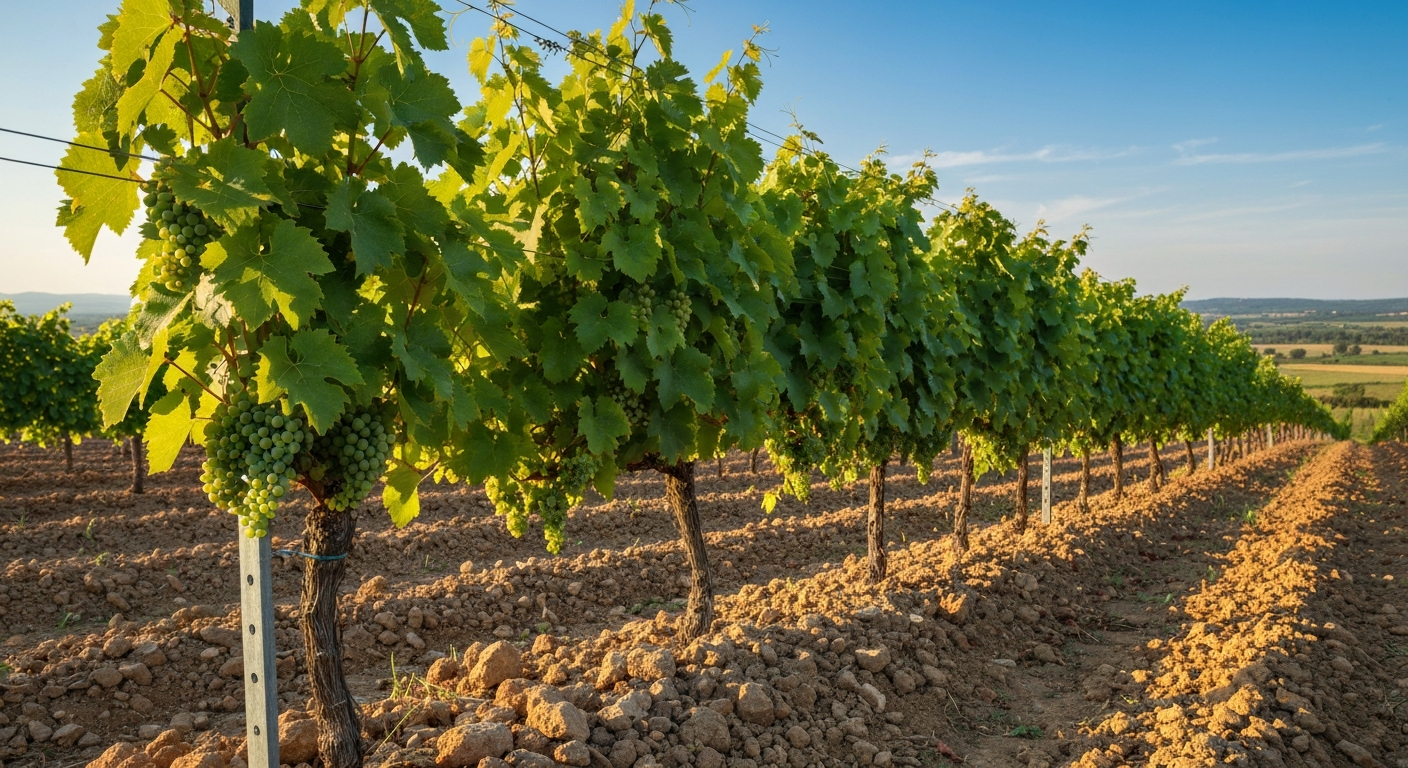
Rocky soil gets an unfairly bad reputation. Many of the world's most celebrated vineyards sit on thin, rocky ground that most food crops would struggle in. Rocks improve drainage, and dark stones absorb daytime heat and radiate it back to clusters at night, aiding ripening. If your yard is gravelly or rocky, that is not a problem to solve; it may actually be an advantage. See can grapes grow in rocky soil for detailed guidance on planting, drainage, and managing gravelly vineyard sites.
Wet soils are a different story. Consistently saturated ground and grapevines are a poor combination, and not just because of root rot. Phylloxera, the root-feeding pest that devastated European vineyards historically, causes more severe damage in heavy clay soils. If your site has drainage problems that you cannot fully correct with raised beds or drainage tile, seriously consider whether grapes are the right crop for that spot. For more detail on this issue, see our guide on can grapes grow in wet soil and how to correct poor drainage for vines.
Water and irrigation: how much do grapevines actually need?
Established grapevines are more drought-tolerant than most gardeners expect, but they are not drought-proof. In humid climates like the Northeast, mid-Atlantic, and Pacific Northwest, rainfall alone often meets vine water needs, and supplemental irrigation may only be necessary during extended dry spells. In dry climates (the Southwest, California, and the arid interior West), irrigation is not optional: it is essential from the start.
How to think about irrigation amounts
Commercial wine vineyards in Washington State have been measured using around 16 acre-inches of water per season under full irrigation. Home gardeners do not need to track acre-inches, but the underlying principle matters: vine water needs track evapotranspiration (how much water the plant and soil are losing to heat and wind). During hot, dry, windy weather, vines need more. During cool overcast weeks, they need far less. The most practical approach for a home planting is drip irrigation on a timer, adjusted monthly or bi-weekly based on weather. A soil moisture probe or the simple finger-test at 4 to 6 inch depth will tell you more than any fixed watering schedule. Aim to keep soil consistently moist but never waterlogged through the growing season, and taper off irrigation after veraison (the point when berries change color and begin ripening) to encourage sugar concentration.
First-year vines need more attention
Newly planted vines have not established the deep root systems that let mature vines buffer drought stress. In the first two growing seasons, water young vines more frequently and more carefully, especially during heat waves. A deep, thorough soaking once or twice a week is better than shallow daily sprinkles. Mulching around the base of young vines helps retain soil moisture and moderates root-zone temperature.
Growing grapes in tough spots: cold climates, desert heat, and marginal sites
Two of the most common questions I get are whether grapes will survive a brutal northern winter and whether they can handle the heat of a desert summer. The honest answer to both is: it depends on the variety and the specific site, but there are real options for each.
Cold climates (Zones 3 to 5)
European vinifera varieties (Cabernet Sauvignon, Pinot Noir, Chardonnay) are not suitable for Zone 4 and below without very protected microclimates or expensive winter hilling and burial techniques. The practical path for cold-climate growers is the Minnesota Hardy series: Marquette and Frontenac for red wines, La Crescent and Itasca for whites. These cultivars are rated to Zone 4 (and some to Zone 3), surviving lows of -25 to -30°F, and they ripen early enough to beat the first fall frost in most northern growing regions. Concord, the classic American table and juice grape, is another reliable cold-climate workhorse for Zones 4 to 8. For Zone 3 growers, even these hardy hybrids may need some winter protection in the most exposed years, but they give you a fighting chance that vinifera simply cannot. If you're asking "can grapes grow in cold climates", the short answer is yes, with cold-hardy hybrids like Marquette and Frontenac, successful grape growing is practical in Zones 3–5.
Desert and high-heat sites (Zones 8 to 10)
Desert growing is genuinely challenging but not impossible. For practical guidance on whether can grapes grow in the desert and how to adapt varieties and irrigation for arid conditions, see our detailed desert-growing guide. The main issues are extreme summer heat, alkaline soils, low humidity (which increases evapotranspiration demand), and the absence of a natural chilling period in the very lowest-elevation desert zones. Table grape varieties bred for hot conditions, such as Black Monukka, Thompson Seedless, and some of the heat-tolerant Texas cultivars, perform better than wine grapes in extreme heat. Afternoon shade from a structure or shade cloth during peak summer can protect clusters from sunburn. Drip irrigation is non-negotiable, and alkaline desert soils often need pH adjustment before planting. The reward is an early and very long growing season that allows thorough fruit ripening.
Other marginal sites: shade, slopes, and short seasons
Part-shade sites below 6 hours of sun per day are genuinely problematic: expect weak growth, poor fruit set, high disease pressure, and fruit that never fully ripens. If shade is unavoidable, aggressive canopy management and very disease-resistant varieties (many American species hybrids have good inherent disease resistance) help, but results will be limited. Short-season sites at the cool margin of a variety's range can benefit from black plastic mulch to warm the soil, south-facing wall placement to capture reflected heat, and early-ripening cultivar selection. If your frost-free window is consistently under 140 days, prioritize the earliest-ripening cold-hardy hybrids available and accept that some years will not deliver fully ripe fruit.
Basic maintenance: pruning, trellis, and disease management
Grapes are not hard to grow in the sense that they are fragile or finicky, but they do require annual attention. If you're wondering 'are grapes easy to grow', see our detailed guide for a quick assessment of effort versus reward and variety recommendations. Skipping pruning for even one season leads to a tangled, overcrowded canopy that produces poor fruit and invites disease. Annual winter pruning (removing 80 to 90% of the previous year's growth) is not optional; it is the single most important task in the grape gardener's calendar. A simple VSP (vertical shoot positioning) trellis made from wooden posts and two to three wires handles most home plantings cleanly and makes pruning straightforward.
Disease pressure varies a lot by region. Humid climates (East of the Rockies in general, and especially the Southeast) deal with powdery mildew, downy mildew, and black rot more aggressively than drier western climates. Choosing disease-resistant varieties is the most effective first line of defense for home gardeners who do not want to spray on a commercial schedule. Opening up the canopy with fruit-zone leaf removal improves airflow, reduces humidity around clusters, and is a proven low-input way to reduce disease pressure. In very humid areas, plan for some preventive fungicide applications at bloom and early fruit development regardless of variety choice.
A quick note on grape seeds and digestion
One question that occasionally comes up in beginner circles is whether a grape seed could somehow sprout inside your body if swallowed. It cannot. Seeds need external soil, light, and specific temperature conditions to germinate. The human digestive system is an acidic, anaerobic environment that breaks down plant material efficiently. Swallowing a grape seed is completely harmless and no more botanically eventful than swallowing a watermelon seed.
Your quick-start checklist before planting
Before you order bare-root vines, run through these steps to set yourself up for success:
- Look up your USDA Plant Hardiness Zone and your average frost-free day count for your specific location.
- Estimate your local Winkler GDD total using your state extension service's viticulture resources or by checking historical April–October temperature data.
- Choose at least two varieties matched to your zone, GDD range, and disease environment (favor disease-resistant hybrids in humid climates).
- Assess your planting site: confirm at least 6 to 8 hours of daily sun, check drainage by digging a hole and filling it with water (it should drain fully within a few hours), and note slope aspect and cold-air drainage patterns.
- Get a lab soil test and adjust pH to 5.5–7.0 before planting; fix drainage problems before setting posts.
- Plan your trellis: install wooden or metal posts and at least two horizontal wires before vines arrive.
- Source bare-root or containerized vines from a reputable nursery that carries varieties recommended for your region.
- Plant in early spring after the ground is workable but before bud break; water deeply at planting and mulch the root zone.
- Commit to annual winter pruning; mark your calendar now for late winter (late February to early March in most of the U.S.).
Putting it all together: matching environment to expectation
The core lesson from every successful home vineyard I have seen is simple: variety selection matched to your actual environment does most of the work. A cold-hardy Minnesota hybrid planted in Zone 4 with decent drainage and full sun will outperform a prestigious vinifera variety planted in the wrong zone every single time, no matter how much effort goes into the latter. Grapes are genuinely adaptable plants with a wide geographic range when you work with your climate rather than against it. Check your zone, measure your sun, test your soil, and pick varieties that are designed for where you live. That combination gets most home gardeners to a rewarding harvest.
FAQ
What is a natural, search-friendly title and a concise meta description for this article?
Title: What Environment Do Grapes Grow In? A Practical Guide for Home Gardeners Meta description: Learn the climate, soil, sun, water and microclimate grapes need, plus variety picks and checklists for U.S. regions.
What climates and hardiness zones are suitable for growing grapes?
Grapes grow across many USDA zones but suitability depends on species/cultivar. Vitis vinifera (European wine grapes) prefer milder winter minima and are best in warmer zones or protected sites (commonly Zones 7–10 for reliable winter survival without rootstock/grafting). North American species and cold-hardy interspecific hybrids (examples: Frontenac, Marquette, La Crescent) tolerate much colder winters and are recommended for colder areas (Zones 3–6). Use the USDA Plant Hardiness Zone Map as a starting point and always check local microclimate (slope, aspect, cold-air drainage) for frost pockets or warm sites.
How much growing season/heat do grapes need to ripen fruit?
Many wine/table cultivars need a frost-free season roughly 165 days or more to ripen well; short-season cold-hardy hybrids can require fewer frost-free days. Use local average last spring and first fall frost dates to estimate season length. Match varieties to local heat-summation (Winkler) regions: Region I (cool) suits Pinot/Chardonnay; Region II suits many Bordeaux varieties; Regions III–V suit warmer-climate varieties and table/raisin types. Compare your April–October growing degree days (base 50°F) with variety recommendations from local extension or trial data.
How much sun and heat do grapevines require?
Grapevines require full sun for flowering, sugar accumulation and disease suppression. Aim for at least 6–8 hours of direct sun daily; more is better in cooler climates. High fruit surface temperatures can cause sunburn (often when FST exceeds ~40°C); site orientation, canopy management, and watering influence fruit temperatures. In hot, dry sites, mitigate sun/heat risk with east–west row orientation, avoiding sudden fruit-zone defoliation, temporary shade/netting, kaolin sprays, and keeping vines adequately watered during heat waves.
What soil types and drainage conditions do grapes prefer?
Grapes prefer well-drained soils—loam or sandy-loam with moderate organic matter and deep rooting depth (30–70+ inches ideal). Slightly acidic to neutral pH (about 5.5–7.0) is generally suitable; vinifera often performs best near neutral (~6.5). Heavy, poorly drained clay or shallow restrictive layers increase risk of root decline and Phytophthora; on wet sites use raised beds, improved drainage or choose resistant rootstocks. Do a lab soil test before planting and correct pH/nutrients as recommended.
How much water and irrigation do grapes need for home gardens?
Water needs vary by climate and management. Mature drip-irrigated vineyards often use roughly 15–25 acre-inches per season in research settings, but small home plantings use much less. For home vines, install a simple drip/soaker system, monitor soil moisture, and irrigate to avoid prolonged drought stress—especially during fruit set and berry sizing. Use local ET or simple soil-probe checks; consider deficit irrigation strategies (RDI) in wine grapes to manage vigor and quality. Avoid waterlogging—good drainage is more important than high water volumes.