
Yes, grapes absolutely grow in Oklahoma, and with the right variety selection you can have a productive backyard vine that rewards you with fresh fruit, juice, or homemade wine. The best all-around choices for most Oklahoma home gardeners are disease-resistant American and hybrid varieties like Concord, Reliance, Marquis, Chambourcin, and Cynthiana (Norton), with muscadines added in the southeastern third of the state. Steer clear of pure Vitis vinifera (think Cabernet Sauvignon, Chardonnay) unless you're very experienced, because Oklahoma's heat, humidity, and phylloxera pressure make them a genuine uphill battle.
Best Grapes to Grow in Oklahoma: Top Varieties and Plan
Marcus Whitfield
14 Jun 2026
Oklahoma grape viability and what your climate demands
Oklahoma is one of those states that looks simple on a map but throws a surprising range of conditions at your vines. The panhandle gets colder winters and drier air than anywhere else in the state. Central Oklahoma sits in a middle zone with hot summers, periodic late freezes, and moderate humidity. Eastern Oklahoma, including the Ozark foothills and the southeastern corner, gets considerably more rainfall and humidity, which cranks up disease pressure dramatically. OSU Extension makes this point directly: humid eastern Oklahoma creates exactly the conditions that fungal diseases love.
The good news is that grapes can be grown throughout the entire state. If you move north to Iowa, the same idea applies, but you will want to pick varieties that handle cooler winters and shorter summers grapes can be grown throughout the entire state. What changes is the specific variety you choose and the level of disease management you'll need to keep up with. A vine that coasts along in the drier panhandle with minimal spraying will struggle badly in Muskogee County if it lacks solid disease resistance. Getting this match right from the start is the single most important decision you'll make as a grape grower in Oklahoma.
Winters are generally manageable across most of the state for American-type and many hybrid varieties, but temperature swings are the real hazard. Oklahoma can swing from a warm spell in February back to a hard freeze days later, and that kind of fluctuation stresses vines more than steady cold does. OSU Extension notes that this kind of fluctuating temperature pattern can increase winter injury risk, which is worth keeping in mind when choosing cultivars for the panhandle or northern Oklahoma.
Best-performing grape varieties for Oklahoma
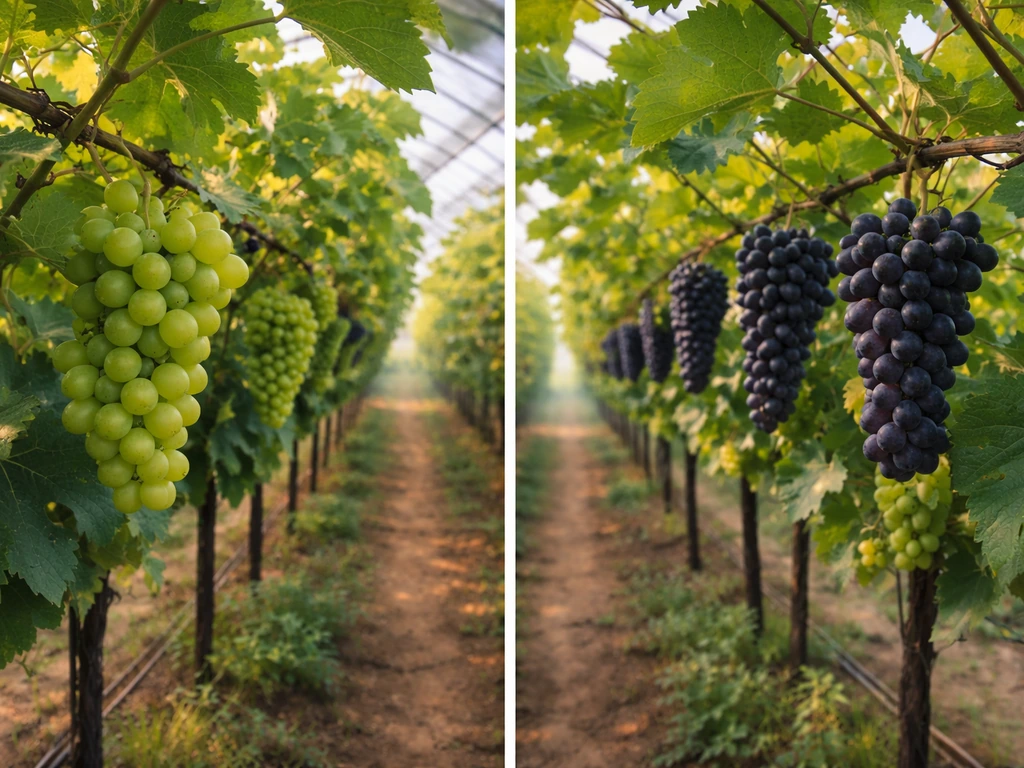
Here's a practical breakdown of the top varieties by type. OSU Extension maintains tables of recommended cultivars for both table grapes and wine/hybrid grapes, and the picks below reflect those recommendations combined with what consistently performs well for home gardeners across the state.
| Variety | Type | Best Use | Disease Resistance | Winter Hardiness | Best Region in Oklahoma |
|---|---|---|---|---|---|
| Concord | American (V. labrusca) | Fresh eating, juice, jelly | Good | Excellent | Statewide, especially north/central |
| Reliance | American hybrid | Fresh eating (seedless) | Good | Excellent | Statewide |
| Marquis | American hybrid | Fresh eating (seedless) | Good | Very good | Central to north Oklahoma |
| Cynthiana / Norton | American hybrid | Red wine | Very good | Good | Central and eastern Oklahoma |
| Chambourcin | French-American hybrid | Red wine | Good | Good | Central and eastern Oklahoma |
| Vidal Blanc | French-American hybrid | White wine | Good | Very good | Statewide |
| Seyval Blanc | French-American hybrid | White wine | Moderate | Good | Central Oklahoma |
| Carlos (muscadine) | Muscadine (V. rotundifolia) | Fresh eating, wine, juice | Excellent | Moderate (SE Oklahoma only) | Southeastern third of Oklahoma |
| Nesbitt (muscadine) | Muscadine (V. rotundifolia) | Fresh eating | Excellent | Moderate (SE Oklahoma only) | Southeastern third of Oklahoma |
For pure fresh eating, Reliance and Concord are hard to beat as starting points. Reliance is seedless and sweet, and it handles Oklahoma summers well. Concord is the classic slip-skin grape that makes excellent juice and jam if you end up with more than you can eat fresh. For wine production, Cynthiana (also sold as Norton) is arguably Oklahoma's signature red wine grape, with outstanding disease resistance and a deep, bold flavor profile that suits the state's conditions. Chambourcin is a strong second choice for red wine with a bit more approachable fruit character. On the white side, Vidal Blanc is reliable statewide and used in a range of wine styles.
How to choose the right variety for your part of Oklahoma
Start by being honest about where you live within the state, because your location changes the calculus significantly. OSU Extension explicitly recommends selecting varieties based on your specific region, not just the state as a whole. Here's how to think through it:
- Panhandle and northwestern Oklahoma: Prioritize cold hardiness above all else. Concord, Reliance, and Vidal Blanc are your safest bets. Disease pressure is lower here, so you have a bit more flexibility, but late-season freezes can damage early-budding varieties.
- Central Oklahoma (OKC metro and surrounding counties): This is the most flexible zone. You can grow American varieties, French-American hybrids, and even experiment with some moderately hardy wine grapes. Disease resistance still matters because summers bring enough humidity for problems to develop.
- Eastern and northeastern Oklahoma (Ozarks, Green Country): Disease resistance is non-negotiable here. Choose varieties rated as resistant to black rot, downy mildew, and powdery mildew. Cynthiana, Chambourcin, and Concord all hold up reasonably well. Avoid anything with moderate or poor disease ratings unless you're ready for an intensive spray program.
- Southeastern Oklahoma: This is muscadine territory. Muscadines are native to this climate zone and thrive where other grapes struggle with heat and disease. Varieties like Carlos, Nesbitt, and Darlene do well here. For other grape types, the same disease-resistance rules apply as in eastern Oklahoma.
Beyond location, match the variety to what you actually want to do with the fruit. If you want something to eat off the vine with the kids, seedless table grapes like Reliance or Marquis win on convenience. If you're thinking about making wine, Cynthiana gives you the most distinctly Oklahoma-appropriate result. If you want something for juice, jelly, and preserves, Concord is a proven workhorse and produces heavily once established.
It's also worth noting that OSU Extension warns strongly about Vitis vinifera varieties (European wine grapes) being extremely susceptible to phylloxera, a soil insect that's present in much of Oklahoma. OSU Extension emphasizes that phylloxera susceptibility is especially critical for Vitis vinifera, noting vinifera is extremely susceptible to phylloxera while using rootstocks can help manage the problem in highly affected areas Vitis vinifera varieties (European wine grapes) being extremely susceptible to phylloxera.
Unless you're planting on a specific phylloxera-resistant rootstock, pure vinifera is a risky choice for backyard growers.
If you're comparing neighboring states for reference, Missouri and Kansas share some similar variety choices for hybrid wine grapes, with Cynthiana and Chambourcin appearing across the region. If you're also comparing Kansas conditions, it helps to look at the best grapes to grow in Kansas so you can pick varieties that match the climate and disease pressure. If you're specifically planning around Missouri conditions, you’ll want to start with region-appropriate hybrid and American grapes for the best chances of reliable harvests. But Oklahoma's southeastern corner is genuinely different, having more in common with Arkansas and Texas muscadine-growing zones than with the Missouri Ozarks.
Planting basics: site, sun, soil, spacing, and drainage
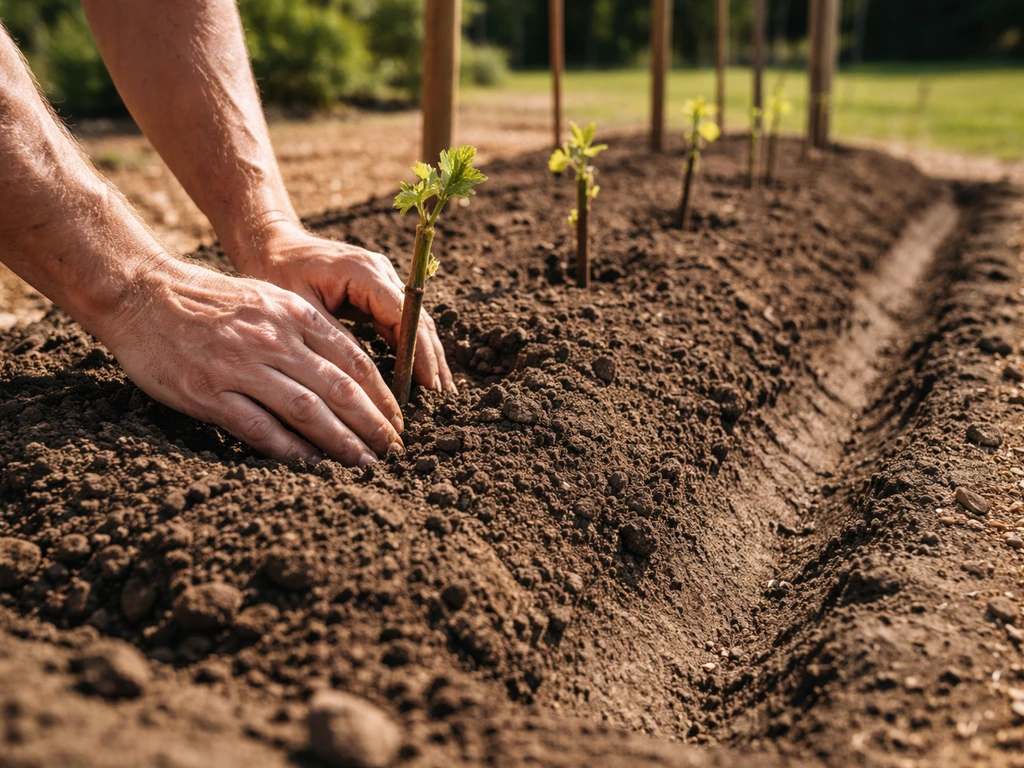
Grapes need full sun, and that means at least 8 hours of direct sunlight per day. This isn't a crop you can tuck into a semi-shaded corner of the yard and expect much from. OSU Extension states clearly that full sunlight and well-drained soils are the two non-negotiable site requirements. Pick the sunniest spot you have, ideally on a south-facing or south-sloping area if your yard has any topography to work with.
Drainage matters enormously. Grapes don't tolerate waterlogged roots, and Oklahoma soils range from heavy clay in the central and eastern parts of the state to sandier soils in the west. If your soil is heavy clay, build in drainage by planting on a slight raised berm or amending heavily with compost and grit. Grapes want soil that drains freely but retains enough moisture to keep the vine from stressing during Oklahoma's brutal July and August heat. If you're not sure about your drainage, dig a hole about 12 inches deep, fill it with water, and see how long it takes to drain. If it's still standing after several hours, you've got a drainage problem to solve before planting.
For planting time, target late winter to early spring for most of the state, when vines are still dormant. For muscadines in southeastern Oklahoma specifically, OSU Extension gives a planting window of February 1 through March 20, with fall planting (October through mid-November) also an option in that southeastern third of the state. Don't try to rush things and plant too early when the ground is still frozen or too late when vines are already pushing new growth aggressively.
Spacing depends on your training system, but a general rule for backyard gardeners is to plan for about 6 to 8 feet between vines within a row, with rows spaced at least 8 to 10 feet apart if you're planting multiple rows. This gives each vine enough space to develop properly and allows airflow between plants, which is critically important for disease management in Oklahoma's humid summers.
Trellising and training essentials for backyard success
You cannot skip trellising. Grapes are vigorous climbers that will sprawl all over everything if you don't give them a structure to grow on, and an unmanaged vine is a disease magnet. Build your trellis before or at planting time, because trying to install posts around an established vine is a frustrating job.
For most American and hybrid varieties, two training systems work well for Oklahoma home gardeners. UMN Extension notes that cold-climate grapes are typically managed with training systems matched to the vine’s growth habit, and that many wine grapes in their region are trained as bilateral cordons on 2D trellises such as High Cordon or VSP Training systems for cold.
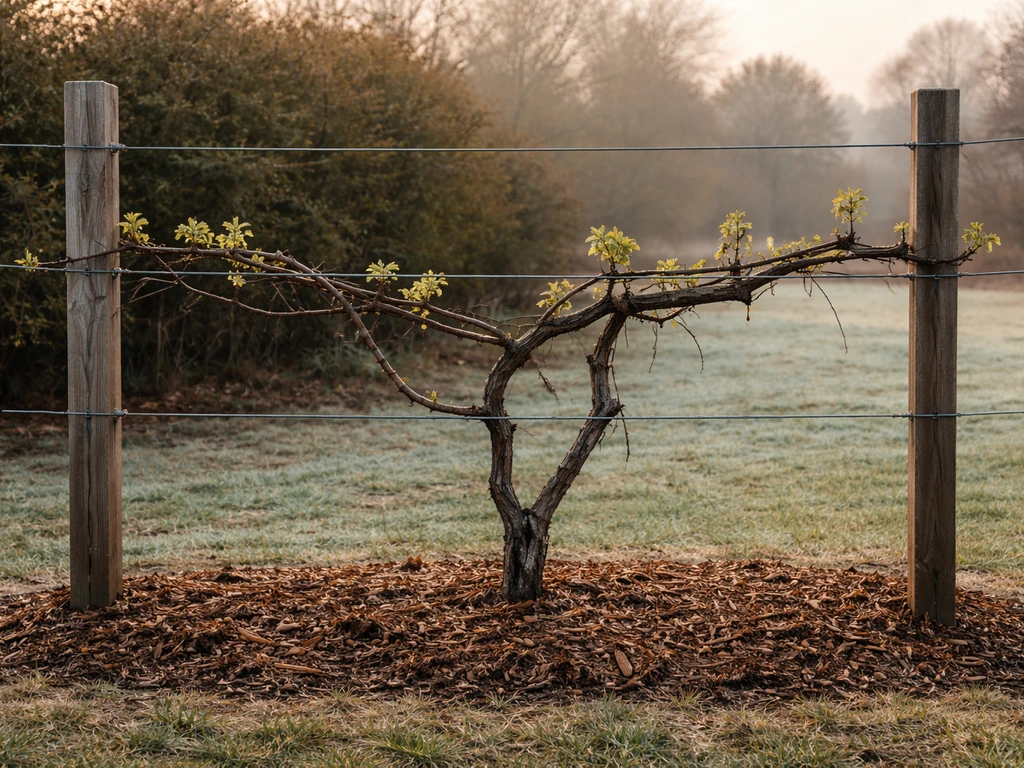
The first is a Vertical Shoot Position (VSP) trellis, which uses a series of horizontal wires strung between posts at roughly 18-inch intervals, with the fruiting zone kept low and shoots trained upward. This system is tidy, keeps the canopy open, and makes pruning straightforward. The second is a High Cordon system, where the permanent trunk is trained up to a single high wire (around 5 to 6 feet) and arms extend horizontally in both directions.
OSU Extension references both VSP and High Cordon as appropriate systems for Oklahoma backyard grapes.
For American-type grapes and many hybrids, it's worth knowing that their basal buds (the buds closest to the base of each cane) are often vegetative rather than fruiting buds. This means cane pruning tends to outperform spur pruning for these types, because you're leaving more of the productive mid-cane buds. A classic 4-cane Kniffin system works well for Concord-type varieties: you train four canes along two wire levels and replace them with new growth each season. Muscadines in the southeastern part of the state respond well to a high bilateral cordon or a Geneva Double Curtain system, both of which accommodate their naturally vigorous growth habit.
One critical piece of pruning knowledge: grapes fruit on the current season's growth coming from one-year-old wood. That means the new shoots that grow this spring will produce next year's fruit, and the wood those shoots grew from needs to have been produced last year. If you leave old, multi-year-old spurs and never renew them, fruit production drops off. Prune every year, consistently, and your yields will reflect it.
Growing timeline and what to expect the first few seasons
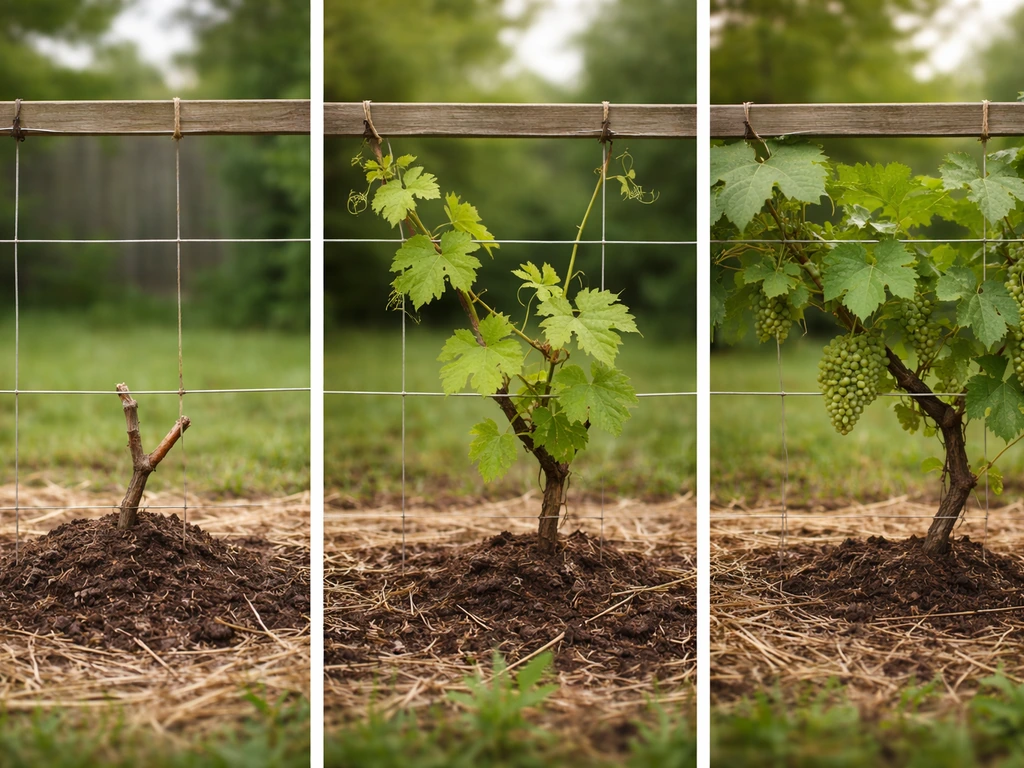
Set realistic expectations from the start. Grapes are not a crop you plant in spring and harvest that fall. The timeline below reflects what most Oklahoma home gardeners experience with well-sited, well-managed vines.
- Year 1: Focus entirely on establishment. Your vine should put on 2 to 4 feet of cane growth, develop a healthy root system, and get oriented to your trellis. Remove any flower clusters that form so the vine directs its energy into root and cane development rather than fruiting. Water consistently and keep the area around the vine weed-free.
- Year 2: The vine grows more vigorously and you begin training the permanent trunk and arms. You may see a small cluster or two, and it's okay to let a very light crop form if the vine looks strong, but don't let it carry a heavy load yet. Your goal is still structural development.
- Year 3: This is when most home gardeners see their first meaningful harvest, meaning enough fruit to actually do something with. A healthy, well-trained 3-year-old vine should produce a modest but real crop. OSU Extension crop-load guidance recommends removing about half of the flower clusters even at this stage so the vine doesn't exhaust itself.
- Year 4 and beyond: Production increases and the vine reaches closer to its full potential. With proper annual pruning, disease management, and water management after fruit set, a mature backyard vine can produce 10 to 20 or more pounds of fruit per season depending on variety and conditions.
One note on water management that OSU Extension specifically highlights: once fruit has set, you want to gradually back off watering rather than continuing to push vigor. Vines that get too much water after fruit set tend to produce vigorous leafy growth at the expense of fruit quality and ripening. This is a mistake a lot of first-time growers make, including me early on, because watering more feels like the helpful thing to do during Oklahoma's hot summers.
Common problems and how to prevent them in Oklahoma
Disease is the main challenge for Oklahoma grape growers, especially in the central and eastern parts of the state. OSU Extension's grape disease management materials identify the key fungal threats as black rot, downy mildew, powdery mildew, Phomopsis cane and leaf spot, anthracnose, and Botrytis bunch rot (gray mold). You don't necessarily face all of these every season, but you need to be prepared for several of them depending on your location and the spring/summer weather pattern.
- Black rot: One of the most damaging diseases for Oklahoma backyard growers. It turns berries into hard, black, mummified shrivels. Susceptibility is highest for about six weeks after bloom begins, so early-season fungicide timing is critical. Choose disease-resistant varieties and remove any mummified fruit you find.
- Downy mildew and powdery mildew: Both thrive in humid conditions with warm temperatures. Powdery mildew shows as a white powdery coating on leaves and fruit. Downy mildew appears as yellowish patches on upper leaf surfaces with white fuzz underneath. Good canopy management (open, airy vines) slows both diseases down significantly.
- Phomopsis cane and leaf spot: Shows up as dark spots on young canes early in the season. It can cause cane dieback and affect berries later. Starting a fungicide program at bud swell helps prevent early infections.
- Botrytis bunch rot: OSU Extension notes this isn't a problem every year in Oklahoma, but in seasons when a vineyard has a history of it, targeted sprays become critical. Tight-clustered varieties are more susceptible.
- Phylloxera: A soil insect that attacks roots and is devastating to pure Vitis vinifera. American varieties and most hybrids have natural resistance. This is one of the core reasons to stick with American and hybrid cultivars for Oklahoma backyard growing.
- Japanese beetles: These can defoliate vines quickly in summer. Hand-picking, row cover on young vines, or targeted insecticides help manage them. Keep an eye out starting in late June through July.
- Pierce's disease: A bacterial disease spread by leafhoppers that is lethal to susceptible varieties. It's more prevalent in the southeastern part of the state. Muscadines are resistant, and many hybrids tolerate it well.
The most effective prevention strategy is choosing resistant varieties in the first place, then backing that up with a simple spray program starting at bud swell in spring. OSU Extension's fungicide guidance emphasizes that timing and thorough coverage matter more than just what product you use. You don't need a complicated spray rig for a few backyard vines, but you do need to stay on schedule during the critical early-season window. Missing that window and trying to catch up later rarely works well.
Your best bets, matched to your goals
Here's the short version for when you're standing in the nursery trying to decide: if you're in central or northern Oklahoma and want a reliable, low-fuss fresh-eating grape, start with Reliance or Concord. If you're in eastern Oklahoma and disease pressure is a real concern, Cynthiana and Concord are your most dependable options. If wine making is the goal, Cynthiana for red and Vidal Blanc for white are the safest starting points for most of the state.
If you want a clear starting point, the best grapes to grow in Nebraska will also depend on matching a hardy variety to your climate Cynthiana for red and Vidal Blanc for white. And if you're in the southeastern corner, plant a muscadine, ideally a self-fertile variety like Nesbitt or a male-female pair like Carlos with a compatible pollinator.
One last thing: don't overthink the first vine. Pick a variety that fits your region and your goals, prep the site with full sun and good drainage, get your trellis in before the vine needs it, and commit to annual pruning. Oklahoma's climate is absolutely capable of producing excellent grapes, and the gardeners who do it well aren't doing anything magic. If you're also comparing colder Midwest regions, the guidance on the best grapes to grow in Minnesota can help you pick varieties that handle winter risk. They just matched their variety to their location and showed up consistently every season.
FAQ
How can I protect grapevines from Oklahoma’s freeze-thaw temperature swings?
Oklahoma winters can still hurt dormant vines, especially when temperatures swing between warm spells and hard freezes. To reduce winter injury risk, choose varieties known for your region’s cold tolerance, and protect the vine base (mulch or a protective mound) in the panhandle and far north. Avoid heavy nitrogen feeding late in the season, since it can leave newer growth less hardened for winter.
Do disease-resistant grapes still need spraying in Oklahoma?
In humid eastern Oklahoma, a common mistake is assuming “resistant variety” means “no sprays.” Resistant grapes typically need fewer applications, but they still benefit from a timed early-season program starting at bud swell and good coverage. If you skip the early window, later attempts usually arrive after infections have already taken hold.
What are the most dependable seedless grapes to grow in Oklahoma, and do I need pollinators?
If you want seedless options, Reliance and Marquis are the most reliable starting points mentioned for Oklahoma-style backyard production. However, don’t confuse seedlessness with easy pollination, some seedless types still perform best with compatible pollinators or adequate vine vigor, so follow spacing and keep the canopy open for consistent bloom and airflow.
Why did my grape harvest drop even though the vine leafed out normally?
For most backyard gardeners, the best pruning approach is to renew fruiting wood every year rather than relying on old spurs. Since grapes fruit on current season growth from one-year-old wood, leaving multi-year wood without renewal gradually reduces yield even if the vine looks healthy. Plan on consistent annual pruning instead of “light touch” pruning.
Can I grow Cabernet Sauvignon or Chardonnay in Oklahoma if I manage pests well?
Yes, but it usually requires more planning than people expect. Vinifera can be grown only with the right disease pressure management and a phylloxera-safe setup. Without phylloxera-resistant rootstock, vinifera is a high-risk gamble in much of Oklahoma, and even with rootstock you may still spend more time on disease control than with American or hybrid choices.
Why are muscadines recommended mainly for southeastern Oklahoma?
Muscadines are only the best fit for the southeastern third of Oklahoma because they handle that region’s conditions better than most American hybrids. If you plant muscadines farther north without a plan for winter injury, you may see inconsistent bud survival and reduced crops. Match muscadines to your location, don’t treat them as “statewide any zone” grapes.
What’s the best way to choose and install a trellis for Oklahoma grapes?
A great harvest starts with a grape-specific trellis and training plan before the vine gets big. If you install posts after establishment, you risk damaging roots and trunk. Build your VSP or High Cordon structure early, then train shoots to keep the fruiting zone and canopy airflow optimized for disease prevention.
Should I keep watering the same amount after the grapes start setting fruit?
Watering should change after fruit set. A common mistake is continuing to water heavily to encourage growth during Oklahoma’s heat, which often increases leafy vigor and slows ripening, and can worsen disease conditions by keeping the vine too lush. Gradually back off watering once fruit is set to improve fruit quality and maturity.
How do I know if my soil drainage is good enough to plant grapes?
A low-effort way to start is to plant in the sunniest, best-draining spot you have, then run a drainage test before digging a larger hole. Fill the planting hole with water and watch how long it takes to drain, if it lingers after several hours, fix drainage before planting using a raised berm or soil amendments. Poor drainage leads to root stress and weak growth even if you choose the right cultivar.
What spacing should I use for grape vines in Oklahoma to reduce disease problems?
Choose spacing based on airflow, because Oklahoma’s humid summers make canopy management part of disease control. Keep roughly 6 to 8 feet between vines in a row and at least 8 to 10 feet between rows if planting multiple lines. If you tighten spacing, expect more mildew and black rot risk unless you can manage pruning and canopy opening aggressively.
When should I expect my Oklahoma grapevine to start producing full crops?
Most Oklahoma growers see established vines take time to build reliable production, and the first season is often about getting the vine rooted and trained, not maximum yield. Expect a more noticeable fruiting improvement after the vine matures, while still pruning annually to encourage the one-year wood the vine needs to carry next year’s crop.