
Yes, you can absolutely grow wine grapes in Maryland, and the state's established commercial wine industry proves it works. The main caveats are honest ones: Maryland summers bring serious humidity and disease pressure that punish lazy canopy management, and western Maryland's colder elevations (USDA zone 5b in Garrett County) rule out most Vitis vinifera without cold-protection strategies. Pick the right variety for your specific zone and microclimate, stay on top of a fungal-spray program, and you can produce real wine-quality fruit at home. The best all-around starting varieties for most Maryland gardeners are Chambourcin (red), Traminette (white), and Vidal Blanc (white), all hybrids that balance cold hardiness, disease resilience, and genuine winemaking potential.
Best wine grapes to grow in Maryland: Varieties, tips
Maryland's Climate for Growing Wine Grapes
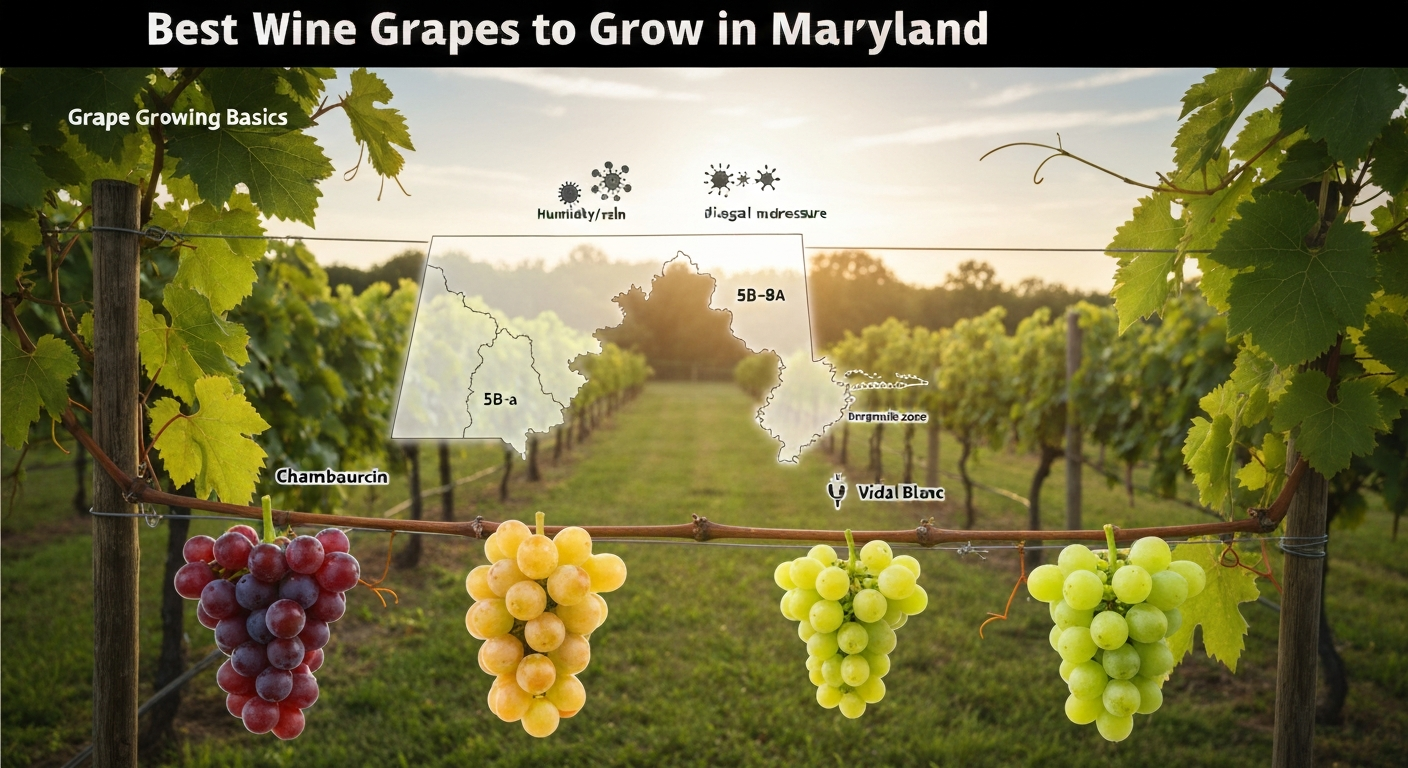
Maryland is a small state with a surprisingly wide climate range. According to the 2023 USDA Plant Hardiness Zone Map, the state runs from zone 5b in the Garrett County highlands all the way to zone 8a along the southern Atlantic and Chesapeake coastal areas. That's nearly three full zones of variation in a state you can cross by car in two hours. Your county and elevation matter enormously here.
NOAA's 1991–2020 Climate Normals tell the practical story for grape growers. In the warmer Piedmont and coastal plain areas around Annapolis, Baltimore, and the Eastern Shore, the average last spring frost falls in mid-to-late March and the first fall frost arrives in mid-to-late October, delivering a frost-free growing season of roughly 200 or more days. In the western highlands of Garrett and Allegany Counties, those windows compress to last frost in mid-May and first frost in early October, shrinking the season to 140–160 days. That difference determines whether late-ripening vinifera is even in the conversation.
Growing degree-day (GDD, base 50°F) accumulations reflect the same gradient. The Maryland State Climatologist's GDD diagnostics show the warmest coastal plain and southern Piedmont sites reliably piling up the most heat units, enough to ripen Chambourcin, Chardonnay, and even Cabernet Franc in good years. Western highlands accumulate significantly fewer GDD and are better matched to cold-hardy hybrids like Marquette or Frontenac that can reach full sugar development in shorter windows.
The most consistent challenge across all of Maryland is summer humidity and disease pressure. Peer-reviewed Mid-Atlantic research has quantified exactly how leaf wetness duration combined with warm temperatures drives ripe rot, black rot, downy mildew, and other cluster diseases in Maryland vineyards. The principal pathogens, powdery mildew (Erysiphe necator), downy mildew (Plasmopara viticola), black rot (Guignardia bidwellii), Phomopsis, and late-season rots, are all favored by Maryland's frequent summer rain and high relative humidity. This isn't a reason to give up; it's a reason to choose disease-resistant varieties and treat canopy management as non-negotiable.
How Maryland Stacks Up Against Nearby Regions
Comparing Maryland to its neighbors helps set realistic expectations. Pennsylvania's grape-growing regions span similar zones (roughly 5b to 7a), with southeastern PA sharing Maryland's warmer Piedmont conditions and the northern tier of the state facing challenges closer to Maryland's western highlands. Growing conditions in Pennsylvania and Maryland are similar enough that variety recommendations from Penn State Extension translate well for Maryland gardeners. For specific variety lists tailored to Pennsylvania's zones, see our guide to the best grapes to grow in PA. For growers in nearby Connecticut, see best grapes to grow in CT for variety recommendations and guidance tailored to Connecticut's climate. New Jersey's southern coastal plain and Delaware Bay corridor is actually somewhat warmer and more humid than most of Maryland, very similar disease-pressure story, with Chambourcin performing as one of NJ's strongest red varieties there too.
New England and upstate New York's Finger Lakes region are noticeably cooler and shorter-season than central and coastal Maryland. For variety recommendations suited to cooler climates, see our guide to the best grapes to grow in New England. The Finger Lakes benefits from deep-lake temperature moderation that buffers cold snaps and extends the season in ways Maryland doesn't have at scale, but Maryland's warmer baseline means it can ripen varieties that struggle in those northern climates. For more on why do grapes grow well in the Finger Lakes region, note that deep-lake temperature moderation combined with steep, well-drained slopes creates a longer, frost-buffered season ideal for ripening. For specific cultivar recommendations suited to cooler Finger Lakes and upstate New York conditions, see our guide to the best grapes to grow in upstate NY. If a variety is recommended for the Finger Lakes, it will almost certainly ripen earlier and easier in Maryland's coastal plain and Piedmont. The practical takeaway: Maryland gardeners in zones 6b–7b have more variety options than their counterparts in Massachusetts or upstate New York, but they trade that warmth for significantly higher fungal disease risk.
Site Selection: Coastal, Piedmont, and Western Maryland
Where you plant is at least as important as what you plant. A south- or southeast-facing slope drains cold air downhill overnight, warms quickly in the morning sun, and dries foliage faster after rain, all of which reduce disease risk and improve ripening. Avoid low-lying frost pockets, depressions, or valley bottoms where cold air settles. Even a 20-foot elevation difference on a gentle hillside can mean a 3–5°F temperature difference on a clear, calm night, and that's the difference between a damaging late frost and a clean escape in April or May.
In the coastal plain and Eastern Shore, proximity to the Chesapeake Bay and Atlantic moderates winter minimums noticeably, these sites can function one half-zone warmer than their official USDA zone suggests, which is why commercial vinifera vineyards cluster in that corridor. If you're in Anne Arundel, Calvert, Charles, or the Eastern Shore counties, you have the warmest, longest-season conditions in the state and can reasonably attempt well-chosen vinifera varieties with appropriate care. Urban areas like the Baltimore metro also benefit from heat-island effects that push effective zone ratings warmer.
Western Maryland is a different calculation. Garrett County's elevations above 2,500 feet are genuinely zone 5b, with winter minimums that can reach −15°F to −20°F in severe years. That's not a place for Cabernet Franc or Chardonnay. In Allegany County and the Hagerstown Valley, you're typically in zone 6a–6b, where well-chosen cold-hardy hybrids (Marquette, La Crescent, Frontenac) make more sense than vinifera. Always check the USDA zone map with your specific zip code and factor in your local slope and cold-air drainage before committing to a variety.
Soil, Drainage, and pH for Maryland Vineyards
Grapevines want well-drained soil above everything else. Waterlogged roots stress vines, encourage crown rot and Phytophthora, and reduce cold hardiness going into winter. If your site has heavy clay or poor drainage, you have two options: build raised rows or berms to lift the root zone, or plant on a slope where water moves through naturally. Maryland's Piedmont soils are often clay-loam or silty-clay-loam, workable, but they'll need organic matter incorporation and may need row orientation adjusted to maximize airflow and drying.
Target a soil pH of 6.0–6.5 for most wine grape varieties. At that range, nutrient availability is optimal and vine health is generally strong. Take a soil test through the University of Maryland Extension soil testing lab before planting, it's inexpensive and will tell you exactly how much lime or sulfur you need to hit the target. Sandy soils on the Eastern Shore or coastal plain drain well but may need more attention to potassium and magnesium levels.
Rootstock selection matters if you're dealing with specific soil challenges. For most Maryland home gardeners planting virus-tested own-rooted vines, own-rooted plants work fine in sandy to loam soils with no known nematode or phylloxera pressure. If you're in heavier clay soils or have had previous vine failures, grafted vines on rootstocks like 3309C (moderate vigor, good on moderately fertile sites), SO4 (good phylloxera resistance, works on heavier soils), or 101-14 Mgt (low-vigor sites, good in moist soils) are worth considering. Grafted vines are also the right call if you're planting vinifera varieties in areas where soil phylloxera has been confirmed.
Best Wine Grape Varieties for Maryland
The ranking below reflects a combination of cold hardiness, disease resistance, ripening reliability in Maryland's climate, and wine quality potential. Hybrids dominate the top recommendations because they were bred for exactly this kind of humid, moderate-GDD region. That said, vinifera has a real place in warmer Maryland sites if you go in with eyes open about the spray program they require. Here's how I'd rank them for a home gardener starting from scratch.
- Chambourcin — Best red hybrid for Maryland; excellent disease resistance, reliable ripening, consistent wine quality
- Traminette — Top white hybrid; aromatic Gewürztraminer-style wine, good cold hardiness, manageable disease resistance
- Vidal Blanc — Workhorse white hybrid; versatile (dry, off-dry, late harvest ice wine styles), reliable yields
- Chardonel — Chardonnay-Seyval cross; makes a clean, Burgundian-style white, better disease resistance than Chardonnay alone
- Seyval Blanc — Very reliable, early-ripening white hybrid; clean neutral wine, high disease tolerance
- Marquette — Cold-hardy red hybrid; suited for zone 5b–6a western Maryland, earlier ripening than Chambourcin
- Norton/Cynthiana — Native American red; extraordinary disease resistance, makes a bold rustic red, needs full season to ripen
- Chardonnay (vinifera) — Viable in zone 6b–7b coastal/Piedmont sites with diligent spray program; classic wine style
- Cabernet Franc (vinifera) — Best vinifera red for Maryland; earlier ripening than Cab Sauv, good for coastal/Piedmont zones 6b–7b
- Riesling (vinifera) — Works in cooler Piedmont and western zone 6b sites; needs careful disease management
| Variety | Type | USDA Zone | Ripening Window | Cold Hardiness | Disease Resistance | Wine Style |
|---|---|---|---|---|---|---|
| Chambourcin | French-American Hybrid | 6a–8a | Late (Oct) | −10°F to −15°F | Good | Earthy red, Rhône-like |
| Traminette | Hybrid | 5b–7b | Mid-late (late Sept–Oct) | −13°F to −17°F | Good | Aromatic white, spicy/floral |
| Vidal Blanc | French-American Hybrid | 5b–8a | Mid-late (Sept–Oct) | −15°F | Good | Crisp dry, off-dry, ice wine |
| Chardonel | Hybrid (Chardonnay × Seyval) | 5b–7b | Mid (Sept) | −15°F | Good-Moderate | Lean Chardonnay-style white |
| Seyval Blanc | French-American Hybrid | 5b–7b | Early-mid (late Aug–Sept) | −15°F | Very Good | Clean, neutral dry white |
| Marquette | Hybrid | 4b–6b | Mid (Sept) | −32°F | Good | Structured red, cherry/pepper |
| Norton/Cynthiana | Native (Vitis aestivalis) | 5b–8a | Late (Oct) | −20°F+ | Excellent | Bold, tannic, dark red |
| Chardonnay | Vitis vinifera | 6b–8a | Early-mid (late Aug–Sept) | −5°F to −10°F | Poor-Moderate | Classic Burgundy-style white |
| Cabernet Franc | Vitis vinifera | 6b–8a | Mid-late (Oct) | −5°F to −10°F | Moderate | Medium red, herbal/berry |
| Riesling | Vitis vinifera | 6a–7b | Mid (Sept–early Oct) | −5°F to −10°F | Moderate-Poor | Aromatic white, off-dry potential |
A note on vinifera in Maryland
I want to be straight with you about vinifera: Chardonnay and Cabernet Franc can produce beautiful wine in Maryland's warmer zones, and commercial vineyards on the Eastern Shore and Piedmont do it well. But they will punish you if you skip spray applications during wet springs, choose a frost-pocket site, or don't manage canopy openness. A hybrid like Traminette or Chambourcin will give you better odds and less heartbreak on your first planting. Once you've learned your site and built a spray routine, adding a row of Chardonnay or Cab Franc makes total sense.
Planting Timing, Spacing, and Rootstock Pairing by Variety
In Maryland, bare-root vines should go in the ground in early spring, typically late March through mid-April depending on your zone, as soon as the soil is workable and you're past the heaviest frost risk. Potted vines can be planted a few weeks later. Avoid planting in the heat of summer; vines planted in June or July in Maryland's humidity and heat have a much harder time establishing. Fall planting is possible in zones 7–8 but carries more risk of winter damage before roots establish.
| Variety | Row Spacing | Vine Spacing in Row | Recommended Rootstock | Planting Notes |
|---|---|---|---|---|
| Chambourcin | 9–10 ft | 6–8 ft | Own-rooted or 3309C | Vigorous grower; wider spacing helps airflow |
| Traminette | 9–10 ft | 6–8 ft | Own-rooted or SO4 | Moderate vigor; space adequately to reduce canopy density |
| Vidal Blanc | 9–10 ft | 6–8 ft | Own-rooted | Very vigorous; don't crowd; needs good airflow |
| Chardonel | 9–10 ft | 6–8 ft | Own-rooted or 3309C | Medium-high vigor; 3309C moderates on fertile soils |
| Seyval Blanc | 8–9 ft | 6–8 ft | Own-rooted | Less vigorous; easier to manage; good starter variety |
| Marquette | 8–9 ft | 5–6 ft | Own-rooted | Upright growth; suitable for VSP; very cold-hardy |
| Norton/Cynthiana | 10 ft | 6–8 ft | Own-rooted | Extremely vigorous; needs space and aggressive pruning |
| Chardonnay | 9 ft | 6 ft | 3309C or 101-14 Mgt | Grafted strongly recommended; virus-tested stock essential |
| Cabernet Franc | 9–10 ft | 6–8 ft | 3309C or SO4 | Grafted for phylloxera protection; moderate-high vigor |
| Riesling | 9 ft | 5–6 ft | Own-rooted or 3309C | Moderate vigor; does well on sloped sites with good drainage |
Always source certified, virus-tested nursery stock. The National Clean Plant Network (NCPN) and regional clean plant centers, including Cornell AgriTech's Eastern Center, are the recommended pipeline for foundation vines. Leafroll virus and red blotch virus are both transmitted through infected nursery material, and once a vine is infected there's no cure, you pull it. Paying a little more for certified stock from a reputable nursery is the single best investment you can make before a vine goes in the ground. Ask your nursery directly whether their stock is NCPN-certified or sourced from a certified clean plant program.
Training Systems and Trellis Setup
For Maryland's humid climate, the training system you choose is partly a disease-management tool, not just a structural choice. Open canopies that let air circulate and sunlight penetrate dry leaves and clusters faster after rain, which directly cuts your fungal disease risk. High-density, shaded canopies are where rot takes hold.
Vertical Shoot Positioning (VSP)
VSP is the most commonly recommended system for Maryland home vineyards and suits most of the varieties listed above. Shoots are trained vertically between catch wires, creating a thin, open wall of foliage. It's easy to manage, works well with Guyot (cane) pruning or cordon (spur) pruning, and keeps the canopy open. Set your fruiting wire at 30–36 inches from the ground, with two sets of catch wires at roughly 18-inch intervals above that. Vidal Blanc, Traminette, Chardonel, Chardonnay, and Riesling all perform well on VSP.
High-Wire Cordon (High-Wire)
For vigorous varieties like Chambourcin, Norton/Cynthiana, and Vidal Blanc, a high-wire cordon system with a single fruiting wire at 5.5–6 feet and shoots hanging downward can be a good alternative. The drooping shoot habit opens the canopy naturally, improves air circulation at the cluster zone, and suits the vigor level of these varieties better than the confinement of VSP. It's also easier on your back during summer shoot-tucking operations.
Guyot vs. Spur Pruning
Double Guyot (cane) pruning works well for varieties with poor fruitfulness on basal nodes, like Chardonnay and Riesling, you retain two one-year-old canes each winter, each with 8–12 buds, and replace them annually. Spur pruning (bilateral cordon with two-bud spurs every 4–6 inches) is simpler and suits varieties with good basal-node fruitfulness, including Chambourcin, Traminette, Seyval Blanc, and Marquette. For beginners, I'd recommend starting with cordon/spur pruning on hybrid varieties, it's more forgiving and easier to learn the annual cut.
Getting to First Fruit Faster
Expect to wait. A well-planted hybrid vine typically produces its first small crop in year 3, with a meaningful crop in years 4–5. Vinifera can take a year longer to establish fully. To get there faster, focus year-one energy entirely on building a strong trunk to the fruiting wire, remove all flower clusters in years 1 and 2 so the vine puts energy into root and trunk development rather than fruit. It feels wrong to knock off the first little flower clusters, but vines that are pushed to fruit too early never develop the trunk structure they need for long-term productivity.
Seasonal Care Calendar for Maryland Growers
Winter and Early Spring (December–March)
Complete dormant pruning by late February to mid-March, before bud swell. This is the most important single annual task. Cut back to your cordon spurs or replacement canes, remove all brush from the trellis, and rake and remove prunings from the vineyard floor, leaving diseased canes or leaves on the ground is an easy way to carry Phomopsis and black-rot inoculum into the new season. In western Maryland (zones 5b–6a), check vines after severe cold snaps for winter injury by cutting a few buds and looking for brown primary bud tissue.
Spring (April–June)
At budbreak (typically early April in zones 7b coastal, late April in western zones), begin your fungal spray program immediately. This is the highest-risk window for Phomopsis cane and leaf spot and early downy mildew. Use a fixed copper or approved contact fungicide at the 2–3 inch shoot stage, then transition to systemic materials (like captan, mancozeb, or sterol-inhibitor fungicides) through bloom. Do not skip the bloom window, this is the critical infection period for black rot and powdery mildew. Shoot-thin to the target shoot density (roughly one shoot per 4–6 inches of cordon) after shoots are 6–8 inches long to start opening the canopy early.
Summer (July–August)
Continue spray applications on a 7–14 day schedule, shortening the interval after rain events. Leaf removal in the cluster zone (pull leaves on the east/morning-sun side of the canopy) after fruit set improves air circulation and reduces the humidity microclimate around clusters that drives ripe rot and bunch rot. Avoid removing too many leaves on the hot west-facing side in July and August, sunburn on clusters is a real problem in Maryland's summer heat. Hedge (top) shoots when they reach 12–18 inches above the top catch wire to redirect energy to the clusters.
Harvest (September–October)
Don't harvest by calendar. Use a refractometer to track sugar accumulation (°Brix). Target ranges from regional trial data: Traminette is typically harvested at around 19–20 °Brix with a titratable acidity around 3.1–3.5 g/L and pH near 3.8. Chambourcin in Mid-Atlantic trials and New Jersey winery reports is commonly targeted at above 23.5 °Brix for a balanced red. Chardonnay and Riesling should be pulled at 20–23 °Brix before acid drops too far. Taste the grapes, seed color going brown, berry softening, and the flavor shifting from tart-grassy to complex-fruity all signal readiness. Watch for ripe rot pressure in late September; one rainy week before harvest can destroy a crop if you wait too long.
Managing Disease, Pests, and Winter Damage
The five diseases you'll fight in Maryland every year are powdery mildew, downy mildew, black rot, Phomopsis cane and leaf spot, and late-season cluster rots. A consistent, canopy-opening approach plus a well-timed spray rotation handles all of them. The worst mistake home growers make is skipping sprays during a dry stretch in May and then getting hit by black rot when rain returns in June. Disease-resistant varieties like Chambourcin, Traminette, and Seyval Blanc give you more margin for imperfect spray timing than vinifera, which is another reason they're the better starting point.
- Powdery mildew: sulfur-based fungicides (wettable sulfur or potassium bicarbonate) applied every 10–14 days from budbreak through veraison; avoid sulfur when temperatures exceed 90°F
- Downy mildew: copper-based products at budbreak, then protectant fungicides (mancozeb, copper) through mid-summer; systemic materials (phosphonate-based) after rain events
- Black rot: most critical spray window is 2 weeks before and 4 weeks after bloom; captan, mancozeb, or myclobutanil are effective; remove mummified berries from the trellis
- Phomopsis: fixed copper at budbreak (tight cluster stage), then captan through bloom; remove infected wood during dormant pruning
- Late-season rots (Colletotrichum/Diaporthe): leaf removal at cluster zone, thinning clusters to improve airflow, and switch-horning (removing secondary and tertiary clusters) on hybrids to reduce bunch compactness
For insect pests, Japanese beetles are the most frustrating summer visitor in Maryland, hand-removal in the morning when they're sluggish, row-cover exclusion on small plantings, or targeted neem-oil applications are the least-toxic options. Grape berry moth is a serious pest in the Mid-Atlantic that can devastate clusters; pheromone traps help you time the spray program to moth flights. Deer pressure is significant in rural Maryland, an 8-foot deer fence is the only reliably effective solution if you're outside an urban area.
For winter damage, your best insurance is choosing appropriately hardy varieties for your zone and not over-fertilizing with nitrogen in late summer, which delays hardening off. If you grow vinifera in a zone-6 site, consider hilling up soil around the graft union in late November and removing it carefully in spring, this protects the graft union from the most damaging low temperatures even if the canes above freeze. After a severe cold event, prune back damaged wood to live green tissue and allow secondary buds to push; Chambourcin and Traminette typically have better secondary bud fruitfulness than vinifera, so they recover better after partial injury.
Choosing Your Variety by Garden Conditions and Winemaking Goal
Here's a quick decision guide based on your specific situation. Match your zone, site constraints, and wine goals to the right first planting.
| Your Situation | Best Variety Choice | Why |
|---|---|---|
| Zone 5b–6a, western MD, cold winters | Marquette or Traminette | Extreme cold hardiness; both ripen in short seasons |
| Zone 6b–7a, Piedmont, average disease pressure | Chambourcin (red) + Traminette (white) | Reliable performers across most of Maryland's core wine region |
| Zone 7a–7b, Eastern Shore or coastal, warmer | Chambourcin + Chardonnay or Cab Franc | Warmer GDD opens the door to best vinifera options |
| Very small yard, low-maintenance priority | Seyval Blanc or Vidal Blanc | Forgiving, productive, easy to manage |
| Bold red wine goal, maximum disease tolerance | Norton/Cynthiana | Near-indestructible vine, excellent disease resistance, powerful red |
| Aromatic/Gewürztraminer-style white | Traminette | Specifically bred for this profile; consistent in MD conditions |
| Late harvest or ice wine ambition | Vidal Blanc | Thick skins resist rot into late fall; classic ice wine variety |
| Classic Burgundy-style Chardonnay, zone 7+ | Chardonnay on 3309C rootstock | Worth the extra spray effort on a well-chosen coastal site |
| Want both red and white, first vineyard | Chambourcin + Vidal Blanc | Both are Maryland workhorses; low-risk, high-reward pair |
Finding Good Vines and Regional Resources
Start with University of Maryland Extension's grape-growing resources, they publish both a general home-garden guide and a specific recommended wine-grape varieties fact sheet for Maryland regions, which is exactly the kind of state-specific guidance that saves you from importing advice calibrated for California or France. Recommended Wine Grape Varieties for Maryland, UMD Extension (variety performance summary) summarizes variety performance and suitability for Maryland regions Recommended Wine Grape Varieties for Maryland — UMD Extension (variety performance summary) summarizes variety performance and suitability for Maryland regions.. The Maryland Wineries Association also maintains a list of commercial Maryland vineyards, many of which are willing to talk to home growers about what's working in their specific county.
When you're ready to buy vines, prioritize nurseries that can confirm their stock is sourced from a certified clean plant program. Cornell AgriTech's Eastern Clean Plant Center and the National Clean Plant Network are the standard certifying bodies for the eastern U.S. Ask specifically: 'Is this vine certified virus-tested?' A few well-sourced, certified vines are worth far more than a truckload of cheap, unverified stock, the viruses you can't see at planting will silently reduce your yields and fruit quality for the life of the vineyard.
Growing wine grapes in Maryland is genuinely doable, and the state's wine industry, now numbering more than 80 licensed wineries, is proof that the climate rewards growers who pick the right varieties and manage their vines with care. Start with a disease-resistant hybrid on a well-drained, south-facing slope, source certified stock, and build your spray routine from day one. Your first harvest will be a few years away, but when it arrives, it's completely yours, and there's nothing quite like pouring a glass of wine made from grapes you grew in your own Maryland backyard.
FAQ
Can wine grapes be grown successfully in Maryland?
Yes — Maryland is broadly viable for wine grapes, but success depends on matching variety to local USDA zone (5b–8a), coastal vs inland microclimate, and accepting higher disease‑management needs from Mid‑Atlantic humidity. Coastal/southern Piedmont sites (warmer, more GDD) can support some Vitis vinifera with intensive care; inland/high elevation and western counties favor cold‑hardy hybrids and native varieties. (See local hardiness and GDD maps to pick site/varieties.)
What are Maryland’s main climate constraints for grape growing?
Key constraints are: variable USDA zones (5b to 8a), a short to moderate frost‑free season in higher elevations, high summer humidity and frequent canopy wetness that raise mildew/rot pressure, and variable growing degree‑day (GDD) totals—coastal areas accumulate more GDD than western highlands. Use NOAA/NCEI frost‑date normals and PRISM/State Climatologist GDD products to assess a site’s ripening potential and frost risk.
How do Maryland conditions compare with nearby regions (PA, NJ, New England, Finger Lakes)?
Maryland’s coastal/southern zones are warmer and more maritime than most of New England and the Finger Lakes, closer to southern NJ/VA microclimates—favoring later‑ripening varieties there. Western Maryland (Garrett/Allegany) is cooler, similar to colder PA/highland sites and requires more cold‑tolerant cultivars. Overall, Maryland has higher humidity than inland northern regions, increasing disease management needs.
Which grape varieties are recommended for Maryland (vinifera, hybrids, native) and why?
Top recommended choices by type: - Hybrids (widely recommended statewide): Chambourcin (red; vigorous, good quality, mid–late ripening), Traminette (aromatic white; mid ripening), Vidal Blanc (white; late, reliable), Seyval/Chardonel (white; earlier ripening for cooler sites). - Natives: Norton/Cynthiana (red; very disease‑tolerant, late ripening). - Vinifera (site‑dependent; best for warmer coastal/Piedmont sites with intensive sprays): Chardonnay and Riesling (whites; early–mid ripening), Cabernet Franc (red; mid ripening). Choose hybrids/natives for inland/cooler or high‑disease pressure sites.
What are typical ripening windows, cold hardiness and disease resistance notes for common varieties?
Typical region notes: - Chambourcin: mid–late ripening, moderate cold tolerance, fair disease resistance (needs sprays for downy/PM/black rot); makes fruity reds/rosés. - Traminette: mid ripening, moderate cold tolerance, good disease resistance; aromatic whites (Gewurz‑like). -Vidal Blanc: late ripening, good cold tolerance, tolerant to rot in many sites; used for late harvest/winemaking. -Norton: late ripening, excellent disease tolerance and winter hardiness; robust reds. -Chardonnay/Riesling: early–mid ripening, limited cold tolerance and disease susceptibility; higher spray input needed. Cold‑hardiness and MLTE/LT50 vary by cultivar and location—use local trial data when available.
How should I choose varieties by USDA zone, coastal vs inland and microclimate?
Guidelines: - USDA zones 7–8 / coastal/southern Piedmont: consider vinifera (Chardonnay, Riesling, Cabernet Franc) or hybrids, if willing to manage disease. - Zones 6–6a (central MD): favor disease‑tolerant hybrids (Chambourcin, Traminette, Vidal, Seyval/Chardonel) and Norton in well‑drained warm microsites. - Zones 5b–6b (western/high elevations): prefer cold‑hardy hybrids and natives (Norton, Vidal, some Seyval) and avoid late‑ripening vinifera. - Microclimate: choose warmer microsites (slope, southern aspect, near large water bodies) for later‑ripening varieties; choose earlier/more disease‑tolerant types for cool/wet microclimates.