
Yes, you can grow grapes in Colorado, but the honest answer comes with real caveats. Colorado is not an easy state for grapes. Cold winters, wild temperature swings, a short frost-free season, and an arid climate all push back against you. That said, home gardeners in the right spots, with the right varieties and a solid setup, do grow grapes successfully here every year. The key is understanding that location and variety selection do most of the heavy lifting, and if you get those two things right, the rest is manageable.
Can You Grow Grapes in Colorado Yes With Caveats
Marcus Whitfield
18 Apr 2026
The short answer: yes, but location matters enormously
Colorado State University Extension puts it plainly: grapevine survival in Colorado is feasible only in restricted areas that are buffered from dramatic temperature changes. It is not just about how cold it gets at the worst moment, but about how often and how fast temperatures swing. That distinction matters a lot. A vine can handle a cold night if it has been hardening off gradually. What tends to kill vines is a sudden arctic plunge, or a warm spell in February followed by a hard freeze.
The most naturally buffered spots in the state are the major river valleys, specifically the Grand Valley on the Western Slope, the North Fork Valley of the Gunnison, and the Arkansas River Valley near Canon City. These areas benefit from the moderating effect of water bodies and valley topography. If you live in or near one of those regions, your odds are genuinely good. If you are in the high mountains, on the Eastern Plains with no wind or cold-air protection, or at elevation above those valleys, you will need to be much more selective about site and variety.
The Colorado constraints that make or break your vineyard
Before you plant, you need to understand what you are actually working against. Each of these factors can determine whether your vines thrive or simply struggle and die.
Frost-free days and winter cold
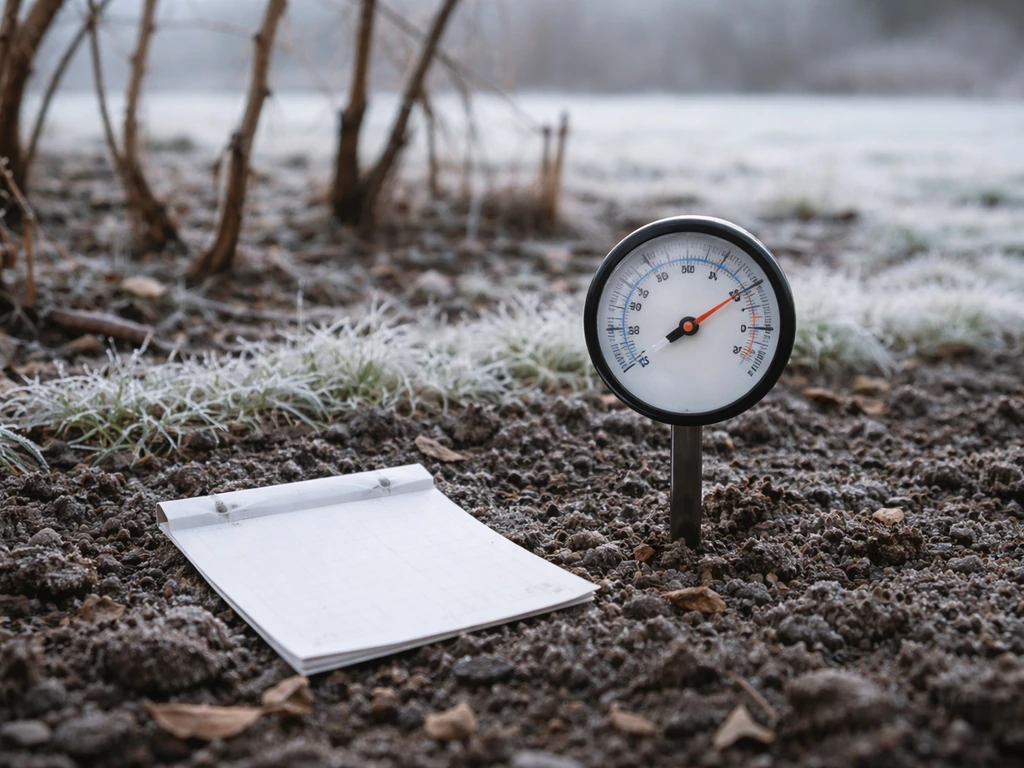
CSU Extension is direct about the frost-free day threshold: do not plant wine grapes where you have 150 frost-free days or fewer. Most Colorado varieties need somewhere between 160 and 200 frost-free days to bring fruit to maturity. If your location clears that bar, you are in the game. If it does not, you need cold-hardy table grape varieties and realistic expectations about wine grapes. Mid-winter lows of -10°F and colder can injure or kill buds and canes outright, so your variety choice has to match your actual winter low temperatures, not an optimistic average.
Cold air drainage and frost pockets
This is the big one that most beginners overlook. Cold air is dense and flows downhill like water, pooling in low spots, valley bottoms, and depressions. CSU Extension calls cold air drainage the single most important feature of a planting site in Colorado. On calm, clear nights, the temperature difference between a low-lying frost pocket and a well-positioned hillside site just a short distance away can be as much as 10°F. That is the difference between a vine that survives and one that gets hammered every spring and winter. Avoid planting at the bottom of a slope, in a low-lying valley, or anywhere cold air and moisture tend to settle.
Short season and spring frost timing
Colorado grapes typically push growth in early May, which is actually later than in many warmer states. That late start narrows the window for spring frost damage compared to a place like California, where vines break dormancy earlier. Still, a late frost after budbreak can wipe out your crop for the year, and late frosts in April and even May are common depending on your elevation and location.
Dry climate and midwinter desiccation
Colorado's dry air kills vines in a way that surprises people: midwinter desiccation. Even when temperatures are not extreme, the combination of dry winter air, frozen ground, and sometimes wind can dehydrate and kill canes and buds. CSU Extension recommends preventing this with a deep late-fall irrigation applied after frost, which recharges the soil moisture reservoir going into winter. The timing matters because you do not want the irrigation to encourage vines to break dormancy again.
Irrigation requirements
Colorado receives far less natural precipitation than grapes need to thrive. Plan on supplying roughly 20 to 25 inches of moisture per growing season depending on your soil and local climate. You need a reliable irrigation setup before you plant, not as an afterthought.
Best grape varieties for Colorado home gardens
European wine grapes (Vitis vinifera) are the ones people dream about, but they have limited potential in Colorado. They need more heat units to ripen than most Colorado locations can consistently provide, and they are less cold-hardy. For most home gardeners here, the better path is American cultivars (Vitis labrusca) and cold-hardy hybrid varieties. American grapes like Concord have a characteristic flavor that some people love and others find too strong, but they are tough, productive, and well-suited to Colorado conditions.
Here is a breakdown of the varieties CSU Extension recommends most often for Colorado home gardens:
| Variety | Type | Best Use | Cold Hardiness |
|---|---|---|---|
| Himrod | American/hybrid table | Fresh eating, seedless | Good |
| Interlaken | American/hybrid table | Fresh eating, seedless | Good |
| Canadice | American/hybrid table | Fresh eating, seedless | Good |
| St. Theresa | American/hybrid table | Fresh eating | Good |
| Reliance | American/hybrid table | Fresh eating, seedless | Very good |
| Concord | American | Juice, jelly, fresh | Excellent |
| Valiant | American | Juice, jelly | Excellent |
| Niagara | American | Juice, white table wine | Good |
| St. Croix | Hybrid | Juice, wine | Excellent |
If you are in a colder or higher-elevation spot, lean toward Valiant, Concord, St. Croix, and Reliance. These are genuinely tough plants. If you are in one of the warmer river valleys with a solid frost-free window, you have more flexibility and can experiment with some of the table varieties like Himrod and Interlaken. For now, skip the European vinifera unless you are in a prime Grand Valley microclimate and willing to do extra work.
Picking the right site and preparing your soil
Sun, wind, and slope
Grapes need full sun, so find the spot in your yard that gets the most direct sun all day, ideally eight or more hours. Wind is a real problem in Colorado, especially on the plains, so a site with some natural wind protection is better than an exposed one. A gentle slope is ideal because it improves cold air drainage, but make sure the slope does not channel water toward your vines during heavy rain. South or southeast-facing slopes warm up faster in spring, which helps in shorter-season areas.
Soil depth, drainage, and preparation
CSU Extension recommends deep, well-drained soil with at least 3 to 5 feet of usable rooting depth. Shallow roots are more vulnerable to both cold damage and drought stress because they track soil temperature changes too quickly. Many Colorado soils have clay hardpans that block deep rooting, so before you plant, dig down and check. If you hit a dense clay layer at 18 inches, you need to break that up, either by deep ripping mechanically or by digging and amending the planting area. Do not skip this step. Grapes also perform better in moderately fertile soil, not super-rich garden beds, so avoid loading the planting area with heavy nitrogen fertilizer.
Weed control and mulch
Lawn grass and weeds compete aggressively with young vines and will slow establishment significantly. CSU Extension recommends maintaining a four-foot-wide weed-free strip under the trellis, ideally mulched with bark or wood chips. This also helps retain soil moisture, which matters a lot given Colorado's dry conditions.
Spacing and irrigation planning
Space your vines 6 to 8 feet apart within a row, and if you are planting multiple rows, keep rows 6 to 10 feet apart depending on how you plan to trellis them. Set up your irrigation system before you plant, not after. Drip irrigation works well for Colorado home vineyards because it delivers water directly to the root zone without wetting the foliage, which helps reduce disease pressure.
When to plant and what to expect in the first few years
Spring planting in April or May is the right window for Colorado. CSU Extension specifically recommends planting before high temperatures arrive, so earlier in that window is generally better than waiting until late May. If you are planting bare-root or cutting stock, store it at around 40°F and keep it moist until you are ready to put it in the ground.
At planting, set the vine so that the bulk of the root system starts at about 12 to 14 inches depth. Planting too shallow means the roots will be in soil that swings dramatically with temperature in winter and spring, which increases stress and winter injury risk. Leave two buds above the soil surface. After planting, irrigate immediately and thoroughly. UC IPM notes that irrigation is essential for vine growth and production, and that irrigating about every 2 to 3 weeks is usually adequate under good soil conditions and a moderate climate irrigate immediately and thoroughly. This sounds obvious but CSU Extension flags it specifically because poor early irrigation is one of the most common reasons for failed establishment in Colorado's dry climate.
At planting, prune back to two or three buds. That seems aggressive, but it forces the vine to put energy into root development and building one strong trunk rather than sprawling shoots that go nowhere. During the first summer, let the vine grow freely and select the strongest shoot to become your main trunk.
Be honest with yourself about the timeline. You will not get a meaningful harvest in year one. Year two might give you a small taste. Year three is when most Colorado home growers start seeing real production. The first couple of years are about building roots and structure, not fruit. That patience is worth it.
Trellising, training, and seasonal care
Building your trellis
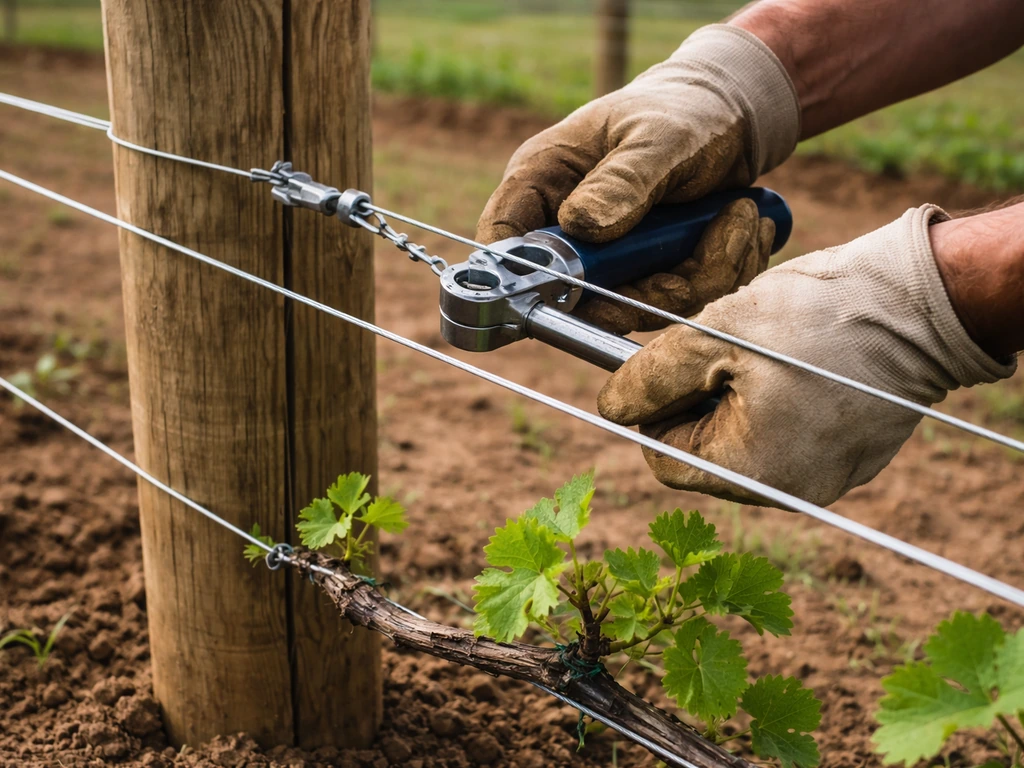
Do not underestimate how heavy a mature grapevine becomes, especially loaded with fruit. CSU Extension recommends using treated posts and wire that is at least 12-gauge, and heavier if you can manage it. Flimsy garden stakes or lightweight wire will not hold up. A simple and practical system for home growers is the Single Curtain System, which uses one main cordon (horizontal arm) trained along a wire, with fruiting canes hanging down. It is manageable, easy to prune, and works well in smaller home garden spaces.
Annual pruning: the most important thing you do
Grapes fruit on one-year-old wood. That one fact drives all of your pruning decisions. Every year, you need to prune back aggressively and select new one-year-old canes to be your fruiting wood for the coming season. An unpruned vine produces excessive leafy growth, tiny undersized clusters, and poor fruit quality. By year three and beyond, aim for roughly 40 to 60 buds per plant, adjusting based on the variety and the typical cluster size it produces.
On timing: in Colorado, wait to prune until after mid-February if possible. Severe arctic cold spells, those dipping to 0°F or below, typically happen before mid-February in places like the Grand Valley. Pruning in the dead of winter removes wood before you can assess what the cold has damaged. Waiting until late February or early March lets you see what is healthy and choose the best canes to keep.
Summer care
Keep the canopy open and well-ventilated by removing excess shoots and tucking canes into the trellis wires. This is not just about neatness, it directly reduces Botrytis bunch rot risk, which is much more likely in dense, shaded canopies. Water consistently through the growing season to meet the vine's moisture needs, and do not forget that late-fall deep irrigation before the ground freezes to prevent midwinter desiccation.
Frost protection, pests, and common Colorado problems
Protecting against late frosts
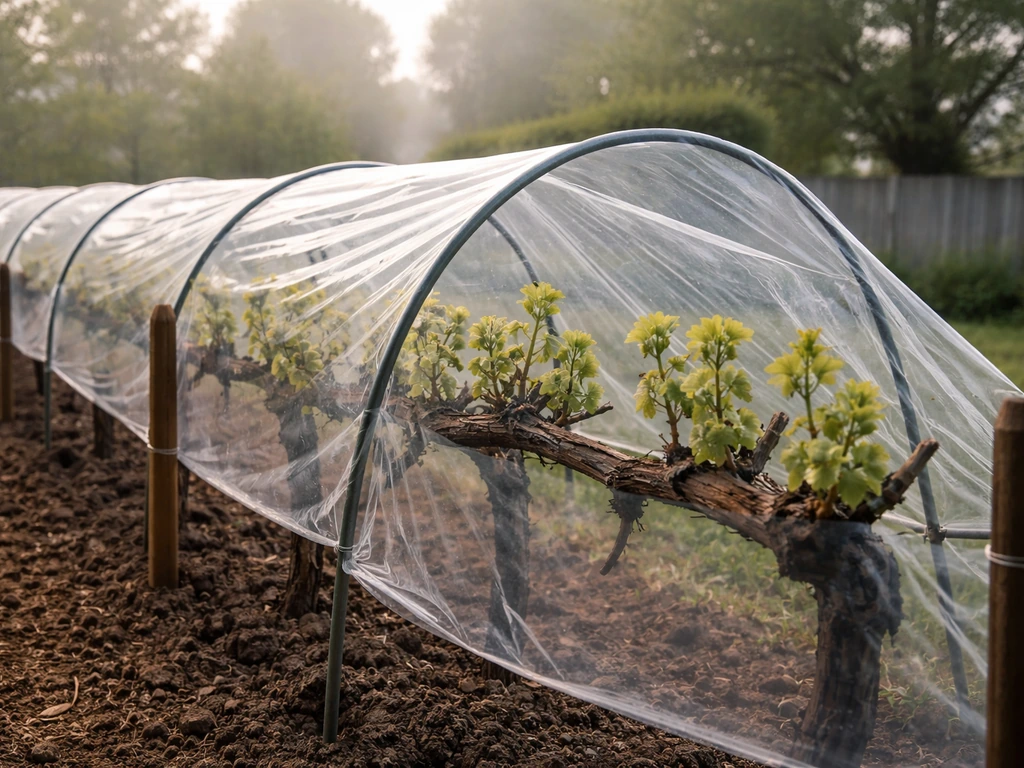
After budbreak, a late frost can wipe out your crop for the year. The practical protection method for home growers is row covers or hoop covers. CSU Extension describes using hoops spaced three to five feet apart (closer spacing in windier spots) with fabric covers that trap heat and buffer cold air. CSU Extension also notes that trials in Fort Collins found plastic covers on frames can provide several degrees of frost protection row covers or hoop covers. These covers can also raise early-season temperatures around the vines, which is a bonus in Colorado's short season. Keep covers handy from budbreak through mid-May, because late frosts in that window are not rare.
Powdery mildew
Powdery mildew is the most common grape disease in Colorado, showing up throughout the state. It appears as a white powdery coating on leaves, shoots, and fruit. Managing it starts at budbreak, not after you see it. CSU Extension recommends a fungicide program starting at budbreak using sulfur on a 10 to 14-day interval, followed by DMI (demethylation inhibitor) fungicide applications through bloom and early shoot growth. Good canopy management that keeps air moving through the vine helps too. Do not let this one slide, because once it gets established in a dry, warm season, it spreads fast.
Crown gall
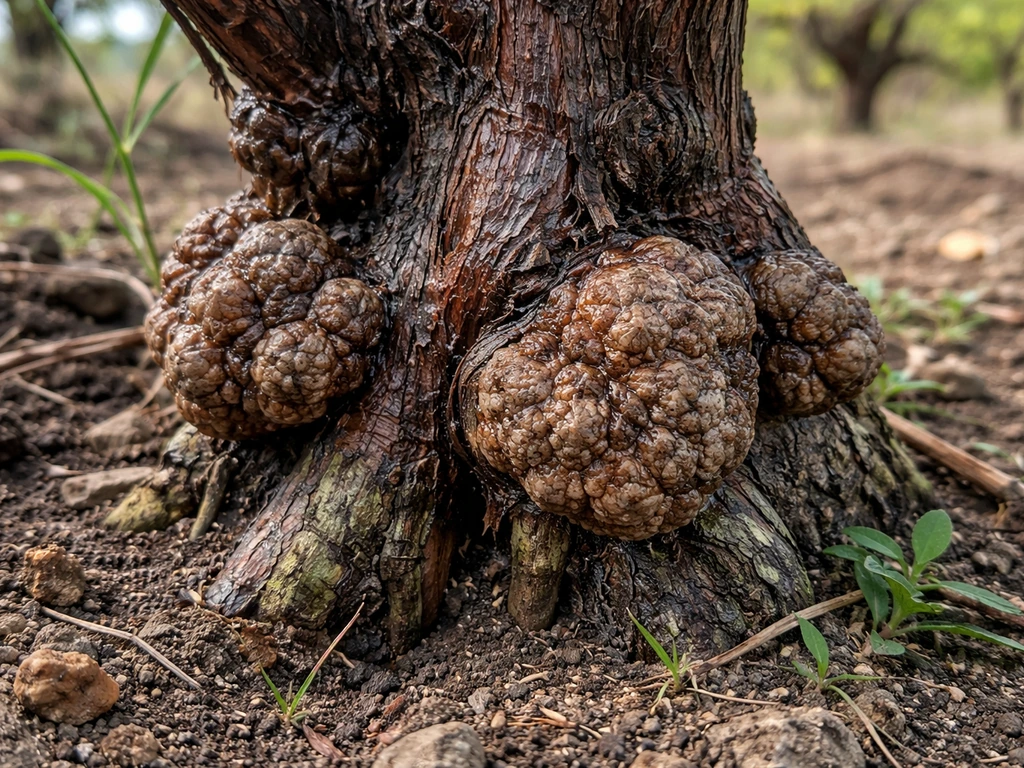
Crown gall is very common in Colorado vineyards and shows up as warty, tumor-like growths at the base of the vine or on canes, typically after winter injury. The best defense is choosing cold-hardy varieties that avoid the freeze-thaw damage that creates entry points for the bacteria, planting in good sites with adequate cold air drainage, and avoiding mechanical damage to vines during pruning and cultivation.
Other issues to watch for
- Iron chlorosis: yellowing between leaf veins, often triggered by overwatering in spring in alkaline Colorado soils. Back off on irrigation early in the season and consider chelated iron if the problem persists.
- Botrytis bunch rot: fuzzy gray mold on fruit clusters, almost always linked to a dense, poorly pruned canopy with bad air circulation. Open the canopy up and prune properly.
- Root rot: usually tied to poor soil drainage. If your soil stays wet, you planted in the wrong spot, and this problem does not fix itself.
- Birds: as fruit ripens, birds can strip a small planting quickly. Bird netting draped over the vines a few weeks before harvest is the simplest solution.
How Colorado compares to other challenging states
Colorado is genuinely one of the more demanding states for home grape growing, but it is far from the only one with real constraints. Gardeners in states like Florida or Louisiana deal with opposite problems, heat, humidity, and disease pressure that makes cold-hardy varieties irrelevant and fungal issues relentless. If you are wondering can you grow grapes in Louisiana, the key differences will be heat, humidity, and disease pressure rather than cold, short-season constraints. If you are wondering can you grow grapes in Florida, the big differences are heat, humidity, and disease pressure compared to Colorado. Texas and Oklahoma sit somewhere in between, with their own mix of heat and cold depending on the region. If you are asking can you grow grapes in Oklahoma, the same basics apply, but you will need to judge frost risk and heat swings for your specific region. If you want to know can you grow grapes in texas, the same thinking about site, frost risk, and variety selection will guide you Texas and Oklahoma sit somewhere in between. Colorado's challenges are mostly about cold, short seasons, and dry air, and those are problems that good variety selection and site prep can directly address. The state has a real commercial wine industry built in those prime river valleys, which tells you that the conditions are workable when you set things up correctly.
Your next steps starting today
If you want to start this spring, here is what to do right now. First, assess your site: check frost-free days for your specific location (your local CSU Extension office can help), walk your yard and identify where cold air might pool, and pick the sunniest, best-drained spot with some wind protection. Second, choose your variety based on your location. If you are in the Grand Valley or a similar prime spot, Himrod, Reliance, or St. Croix are excellent starting points. If you are in a colder or more exposed location, Valiant or Concord are your safest bets. Third, source your vines from a reputable nursery that specializes in cold-hardy varieties. Local nurseries in Colorado's wine regions often carry varieties selected for the state. Fourth, build your trellis before planting, not after. Get those posts in the ground and wire strung so the vine has something to grow toward from day one. Fifth, plant in April or May, irrigate immediately, and mulch that four-foot strip under your trellis. Then be patient. Colorado grapes reward the growers who set things up right at the beginning.
FAQ
What if my location has fewer than 160 frost-free days, can I still grow grapes?
It usually is, for most Colorado home sites. If you cannot document at least about 160 frost-free days, many people end up with vines that survive but never ripen fruit reliably. In marginal spots, consider cold-hardy table varieties first, and treat any “wine grapes” goal as experimental until you confirm your year-by-year frost history.
How do I get bigger clusters or better quality grapes in Colorado without over-fertilizing?
For “bigger grapes” than Colorado typically produces, the trellis system and shoot selection matter more than fertilizer. Excess nitrogen creates leafy growth and dilutes fruit quality, so aim for moderate fertility, and prune to manage bud load (roughly 40 to 60 buds per vine by year three) rather than feeding heavily to force size.
When should I water during winter and early spring, and what’s the most common watering mistake?
Mulch does not replace irrigation planning. Use the deep late-fall irrigation to reduce winter desiccation risk, then switch to consistent growing-season watering based on soil and weather, not a fixed schedule. The quick mistake is irrigating only shallowly or skipping the late-fall recharge, which increases winter bud and cane loss.
Do row covers actually work for protecting grapes from Colorado late frosts, or do they create new problems?
Yes, but the safe move is to protect more than the vine. Focus on cold-air flow and frost timing, then add physical protection like hoop or row covers during budbreak through mid-May. Also keep the covers from overheating on sunny days by venting or removing them during warm periods, otherwise you can damage tender growth.
Can I cultivate or weed around the base of the vine to control grass, or will that hurt the plant?
Grapes are sensitive to root injury and crown damage, especially in Colorado’s freeze-thaw cycles. Avoid heavy cultivation near the trunk, keep lawn equipment away, and be careful when pruning because wounds can invite bacteria like crown gall after winter injury.
What if I only have a small backyard, can I still grow grapes successfully?
You do not need an enormous yard planting, but you do need a workable trellis and spacing. If you are short on space, a single-curtain style training system still needs room for airflow and access for pruning, and vines should still be spaced about 6 to 8 feet apart so you can manage bud selection and canopy openness.
Is it better to start with nursery vines, or can I start grapes from cuttings in Colorado?
It’s possible, but it is higher risk than starting with a mature, well-rooted nursery vine. If you start from cuttings or delayed material, you must be especially strict about planting depth, early irrigation, and winter survival since young plants have less established wood and roots to buffer cold swings.
How do I choose between Grand Valley type locations and colder sites if both seem “good” on paper?
Go by your local microclimate, not the general valley name. Even within the same region, sheltered, south-leaning slopes can break bud earlier, which increases exposure to late frosts. Before committing, watch spring temperatures and cold-air patterns for at least one season or consult local records, then select a variety whose ripening aligns with your heat and frost timeline.
If I wait to prune until late February, won’t that delay fruiting too much?
Pruning timing is partly about cold damage, but it is also about labor and observation. The practical approach is to wait until after mid-February when possible, then prune based on what is visibly healthy. If you prune too early you may remove wood that actually survived hard freezes, reducing your available fruiting canes.
What should I do if I notice powdery mildew later in the season instead of at budbreak?
If powdery mildew shows up, don’t assume you missed your chance. You can still reduce spread by improving canopy airflow, removing heavily infected leaves if appropriate, and restarting targeted control at the next growth stage. But best results come from starting at budbreak, so treat any late start as damage control, not prevention-only.