
Yes, you can absolutely grow grapes in Oklahoma, and with the right variety and a little planning, you can get a genuinely productive vine. Oklahoma's climate is actually well-suited to grapes in most parts of the state. The bulk of Oklahoma sits in USDA hardiness zones 6b and 7, with the panhandle dipping into zone 6a and the southern counties along the Red River reaching zone 8a. For the official USDA Plant Hardiness Zone Map materials and downloadable resources, see the USDA ARS map downloads page. That range covers a wide swath of cold-hardy and heat-tolerant varieties, so the question isn't really whether grapes will grow here but which type to plant and where.
Can You Grow Grapes in Oklahoma? How to Succeed
Marcus Whitfield
22 Apr 2026
The two biggest challenges in Oklahoma are summer disease pressure (especially in the eastern, more humid part of the state) and matching your variety to your winter lows. Get both of those right, and you have a real shot at fruit by year three.
Best Grape Varieties for Oklahoma
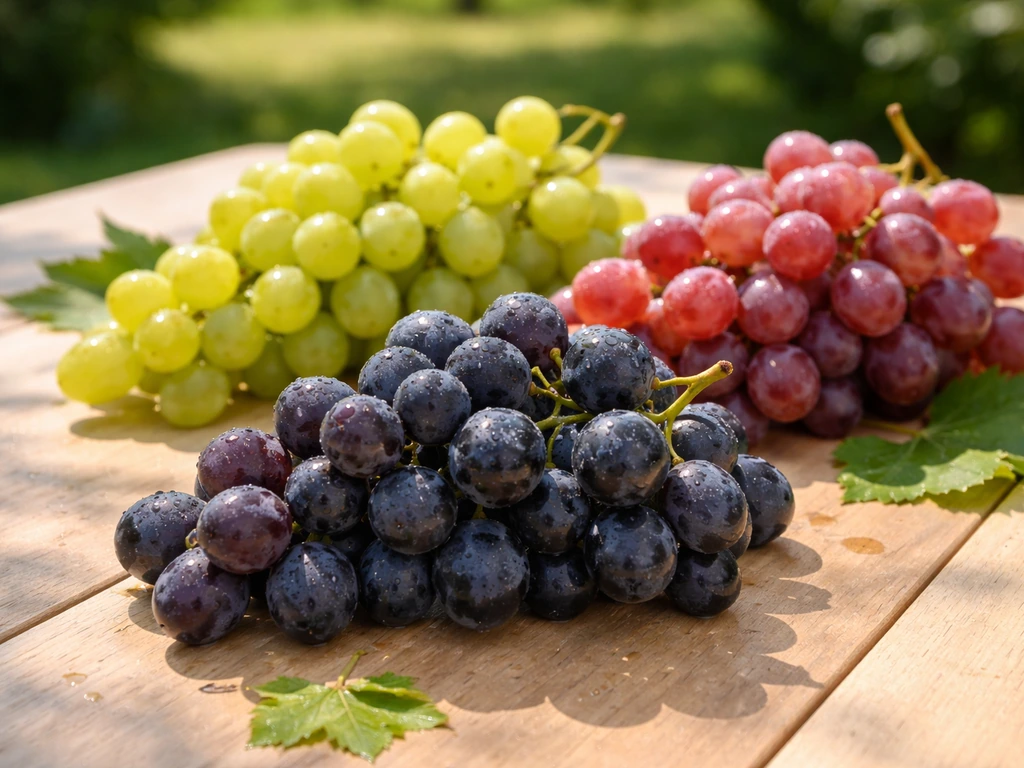
Variety selection is the single most important decision you'll make. Oklahoma's combination of hot summers, periodic drought, and hard winters rules out a lot of classic European wine grapes, but it's actually a great environment for American and hybrid varieties that were bred with exactly these conditions in mind.
OSU's home-garden grape guide recommends both table and wine types for Oklahoma gardeners. Niagara is one of the wine grape options specifically listed for Oklahoma conditions. For table grapes, look for American varieties or French-American hybrids with documented cold hardiness down to at least zone 6 or 7. These generally have better disease resistance than pure European (Vitis vinifera) types, which is a real advantage in humid eastern Oklahoma.
Muscadines deserve a separate note. They handle heat and humidity beautifully, but they are sensitive to cold and are not well adapted to northern Oklahoma. If you're in Tulsa or north of there, skip muscadines entirely. If you're in the Ardmore or Durant area near the Red River (zone 8a), muscadines become a legitimate option. For anyone in the middle of the state, cold-hardy American or hybrid varieties are the safer and more reliable bet.
| Variety Type | Best Oklahoma Region | Primary Use | Key Strength |
|---|---|---|---|
| Cold-hardy American (e.g., Concord, Niagara) | Statewide, including panhandle | Table/Juice/Wine | Winter hardiness, disease tolerance |
| French-American hybrids (e.g., Chambourcin, Vidal Blanc) | Central and eastern Oklahoma | Wine | Better disease resistance than vinifera |
| Muscadine (e.g., Carlos, Magnolia) | Southern Oklahoma only (zone 8a) | Table/Juice | Heat and humidity tolerance |
| European/vinifera (e.g., Cabernet, Chardonnay) | Not generally recommended | Wine | Low cold hardiness, disease-prone in OK |
If you're in eastern Oklahoma where humidity is higher, disease resistance should be your top filter when choosing a variety. It doesn't matter how cold-hardy a vine is if black rot or downy mildew wipes out your crop every year. Pick something rated disease-resistant first, then factor in flavor and use.
Site Selection and Soil in Oklahoma
Grapes are forgiving about a lot of things, but not about drainage. If your soil holds water after a rain, your vines will struggle. A gentle slope is ideal because it moves cold air and excess water away from the root zone. Raised beds work well if you're dealing with heavy clay soils, which are common in central and eastern Oklahoma.
Soil pH should be between 5.5 and 6.5 for best results. Get a soil test before you plant so you know where you're starting. If your pH is too high (which can happen in western Oklahoma's alkaline soils), you'll need to amend with sulfur before planting. If it's too low, lime brings it up. Either way, a $15 soil test saves you years of frustration.
Wind protection is worth thinking about, especially in western Oklahoma where strong spring winds are common. A windbreak to the north or northwest can protect early shoots and reduce physical damage, but don't box the vines in on all sides. Grapes need airflow to dry off after rain and reduce disease pressure. Think about a windbreak behind the row, not a wall around it.
Sun, Spacing, and Trellis Setup
Full sun means at least eight hours of direct sun per day. This is non-negotiable. Partial shade slows ripening, weakens wood going into winter (which matters for cold hardiness), and dramatically increases disease risk. South or southwest-facing sites are ideal in Oklahoma.
For spacing, plant vines eight to ten feet apart in the row. If you're planting multiple rows, space them eight to ten feet apart as well to allow equipment access and good light penetration. For most home gardens, a single row of three to five vines is plenty to start.
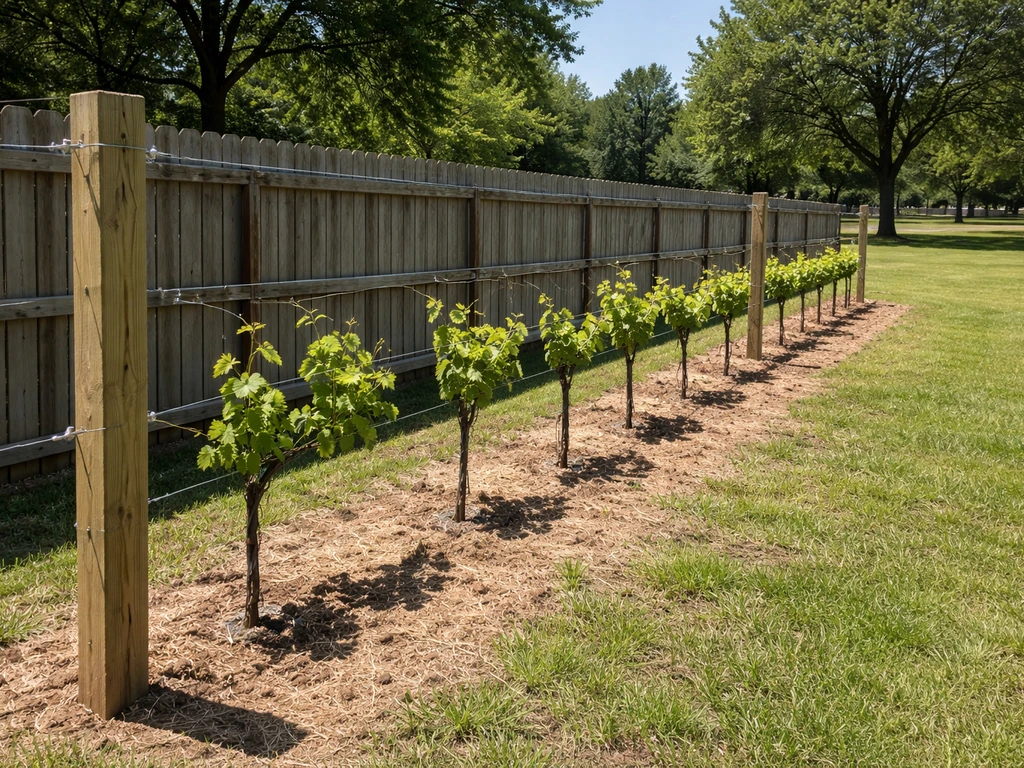
Install your trellis before or at planting time, not after the vines start growing and need it urgently. A simple two-wire system with posts every 20 feet works well. Set posts at least two feet into the ground (three feet is better in Oklahoma's wind-prone areas) and run wires at about five to six feet high for the top wire, with a lower training wire at about three feet. Use 12- or 14-gauge galvanized wire. The whole system needs to be sturdy because a mature grape vine is heavy and has real wind resistance.
For training, the most practical system for Oklahoma home gardeners is a bilateral cordon (also called a T-trellis). You train two permanent arms along the top wire in opposite directions from the trunk. Each year you prune short fruiting spurs off those arms. It's clean, manageable, and gives you good control over vine size without a lot of complexity.
When to Plant and What to Expect Each Season
Spring planting (late February through March) is the standard for Oklahoma. Bare-root plants are widely available at this time and establish well if the soil is workable. Before planting, soak bare-root vines in water for two to three hours to rehydrate the roots. Dry roots are a common and easily avoided reason for early failures.
Plant at the same depth the vine was growing at the nursery. If your plant is grafted (many commercial vines are), make sure the graft union stays above the soil line. Burying the graft union encourages the top variety to root on its own, which defeats the purpose of grafting onto a disease-resistant rootstock.
After planting, mulch the row with about four inches of straw, sawdust, or pine bark. This keeps moisture in, suppresses weeds, and moderates soil temperature during Oklahoma's hot summers. It's one of the highest-return tasks you can do in year one.
- Year 1 (establishment): Focus entirely on building a strong root system and training a single upright shoot toward the top wire. Remove any flower clusters that form. The vine is not ready to fruit yet.
- Year 2 (trunk and cordon development): Begin training the two cordon arms along the top wire. Remove flowers again. Apply fertilizer in a circle around the vine using about one pound of balanced 10-10-10 per vine.
- Year 3 (first light crop): Once the cordon arms have reached the desired length and are established, the vine can support a light crop. Don't let it overproduce. Thin clusters to avoid stressing the vine.
- Year 4 and beyond: Full production. A well-established vine in Oklahoma can produce 15 to 20 pounds of grapes per vine annually under good management.
Your Care Calendar: Watering, Fertilizing, and Pest Management
Watering
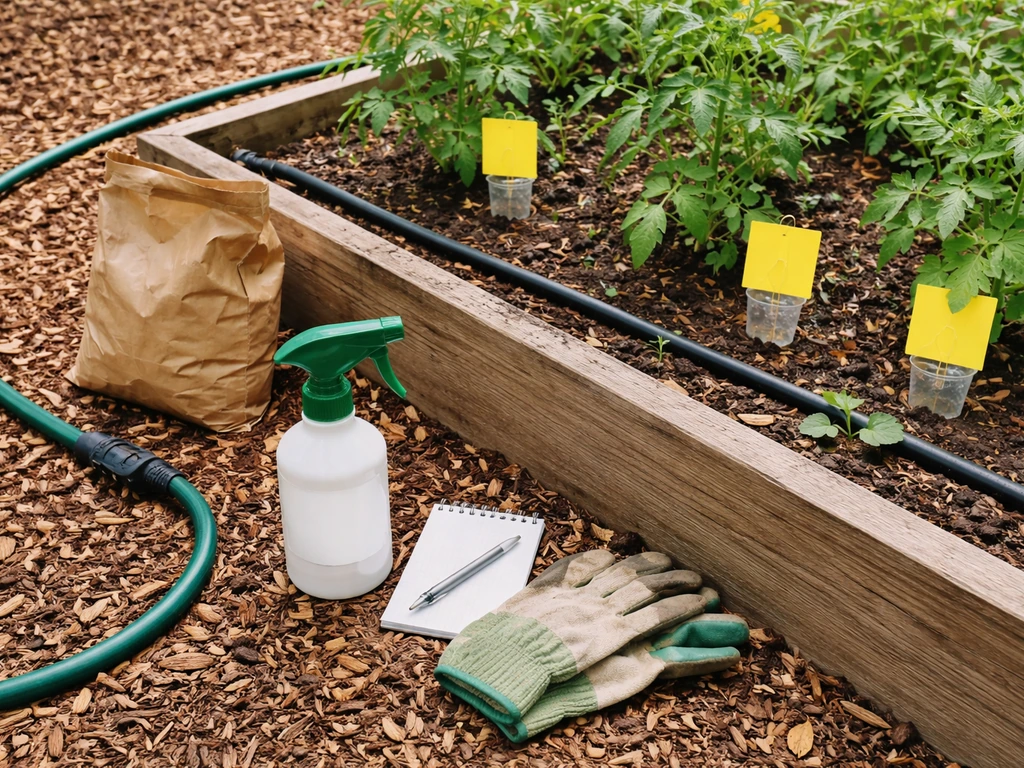
During the first two years, consistent moisture is critical. Water deeply once or twice a week in the absence of rain, especially during Oklahoma's dry spells in June through August. Established vines are more drought-tolerant but still benefit from deep watering during fruit development. Drip irrigation is ideal because it keeps foliage dry, which directly reduces disease pressure.
Fertilizing
In year two, apply one pound of 10-10-10 fertilizer per vine in early spring before growth begins. Broadcast it in a circle around the vine and water it in. As vines mature, you'll rely more on a soil test to guide fertilization than a fixed formula. Over-fertilizing with nitrogen produces excessive leafy growth at the expense of fruit and wood hardening, which can hurt cold hardiness going into winter.
Disease Management
Black rot is the most serious grape disease in Oklahoma, and it can wipe out an entire crop if you're not watching for it. It infects leaves and fruit during warm, wet periods, primarily from bud break through about four weeks after bloom. You'll see circular brown spots on leaves and shriveled, mummified berries. The key to control is starting a fungicide program at bud break and staying on schedule through bloom and fruit set. Sulfur-based fungicides are an effective and inexpensive option for powdery mildew. Copper-based or broad-spectrum fungicides handle black rot and downy mildew.
Downy mildew often shows up in spring home gardens, especially in eastern Oklahoma after rainy periods. Look for a white fuzzy coating on the undersides of leaves. Pruning out infected tissue and improving airflow through the canopy are your first cultural steps. Follow up with a fungicide labeled for downy mildew if the infection is spreading.
The practical disease management schedule for Oklahoma looks like this: start spraying at bud break, spray again at one to two week intervals through pre-bloom, bloom, and four weeks post-bloom. After that, disease pressure drops significantly and you can back off. Don't skip the early-season sprays. That window is when black rot does most of its damage.
Insect Pests
After petal-fall, start monitoring for insect pests. The ones most likely to cause problems in Oklahoma are grape berry moth, leafhoppers, and Japanese beetles. Japanese beetles are hard to miss and will skeletonize leaves quickly. Hand-pick them in the early morning when they're sluggish, or use a labeled insecticide if populations are high. Grape root borer is technically a pest of grapes but is not common in Oklahoma, so don't spend a lot of energy worrying about it.
Pruning, Harvesting, and Keeping Vines Productive Long-Term
When and How to Prune
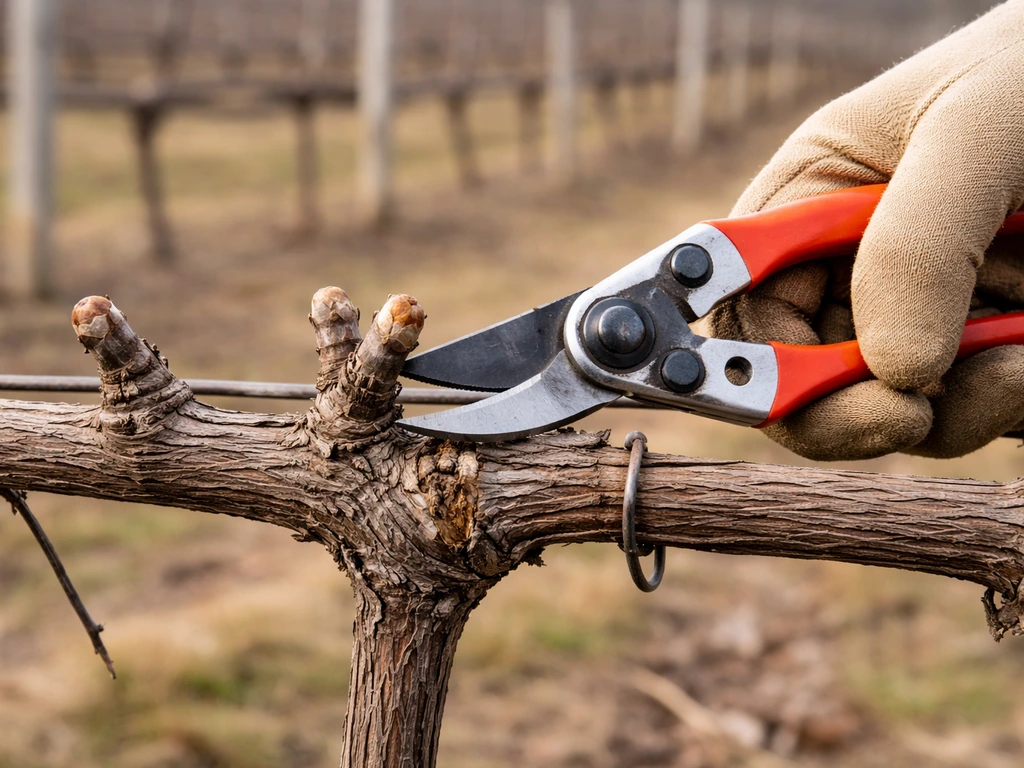
Late February through early March is the right pruning window for Oklahoma. You want to prune before shoots reach about two inches in length. Pruning dormant wood is much easier to manage, and you avoid accidentally knocking off tender new growth. If you prune too early in January, a cold snap can damage freshly cut wood. Late February to early March hits the sweet spot.
For spur pruning on a bilateral cordon system, cut each spur back to two or three buds. Aim for five or six spurs per cordon arm. That gives you a manageable number of fruiting positions and keeps the vine from overproducing, which weakens wood and reduces cold hardiness the following winter. Remove any dead, diseased, or crossing wood entirely. The goal is an open canopy with good air and light penetration.
Pruning for grape health and production is the same basic act, but the emphasis is slightly different. For fruit, you're leaving just enough wood to produce a good crop without overtaxing the vine. For long-term vine health, you're also removing infected tissue, managing vine size so it doesn't outgrow its trellis, and keeping the canopy open so disease has less chance to take hold.
Harvest Expectations
Realistically, plan for year three as your first meaningful harvest. By that point your cordon arms should be established and the vine can support a light crop without stress. Full production typically arrives in year four or five. Grapes are ready to harvest when they taste right, not just when they look ripe. Sample a berry from the interior of the cluster, not the tips (those ripen first and overstate how ready the cluster is). In Oklahoma, most American varieties ripen between late August and early October depending on the variety and the season.
Long-Term Maintenance
Once your vines are in full production, the annual rhythm becomes fairly straightforward: prune in late February, begin fungicide applications at bud break, monitor for insects after bloom, harvest in late summer or fall, and then let the vines harden off going into winter. Refresh your mulch each spring. Re-do your soil test every two to three years. Replace any mummified fruit left on the vine before the next season starts, since those mummies are a primary source of black rot reinfection.
If you're curious how Oklahoma compares to neighboring states, the challenges here are broadly similar to Texas (heat and disease pressure) but with more winter cold than southern Texas growers face. If you want to know can you grow grapes in Florida, the same fundamentals apply, but you'll need to choose varieties and manage disease pressure for Florida's heat and humidity.
Louisiana’s higher humidity means you’ll want to prioritize disease-resistant varieties and plan your fungicide and airflow strategy early can you grow grapes in Florida. Louisiana growers deal with even higher humidity and lean heavily on muscadines. Colorado, by contrast, has colder winters and lower disease pressure, which opens up different variety options. Oklahoma sits in a middle zone where cold-hardy, disease-resistant hybrids really shine, and that's actually a good position to be in as a home grape grower.
The best next step is to get a soil test this week, pick two or three cold-hardy, disease-resistant varieties from OSU's recommended list for your zone, and order bare-root plants for a late February or March planting. Get your trellis posts in the ground before the vines arrive. That preparation work, done in the dormant season, sets you up for a clean, successful start and takes most of the guesswork out of year one.
FAQ
How do I know whether I should treat early for black rot or wait and see?
If your site gets frequent rain or you are in eastern Oklahoma, plan on a disease-focused routine (fungicide starting at bud break plus canopy airflow). In drier western areas, you may still need to spray early for black rot, but you can sometimes reduce later-season applications if weather stays dry and you see little new spotting.
Will mulch alone be enough watering for young grapevines in Oklahoma?
Yes. Mulch helps, but don’t rely on it alone for establishment. In hot spells, you can still get stress even when the surface looks moist, so use a simple check (push a finger or small trowel a few inches into the soil). If it’s dry at that depth, water deeply.
What should I do if my yard has clay and doesn’t drain well?
Generally, avoid heavy or wet spots, and do not plant where you regularly see standing water after storms. If you must plant near clay or low areas, build raised beds or ensure the row drains well before planting. Poor drainage can cause chronic vine weakness that is hard to fix mid-season.
Can I grow grapes if my spot only gets morning sun or less than full sun sometimes?
Not usually. Grapevines often do better on long, uninterrupted sun exposure. If you only get eight hours some days and less on others, choose a more consistent site, because lower light slows ripening and weakens wood quality going into winter.
Why is my grapevine growing leaves but not producing fruit in year two or three?
It depends on why the vine isn’t growing. If growth is vigorous but fruit is missing, spur pruning and crop balance are likely off. If growth is weak, check drainage and root establishment, then confirm soil pH and whether you over- or under-fertilized nitrogen. A soil test plus a look at pruning structure usually narrows it down fastest.
Do I have to use drip irrigation, or can I water with a hose or sprinkler?
For most home growers, yes, drip irrigation is a strong choice because it keeps foliage drier. If you use sprinklers, switch to drip or at least water early in the morning and avoid wetting leaves after petal-fall, since disease risk rises when foliage stays wet.
My vine looks like it’s getting buried over time, should I be worried about the graft union?
If the graft union is buried, the top variety may develop its own roots, which can change performance and reduce the benefit of grafted rootstock. Keep the graft union above the soil line (or only at the same depth it was in the nursery), and re-check after mulching so it does not get covered over time.
What if I missed the recommended pruning window in Oklahoma?
Try to avoid pruning too close to a cold snap. If you already missed the late February to early March window, do the minimum needed to remove dead or clearly damaged wood, then finish structural spur pruning when temperatures stabilize. Sudden cold after pruning can damage tender new growth.
How do I decide whether to leave more or fewer spurs on a T-trellis?
A bilateral cordon is a good default, but make sure you don’t overload spurs, since too many fruiting positions can weaken wood hardiness. Aim for the spur count you’ve planned (about five to six per arm as a starting guideline), then adjust in later years based on vine vigor and winter performance.
Should I spray for every pest I see, or only specific ones?
Yes, but choose your battles. Japanese beetles can cause quick leaf loss, so treat or hand-pick early when numbers are low. For other pests, don’t blanket-spray unless you’re seeing active damage, because beneficial insects can help keep leafhoppers and other problems in check.
How can I protect grapes from birds and still manage disease?
If birds are eating berries, use a combination of physical protection and timing. Netting over the row or individual clusters is usually the most effective approach late in ripening. Avoid adding extra nitrogen close to harvest, since overly leafy, lush growth can also hide clusters and make bird damage worse.
My first vine died after one season. Should I replant immediately, or troubleshoot first?
Replanting only makes sense after identifying the cause. If your vine died, common causes are winter injury, standing water, incorrect planting depth, or missed early-season disease pressure. Before buying replacements, check drainage, confirm variety hardiness for your zone, and review your initial pruning and trellis setup.