
Grapes in India grow and ripen primarily in the cool, dry winter-to-spring period, roughly October through April, depending on where you are in the country. In the hot-tropical heartland of Maharashtra and Andhra Pradesh, the main harvest runs January to April, with the bulk of India's table grapes picked in March and April. In the subtropical north plains, budbreak happens in early March and harvest follows about 90 to 95 days later, landing in late May or June. For more on the timing of budbreak and early growth, see when do grape vines start to grow. In mild-tropical Karnataka and Tamil Nadu, some varieties produce two crops a year. So there is no single "grape season" in India, but most home gardeners will be working toward a winter harvest if they are in the south or a late-spring harvest if they are in the north. For a quick region-specific answer to what month do grapes grow, see the month-by-month guide below.
In Which Season Grapes Grow in India: Month-by-Month Guide

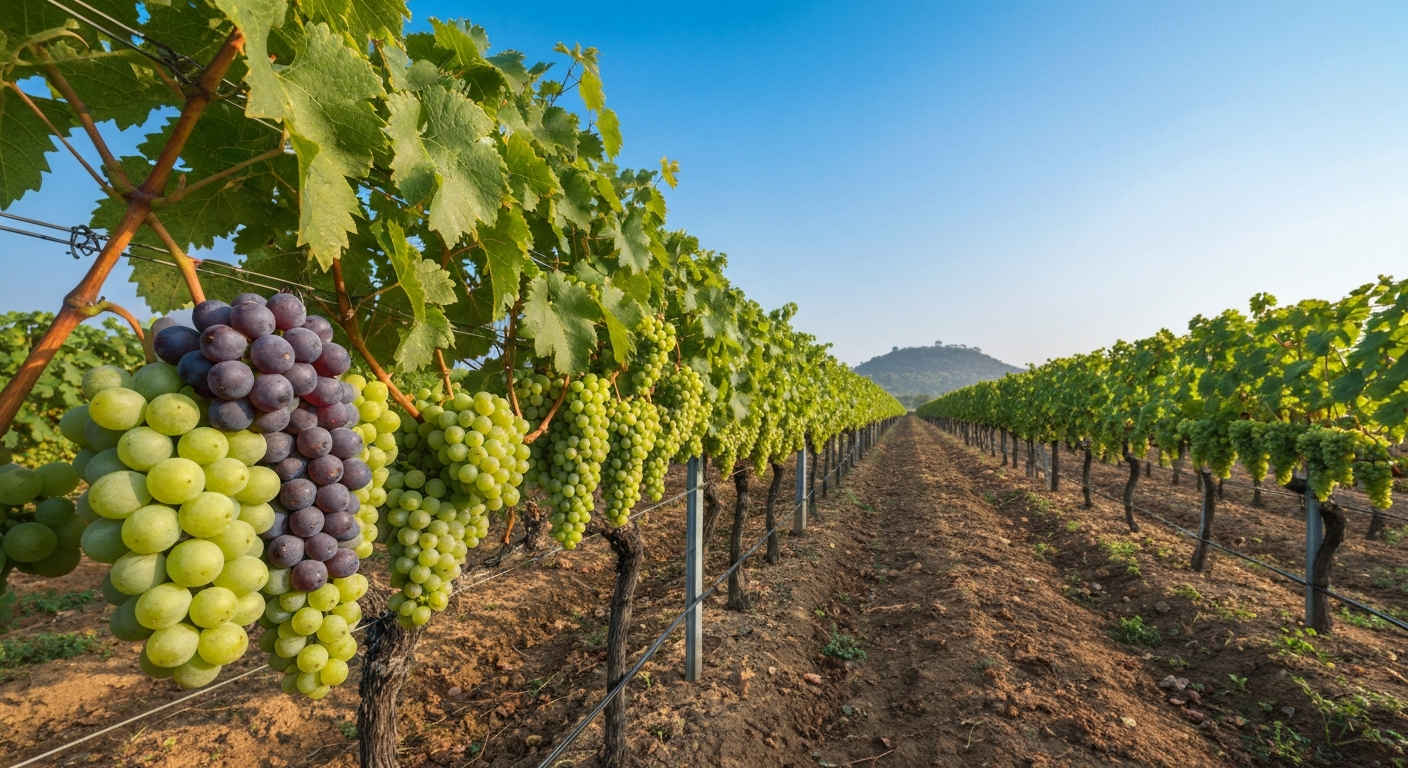
Which season grapes grow in India: the quick picture
The simplest way to think about it: grapes in India are a cool-season crop in a warm country. Vines do their active growing when temperatures moderate, rain is minimal, and the sky is clear for weeks at a stretch. That window falls in the Indian winter and early spring across most grape-growing states. For a quick answer to what season does grapes grow in India: primarily the cool, dry winter to early spring (roughly October through April, with local variation). Commercial grape belts such as Nashik, Sangli, Pune, Anantapur, and Bijapur are built around a harvest concentrated from January to April. Karnataka's Bangalore and Kolar belts, being at higher elevation and slightly cooler, can squeeze in two cropping cycles a year for certain varieties. The subtropical north (parts of Punjab, Haryana, western Uttar Pradesh) experiences real winter dormancy, so the vine rests from November to February and the season is compressed into spring and early summer.
- Hot-tropical zone (Nashik, Sangli, Pune, Anantapur, Bijapur): main harvest January to April; accounts for roughly 70 to 85 percent of India's grape area
- Mild-tropical zone (Bangalore, Kolar, Coimbatore): double-cropping possible for many varieties; harvest cycles spread across the year
- Subtropical north plains (Punjab, Haryana, western UP): winter dormancy from November to February; budbreak in early March; harvest around late May to June
Month-by-month grape phenology across India's climate zones
Understanding what the vine is doing each month is the single most useful thing for a home gardener. Pruning at the wrong time, watering too much during berry fill, or ignoring a spray window by even a week can cost you a whole season. Below is a practical month-by-month breakdown tied to each major zone. Note that the hot-tropical system uses a "double pruning" calendar, where a growth pruning in spring is followed by a fruit pruning in autumn to align the main crop with cool, dry weather.
| Month | Hot-Tropical (Nashik/Anantapur) | Mild-Tropical (Bangalore/Kolar) | Subtropical North Plains |
|---|---|---|---|
| January | Main harvest begins; bunch monitoring for TSS and berry softness; post-harvest pruning on early-cleared plots | Harvest of first-cycle (kharif) crop continues; soil prep for next cycle | Deep dormancy; soil enrichment, trench prep, structural pruning |
| February | Peak harvest; Thompson/Sonaka picked at 21–22 °Brix; pre-pruning manure application | Pruning for second crop cycle; budbreak emerging | Late dormancy; rootstock planting window opens (Feb–Mar) |
| March | Growth/back pruning on cleared vines; new shoot emergence; budbreak actively visible | Rapid shoot growth; leaf canopy expanding; flowering in early varieties | Budbreak in first week of March; rapid leaf flush; irrigation resumes |
| April | Shoot growth vigorous; canopy management; begin fungicide schedule for powdery mildew | Fruit set; young berries forming; mealybug and mite monitoring begins | Flowering; fruit set; warm weather accelerating growth |
| May | Shoots reaching training wires; tip pruning; summer irrigation critical | Berry sizing; irrigation increase; heat stress watch | Berry sizing; harvest of early varieties possible by late May (90–95 days after Mar budbreak) |
| June | Pre-monsoon; manage canopy against humidity; reduce irrigation before monsoon | Veraison; color change in colored varieties; harvest of early mild-tropical varieties | Harvest peak for subtropical north; post-harvest pruning; monsoon onset prep |
| July | Monsoon: vine in semi-dormancy on many farms; minimal management; drainage critical | Monsoon: drainage and disease watch; minimal irrigation needed | Monsoon: rest period; weed and drainage management |
| August | Monsoon continues; powdery and downy mildew pressure high; preventive sprays | Monsoon; canopy thinning to reduce humidity inside vine | Monsoon; structural trellis checks; soil amendment if possible |
| September | Post-monsoon recovery; pre-pruning manure/fertilizer application | Post-monsoon; shoot hardening; preparation for second pruning | Planting window opens for rooted cuttings (Sep–Oct); hardwood cuttings taken for nursery |
| October | Fruit pruning (forward/cane pruning) for main crop; key calendar event in Nashik system | Second-cycle fruit pruning; budbreak for winter crop | Vine establishment work for new plantings; shoot trimming for mature vines |
| November | Budbreak after fruit pruning; rapid shoot growth; flowering in 30–40 days | Rapid shoot growth; flowering; fruit set begins | Shoots hardening; early dormancy; no new growth expected |
| December | Fruit set; berry sizing begins; weather cooling, which benefits TSS accumulation | Berry sizing and fill; color development in colored varieties; early harvest of fast-ripening types | Full dormancy; no active growth |
For varieties like Thompson Seedless in the Nashik system, harvest typically falls 115 to 120 days after the fruit pruning in October, which lines up neatly with February to March. ICAR‑NRCG annual report (Manjri/Pune) – variety harvest timing and days‑after‑pruning notes reports Thompson Seedless harvest around 115–120 days after the fruit pruning in their trials. IIHR-released varieties like Arka Shweta take a longer 153 to 155 days after pruning, which pushes harvest later into spring. Knowing your variety's days-after-pruning figure is one of the most practical numbers you can track in your own garden. If you want to dig deeper into the general grape phenology calendar, the timing of leaf flush and shoot development is covered in more detail in the guides on when grape vines start to grow and when grape vines grow leaves.
Where grapes grow in India: major regions and judging viability for your locality
India's commercial grape map is concentrated in a handful of states, but that does not mean home gardeners outside those belts cannot grow grapes. If you want to know where do grape leaves grow, see the section on major regions and microclimates to find which areas and backyard sites are suitable. It means you need to be honest about your microclimate before you invest in plants and infrastructure.
The commercial heartland
Maharashtra (Nashik, Sangli, Pune, Solapur) is the dominant producer, accounting for the lion's share of India's table grape output and almost all export tonnage. Nashik valley in particular runs harvests from January all the way to May in some blocks. Karnataka (Bangalore Rural, Kolar, Bijapur, Gulbarga) follows as the second major cluster, with the mild elevation of the Deccan plateau moderating temperatures enough to allow double cropping. Andhra Pradesh (Anantapur, Kurnool, Chittoor) is a major Anab-e-Shahi belt. Tamil Nadu (Theni, Dindigul, Coimbatore) grows Panneer, Muscat, and some seedless varieties in its dry-belt districts. Punjab and Haryana produce grapes under subtropical conditions with genuine winter dormancy.
Judging viability for your own location
The two questions that matter most are: does your location get three to four months of dry, clear weather during the potential harvest window, and does your summer peak temperature exceed about 45°C for extended periods? Grapes tolerate heat but prolonged scorching above 45°C causes berry shriveling and sunscald. High humidity combined with warmth is the worst combination, because it triggers powdery mildew, downy mildew, and bunch rot simultaneously. Coastal Karnataka and Kerala, for example, have the warmth but not the dry season clarity that grapes need, which makes viticulture difficult without very intensive disease management. For a quick comparison of seasonal requirements with similar subtropical fruits, see when do grapefruits grow. Hill stations in Himachal Pradesh (Kinnaur, Kullu) and parts of Uttarakhand do have a viable cool-season window and even produce wine grapes commercially in Kinnaur, but those are exceptional mountain microclimates.
- At least 3 to 4 months of dry weather (relative humidity below 60%) during berry development and ripening
- Minimum 6 to 7 hours of direct sun daily throughout the growing season
- Summer maximum ideally below 42 to 43°C; grape vines can survive higher but berry quality suffers
- Winter minimum above about 5°C for most Indian commercial varieties (subtropical north varieties tolerate near-0°C dormancy)
- Access to low-salinity irrigation water: chloride ideally below 3.0 mEq/L for quality table grapes
- Well-drained soil with no standing water risk after rain
Picking your site: a step-by-step microclimate assessment
Even within a viable state, the difference between a thriving backyard vineyard and a frustrating failure often comes down to exactly where on your property you plant. I have seen neighbors in the same town get completely different results from the same variety because one chose a south-facing slope and the other planted against a north-facing wall with poor drainage. Here is how I walk through site selection before committing to any planting.
- Check slope and drainage first. Walk your plot after a heavy rain. Any area where water pools for more than an hour is unsuitable for grapes without major soil modification. A gentle slope of even 1 to 2 percent is your friend.
- Assess sun exposure. Observe the site for at least two weeks and confirm it gets six to seven hours of unobstructed sun from roughly 9 am to 4 pm. Shadows from buildings, trees, or walls are easy to miss on a quick walkthrough.
- Measure your soil depth. Grapes want at least 75 cm of workable soil. Take a spade and dig a test pit. If you hit hard pan, compacted clay, or rock before 75 cm, you will need raised bed preparation or deep trenching (both common in Indian commercial practice).
- Test your water. Send your irrigation water source to a local lab for a basic salinity and chloride test. Chloride above 3.0 mEq/L is a flag, especially if you plan to grow export-quality table grapes.
- Note prevailing winds. Strong dry winds (especially loo in north India) can desiccate young shoots. A windbreak of trees or a wall on the west or northwest side is helpful but must not create shade on the vines.
- Check for frost pockets. In subtropical north India, low-lying areas collect cold air on still winter nights. Frost on young shoots post-budbreak (March) can wipe out the season. Slightly elevated spots drain cold air away.
- Estimate your humidity season. Talk to nearby farmers or check district horticulture department records for the months when relative humidity typically exceeds 70 to 75 percent. This is your peak disease pressure window.
What grapes actually need: soil, temperature, chill hours, and sun
Soil
Deep, well-drained loam to sandy-loam soils are the sweet spot for Indian grape growing. Grapes are actually quite tolerant of relatively poor soils (which is why they thrive in the rocky volcanic soils of Nashik), but they will not tolerate waterlogging even briefly. Soil pH between 6.5 and 7.5 is ideal for nutrient availability, though Indian extension literature reports successful cultivation in a broader range of 6.0 to 8.5 in specific regions. Before planting, most Indian growers prepare trenches about 75 cm deep, backfill with a mix of topsoil, farmyard manure, and a basal fertilizer, and let it settle for four to six weeks. Heavy sticky black cotton soils common in parts of Maharashtra and Andhra need amendment and raised planting to avoid root asphyxiation.
Temperature and dormancy
Here is something that surprises a lot of first-time grape growers in India: most of our major commercial varieties do not actually need winter dormancy. Thompson Seedless, Anab-e-Shahi, and Bangalore Blue can be managed for continuous growth in hot-tropical and mild-tropical zones because the pruning calendar, not cold temperatures, is used to force the vine's growth cycle. The dormancy that textbooks describe for European viticulture (triggered by extended chilling) is relevant mainly for subtropical north India where winters are genuinely cold enough to push vines into rest. For Nashik-type climates, the double-pruning system replaces natural dormancy, using a growth pruning in March to May to regenerate wood and a fruit pruning in October to November to trigger the fruiting flush that ripens in winter.
Sun and air circulation
Full sun for at least six to seven hours is non-negotiable. Beyond raw sunlight, air movement through the canopy matters as much. Stagnant humid air inside a dense canopy is the principal reason grapes develop powdery mildew and bunch rots in Indian conditions. The traditional Bower (pandal) training system used for Anab-e-Shahi and Bangalore Blue creates a flat overhead canopy that can actually trap humidity underneath unless carefully managed with shoot thinning and leaf removal around bunches. Training and canopy management decisions have direct seasonal consequences: a well-aerated canopy in November means far less fungicide spend in December and January.
Irrigation and water management by region and season
Water management is where most home gardeners in India either overwater (causing root rot and diluted flavor) or underwater at critical berry-fill stages (causing shriveling and poor weight). The goal is stage-specific irrigation that matches the vine's actual demand, not a fixed daily schedule.
General seasonal approach
Drip irrigation is overwhelmingly preferred for Indian grape growing, both for water-use efficiency and for keeping foliage dry (which reduces disease pressure). ICAR-NRCG trials at Pune and Manjri developed stage-wise drip schedules expressed as a percentage of open-pan evaporation to be replenished. Detailed stage-wise tables and validated schedules are published in the ICAR‑NRCG Annual report / irrigation scheduling tables (NRCG annual reports). Their validated schedules found that replenishing around 30 percent of pan evaporation during the early post-pruning shoot growth stage, stepping down to 15 percent during flowering (reducing water stress slightly encourages fruit set), and then increasing again during berry sizing gave good yields and water-use efficiency for Thompson Seedless and similar varieties. Partial root-zone drying, where only one side of the root system is irrigated at a time, was demonstrated in Maharashtra trials to save significant water while maintaining quality.
| Growth Stage | Approximate Timing (Hot-Tropical) | Irrigation Approach | Key Note |
|---|---|---|---|
| Post-pruning / budbreak | Oct–Nov (after fruit pruning) | Moderate; ensure soil moisture to 60 cm depth at pruning; daily or alternate-day drip | Dry soil at pruning time delays and uneven budbreak |
| Shoot growth and flowering | Nov–Dec | Reduce slightly around full bloom; resume after fruit set | Excess water at flowering can reduce fruit set; keep foliage dry |
| Berry sizing (cell division) | Dec–Jan | Increase irrigation; this is highest demand stage | Moisture stress here permanently reduces berry size |
| Veraison / sugar accumulation | Jan–Feb | Taper irrigation gradually | Excess water dilutes sugar (Brix) and reduces color in colored varieties |
| Harvest | Feb–Apr | Withhold or minimal irrigation 10–14 days before harvest | Dry conditions improve TSS, shelf life, and skin firmness |
| Post-harvest / monsoon | Apr–Jul | Rely on rainfall; ensure drainage is functioning | Waterlogging post-harvest causes root disease; avoid irrigation during monsoon unless extremely dry |
Water quality and salinity
Water salinity is a real and frequently underestimated problem in parts of Maharashtra, Andhra Pradesh, and Rajasthan. Andhra extension guidance specifically flags irrigation chloride above 3.0 mEq/L as problematic for quality table grape production. Saline irrigation over multiple seasons causes chloride toxicity in leaves (marginal leaf scorch), reduces vine vigor, and affects berry set. If your groundwater is saline, grafting onto salt-tolerant rootstocks (ICAR-NRCG has documented 110R rootstock showing improved traits in salinity-affected sites) is a practical long-term solution. For home gardeners with a small plot, you may also blend groundwater with rainwater harvested during monsoon to dilute salt load.
Irrigation in the subtropical north
In Punjab, Haryana, and western UP, vines are dormant through December, January, and February and do not need irrigation in that window. Resume watering as budbreak approaches in early March and increase steadily through April and May as temperatures climb and the vine moves through flowering and berry sizing. The compressed 90 to 95 day season from budbreak to harvest means the irrigation schedule is accelerated compared to the hot-tropical zone: you are pushing through all growth stages in a shorter window with rising summer heat, so monitoring soil moisture every few days rather than weekly is important.
Grape varieties for Indian regions: which ones actually perform
Variety choice is the single biggest determinant of success for a home gardener in India, and it is also where the most confusion happens. People read about Cabernet Sauvignon or Chardonnay and try to source those, when the varieties actually suited to Indian conditions are different. Here is a practical guide to what works where.
| Variety | Type | Best Region(s) | Harvest Timing | Why It Works |
|---|---|---|---|---|
| Thompson Seedless (and clones: Tas-a-Ganesh, Sonaka) | Seedless table | Hot-tropical: Nashik, Sangli, Pune, Anantapur | Feb–Apr; ~115–120 days after fruit pruning | High productivity under double-pruning system; good export shelf life; tolerates Nashik's dry-heat conditions well; widely researched with strong extension support |
| Anab-e-Shahi | Seeded table, large berry | Andhra Pradesh (Anantapur, Kurnool), parts of Maharashtra | Feb–Apr main; some double-cropping in Rayalaseema | Large attractive berries; performs well in drier Deccan conditions; harvest at 18–20 °Brix; responds well to Bower training |
| Bangalore Blue (Isabella) | Seeded; dark-skinned | Mild-tropical: Karnataka (Bangalore Rural, Kolar) | Variable; double-crop system | Naturally vigorous; well-adapted to Karnataka's mild elevation and moderate temperatures; good for juice and local table use; relatively disease-tolerant |
| Sharad Seedless (Flame Seedless type) | Seedless table | Hot-tropical Maharashtra, parts of Karnataka | Mar–Apr | Good color and flavor; seedless; increasingly popular as an alternative to Thompson for domestic market |
| Arka Shweta (IIHR release) | Seedless table | Mild-tropical and hot-tropical zones; tested at IIHR Bangalore | ~153–155 days after pruning | IIHR-bred and region-tested; good yield; slightly later season extends the harvest window; suited to gardeners wanting a research-backed Indian release |
| Arkavati (IIHR release) | Table | Mild-tropical Karnataka; IIHR-tested zones | Moderate-season variety | IIHR selection with proven mild-tropical adaptation; recommended where Bangalore Blue's vigour is hard to manage |
| Perlette / Beauty Seedless | Early seedless | Subtropical north plains (Punjab, Haryana) | May–Jun; ripens in the compressed 90–95 day season | Early-ripening; finishes before peak summer heat in north India; tolerates real winter dormancy well |
| Himrod / Flame Seedless | Seedless table | Subtropical north plains; some cool highland areas | May–Jun | Handles dormancy; good sugar accumulation in the warming spring of north India; reasonable disease tolerance |
A note on sourcing: always try to get vines from a state horticulture nursery, a KVK (Krishi Vigyan Kendra) in your district, or a certified private nursery rather than informal cuttings. Virus-infected planting material is widespread in India and is a leading reason backyard vines fail to fruit reliably after the first couple of seasons. For home gardeners, this matters more than for commercial growers who can absorb a proportion of losses.
Propagation, planting, and your first-year care checklist
Propagation and planting timing
The best time to plant rooted cuttings or grafted vines in the main field is September to October in the hot-tropical and mild-tropical zones. This allows the young vine to establish roots during the cooler, lower-stress months before the first growth flush in November and December. In the subtropical north, rootstock planting is done in February to March, and scion budding or grafted vine planting follows in September. Hardwood cuttings for propagation are taken from September to October prunings and need about three months in a nursery bed to develop sufficient roots before field planting.
For most home gardeners, buying ready-to-plant rooted cuttings or grafted vines from a reliable nursery is far more practical than propagating your own. Grafting onto rootstocks (such as 110R for saline or nematode-affected soils) is worth the extra cost if your soil has a known nematode or salinity problem. Self-rooted vines are simpler to establish but more vulnerable on problematic soils.
First-year care checklist for hobbyists
- Prepare planting trenches or pits 75 cm deep, backfilled with a mix of topsoil, 20 to 25 kg farmyard manure, and a balanced fertilizer (follow your state KVK recommendation); allow to settle for 4 to 6 weeks before planting
- Plant rooted vines at the recommended spacing: 3 x 3 m for vigorous varieties like Anab-e-Shahi under Bower, or 2.7 x 1.5 m for seedless varieties under T-trellis or telephone system
- Water immediately after planting and maintain soil moisture consistently for the first 4 weeks; avoid waterlogging
- Install your trellis or Bower framework before or immediately after planting; do not wait until the vine is already growing and trying to find support
- In the first year, focus entirely on building a strong root system and vine framework; remove any flower clusters that form in year one so the vine's energy goes into vegetative growth
- Apply a light nitrogen fertilizer 30 to 40 days after planting to support early shoot growth; avoid heavy potassium or phosphorus applications in the first season
- Begin a preventive fungicide spray (sulfur-based for powdery mildew) as soon as the canopy starts developing; even a small plant can be set back badly by an early mildew infection
- Train the main shoot(s) up to the trellis wire and tie gently with soft twine; pinch lateral shoots to one or two leaves to keep energy in the main stem
- Monitor weekly for mealybugs, mites, and thrips; early detection on young plants is much easier than managing an established infestation
- In the monsoon months (June to September), ensure drainage is working and reduce or stop irrigation; your biggest risk is root rot from waterlogged soil
- In October of year one, take stock: a healthy first-year vine should have reached the trellis wire and produced several strong lateral shoots; this is the foundation for productive fruiting in year two or three
Training systems: a quick orientation
India uses three main training systems, and your choice should match your variety and region. The Bower (pandal) system, a flat overhead trellis at about 2 m height, suits vigorous seeded varieties like Anab-e-Shahi and Bangalore Blue. The Telephone or T-trellis, a vertical divided canopy, is the standard for Thompson Seedless and most seedless varieties in Maharashtra (around 25 to 30 percent of the state's vineyards use this system). The Flat-roof gable is increasingly adopted for grafted vines and vigorous rootstock combinations, as it protects bunches from direct sun and makes spraying and harvest easier. For a home garden, the Bower is often the most practical to construct and manage in the first year.
Pests, diseases, and seasonal problems to watch for
Indian viticulture deals with a consistent cast of pest and disease characters that appear at predictable seasonal windows. Knowing the timing is your biggest advantage as a home gardener, because most of these problems are far easier to prevent than to cure.
| Problem | Peak Risk Period | Symptoms | Preventive and Management Action |
|---|---|---|---|
| Powdery mildew (Erysiphe necator) | Nov–Feb in hot-tropical; Apr–Jun in north | White floury patches on leaves, shoots, berries; berries crack if infected young | Preventive sulfur or trifloxystrobin sprays starting at budbreak; ensure canopy airflow; avoid overhead irrigation |
| Downy mildew (Plasmopara viticola) | Monsoon and post-monsoon high-humidity periods | Yellow-green oily spots on upper leaf surface; white sporulation underneath | Copper-based fungicides before and after monsoon; remove infected leaves immediately |
| Bunch rot (Botrytis and others) | Berry sizing through harvest in humid conditions | Brown, shriveling berries; gray mold on bunches | Thin bunches early; remove damaged berries; reduce irrigation near harvest; apply registered fungicide at early berry stage |
| Mealybugs | Year-round with peaks after pruning; warm dry months | White waxy cottony masses on canes, bunches, under bark; sooty mold follows | Inspect at pruning; remove bark flaps; apply neem oil or registered insecticide at first sign; biocontrol with Cryptolaemus beetles effective |
| Mites (rust mite, spider mite) | Warm dry periods; spring and early summer | Leaf bronzing, curling; reduced photosynthesis; berry russet in severe cases | Monitor with hand lens; predatory mite releases or miticide sprays; avoid broad-spectrum insecticides that kill beneficials |
| Thrips | Flowering and early berry stage | Silvery scarring on berries; flower damage reducing set | Targeted insecticide at early flowering; sticky traps for monitoring |
| Berry cracking | Around harvest, especially after irrigation following dry period | Skin splits, exposing pulp; secondary infection follows quickly | Maintain consistent soil moisture in last 4 weeks before harvest; avoid sudden heavy irrigation |
One practical tip I have found helpful: keep a simple spray diary noting what you applied, when, and what you observed. After two seasons you will have a site-specific calendar that is far more useful than any generic schedule, because pest and disease timing in your garden will stabilize into a predictable pattern.
Harvest: knowing when your grapes are ready
Do not harvest by calendar date alone. Grapes do not ripen on schedule; they ripen in response to accumulated heat and light, and a cooler or cloudier season can push harvest two to three weeks later. The reliable indicators are: TSS (Total Soluble Solids, measured with a refractometer) reaching the target Brix for your variety; softening and color change of basal berries at the bottom of the bunch (they ripen last, so if those are ready, the whole bunch is ready); brown and hardened seed color for seeded varieties; and taste, because a number tells you sugar but your palate tells you flavor balance. Anab-e-Shahi is typically harvested at 18 to 20 °Brix; Thompson Seedless for most domestic markets at around 21 to 22 °Brix. Cut bunches in the early morning, handle gently, and get them into shade immediately. For home gardeners, harvesting in stages as individual bunches reach maturity rather than clearing the whole vine on one day gives you the best quality from each bunch.
Your seasonal planning checklist at a glance
Whether you are in Nashik, Bangalore, Lucknow, or Coimbatore, you can adapt this master checklist to your zone's specific calendar.
- Confirm your zone: hot-tropical, mild-tropical, or subtropical north. This determines your pruning calendar and variety shortlist.
- Choose your variety based on your zone first, then on your preference for seeded or seedless and table versus juice use.
- Test your soil depth (minimum 75 cm) and drainage before spending anything on plants or infrastructure.
- Test your irrigation water for salinity and chloride; address problems before planting.
- Install your trellis or Bower framework before or at planting.
- Plant rooted cuttings in September to October (hot/mild-tropical) or February to March (subtropical north).
- Follow stage-wise drip irrigation, reducing water at flowering and tapering before harvest.
- Start preventive fungicide and pest monitoring from the first shoot growth flush.
- Do not allow fruiting in year one; build the vine framework first.
- Assess harvest readiness with a refractometer; target the Brix range for your variety.
- Prune at the right time for your system; in hot-tropical zones, the fruit pruning in October is the most critical calendar event of the year.
FAQ
In which season do grapes grow in India — a short, clear answer for home gardeners?
Grapes in India grow mainly in the cool, dry winter–spring season in the major hot‑tropical production areas (harvests Jan–Apr). In subtropical and mild‑tropical zones some varieties can be double‑cropped and may have harvests in Nov–Dec and Apr–May. In the north (sub‑tropical/winter‑dormant areas) vines break dormancy in late Feb–Mar and produce a single summer harvest (Apr–Jun). Which season your vine follows depends on your climate zone, pruning system and variety.
What is a month‑by‑month phenology timeline for grapes in India (three major zones: hot‑tropical, mild‑tropical, sub‑tropical)?
Hot‑tropical (Nashik/Sangli/Anantapur; most commercial area): - Jan–Feb: Fruit ripening and main harvest begins (early table varieties). - Mar–Apr: Peak harvest (Thompson Seedless and many table varieties). - May–Jun: Late harvests, post‑harvest shoot growth, summer pruning. - Jul–Aug: Growth flush; summer pruning/ canopy management; new cane formation. - Sep–Oct: Planting of rooted cuttings, cane selection, start of foundation pruning. - Nov–Dec: Fruit‑pruning (selecting fruiting canes) and crop finishing; pre‑harvest thinning for off‑season crop in some districts. Mild‑tropical (Bengaluru/Kolar/Coimbatore): - Nov–Dec: One harvest window for some varieties; possible off‑season harvests. - Jan–Mar: Flowering to ripening for main crop depending on pruning. - Apr–May: Possible second harvest for double‑cropping varieties. - Jun–Aug: Active vegetative growth; canopy work; irrigation management. - Sep–Oct: Planting of nursery material; pruning. Sub‑tropical/northern plains (Himachal/parts of North India with chill): - Feb: End of dormancy; budbreak begins late Feb–Mar. - Mar–Apr: Vegetative growth and flowering. - Apr–May: Fruit set and early berry growth. - May–Jun: Ripening and harvest. - Jul–Sep: Heat/monsoon slows quality; summer canopy management. - Oct–Jan: Winter dormancy and heavy pruning preparation. Note: Timing shifts by a few weeks with elevation and microclimate; use pruning date and days‑after‑pruning rules for precise timing.
Where in India are grapes commercially and successfully grown — and how can I judge viability for my district or microclimate?
Main commercial clusters: Nashik, Sangli, Pune (Maharashtra) — largest hot‑tropical export/table area; Bijapur/Anantapur (Karnataka/Andhra) and parts of Rayalaseema — hot/dry areas with off‑season capability; Bengaluru/Kolar and Coimbatore regions — mild‑tropical/processing/table grapes; smaller pockets in Punjab/Haryana/UP/HP where sub‑tropical/viticulture exists. To judge viability locally: check these criteria — (1) winter minimums and summer highs (grapes need cool nights during ripening for sugar), (2) number of chill hours if you expect winter dormancy (northern areas), (3) length of a dry, clear period of 3–4 months during ripening to avoid bunch rots, (4) well‑drained deep soils and irrigation water salinity (high chloride/salt is limiting), and (5) availability of nursery/varieties suited to your zone. If your site has heavy waterlogging, high salinity, or continuous humid monsoon during ripening months, grapes are unlikely without protected structures.
Which grape varieties are recommended for different Indian regions and why do they perform well?
Hot‑tropical (Nashik/Sangli/Anantapur): Thompson Seedless (and clones), Flame, Sharad Seedless — suited to warm days + cool nights, responsive to double pruning, high yields and export quality. Anab‑e‑Shahi and local vigorous seeded types perform well where bower systems used. Mild‑tropical (Karnataka/Tamil Nadu): Bangalore Blue (vigorous, tolerant of local pests/diseases), IIHR/ICAR releases like Arka Shweta/Arkavati (region‑tested improved seedless types) — adapted to milder winters and two‑crop calendars. Sub‑tropical/cool highlands and northern plains: Varieties needing winter dormancy or rootstocks selected for chill/performance; some table and wine cultivars can be trialed but choose types trialed by state ICAR/SAU. Why they perform: choices reflect heat tolerance, response to pruning/double‑cropping, disease tolerance, berry firmness and market maturity periods. Use local extension/ICAR/IIHR recommendations for district‑specific selections.
Soil, temperature, chill/dormancy, irrigation and sun requirements that determine season timing and success — what should gardeners know?
Soil: deep (≥75 cm), well‑drained loam to sandy‑loam preferred; avoid waterlogging and heavy clays; pH ~6.5–7.5 ideal but 6.0–8.5 tolerated with management. High salinity or chloride in water reduces quality. Temperature & sun: Grapes need warm sunny days for sugar synthesis and cool nights at ripening for colour and TSS; flowering and fruit‑set prefer stable warm temperatures (15–30°C). Excessive heat (>40°C) during berry set causes poor set/cracks; prolonged cloudy/humid conditions during ripening cause rots. Chill/dormancy: In sub‑tropical/cool zones vines have winter dormancy; adequate chill helps synchronized budbreak. Hot‑tropical areas often lack full dormancy — growers use double pruning and summer pruning to manage cycles. Irrigation: Regular, well‑timed irrigation is critical — use drip where possible. Water scheduling tied to growth stages improves yield and quality (stagewise schedules validated by NRCG). Keep soil moisture even during berry enlargement but reduce irrigation before harvest to concentrate sugars; avoid saline irrigation.
What is a practical planting and care checklist for hobbyists starting grapes in India?
Pre‑planting: choose a sunny site with good air drainage and slope for runoff; test soil depth, drainage and irrigation water quality (salinity). Select varieties suited to your zone. Buy certified nursery material/virus‑tested plants. Planting: plant rooted cuttings in Sep–Oct (main field) or Feb–Mar for some rootstocks; plant in holes/backfilled with friable mix and compost; set trellis posts at planting or within first year. Year‑1 care: water regularly with light frequent irrigation; train a single shoot to the support, remove side shoots except one or two leader canes; protect from birds and sunburn. Ongoing care: establish drip irrigation, mulching, balanced fertilization guided by soil test, monitor pests/diseases, prune annually (timing depends on training/pruning system — e.g., main pruning in Mar–May or Oct–Nov in hot zones). Use bunch thinning and leaf removal for airflow during ripening. Harvest & postharvest: sample TSS (Brix) to decide harvest; pick in dry weather, handle gently, refrigerate/consume quickly.