Yes, grapes will grow in upstate New York, and some of the best wine grapes in the northeastern United States come from this region. The Finger Lakes alone produces award-winning Riesling and an increasingly impressive lineup of cold-hardy hybrids. For home gardeners, the realistic options are table grapes like Concord and Niagara, juice and jelly workhorses like Concord and Buffalo, and a solid range of cold-hardy wine varieties including Marquette, Frontenac, and LaCrescent. What you can grow depends almost entirely on your specific site: which zone you're in, whether you have a slope with good air drainage, how close you are to a moderating lake, and what you're actually going to do with the fruit.
Best grapes to grow in Upstate NY: Varieties, care & tips guide
Marcus Whitfield
10 Aug 2026
Upstate NY climate and hardiness zones
Upstate New York is not one climate. The USDA 2023 Plant Hardiness Zone Map (the updated federal reference based on PRISM high-resolution climate data) places most of upstate NY in Zones 5a through 6b, with colder pockets. The Adirondack interior drops into Zone 4a and even Zone 3b in its coldest valleys. The Southern Tier and much of the Catskill foothills sit in Zone 5. The Finger Lakes corridor tends to run Zone 6a to 6b thanks to thermal buffering from the lakes. The narrow Lake Erie grape belt along the southern shore of Lake Erie in western NY also benefits from lake moderation and sits in Zone 6. Look up your specific ZIP code on the USDA 2023 PHZM before committing to any wine-grape variety, because a couple of miles of elevation or exposure can shift you a full zone.
Lake-effect microclimates are a real and significant factor here. The Great Lakes and Finger Lakes push moderating moisture and heat into surrounding areas, delaying frost in fall and reducing the frequency of extreme cold snaps in winter. The Tug Hill Plateau, by contrast, sits in a lake-effect snow shadow that delivers brutal winters with very limited thermal buffering. Growers there are essentially working in Zone 4 conditions even if the PHZM says 5. The lesson: use the zone map as a starting point, then talk to a local nursery or Cornell Cooperative Extension office to understand what winter minima actually look like at your exact site.
Why grapes thrive in the Finger Lakes
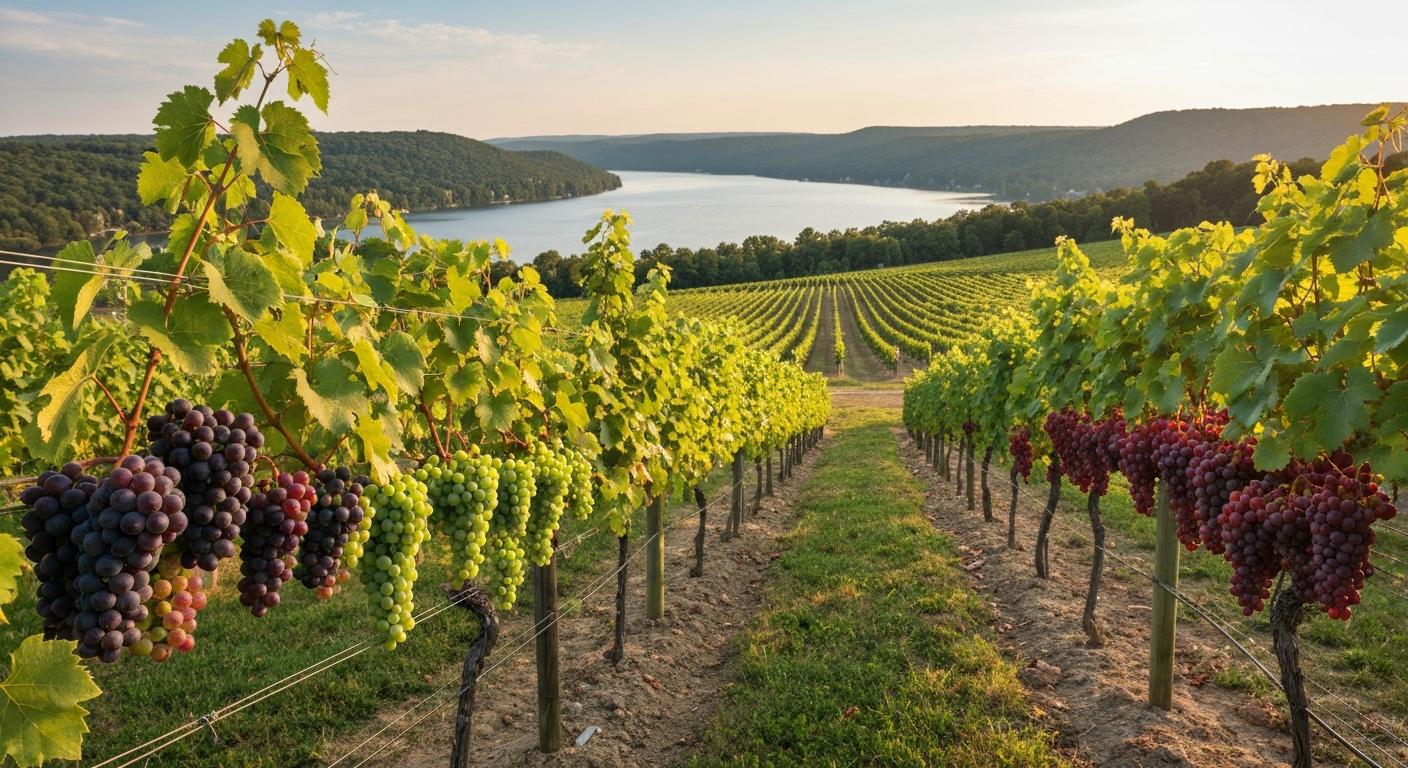
The Finger Lakes region is genuinely special for grapes, and it's worth understanding why before you assume your own site has the same advantages. The long, narrow lakes act as thermal reservoirs. They absorb heat through summer, then release it slowly into fall, extending the frost-free growing season by several weeks compared to sites just a few miles away from the water. That extra time at the end of the season is what allows later-ripening varieties (including Riesling and other European vinifera) to accumulate sugar and develop flavor. It also means earlier autumn frost events are less damaging. In spring, the cold lake water slows warming, which actually delays bud break and reduces the risk of late-frost damage to newly emerged shoots.
Beyond temperature buffering, the Finger Lakes sites typically offer well-drained shale and glacial soils on hillside slopes with excellent cold-air drainage (cold air flows downhill and away from the vineyard). The combination of these factors makes Finger Lakes sites competitive with much warmer regions for wine-grape quality. If you garden near one of the Finger Lakes, you have a real advantage. If you're 20 miles inland and uphill from any lake influence, you're operating in a different climate entirely and need to choose your varieties accordingly.
Assessing your site before you plant anything
Grapes are long-lived plants. A vine planted today can produce fruit for 30 or more years, so getting your site assessment right before you order plants is genuinely worth the effort. The Cornell Finger Lakes Grape Program recommends a one-to-two year pre-plant planning phase for exactly this reason. Start with these key factors.
- Sun exposure: grapes need at least 6 to 8 hours of direct sun daily. South- and southeast-facing slopes are ideal. North-facing slopes or sites shaded by buildings or trees through morning hours will underperform.
- Slope and air drainage: cold air is denser than warm air and flows downhill. A gentle slope allows cold air to drain away from your vines on frosty nights, reducing freeze damage. Flat low-lying sites are frost pockets and should be avoided if possible.
- Wind exposure: some air movement is helpful for drying foliage and reducing disease pressure, but exposed hilltops with sustained wind can desiccate canes and buds in winter. A windbreak to the northwest (prevailing cold-wind direction in upstate NY) helps.
- Proximity to lake or water bodies: if you're within a mile or two of one of the Finger Lakes, Lake Erie, or Lake Ontario, check local frost records to quantify your season extension benefit. Even small ponds can create local microclimates.
- Overhead obstructions: check for overhanging trees that drip on vines, shade, or compete for root space.
Soil and drainage: what grapes actually need
Grapes are more tolerant of poor soil than most fruit crops, but they absolutely cannot tolerate waterlogged roots. Standing water or compacted subsoil that holds moisture will kill vines through root rot, freeze damage to waterlogged tissue, and general stress. Before planting, dig a few holes 18 to 24 inches deep across your site and check: does water drain away within a few hours of rain? If it doesn't, you need to install drainage, build raised rows, or choose a different site. Soil pH should sit between 5.5 and 6.5 for most varieties. Test your soil through Cornell Cooperative Extension or a private lab before planting so you can lime or acidify as needed, which takes time to work into the soil profile.
The ideal upstate NY vineyard soil is a well-drained loam or gravelly loam over a porous subsoil. The classic Finger Lakes shale soils are excellent: they drain freely, restrict vine vigor somewhat (which is usually a good thing for wine grapes), and provide good root anchorage. Heavier clay soils in the Southern Tier or flatter areas of the region can work if drainage is improved, but they tend to encourage excessive vine vigor that can increase disease pressure and delay ripening. Adding organic matter helps texture but should not be overdone; lush high-nitrogen soils push excessive shoot growth at the expense of fruit. Keep amendments modest and targeted.
Frost risk, frost-free days, and growing-season requirements
Grape varieties differ significantly in how many frost-free days and growing degree days (GDDs) they need to ripen fruit fully. European vinifera varieties like Riesling and Chardonnay typically need 150 to 180 frost-free days and 2,400 to 2,800 GDDs (base 50°F). Finger Lakes sites near the water can meet those thresholds in good years, but sites farther from lake influence may fall short. French-American hybrids like Seyval Blanc, Vidal, and Baco Noir need somewhat fewer GDDs and carry better cold hardiness. Cold-hardy interspecific hybrids from the University of Minnesota breeding program (Frontenac, Marquette, LaCrescent) need roughly 140 to 160 frost-free days and are rated for Zone 4 or colder. Native labrusca varieties like Concord and Niagara are the most forgiving, ripening earlier and tolerating wider temperature swings.
| Grape Type | Min. Frost-Free Days | Hardiness Zone | Notes for Upstate NY |
|---|---|---|---|
| V. vinifera (Riesling, Chardonnay) | 160–180 | Zone 6b+ near lakes | Viable near Finger Lakes with good site; risky elsewhere |
| French-American hybrids (Seyval, Vidal, Baco Noir) | 150–165 | Zone 5b–6a | Good fit for Finger Lakes and similar lake-buffered sites |
| UMN cold-hardy hybrids (Marquette, Frontenac, LaCrescent) | 140–160 | Zone 4–5 | Reliable across most of upstate NY including Zone 5 interior |
| V. labrusca (Concord, Niagara, Buffalo) | 140–155 | Zone 4b–5 | Most widely adaptable; excellent for juice, jelly, table use |
| Cornell table-grape releases (Everest Seedless) | 145–160 | Zone 5–6 | Newer seedless option; confirm availability and site suitability |
Late spring frosts are a real hazard in upstate NY. Even a brief dip to 28°F after bud break can destroy a season's crop. If your site is in a frost pocket or at elevation without lake buffering, build that risk into your variety selection. The UMN cold-hardy hybrids and labrusca types bud a little later relative to how quickly they ripen, which helps. Delaying pruning until mid-spring (after the worst cold snaps) is a practical tactic to keep buds protected longer in the sheath.
Choosing varieties by end use: table, juice/jelly, or wine
Before you look at any variety list, decide what you want to do with your grapes. This choice shapes everything: the varieties you plant, how you trellis them, and what quality thresholds you're working toward. Table grapes need attractive, firm, often seedless fruit that tastes good fresh. Juice and jelly grapes need high yield, robust flavor, and reliable ripening. Wine grapes need specific sugar, acid, and flavor profiles that depend heavily on site and season. Mixing a few plants from each category in a home garden is completely reasonable, but match your expectations to the purpose.
Table grapes
For fresh eating in upstate NY, Concord remains a reliable standby even though most people think of it as a juice grape. Himrod (a seedless white) and Reliance (a seedless pink-red) are the most widely grown seedless table grapes in the Northeast and perform well across much of upstate NY in Zone 5b and warmer. Interlaken (green-gold, seedless) is another popular early-season option. Cornell AgriTech at Geneva has released Everest Seedless, a Concord-type seedless table grape, which brings that familiar labrusca flavor to a seedless format. Big, blue Everest Seedless is Cornell’s newest grape, Cornell Chronicle Big, blue Everest Seedless is Cornell’s newest grape — Cornell Chronicle. Seedless table varieties generally need a slightly warmer and more sheltered site than Concord, so be conservative if you're in a colder zone.
Juice and jelly grapes
Concord is the dominant juice and jelly grape in upstate NY and essentially the backbone of the Lake Erie grape belt in western NY, where roughly 98.5% of commercial acreage is labrusca types grown for juice and processing. For home use, Concord is hard to beat: it's cold-hardy to around Zone 4b-5, disease-tolerant relative to wine grapes, productive, and gives you that classic Concord flavor that makes exceptional jelly and grape juice. Niagara (the white equivalent of Concord) is a natural partner. Buffalo ripens about two weeks before Concord and offers a slightly different flavor profile. If you want to extend your juice season, plant a few vines of each.
Wine grapes
This is where site matters most. On a well-drained south-facing slope within a mile or two of a Finger Lake, you can successfully grow Riesling, Gewurztraminer, Pinot Gris, and Chardonnay. Away from lake moderation, French-American hybrids like Seyval Blanc, Vidal Blanc, Baco Noir, and Marechal Foch are significantly more reliable. For sites in Zone 4b to 5a, the University of Minnesota cold-hardy hybrids are the most dependable wine-grape option: Marquette (red, rated Zone 4, moderate disease resistance), Frontenac (red, rated extremely hardy to -35°F), Frontenac gris (pink), Frontenac blanc (white), and LaCrescent (aromatic white). The University of Minnesota Extension Marquette fact sheet (Marquette fact sheet (University of Minnesota Extension)) states Marquette is suitable for USDA Zone 4 (surviving roughly −20 to −30 °F), has moderate resistance to black rot, botrytis, and downy and powdery mildews, and recommends about 3–4 spurs per linear foot and limiting buds per vine based on winter injury. Cornell and the Northern Grapes Project ran multi-site trials of these cultivars including a site at Willsboro in northeast NY, where LaCrescent, Frontenac, and Marquette all reached wine-grade sugar levels, confirming they work in cold upstate NY conditions.
Matching cold-hardiness and disease resistance to your site
Cold hardiness and disease resistance are the two filters that narrow your real-world list faster than anything else. Upstate NY has both cold winters and humid summers, which means pressure from black rot, downy mildew, powdery mildew, Phomopsis, botrytis, and anthracnose. Cornell's NY/PA Pest Management Guide is the definitive resource for disease susceptibility ratings by variety, and it's updated regularly. The practical takeaway for home growers is this: the more disease-susceptible your variety, the more faithfully you need to follow a spray program. For hobbyists who want a lower-maintenance planting, choose varieties with good inherent disease resistance and reserve the high-maintenance vinifera for a small, well-placed block where you're willing to do the work.
| Variety | Type/Use | Hardiness Zone | Cold Rating | Disease Resistance | Notes |
|---|---|---|---|---|---|
| Concord | Juice/jelly/table | 4b–5 | Very good | Moderate (some black rot susceptibility) | Most reliable labrusca for upstate NY; classic flavor |
| Niagara | Juice/table (white) | 5 | Good | Moderate | White equivalent of Concord; pair with Concord for white juice |
| Buffalo | Juice/table | 5 | Good | Moderate | Ripens 2 weeks before Concord; useful for extending season |
| Himrod | Table (seedless white) | 5b–6 | Moderate | Moderate | Early-season seedless; needs good site; popular in Finger Lakes |
| Reliance | Table (seedless red) | 5–6 | Moderate | Moderate | Reliable seedless table grape for Zone 5+ |
| Marquette | Wine (red) | 4–5 | Very good (−20 to −30°F) | Moderate resistance to major fungal diseases | Best cold-hardy red wine grape for most of upstate NY |
| Frontenac | Wine (red) | 3b–4 | Extreme (−35°F) | Moderate (susceptible to black rot/botrytis) | Proven at Willsboro, NY; high acid; needs blending or winemaking care |
| Frontenac gris | Wine (pink/rosé) | 3b–4 | Extreme | Moderate | Lower acid than Frontenac; good for rosé/white-style wines |
| LaCrescent | Wine (white/aromatic) | 4–5 | Very good | Good disease resistance overall | Apricot/peach aromatics; proven at Willsboro; slightly earlier-ripening |
| Seyval Blanc | Wine (white hybrid) | 5–6 | Good | Moderate (susceptible to botrytis) | French-American hybrid; excellent white wine base for Finger Lakes |
| Baco Noir | Wine (red hybrid) | 5–6 | Good | Good (resistant to downy mildew) | Reliable red hybrid; vigorous; needs good pruning management |
| Marechal Foch | Wine (red hybrid) | 4–5 | Very good | Good | Early-ripening red; works well in Zone 4b–5 sites away from lakes |
| Vidal Blanc | Wine/ice wine (white) | 5–6 | Good | Good overall | Classic French-American white; popular in Finger Lakes region |
A practical decision framework for hobbyists: start by identifying your USDA zone and whether you have lake-buffering influence. If you're in Zone 6a or warmer with a good south-facing slope near a Finger Lake, you can try a vinifera or French-American hybrid wine grape. If you're in Zone 5, go with French-American hybrids or UMN cold-hardy hybrids for wine, and labrusca types for juice and table. If you're in Zone 4b or colder, Frontenac, Frontenac gris, Marechal Foch, and labrusca types are your most reliable options. Cornell's Finger Lakes Grape Program specifically recommends matching variety to site microclimate and intended use before everything else.
Planting and trellis basics for backyard growers
Order vines one to two years in advance if you're targeting specific cultivars, especially the UMN hybrids and newer Cornell releases, which can sell out early. Buy certified virus-free plants from reputable nurseries. V. vinifera should be purchased on grafted rootstock for Phylloxera protection. Labrusca and most interspecific hybrids can be grown own-rooted in most upstate NY soils, though rootstock can help on problem sites.
- Test soil one to two years before planting. Adjust pH to 5.5–6.5, address drainage issues, and incorporate any needed amendments.
- Plant in spring after last frost risk, typically mid-May in most of upstate NY. Space vines 6 to 8 feet apart in rows 8 to 10 feet apart for most training systems.
- Install a trellis before or at planting time. A simple two-wire system (wires at 3 feet and 5–6 feet) works for most labrusca and hybrid varieties. VSP (Vertical Shoot Positioning) with multiple wires works well for wine hybrids.
- Choose your training system by variety: four-arm Kniffin works well for vigorous labrusca like Concord; high-wire cordon or VSP suits wine hybrids. Consult cultivar-specific fact sheets for spur spacing (Marquette: 3–4 spurs per linear foot; Frontenac: 3–3.5 spurs per foot).
- In Year 1, focus entirely on building the root system. Remove any flower clusters that form and train one strong shoot up the stake toward your first wire.
- Year 2 begins establishing your permanent trunk and arms. Prune back hard to encourage strong growth from the base structure.
- Expect your first meaningful harvest in Year 3 or 4. Start small: 5 to 10 vines gives you enough fruit to learn your site without overwhelming yourself.
Pruning and training schedule for hobbyists
Dormant pruning is the single most important annual task in a home vineyard. Grapes fruit on one-year-old wood, and every year you need to remove the majority of last season's growth, leaving only the best canes or spurs to carry next year's crop. In very cold upstate NY locations, delay heavy pruning until late winter or early spring (February through late March), after the worst cold snaps have passed. This keeps protective tissue around dormant buds longer. In milder sites closer to the lakes, pruning can begin in late January through February. Always check for winter injury before finalizing your pruning: cut into a few canes and look at the cross-section. Green tissue means the bud is alive; brown means it died over winter. If injury is significant, adjust your pruning to leave more retained buds to compensate.
- Late winter/early spring (February–March): dormant pruning. Remove 70–90% of last year's growth. Set cane or spur positions for the coming season.
- Spring at bud swell: assess winter injury. If significant bud death occurred, retain more buds per vine than usual.
- Post-bud break through bloom: shoot thinning and positioning. Remove shoots from the trunk below the cordon. Tuck shoots into the trellis wires as they extend.
- Bloom through veraison (berry color change): manage canopy density. Leaf pulling around the fruit zone (2–3 leaves per cluster removed) improves spray penetration, air circulation, and fruit quality.
- Post-harvest (October): remove any diseased or damaged material from the vineyard floor. Do not prune heavily at this time; leave full foliage until after a killing frost to allow maximum carbohydrate storage in roots and trunk.
- Late fall before hard freeze: mound soil or apply mulch around vine bases in Zone 4–5 sites to protect graft unions and root systems.
Managing pests and diseases in upstate NY
The five primary fungal diseases to manage in NY vineyards are Phomopsis, black rot, downy mildew, powdery mildew, and anthracnose. Cornell's research consistently identifies the bloom-through-immediate-post-bloom window as the most critical period for fungicide timing, particularly for protecting developing fruit from black rot and downy mildew. Missing that window is the most common cause of crop loss in home vineyards. Cornell IPM emphasizes that downy mildew (Plasmopara viticola) causes serious fruit infection in NY and requires early-season management from bloom onward.
For hobbyists who want a low-spray approach, variety selection is your best tool. Choosing moderately disease-resistant varieties like Marquette, LaCrescent, or Baco Noir reduces but does not eliminate your spray needs in a humid upstate NY season. Even the most resistant hybrids may need 3 to 5 well-timed fungicide applications in a wet year. For vinifera or susceptible hybrids, plan for a full spray program through the season. The Cornell 2024 NY/PA Pest Management Guide for grapes provides the detailed susceptibility ratings and spray schedules you need, and it's updated yearly.
- Phomopsis: infected during early shoot growth in wet springs; copper or approved fungicide at 1-inch shoot growth helps.
- Black rot: critical window is bloom to 3–4 weeks post-bloom; remove mummified fruit (inoculum source) each season.
- Downy mildew: primary threat to fruit at bloom; apply downy mildew-specific products at and immediately after bloom in wet years.
- Powdery mildew: affects shoots, leaves, and fruit throughout season; sulfur products effective for lower-susceptibility varieties.
- Anthracnose: more of a problem in warm, wet early seasons; some riparia-background cold-hardy hybrids show higher susceptibility.
- Japanese beetle: monitor from late June; hand-picking is effective at small scale; bags can protect individual clusters.
- Birds: netting is the only reliable protection once fruit begins to color; install at veraison.
Winter protection in colder zones
For most home growers in Zone 5b and warmer, well-chosen cold-hardy varieties and good site selection provide adequate winter protection without extra measures. In Zone 4b to 5a, particularly in sites without lake buffering (the Adirondack foothills, Tug Hill plateau, higher elevations in the Southern Tier), a few extra steps significantly improve winter survival. Mounding soil 6 to 8 inches around the base of vines in November protects the root system and graft union. For young vines (first two or three winters), wrapping the trunk in foam pipe insulation or burlap adds meaningful protection. Avoid pruning or disturbing vines after leaves drop and before temperatures stabilize below freezing; dormancy takes a few weeks to set fully. When assessing winter damage in spring, be patient: vines can look dead in early April and push new growth from below the graft union or from surviving buds at the base.
How upstate NY compares to neighboring states
Upstate NY sits in a middle ground among northeastern states for grape growing viability. New Jersey and Pennsylvania generally run one to two zones warmer in their most productive regions (southern NJ and southeastern PA), which expands vinifera options considerably. For growers in Pennsylvania looking for regional recommendations, see the guide to the best grapes to grow in PA for cultivar and site-specific advice. For specific recommendations for southern New Jersey, see our guide to the best grapes to grow in NJ. Connecticut and Massachusetts have their own lake and coastal moderating effects but tend to face similar or slightly shorter growing seasons compared to the Finger Lakes corridor. For gardeners in Connecticut, see our guide on the best grapes to grow in CT for variety recommendations tailored to coastal and inland microclimates. New England overall, including Massachusetts, faces more compressed seasons and colder Zone 4-5 conditions in inland areas, making the UMN cold-hardy hybrids particularly relevant there too. For specific variety recommendations and site tips, see our guide to the best grapes to grow in New England. For growers in New England, see a regional guide to the best grapes to grow in Massachusetts for cultivar recommendations and zone-specific advice. Upstate NY's advantage is the Finger Lakes microclimate, which is genuinely exceptional and rivals many cooler European wine regions for quality. Maryland's wine-grape growing regions (western and central MD) sit mostly in Zone 6-7, giving them an edge for vinifera production. See a regional roundup of the best wine grapes to grow in Maryland for cultivar recommendations tailored to Zone 6–7 and similar climates. The honest comparison: if you're in the Finger Lakes zone, you can grow wine grapes that compete with anything in the Northeast. If you're in Zone 4b upstate, focus on the cold-hardy hybrids and labrusca types that simply don't have peers in colder climates.
Your pre-plant decision checklist
- Look up your USDA zone (2023 PHZM) using your ZIP code. Note whether you're near a large body of water with documented frost-date extension.
- Walk your site in winter and early spring: observe where frost lingers, where cold air pools, and how quickly surface water drains after rain.
- Dig soil holes 18–24 inches deep in your intended planting area and check drainage. Get a soil test from Cornell CCE or a certified lab.
- Decide your primary use: table grapes, juice/jelly, or wine. This narrows your variety list dramatically.
- For Zone 5b and warmer near lakes: consider French-American hybrids or even vinifera on a well-placed site. For Zone 5a and colder: prioritize UMN cold-hardy hybrids (Marquette, Frontenac, LaCrescent) and labrusca types.
- Start small: 5 to 10 vines gives you enough fruit to experiment and learn your microclimate before scaling up.
- Order vines 1 to 2 seasons ahead for best cultivar availability, especially for UMN releases.
- Contact your local Cornell Cooperative Extension office. They have county-specific data, trial results, and often host grape grower workshops.
Local resources worth bookmarking
Cornell Cooperative Extension has county offices across upstate NY and the Cornell Finger Lakes Grape Program (FLGP) is one of the most active grape extension programs in the country. Their vineyard establishment timeline, variety selection guides, and annual pest management publications are free and updated regularly. The Cornell AgriTech station in Geneva (Ontario County) is the source for many of the newer table grape releases and trial data. For cold-hardy hybrids, the University of Minnesota's cultivar fact sheets (available free online) give detailed viticultural notes for Frontenac, Marquette, LaCrescent, and others. Local nurseries that specialize in cold-climate fruit (particularly those serving the Finger Lakes and Lake Erie regions) are excellent sources of regionally adapted planting stock and practical advice on what's actually surviving winters in your area.
The honest bottom line: upstate New York is a genuinely good grape-growing region for the right varieties on the right sites. You don't need a commercial vineyard or a Finger Lakes microclimate to grow satisfying grapes in your backyard. You need to match your variety to your zone, give your vines sun and drainage, manage disease during the critical bloom window, and be patient through the first couple of years while roots establish. Get that right and you'll be harvesting your own Concord jelly, fresh Himrod clusters, or a bottle of Marquette within a few seasons of planting.
FAQ
Will grapes reliably grow in upstate New York (including Finger Lakes and lake‑effect areas)?
Yes—many grape types grow well in upstate NY, but success depends on matching species/variety to your microclimate. Labrusca types (Concord, Niagara) and cold‑climate interspecific hybrids (Frontenac, Frontenac gris, Marquette, LaCrescent, Brianna) tolerate the region’s winter lows and shorter seasons. Vinifera (Cabernet, Chardonnay, Riesling) can succeed in protected, low‑frost sites (Finger Lakes lake‑moderated sites are best) but usually require grafting, excellent drainage, and active winter protection.
How do I assess whether my site in upstate NY is viable for grapes?
Evaluate minimum winter temperature (USDA hardiness zone and local historical lows), growing‑degree days (GDD) or frost‑free days, slope/exposure (south/southeast slopes warm faster and drain cold air), soil drainage and depth (grapes need well‑drained soils), sun (minimum 6–8 hours of direct sun), and frost pockets (avoid bottom of hollows). Use local PRISM/NOAA data or extension resources to confirm frost‑free period and typical winter minima. Do a soil test and correct pH and drainage before planting.
Which grape varieties are most reliable for home gardeners in upstate NY, by end use?
Table grapes: Concord and seedless selections from Cornell trials (e.g., Everest) for Labrusca flavor and hardiness. Juice/jelly: Concord (western NY/Lake Erie areas) and Niagara. Wine grapes: cold‑tolerant hybrids such as Frontenac, Frontenac gris/blanc, Marquette, LaCrescent, Brianna, Marechal Foch for backyard wine or rosé; Riesling and other vinifera can work in lake‑effect Finger Lakes microclimates but are higher risk and require more care.
Which varieties are recommended specifically for cold‑hardiness and disease resistance?
High cold‑hardiness: Frontenac (survives to about −30 to −35°F), Frontenac gris/blanc, Marquette (Zone 4 tolerant), LaCrescent (cold‑hardy, early ripening). Good disease resistance but variable: Marquette and some UMN releases show moderate resistance to powdery/downy/black rot. Labrusca cultivars like Concord are hardy and generally tough but can be susceptible to some diseases. Always consult cultivar fact sheets for specific susceptibility patterns.
How should I choose rootstock and decide whether to plant own‑rooted vines?
Own‑rooted Vitis labrusca (Concord/Niagara) perform well and are common for juice/table grapes. Hybrids and vinifera are often grafted onto phylloxera‑resistant rootstocks when soil or phylloxera risk exists; grafting also helps adaptation to specific soil conditions. Choose rootstock for soil type (wet vs. dry), vigor management, and phylloxera presence. For a small home planting, many hobbyists plant own‑rooted cold‑hardy hybrids; consult your nursery or extension for local rootstock recommendations.
What are the basic planting and trellis rules for a backyard grape planting?
Spacing: 6–8 ft between vines for vigorous hybrids; 8–10+ ft for vigorous vinifera or commercial spacing. Row spacing: allow room for mowing and access (10–12+ ft). Planting time: spring after soil warms or dormant early spring; fall planting possible where winters are mild. Planting depth: set graft union above soil if grafted; promote good soil‑to‑root contact. Trellis: simple two‑post + single wire, four‑arm Kniffin, or vertical shoot positioning (VSP) for small plantings. Use strong end posts and galvanized wire; install trellis at planting or within first 1–2 years.