
Yes, you can absolutely grow grapes in Washington state, and depending on where you live, you might have some of the best grape-growing conditions in the entire country. Eastern Washington's Columbia Basin is a world-class wine grape region with long, warm summers, minimal rain, and well-drained soils that let Vitis vinifera thrive with irrigation. Western Washington is trickier due to its cooler, wetter maritime climate, but it's far from a lost cause: the right variety in the right microclimate will produce a rewarding crop. The key is matching your location to the right grape type from the start.
Can You Grow Grapes in Washington State? Regional Guide
Marcus Whitfield
23 Jul 2026
Eastern Columbia Basin vs. Maritime Western WA: The Core Difference
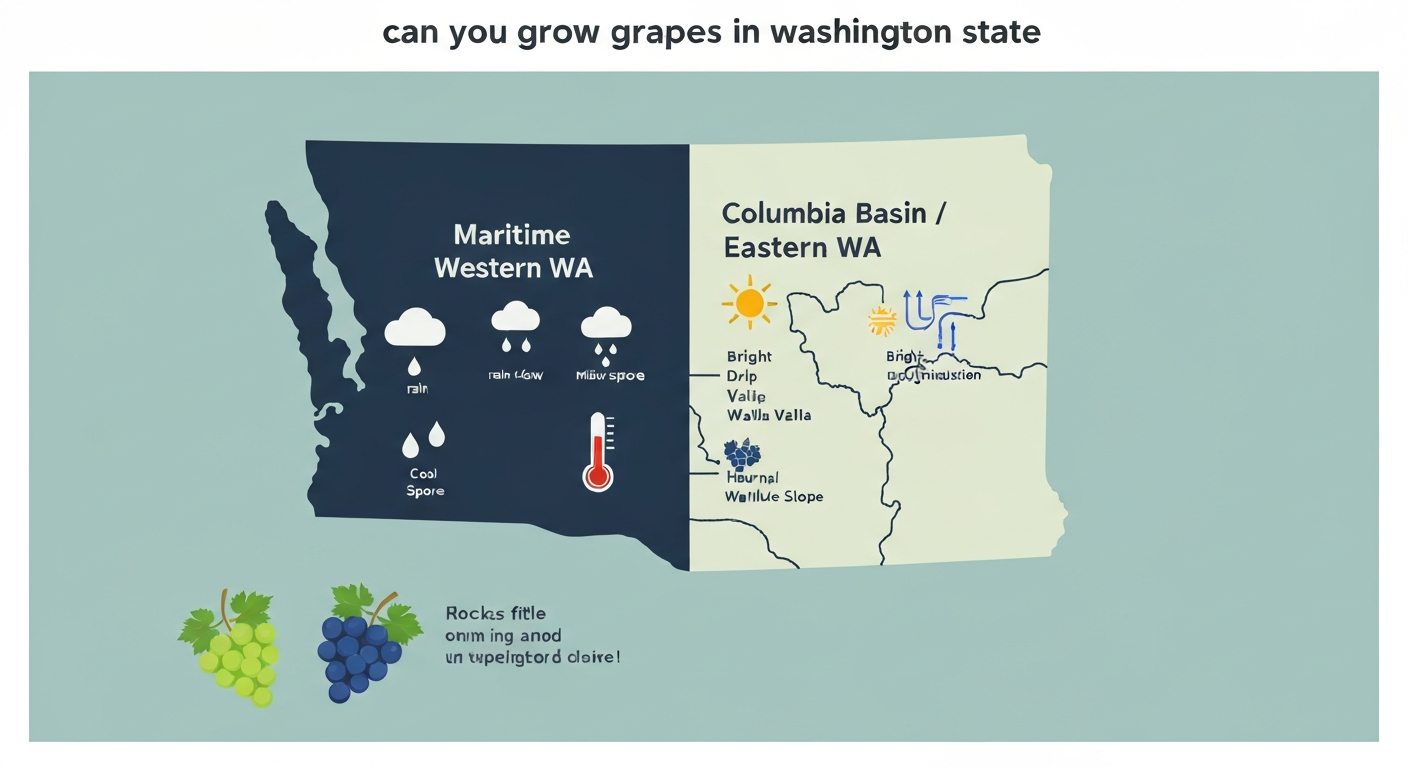
Washington is essentially two different grape-growing worlds separated by the Cascades. East of the mountains, the Columbia Basin (Yakima Valley, Wahluke Slope, Horse Heaven Hills, Walla Walla) offers conditions that rival top wine regions globally: 200 to 300+ frost-free days, growing degree days (GDD) high enough to ripen Cabernet Sauvignon and Syrah, and annual rainfall as low as 6 inches on the Wahluke Slope and around 8 inches in the Yakima Valley. Almost every drop of water the vines get comes from irrigation, which gives growers precise control over vine stress and fruit quality. Diurnal temperature swings of 30–40°F between day and night preserve natural acidity in the fruit. These are genuinely excellent Vitis vinifera conditions.
West of the Cascades is a different story. The Puget Sound lowlands, western foothills, and coastal areas are cooler and much wetter, with maritime air keeping temperatures moderate year-round. GDD totals in many western WA locations fall below the threshold needed to reliably ripen classic European wine grapes. Powdery mildew and botrytis pressure is higher here. That said, protected south-facing slopes with good air drainage can accumulate enough heat for early-ripening vinifera varieties, and French-American hybrids and American types like Concord perform reliably across a much wider range of western WA sites.
How Grape Climate Requirements Map to Washington's Regions
Grapes need three things from a climate: enough growing-degree-days to ripen fruit, a frost-free season long enough to complete that ripening, and winters cold enough to enforce dormancy but not so cold they kill the wood. Most Vitis vinifera varieties need roughly 2,400–3,200 GDD (base 50°F) depending on the cultivar. The Columbia Basin delivers this comfortably. Riesling and Pinot Gris can ripen at the lower end; Cabernet Sauvignon needs the warmer sites like Horse Heaven Hills or Wahluke Slope. Early-ripening vinifera varieties like Madeleine Angevine or Siegerrebe can accumulate enough GDD in some well-sited western WA locations, but it requires a favorable year. Hybrids like Marquette, Frontenac, and Leon Millot are bred to ripen in shorter, cooler seasons and are a much safer bet west of the mountains.
Winter hardiness matters too. The Columbia Basin can see lows of -5°F to -15°F in severe winters, which is cold enough to cause vine damage or even kill marginally hardy varieties. Vinifera is generally rated to 0°F to -5°F without protection, so eastern WA growers need to take winter kill seriously. In western WA, winter temperatures are rarely vine-threatening, but spring frost during bud break is a real risk in low-lying frost pockets.
Assess Your Site: Microclimate, Frost Risk, and Your USDA Zone
Start by looking up your ZIP code on the USDA 2023 Plant Hardiness Zone Map. Most of the Columbia Basin falls in zones 6a to 7b. Western Washington lowlands are typically zones 7b to 9a near the coast. But your zone is just the starting point. Two properties a mile apart can have wildly different frost dates and heat accumulation depending on elevation, slope, and proximity to water or cold air drainages.
Check your last spring frost date and first fall frost date using your county's WSU Extension records or AgWeatherNet (weather.wsu.edu). AgWeatherNet runs a dense network of weather stations across Washington and provides station-level GDD accumulation data you can use to estimate how much heat your site gets each season. This is genuinely useful, not just a nice-to-have. If the nearest station shows your area averaging 1,800 GDD, you know you need early-ripening hybrids. If it shows 2,600 GDD, you have vinifera options.
- Cold air drainage: avoid low spots and valley floors where frost settles; mid-slope sites stay warmer on clear spring nights
- Spring frost risk: even in eastern WA, late-May frosts after bud break can wipe out an entire vintage
- Elevation: every 1,000 feet typically reduces GDD and increases frost risk
- Urban heat: city gardens in Seattle or Spokane run warmer than surrounding rural areas
- South and southwest-facing slopes: maximize sun angle and heat accumulation, especially critical in western WA
Choosing the Best Ground: Site Selection for Your Home Planting
Sun exposure is non-negotiable. Grapes need at least 6 to 8 hours of direct sun daily, and more is better. In western WA, a south or southwest-facing slope isn't just helpful, it can be the difference between ripe grapes and a crop that never quite gets there. In eastern WA, even flat ground usually gets plenty of sun, but slope can still help with cold air drainage during spring frosts.
Soil drainage is equally critical. Grapes genuinely hate wet feet. Waterlogged soils promote root disease and reduce vine vigor in all the wrong ways. The Columbia Basin's deep loess, alluvial, and coarse outwash soils drain freely and have relatively low water-holding capacity, which is actually a feature rather than a bug since it forces mild vine stress that improves fruit quality. In western WA, many native soils are clay-heavy and slow-draining; raised beds or mounded rows can improve drainage significantly. Before you plant, run a percolation test: dig a hole 18 inches deep, fill it with water, and check whether it drains within an hour. If it doesn't, plan to amend or raise your planting.
Use the NRCS Web Soil Survey (websoilsurvey.sc.egov.usda.gov) to look up the specific soil series on your property. It'll tell you drainage class, estimated pH, depth to any restrictive layer, and texture. Columbia Basin soils are often alkaline (pH 7.5 to 8.5), which affects micronutrient availability and rootstock selection. Western WA soils lean acidic. Both are manageable but worth knowing before you plant.
- Minimum 6–8 hours direct sun; south or southwest aspect preferred, especially west of the Cascades
- Well-drained soil is essential; avoid heavy clay without drainage improvement
- Deep, friable soils allow vigorous root development; aim for 3+ feet of workable depth
- Avoid frost pockets and areas with poor air circulation
- Proximity to large water bodies or concrete/pavement can moderate temperature extremes
- Check for deer and bird pressure early: both are serious grape predators in Washington
Rootstocks and Why They Matter in Washington Soils
If you're planting Vitis vinifera in eastern Washington, seriously consider grafted vines on a phylloxera-resistant rootstock. Washington has confirmed phylloxera detections, and own-rooted vinifera is vulnerable. Even if phylloxera hasn't reached your exact location yet, starting with grafted plants is cheap insurance. For hybrid varieties and American types, own-rooted vines are generally fine.
Rootstock choice is not one-size-fits-all. WSU viticulture trials and the EM068E guide from WSU Extension have evaluated several rootstocks in Washington conditions. The short version: 101-14 Mgt and 3309 C work well in heavier, more moisture-retentive soils and offer moderate vigor control. Schwarzmann and Riparia Gloire are low-vigor options suited to fertile soils where you want to keep growth in check. 420A is useful in drier, lower-fertility soils and has some nematode tolerance. In the Columbia Basin, northern root-knot nematode (Meloidogyne hapla) is present, especially near irrigation emitters; if you suspect nematode pressure, get a pre-plant soil sample tested and choose a rootstock with documented tolerance.
| Rootstock | Soil Type Fit | Vigor Level | Nematode Tolerance | Notes for WA |
|---|---|---|---|---|
| 101-14 Mgt | Moderate to heavy, moist | Moderate | Low | Good for western WA and heavier eastern WA soils |
| 3309 C | Moderate, well-drained | Moderate | Low | Widely used in WA; quality-oriented plantings |
| Schwarzmann | Fertile, well-drained | Low-moderate | Low | Vigorous soils; keeps growth manageable |
| Riparia Gloire | Fertile, moist | Low | Low | Very low vigor; use on highly fertile sites only |
| 420A | Dry, low-fertility | Low-moderate | Moderate | Columbia Basin drier sites; some nematode tolerance |
One more important point: always start with certified, virus-tested planting material. WSU's Clean Plant Center Northwest (CPC-NW) at Prosser is the state reference source for clean vines, and many Washington nurseries source from or are certified through this program. Leafroll virus and red blotch virus are significant problems in Washington vineyards, and you simply don't want to import them into your garden at the start. Ask your nursery directly whether their material is certified virus-tested.
Variety Selection by Region
Columbia Basin and Eastern Washington: Vitis vinifera Territory
Eastern Washington is one of the finest Vitis vinifera growing regions in North America. For home gardeners, the variety options are genuinely exciting. Riesling, Chardonnay, Pinot Gris, and Gewurztraminer ripen reliably across most Columbia Basin sites. Merlot, Cabernet Franc, Syrah, and Cabernet Sauvignon do well on warmer sites (Horse Heaven Hills equivalents, south-facing slopes in the Yakima area). For table grapes, Himrod, Interlaken, and Flame Seedless do well given the heat. Thompson Seedless ripens on the warmest sites. If you're in a slightly marginal or higher-elevation eastern WA location, lean toward earlier-ripening wine varieties like Riesling or Pinot Gris, or try Marquette, which handles both cold and earlier seasons easily.
Western Washington and Maritime Areas: Hybrids and Early Vinifera
West of the Cascades, French-American hybrids and selected American varieties are your most reliable options. Marquette, Frontenac, Leon Millot, and Marechal Foch ripen early and tolerate both the cooler summers and the fungal disease pressure that comes with wetter conditions. Concord and Niagara are old standbys for table grapes and juice, and they handle western WA conditions with minimal fuss. If you're set on vinifera, focus on early-ripening varieties: Madeleine Angevine, Siegerrebe, Madeleine Sylvaner, and Muller-Thurgau have all been documented to ripen in favored western WA sites according to WSU's EM068E guide. A warm, south-facing slope in a location like the south Puget Sound or a protected Willamette-adjacent valley south of Olympia gives you the best shot. Expect to manage powdery mildew aggressively if you go the vinifera route in western WA.
| Region | Variety | Type | Use | Notes |
|---|---|---|---|---|
| Columbia Basin / Eastern WA | Riesling | Vinifera | Wine | Reliable; wide site adaptability in eastern WA |
| Columbia Basin / Eastern WA | Cabernet Sauvignon | Vinifera | Wine | Needs warmest sites; south-facing slopes |
| Columbia Basin / Eastern WA | Syrah | Vinifera | Wine | Excellent on warmer Yakima/Wahluke-type sites |
| Columbia Basin / Eastern WA | Himrod / Interlaken | Vinifera hybrid | Table | Seedless; ripen well with eastern WA heat |
| Columbia Basin / Eastern WA | Marquette | French-American hybrid | Wine | Cold-hardy backup for higher elevations or colder sites |
| Western WA / Maritime | Marquette | French-American hybrid | Wine | Early-ripening; top performer west of Cascades |
| Western WA / Maritime | Frontenac | French-American hybrid | Wine | Very cold-hardy; good disease tolerance |
| Western WA / Maritime | Leon Millot | French-American hybrid | Wine | Early ripening; established track record in WA |
| Western WA / Maritime | Concord | American (Vitis labrusca) | Table/Juice | Reliable everywhere; classic Pacific Northwest |
| Western WA / Maritime | Madeleine Angevine | Vinifera | Wine | Best bet for vinifera in western WA; very early |
Quick Decision Guide: Can I Grow Grapes Here and What Should I Plant?
Use this as a quick flowchart to point yourself in the right direction before diving into the details.
- Are you east of the Cascades (Columbia Basin, Yakima, Tri-Cities, Walla Walla, Spokane area)? → Yes: Vitis vinifera is your primary option. Confirm your GDD with a nearby AgWeatherNet station and pick a variety that fits your heat accumulation. Use grafted vines on phylloxera-resistant rootstock.
- Are you west of the Cascades (Puget Sound lowlands, western foothills, coast)? → Yes: Start with French-American hybrids (Marquette, Frontenac, Leon Millot) or American types (Concord). Only attempt vinifera if you have a documented south-facing slope with excellent drainage and confirmed GDD above 2,200.
- Do you have a south or southwest-facing slope with full sun? → Yes: Your microclimate is better than average; expand your variety options up one tier. → No: Stick to the hardiest, earliest-ripening varieties for your region.
- Does your site drain freely (percolation test passes within an hour at 18 inches)? → Yes: Good to go with standard site prep. → No: Install raised rows, improve drainage, or choose a different location.
- Are you in a frost pocket or low valley floor? → Yes: Spring frost risk is elevated; consider frost protection equipment and choose later-budding varieties if possible.
- Do you want wine grapes, table grapes, or both? → Wine east of Cascades: Riesling, Syrah, Cabernet Sauvignon, Merlot. → Wine west of Cascades: Marquette, Frontenac, Madeleine Angevine. → Table everywhere: Concord, Himrod (east), Interlaken (east).
Step-by-Step Startup: Pre-Planting Through First Harvest
Getting grapes in the ground is genuinely not complicated, but the decisions you make before planting matter more than anything you'll do in the first growing season. Here's how to move from idea to harvest.
Planting Timing and First-Year Care
In eastern Washington, early spring planting (late March through April) is standard and gives vines the full growing season to establish. Bare-root plants ordered from nurseries typically ship at the right time for your zone. Fall planting is possible in eastern WA but carries winter kill risk for young, poorly established vines; if you plant in fall, mulch heavily and consider wrapping the graft union. In western Washington, spring planting is strongly preferred, typically April through mid-May after your last expected frost. Container-grown plants give you more flexibility on timing in the west.
Planting depth for grafted vines is critical: the graft union must remain above soil level, typically 2 to 4 inches above ground. Burying the union allows the scion to root, defeating the purpose of the rootstock. Space vines 6 to 8 feet apart in the row for most training systems, with rows 8 to 10 feet apart if you have the space. In a small home garden, 6-foot vine spacing with a simple trellis is plenty. After planting, water in thoroughly and apply 3 to 4 inches of organic mulch around (but not against) the vine base to conserve moisture and suppress weeds.
Trellis and Training Choices for Small Plantings
For a home planting, you don't need a complicated trellis. The four most practical systems for Washington home gardeners are: a simple single-wire trellis at about 36 inches (good for Kniffin or temporary cordon training); a two-wire vertical shoot positioning (VSP) trellis with wires at 36 and 60 inches (excellent for vinifera and hybrids, keeps the canopy open and manageable, and is the industry standard for western WA maritime plantings per WSU EM068E); a fan system on a wall or fence (useful in western WA for heat accumulation against a south-facing structure); and a high cordon at 5 to 6 feet (works well for vigorous American varieties like Concord in western WA).
VSP is the system I'd recommend to most home gardeners because it keeps the canopy tidy, makes spraying for mildew much more effective (important in western WA), and translates directly to any resources or tutorials you find for Washington viticulture. Set posts at 8-foot intervals minimum, use 9- to 10-gauge galvanized wire, and tension it firmly. A single row of 4 to 6 vines on a 20-foot run is a perfectly manageable starter planting.
Pruning Basics: First Three Years and Annual Schedule
Year 1: Let the vine grow. Choose the strongest shoot and train it up to your trellis wire. Remove all other shoots. Don't let it fruit. The entire goal in year one is root establishment and getting a strong trunk started. In eastern WA, vines planted in April can push 4 to 6 feet of shoot growth by late summer; that's a great sign. Tie the shoot loosely to a stake as it grows.
Year 2: In late winter (February in eastern WA, March in western WA), prune back to 2 to 3 buds above your cordon wire or the intended training height. This is the year you start forming the permanent structure: the trunk and the first cordons or canes. Allow no more than one small cluster per vine if any form at all. Root development is still the priority.
Year 3 and beyond: You're pruning to a defined system now, either cane pruning (selecting 2 to 4 new canes each winter, each with 8 to 15 buds) or spur pruning (cutting back to 2-bud spurs along a permanent cordon). Riesling, Merlot, and Chardonnay do well with cane pruning. Cabernet Sauvignon, Syrah, and many hybrids can be spur-pruned. For home gardeners, spur pruning is simpler to execute consistently. Prune during full dormancy, after the hardest cold has passed but before bud swell, typically late February through early March in eastern WA and March in western WA.
- Annual pruning checklist: remove all wood except what you've selected to keep; leave 60–70% of shoots from the previous season on the pruning floor
- Check for winter damage: dead canes snap cleanly and show brown tissue at the cut; healthy canes flex and show green
- Tie new canes to the trellis wire before bud break
- Remove suckers from the trunk base as they appear through the season
- Summer pruning (shoot thinning, leaf removal): tuck shoots into VSP wires in May/June; remove basal leaves around fruit zone in July for air circulation
Month-by-Month Planting and Pruning Calendar for Washington Gardeners
| Month | Eastern WA Tasks | Western WA Tasks |
|---|---|---|
| January | Check dormant vines for winter damage; order plants and supplies | Order plants; check trellis for winter damage |
| February | Prune during dormancy (late Feb); check graft unions | Begin pruning late Feb if no hard freeze expected |
| March | Finish pruning; tie canes; apply dormant oil if needed | Prime pruning month; tie canes; apply lime sulfur for powdery mildew |
| April | Plant bare-root vines; irrigate at planting; watch for frost | Plant after last frost; begin mildew monitoring |
| May | Bud break; frost protection ready; begin irrigation; shoot thinning | Bud break; high frost risk in low spots; begin mildew spray program |
| June | Shoot tuck into VSP wires; first fungicide if needed; irrigation ramp-up | Shoot positioning; mildew spray every 10–14 days; leaf removal in fruit zone |
| July | Leaf removal in fruit zone; monitor irrigation (ET-based); berry sizing | Continue mildew program; check for botrytis in dense canopies |
| August | Veraison (color change); reduce irrigation for RDI; taste for ripeness | Veraison on early varieties; taste frequently; reduce water |
| September | Harvest most varieties; bird net if needed; last irrigation | Harvest early varieties; watch weather; bird and yellow jacket pressure |
| October | Post-harvest fertilization if needed; begin canopy shutdown monitoring | Post-harvest care; clean up diseased material |
| November | Vines go dormant; mound soil over graft union if cold expected | Vines dormant; good time to install or repair trellis |
| December | Inspect for frost damage; plan next season's pruning | Rest period; plan variety additions; review notes from season |
Irrigation and Fertilization: East vs. West
In eastern Washington, irrigation is not optional: it's the foundation of the whole system. The Yakima Valley averages only about 8 inches of annual rainfall and Wahluke Slope about 6 inches, almost none of which falls during the growing season. Drip irrigation is the right choice for home vineyards here. WSU's EM061E and regional PNW research recommend drip irrigation for RDI, noting drip systems achieve ≈85–95% application efficiency compared with ≈60–75% for overhead systems WSU's EM061E and regional PNW research recommend drip irrigation for RDI, noting drip systems achieve ≈85–95% application efficiency compared with ≈60–75% for overhead systems.. It delivers water directly to the root zone with application efficiency of 85 to 95 percent (versus 60 to 75 percent for overhead systems), and it allows you to practice regulated deficit irrigation (RDI): deliberately withholding water at specific growth stages (typically from berry set through veraison) to stress the vine mildly, improve fruit quality, and control excessive vigor. WSU's EM061E publication covers this in detail and is worth reading before your first season.
For scheduling, use a nearby AgWeatherNet station to get reference evapotranspiration (ET) values. A very rough guideline for mature eastern WA vines is 18 to 22 inches of applied water per season for wine grapes, but actual needs vary by soil texture, vine size, and the deficit you're targeting. Start conservatively, monitor soil moisture, and adjust. Soil moisture sensors are inexpensive and genuinely useful.
In western Washington, natural rainfall often meets or exceeds vine water needs through much of the growing season. Supplemental irrigation may only be needed during July and August dry spells, and even then modest amounts suffice. If anything, drainage is more of a concern than irrigation in the west. Avoid watering late in the season in western WA as it promotes late-season growth that won't harden off before winter and increases botrytis risk.
On fertilization: grapes are not heavy feeders. Over-fertilizing with nitrogen is one of the most common mistakes home gardeners make. Excessive nitrogen produces lush, vigorous canopies that shade fruit, increase disease pressure, and delay ripening. In eastern WA, a soil test before planting and again every 2 to 3 years is the best guide. Correcting pH if it's very high (above 8.0) and ensuring adequate zinc, iron, and boron matter more on many Columbia Basin soils than adding nitrogen. In western WA, moderate nitrogen (a handful of balanced fertilizer in early spring) and a potassium source if your soils are deficient are usually sufficient. Stop all fertilization by mid-summer to allow the vine to slow down and harden for winter.
Pest and Disease Management in Washington
Powdery mildew (Erysiphe necator) is the single most important disease in Washington vineyards, and it affects both sides of the Cascades. In western WA, the combination of mild temperatures and humidity makes powdery mildew pressure severe and season-long. In eastern WA, the dry summer air keeps it manageable, but it still needs attention. The key to mildew management is starting early. Begin spraying before the first symptoms appear, at or just after bud break, using sulfur (highly effective, low-cost, organic-approved) on a 10 to 14 day schedule. VSP trellising helps enormously by keeping the canopy open. The PNW Plant Disease Management Handbook is the state reference for timing, products, and thresholds.
Botrytis (gray mold) is the second major disease, especially in western WA and in dense canopies anywhere. Botrytis hits at veraison and beyond, attacking ripe fruit in humid conditions. Leaf removal in the fruit zone during July is the most effective cultural control. Good air circulation through the canopy is your best defense. Avoid late-season irrigation and excess nitrogen, both of which make canopies denser and more susceptible.
On the pest side, the PNW Insect Management Handbook lists the main offenders in Washington: grape berry moth, leafhoppers, mealybugs, spider mites (especially in hot, dry eastern WA), grape phylloxera, spotted-wing drosophila (SWD) at harvest, and physical threats from birds and deer. Spider mites tend to flare in eastern WA in hot, dry years when overhead irrigation that would suppress them is replaced by drip. Kaolin clay applications help with mite and leafhopper pressure and are organically acceptable. SWD is increasingly a problem at harvest on thin-skinned varieties; harvest promptly and use fine mesh netting if SWD pressure is high in your area.
- Powdery mildew: start sulfur sprays at bud break, 10–14 day intervals, stop 2 weeks before harvest; open canopy structure is critical
- Botrytis: leaf removal in fruit zone in July; avoid excess nitrogen and late irrigation
- Spider mites (eastern WA): monitor with sticky tape; kaolin clay or miticide if populations build; avoid dust on leaf surfaces
- Grape berry moth: monitoring traps; well-timed insecticide applications if needed; mostly a concern in established vineyard areas
- Birds and deer: bird netting at veraison is the most effective protection; deer fencing before establishment
- Phylloxera: use grafted vines on resistant rootstock as prevention; own-rooted vinifera is the risk
- Spotted-wing drosophila: harvest promptly; fine mesh netting; monitor with SWD-specific traps
Frost, Freeze, and Winter Protection
Spring frost at bud break is arguably the most nerve-wracking event in eastern Washington grape growing. Buds can push in early April when hard freezes are still possible. Temperatures below 28°F after bud break can kill primary buds and eliminate the year's crop. Watch forecasts closely in April and May. For small home plantings, frost cloth or row cover draped over vines overnight offers meaningful protection. Some growers use small electric fans to circulate air and prevent temperature inversion layers from settling; even a gentle breeze can raise the effective temperature at vine level by several degrees.
For winter dormancy protection in eastern WA, the main risk is extended cold below -5°F to -15°F, which can kill vinifera canes and graft unions. Mounding soil 8 to 12 inches over the graft union in November provides thermal mass that protects the graft through hard freezes. Some eastern WA home growers also wrap the lower trunk with insulating material. After severe winters, prune later than usual and wait to see which buds push before making final pruning decisions; you may need to rebuild from suckers or lower trunk growth if damage is severe.
In western Washington, vine wood hardiness is rarely the issue; spring frost in frost-pocket sites and late cold rain at flowering (which causes poor fruit set) are bigger concerns. Choose sites with good cold air drainage and be ready to protect young vines in their first spring.
Harvest Timing, Fruit Testing, and Expected Yields
Don't harvest by date. Harvest by taste, sugar, and acid. The basic tool is a handheld refractometer, which measures Brix (sugar percentage). Most wine grapes are harvested between 21 and 25 Brix depending on variety and style. For table grapes, the seed color changing from green to brown, combined with taste (sweetness, skin texture, flavor), is the most reliable guide. In eastern WA, wine grapes typically harvest from late August (early whites) through October (Cabernet Sauvignon). In western WA, early-ripening hybrids like Marquette can be ready in September on good years.
For a home planting, don't expect a commercial-scale yield from young vines. Year 1: no fruit (or remove it). Year 2: a few clusters at most; let 1 to 3 develop to test ripening and enjoy the experience. Year 3: a modest crop, perhaps 3 to 5 pounds per vine depending on variety and training. Years 4 to 5: a mature home planting of 6 vines can realistically yield 15 to 40 pounds of fruit depending on variety, site, and season, which is a very satisfying amount for fresh eating, juicing, or small-batch winemaking. Vinifera in eastern WA under irrigation tends to be more consistent year to year. Hybrids in western WA can be excellent in good years and more variable in cool, wet ones.
Year-by-Year Care Checklist: Your First 5 Seasons
| Year | Spring | Summer | Fall/Winter |
|---|---|---|---|
| Year 1 (Planting year) | Plant bare-root or container vines; stake; water in; apply mulch | Train single strongest shoot up stake; remove all other shoots; no fruit allowed; water regularly in eastern WA | Remove any fruit clusters that form; winter protection in eastern WA (soil mound at graft union) |
| Year 2 | Prune to 2–3 buds; begin establishing trunk and cordon framework; watch for late frost | Train cordon arms along wire; remove most shoots; allow 0–1 clusters per vine maximum; continue irrigation | Post-harvest: check for winter kill; mound graft union in eastern WA; plan trellis upgrades |
| Year 3 | Prune to establish permanent spur or cane system; begin mildew spray program early | First real crop (modest); manage canopy with VSP tucking; leaf removal in fruit zone; full irrigation program | Harvest; post-harvest foliar if nutrient deficiency noted; winter protection as needed |
| Year 4 | Full pruning; mildew program begins at bud break; soil or tissue test | Full canopy management; irrigation fine-tuning; monitor for pests; fruit quality focus begins | Harvest at target Brix; post-harvest care; review season notes for next year |
| Year 5+ | Routine annual pruning; update disease and pest program; consider adding varieties | Full production mode; refine irrigation, canopy, and crop load; bird and pest management | Consistent harvest; assess vine health; address any trunk disease or winter damage |
Where to Get Vines and Rootstocks in Washington
Always start with certified, virus-tested material. WSU's Clean Plant Center Northwest (CPC-NW) at Prosser is the state's reference repository for clean grape planting stock. They don't sell retail, but they certify nurseries, and buying from a CPC-NW certified nursery is the best way to ensure your vines are free of leafroll virus, red blotch, and other systemic problems that are genuinely widespread in Washington commercial vineyards.
For sourcing, contact your county's WSU Extension office for a current list of recommended Washington-area nurseries; recommendations do change as nurseries enter or exit certification programs. For mail-order sources, several Pacific Northwest specialty vine nurseries ship to Washington home gardeners and offer both own-rooted and grafted options with variety-specific descriptions. When ordering grafted vines, specify the rootstock you want based on your soil type and confirmed nematode/phylloxera risk. Order early, typically by December or January for spring delivery, as certified grafted vines sell out.
Also check WSU Extension's Viticulture and Enology program publications directly at extension.wsu.edu. EM068E (Maritime Western Washington) and EM061E (Eastern WA Irrigation Basics) are both freely downloadable and are genuinely the most practically useful state-specific guides available to home gardeners here.
Final Checklist: Can You Start This Season?
If it's late winter or early spring, you're in the sweet spot for getting started. Here's what you need to confirm and gather before planting.
- Confirm your USDA hardiness zone and check your area's average last frost date using the USDA map and WSU Extension county resources
- Look up your nearest AgWeatherNet station and check accumulated GDD to confirm which variety class fits your site
- Run a percolation test on your intended planting area to confirm drainage
- Check Web Soil Survey for your property's soil series and pH
- Order virus-tested, certified vines from a CPC-NW certified nursery; specify rootstock if planting vinifera in eastern WA
- Purchase trellis materials: posts, 9–10 gauge galvanized wire, wire tensioners; install before or at planting
- Set up drip irrigation if you're in eastern WA before vines go in the ground
- Source sulfur-based fungicide for the first mildew spray at bud break
- Plan your first-year training: single stake per vine minimum; VSP trellis if you want to get ahead
- Mulch material ready (straw, wood chips) for post-planting weed and moisture control
Washington is one of the most grape-friendly states in the country if you're east of the Cascades, and genuinely workable west of them with the right variety choices. If you're curious about growing grapes in other states, see our guide on can you grow grapes in Iowa for climate- and variety-specific advice. The learning curve is real but not steep, and the WSU Extension resources available to Washington growers are among the best in any state. If you're curious about very different climates, see the short guide on whether you can grow grapes in Hawaii for tips specific to tropical conditions can you grow grapes in Hawaii. For similar, state-specific guidance, see the article can you grow grapes in Indiana which covers climate, variety selection, and site tips for Midwest conditions. Whether you're thinking about a few Concord vines along a fence in Olympia or a proper mini-vineyard of Riesling outside Yakima, the foundation is the same: match your variety to your climate, start with clean certified plants, and give the vines what they actually need rather than what you think they should want. If you're considering plantings in the southeastern U.S., see can you grow grapes in Mississippi for region-specific guidance. You'll be harvesting in year three, and by year five you'll have more grapes than you know what to do with. That's the goal.
FAQ
Can you grow grapes in Washington State?
Short answer: Yes — but success depends on region and variety. Eastern/Central Washington’s Columbia Basin (Yakima Valley, Wahluke Slope, Horse Heaven Hills, Walla Walla) is ideal for Vitis vinifera (wine grapes) because of long, warm, dry summers, high GDD and good drainage — irrigation is required. Maritime Western Washington is cooler and wetter; you can grow grapes there, but choose cold- and disease-tolerant hybrids/American varieties or select vinifera clones in the warmest, driest microclimates and manage mildew carefully. For reference and regional guidance see WSU Extension’s Eastern and Maritime grape publications: https://pubs.extension.wsu.edu/ and WSU Clean Plant Center: https://healthyplants.wsu.edu/.
How do I decide quickly: can I grow grapes on my property?
Quick decision steps: 1) Check your USDA hardiness zone at https://planthardiness.ars.usda.gov/ and typical last/first frost dates. 2) Determine whether you’re on the east (dry, warm summers) or west (cool, wet summers) side of the Cascades. 3) Assess sun and slope — grapes need 6–8+ hours of sun; south- to southeast-facing slopes are best in cooler sites. 4) Use NRCS Web Soil Survey (https://websoilsurvey.nrcs.usda.gov/) to check drainage and soil depth. 5) If you have long, warm frost-free summers and soils that drain, you can aim for vinifera; if not, choose disease-resistant hybrids/American varieties.
Which grape types are best for Eastern/Central Washington vs Western (maritime) WA?
Eastern/Central WA (Columbia Basin): Vitis vinifera performs best — common choices: Cabernet Sauvignon, Merlot, Syrah, Riesling, Chardonnay. Use grafted vines on rootstocks adapted to local soils. Western (maritime) WA: go with cold- and disease-tolerant hybrids/American varieties: Maréchal Foch, Frontenac, Vidal, Concord, St. Pepin, and also hardy vinifera/partial-success varieties in warm sheltered microclimates (e.g., some clones of Pinot Gris, Siegerrebe) but expect greater mildew pressure. For rootstock and variety specifics, see WSU EM068E: https://pubs.extension.wsu.edu/product/growing-winegrapes-in-maritime-western-washington-replaces-eb2001/.
How should I assess my microclimate and USDA zone before choosing varieties?
Steps: 1) Find USDA hardiness zone at the USDA website. 2) Check long-term frost dates and local GDD—use WSU AgWeatherNet for nearby station data: https://weather.wsu.edu/. 3) Note exposure (sun hours), slope/aspect (south-facing warms earlier), cold-air drainage (avoid frost pockets), and proximity to large bodies of water or urban heat islands. 4) Check soil texture/depth/drainage with NRCS WebSoilSurvey. Combine these to decide whether your site behaves more like ‘eastern’ (warmer/drier) or ‘maritime’ (cooler/wetter) — choose varieties accordingly.
How do I select a site (sun, slope, soil, drainage)?
Site selection checklist: - Sun: minimum 6–8 hours direct sun; more is better for ripening. - Slope/aspect: south- or southeast-facing slopes reduce frost risk and increase heat accumulation in cool areas. - Cold-air drainage: avoid depressions/frost pockets; place vines on ridges or upper slopes if possible. - Soil: well-drained loam, sandy loam or deep loess/alluvium preferred; avoid heavy, poorly drained clay unless improved. - pH: many WA soils are neutral to alkaline; most grapes tolerate pH 6–8, but test and amend where necessary. - Drainage: free drainage is critical; use raised beds or mounds where drainage is poor. Use NRCS Web Soil Survey for site-specific data.
Which rootstocks are recommended in Washington and how do I pick one?
Common rootstocks used in WA include 101-14, 3309, 420A, Riparia Gloire, and Schwarzmann. Selection depends on: soil texture (e.g., 101-14 for well-drained lighter soils), vigor control desired, presence of nematodes or phylloxera, and salinity. Phylloxera risk favors grafting vinifera onto resistant rootstocks rather than own-rooted vinifera. Have soil and nematode tests before planting and consult WSU recommendations and nursery rootstock guides. Clean, certified planting material from the WSU Clean Plant Center (https://healthyplants.wsu.edu/) or reputable nurseries is strongly recommended.