
If you searched 'when do grapefruits grow' and landed here, you may actually be looking for information about grapevines, a very common mix-up. This article clears up both. Grapefruit (Citrus × paradisi) is a subtropical citrus tree with a commercial harvest season that runs roughly September through May in the U.S., with the best eating quality arriving November through May (Florida is the main domestic source). Grapevines (Vitis species) are a completely different plant with a seasonal growth cycle driven by temperature: in temperate Northern Hemisphere climates, vines start waking up in March or April, flower in May or June, and reach harvest anywhere from August through October depending on your variety and region. The rest of this article focuses on grapevine timing, since that is what most home gardeners here are really after.
When Do Grapefruits Grow? Grapes vs. Grapefruit Growth Guide

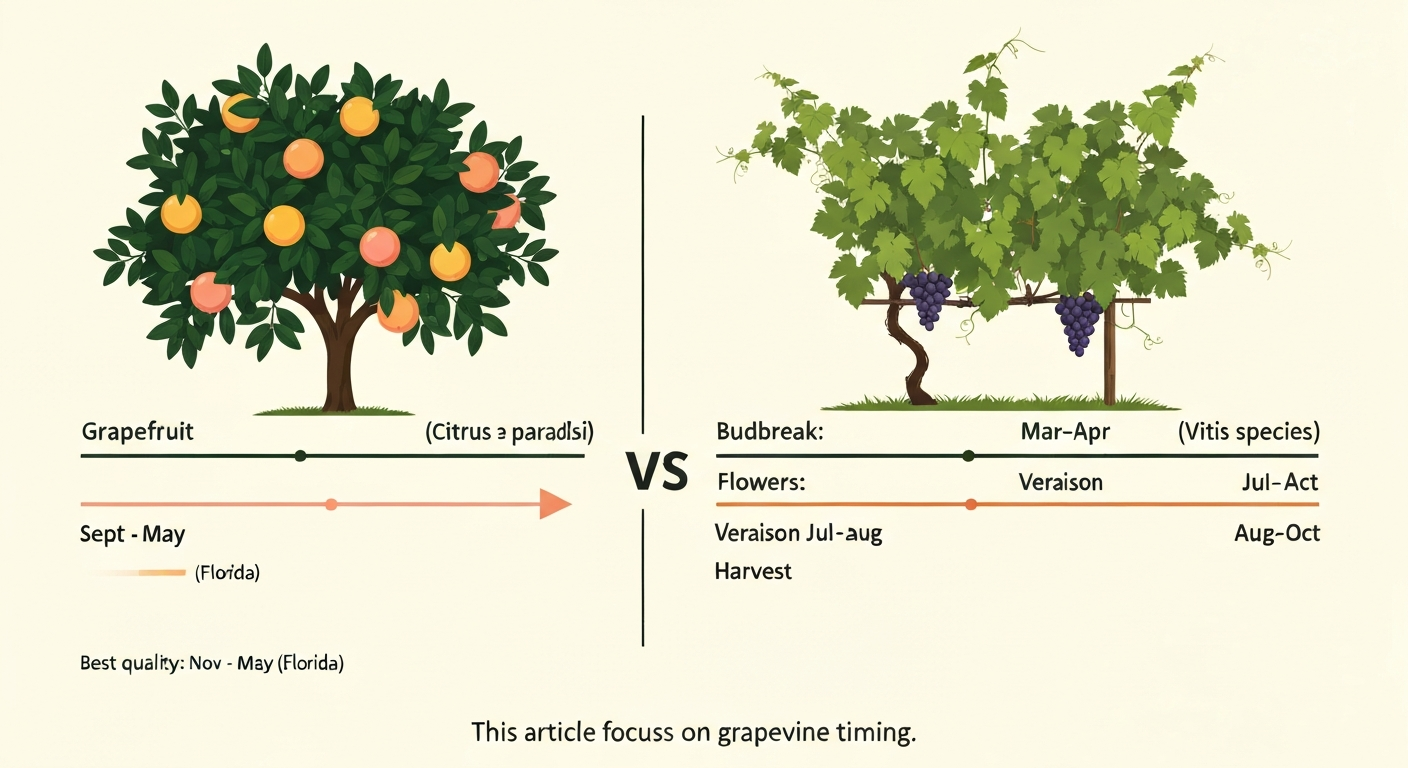
Grapefruit vs. Grape, What You're Really Asking
Grapefruit and grapes share a name but almost nothing else. Grapefruit trees are subtropical and need USDA Hardiness Zones 9–11 to thrive outdoors year-round. Their fruit develops on the tree over many months and is harvested from early fall through spring. Grapes (Vitis vinifera and related hybrids) are temperate deciduous vines that go dormant every winter, break bud in spring, grow vigorously through summer, and ripen fruit in late summer or fall. If you are trying to grow grapes in your backyard, the seasonal timeline below is what you need. If you genuinely want to grow grapefruit trees, the short version is: plant in a frost-free climate or a large container indoors, and expect fruit to be ready roughly 9–12 months after flowering, typically peaking November through April.
Quick Answer: When Do Grapes Grow?
For grapevines in the Northern Hemisphere, the active growing season runs from roughly March–April through October. For a one-line summary of the seasonal timing, see what season does grapes grow. Budbreak, the first visible sign of life after winter dormancy, typically happens in March or April in most temperate U.S. regions. Leaves follow within two to three weeks. Flowering occurs in May or June. Harvest arrives in August through October, depending on the variety and how warm your summers are. For a quick month-by-month answer to what month do grapes grow, see the calendar below. In India's major grape-growing regions like Nashik and Sangli, the main harvest falls December through March due to the subtropical climate and different seasonal rhythm. In Southern Hemisphere countries like Chile, South Africa, and Australia, the entire calendar flips by about six months, putting harvest in February through April.
What 'Growth' Actually Means for a Grapevine
When growers talk about when grapes grow, they usually mean the full phenological cycle, the sequence of biological events that takes a dormant vine from its first swelling bud in late winter all the way to ripe clusters in fall. Each stage is triggered primarily by temperature. Cold winters push the vine into dormancy and help reset its internal clock (a process called chill accumulation). Warming soil temperatures in spring flip the switch back on. Heat accumulation through summer, measured in a unit called Growing Degree Days (GDD, base 50°F / 10°C), largely determines when a variety will ripen. This is the basis of the Winkler heat-summation model used by viticulturists to classify growing regions into Regions I through V, cooler regions ripen early-maturing varieties, while warm Regions IV and V can ripen late, heat-demanding cultivars. As a home gardener, you do not need to calculate GDD by hand, but knowing that your summers need to be warm enough and long enough to ripen your chosen variety is the single most important planning insight you can take away.
The Grapevine Growth Timeline, Stage by Stage
Understanding each phenological stage helps you know what to watch for and when to act. Here is how the cycle plays out in a typical temperate Northern Hemisphere year.
Stage 1: Dormancy and Budbreak (Late Winter to Early Spring)
Vines spend winter dormant. The first sign of activity is bud swell, the compact winter buds start to visibly plump up and then push tiny green tips (called 'woolly bear' stage in vineyard jargon). Full budbreak, when green tissue is clearly exposed, typically occurs in March in California's warmer inland valleys, late March to early April across much of the Mid-Atlantic and Southeast, and as late as early May in the Northeast and cooler Pacific Northwest sites. Soil temperature around 50°F (10°C) is a reliable trigger. This is the most frost-vulnerable moment of the season: a late freeze after budbreak can wipe out an entire year's crop. Temperatures at or below 28°F (−2°C) can damage open buds and young shoots significantly.
Stage 2: Shoot Growth and Leaf-Out (Spring)
Once buds break, shoot growth accelerates quickly, on warm days, shoots can grow an inch or more per day. Leaves unfurl at each node along the shoot. This is also the point at which you start to see the vine's structure clearly: which canes survived winter, where the growth is strong, and whether you need to adjust your training system. By the time shoots are 6–10 inches long, you can assess winter damage honestly. In the Northeast, this stage typically runs through April and into May.
Stage 3: Flowering (Late Spring to Early Summer)
Grapevine flowers are tiny and greenish, nothing like a rose, but this stage is critical. In most Northern Hemisphere temperate climates, bloom occurs in May or June. Flowers are self-fertile on most Vitis vinifera and hybrid varieties, so you do not need multiple plants for pollination. However, rain, cold, or extreme heat during bloom can cause poor fruit set (a condition called coulure), so this window is worth watching carefully. Frost remains a danger through mid-May in many northern states, and open blossoms are especially susceptible to temperatures near 28–30°F (−2 to −1°C).
Stage 4: Fruit Set and Berry Development (Early to Midsummer)
After successful pollination, tiny green berries form on the cluster. Over the next 6–8 weeks, berries grow rapidly through cell division and then cell enlargement. The clusters are still hard, green, and highly acidic at this point. This stage roughly spans June through July in most temperate regions. Canopy management, tucking shoots, removing excess leaves for airflow, is important here to reduce disease pressure.
Stage 5: Veraison (Midsummer)
Veraison is one of the most satisfying moments in the vineyard: berries begin to soften and change color (red varieties turn pink then deep red or purple; white varieties shift from green to golden). Sugar accumulates and acidity drops. In California's warmer inland regions, veraison often arrives in July. In the Pacific Northwest and cooler Northeast, mid-August is more typical. Veraison to harvest usually takes 4–7 weeks depending on the variety and temperatures.
Stage 6: Ripening and Harvest (Late Summer to Fall)
Harvest is the payoff, but timing it correctly matters more than most beginners realize. Sugar (measured in Brix), acidity, and flavor all need to be in balance. Early-ripening varieties like Concord and many cold-hardy hybrids (Frontenac, Marquette) can be ready in late August or early September. Mid-season varieties (many wine grapes, Niagara, Catawba) ripen in September. Late-ripening vinifera varieties in warm climates can run well into October. After harvest, the vine redirects energy to root reserves, do not remove leaves or rush dormancy pruning until after the first hard frost.
When Do Grape Vines Start to Grow and When Do They Grow Leaves?
These are two of the most common questions I hear from first-year growers, and the honest answer is: it depends almost entirely on your location and the weather. If you want a focused guide on timing for budbreak and early shoot growth, see our detailed page on when do grape vines start to grow. In warm inland California, you might see buds swell in late February. In coastal Oregon or New York, you may be waiting until late April or even early May. The trigger is consistently warming soil and air temperatures, once average daily temperatures are reliably above 50°F (10°C), bud activity begins. Leaves appear 10–20 days after budbreak, unfolding from nodes along each shoot. For more detail on regional timing and what to expect, see our guide on when do grape vines grow leaves. A vine that looks completely dead in early March is almost certainly fine; bare dormant canes are normal and not a sign of winter kill (though it is always worth doing a small scratch test on a cane to check for green cambium tissue underneath).
The related question, when do grape vines start to grow after planting?, has a slightly different answer. Newly planted vines are establishing roots in year one and may show slow, modest shoot growth even in favorable conditions. Do not panic if a first-year vine sits quietly for a few weeks before pushing new growth. I planted a young Marquette vine one April and watched it do virtually nothing for six weeks before finally shooting up vigorously in June. Year one is a root year, not a shoot year.
Where Do Grape Leaves Grow? Vine Anatomy Made Simple
Understanding where leaves grow on a grapevine helps you prune correctly, manage the canopy, and spot problems early. The vine has a clear structural hierarchy. For a detailed guide on where do grape leaves grow, see our in‑depth article on leaf placement and canopy management.
- Trunk: the permanent vertical stem rising from the ground. No leaves grow directly here in a mature, well-managed vine.
- Cordons (or canes): horizontal arms extending from the top of the trunk along a trellis wire. These are semi-permanent (cordons) or renewed annually (canes).
- Shoots: the current season's growth that emerges from buds on the cordons or canes. Leaves grow at every node along the shoot, typically spaced every 2–4 inches.
- Nodes and internodes: each node is the point on the shoot where a leaf attaches. The leaf petiole connects there, and a tendril or lateral shoot often grows from the same node.
- Basal leaves: the first few leaves at the base of each shoot. These develop earliest and are often the largest. Research consistently shows that removing 1–2 basal leaves in the fruit zone improves airflow and reduces disease.
- Lateral shoots: secondary shoots that grow from nodes on the primary shoot. They also carry leaves and, on vigorous vines, can develop small secondary clusters. Laterals are typically hedged or tipped to keep the canopy open.
A healthy mid-season vine in full leaf can carry dozens of leaves per shoot, with each leaf doing photosynthetic work that feeds both shoot growth and fruit ripening. The leaf-to-fruit ratio matters: viticulturists commonly target around 7–10 square feet of leaf area per pound of fruit for balanced ripening, though as a home gardener you do not need to measure this precisely. The practical takeaway is: do not strip leaves aggressively, but do open up the fruit zone for sunlight and airflow.
Regional Timing Schedules for Home Gardeners
One of the most useful things I can give you is a regional breakdown, because 'grapes grow in summer' is technically true but nearly useless for planning. Here is how the phenological calendar plays out across major growing regions.
| Region | Budbreak | Flowering | Veraison | Harvest Window |
|---|---|---|---|---|
| California (warm inland / Central Valley) | Late Feb – Mar | May | July | Aug – Oct |
| California (cooler coastal / Napa) | Mar – early Apr | May – June | Late July – Aug | Sept – Oct |
| Pacific Northwest (WA / OR) | Apr | June | Mid-Aug | Sept – Oct |
| Northeast / Mid-Atlantic (NY, PA, NJ) | Late Apr – early May | June | Late July – Aug | Sept – Oct |
| Midwest (cold-hardy varieties) | Late Apr – May | June | Aug | Late Aug – Sept |
| Southeast (SC, GA, NC — muscadine) | Mar – Apr | May – June | July – Aug | Aug – Sept |
| India (Maharashtra: Nashik, Sangli) | Sept – Oct (post-pruning) | Oct – Nov | Nov – Dec | Dec – Mar |
| Chile (Central Valley) | Sept – Oct | Nov – Dec | Jan – Feb | Feb – Apr |
| South Africa (Western Cape) | Sept – Oct | Nov | Jan | Jan – Apr |
| Australia (Victoria / SA) | Sept – Oct | Nov – Dec | Dec – Feb | Jan – Apr |
A Note on India's Grape Season
India's subtropical grape-growing regions work on a fundamentally different system. In Maharashtra, growers prune vines in September or October to force a new growing cycle, essentially using pruning as the trigger that dormant cold temperatures provide in temperate climates. The vines then flower in October–November and ripen fruit for the main harvest from December through March. For a focused guide on in which season grapes grow in India, see the India grape season overview covering pruning schedules, flowering months, and main harvest periods. Some growers also force an early 'kharif' crop for a September–November market. If you are growing grapes in a tropical or subtropical climate, this managed pruning approach is the key to getting reliable annual harvests.
Southern Hemisphere: Just Flip the Calendar
If you are in the Southern Hemisphere, everything shifts by roughly six months. Budbreak in September–October, flowering in November–December, veraison in January–February, and harvest in February–April. In Australia (Victoria and South Australia), budbreak typically occurs in September–October, veraison in December–February, and harvest in January–April, see Spatial analysis of climate in winegrape‑growing regions in Australia, Australian J. of Grape & Wine Research (summary) In Australia (Victoria and South Australia), budbreak typically occurs in September–October, veraison in December–February, and harvest in January–April.. The growing season logic is identical, it is still driven by warming temperatures and accumulated heat, but the calendar months are reversed. Chilean, South African, and Australian commercial harvests typically run February through April, which is why you sometimes see Southern Hemisphere table grapes arriving in Northern Hemisphere stores during what feels like the off-season.
Variety Timing and Climate Fit
Choosing the right variety for your region is the single decision that most influences whether your grapevines succeed. A late-ripening wine grape like Cabernet Sauvignon needs a long, warm growing season, it will not ripen reliably in Zone 5 Minnesota or a cool maritime coastal site. Conversely, cold-hardy hybrids like Frontenac, Marquette, and Concord were bred specifically for shorter seasons and colder winters and will ripen reliably in climates where vinifera varieties struggle.
| Variety | Type | Ripening Timing | Minimum Frost-Free Days | Best Climate Fit |
|---|---|---|---|---|
| Concord | American hybrid | Late Aug – early Sept | ~150 days | Northeast, Midwest, Great Lakes |
| Frontenac | Cold-hardy hybrid | Late Aug – Sept | ~150 days | Midwest, Upper Midwest, Canada |
| Marquette | Cold-hardy hybrid | Sept | ~155 days | Zone 4–6, short-season regions |
| Niagara | American hybrid | Sept | ~150 days | Northeast, Mid-Atlantic |
| Chardonnay | Vitis vinifera | Sept – Oct | ~170 days | Pacific Northwest, California, NY Finger Lakes |
| Cabernet Sauvignon | Vitis vinifera | Oct | ~180–190 days | Warm California, WA Columbia Valley |
| Muscadine (Carlos, Noble) | Vitis rotundifolia | Aug – Sept | ~180 days | Southeast U.S. (Zones 7–9) |
| Thompson Seedless | Vitis vinifera | Aug | ~180+ days | Hot dry climates, Central Valley CA |
The frost-free day requirement is not just about absolute numbers, it is about when those frost-free days fall relative to budbreak and harvest. A 160-day frost-free season is fine if your last spring frost is early April and your first fall frost is late September. But if spring frosts linger into May and fall frosts arrive in September, you have a much tighter window even on paper. Always check your local NOAA or NWS average last-freeze map for the realistic frost probability for your exact location, not just average regional dates.
A Practical Month-by-Month Calendar for Home Grape Growers
This calendar assumes a typical Northern Hemisphere temperate location (roughly USDA Zones 5–7). Adjust timing earlier for warmer Zones 8–9 and later for colder Zone 4 sites. Southern Hemisphere growers: shift all months by approximately six months.
- January – February (Dormancy): No active growth. Ideal time to order bare-root vines and plan your trellis system. Dormant pruning can be done any time the vines are fully dormant and temperatures are above about 20°F (−7°C).
- February – March (Late Dormancy / Pre-Budbreak): Complete dormant pruning before buds swell. Monitor long-range forecasts for late-frost risk. In warmer Zones 8–9 and California's inland valleys, buds may begin swelling in late February.
- March – April (Budbreak): Watch for bud swell and woolly tips. Have frost protection ready (row cover, sprinklers, or simply heaping soil over newly planted vines). Plant bare-root vines once soil is workable and frost risk is manageable.
- April – May (Active Shoot Growth / Leaf-Out): Shoots grow rapidly. Begin training new growth onto trellis wires. Thin to 1–2 shoots per node on young vines. Apply first fungicide or sulfur spray if downy or powdery mildew is a concern in your area.
- May – June (Flowering / Bloom): Avoid disturbing vines during open bloom if possible. Continue fungal disease management. Watch for late frosts in northern zones — provide protection if temperatures threaten to dip below 28°F (−2°C).
- June – July (Fruit Set and Berry Development): Shoot tip and hedge canopy to improve airflow. Remove a few basal leaves in the fruit zone to increase sun exposure and reduce humidity around clusters. Keep up with disease monitoring.
- July – August (Veraison): Berries begin to color and soften. Reduce irrigation (if any) to concentrate flavors. Veraison timing is your ripening clock — note the date each year to improve future harvest predictions.
- August – October (Ripening and Harvest): Taste berries regularly from about 3–4 weeks after veraison. Harvest when sugar (sweetness), acidity, and flavor are balanced for your purpose (fresh eating vs. winemaking). Do not rush — one extra week on the vine can make a real difference.
- October – November (Post-Harvest): Allow leaves to yellow and fall naturally. Vines are storing carbohydrates in roots and trunk. Do not prune now. Apply a dormant copper spray after leaf drop if you had significant fungal disease pressure.
- November – December (Early Dormancy): Vines go fully dormant after hard frosts. In cold climates (Zone 4–5), consider burying young vines or wrapping trunks for winter protection, especially in the first 2–3 years.
Frost Protection: The Detail That Saves Your Harvest
The biggest single threat to home grape growers in most temperate regions is not winter cold, it is late-spring frost after budbreak. Once green tissue is exposed, a temperature drop to 28–30°F (−2 to −1°C) can kill the primary buds and young shoots that carry this year's fruit clusters. Damage near 28°F (−2°C) during flowering or early fruit set can cut your yield substantially or eliminate it entirely. Practical protection options include lightweight floating row covers draped over vines on nights when frost is forecast, overhead sprinkler irrigation (the latent heat of freezing water protects tissue as long as water keeps running), mounding soil over the base of newly planted vines, and simply choosing later-budding varieties for high-frost-risk sites. I have lost a full crop to a single May frost in Zone 6, so I take this seriously now and always keep row cover on hand through Memorial Day.
The Right Variety for Your Growing Window
If there is one thing I want you to leave with, it is this: match your variety to your actual frost-free window before you plant anything. Calculate your average frost-free days (last spring frost to first fall frost) from your local NWS data. If you have 150–160 days, early-maturing cold-hardy hybrids like Concord, Frontenac, or Marquette are your realistic choices and they can be genuinely excellent. See Growing table grapes, Oregon State University Extension (EC 1639) for regional recommendations and cultivar guidance for cool‑climate growers Growing table grapes — Oregon State University Extension (EC 1639). If you are in a warm Zone 8–9 climate with 200+ frost-free days, you have a much wider range of vinifera options. In the Southeast, Muscadine varieties like Carlos and Noble are not just viable, they thrive where vinifera varieties simply struggle with heat and humidity. Getting the variety right costs you nothing; getting it wrong costs you years.
FAQ
SEO title for the article
When Do Grapefruits Grow? (Clarifying Grapefruit vs. Grapes) — Grapevine Growth Timeline & Regional Calendars
Meta description
Confused between grapefruit and grapes? Get a quick answer for grapefruit season and a detailed, region-specific grapevine phenology guide (budbreak → harvest), variety guidance, frost risk, and a practical month-by-month calendar for home gardeners.
Quick answer: When do grapefruits grow?
Grapefruit (Citrus × paradisi) is subtropical. U.S. commercial harvest typically runs September–May (Florida often Sept/Oct start; best eating quality Nov–May). For home citrus growers, fruit matures across fall–spring depending on local warmth.
Quick answer: When do grapes grow (one-line season answer)
Temperate grapes (Vitis spp.) grow in spring–autumn: budbreak in spring (Mar–May NH), flowering late spring, veraison mid-summer, and harvest from late summer through fall (NH roughly Aug–Oct; SH roughly Feb–Apr). Exact months depend on climate zone and variety.
Grapevine phenology — what are the key stages and typical months in temperate Northern Hemisphere sites?
Key stages: budbreak (March–April), leaf-out/shoot growth (March–May), flowering/bloom (May–June), fruit set (late May–June), veraison (July–August), ripening and harvest (August–October). Warmer inland sites shift earlier; cool/coastal sites shift later.
How does the timeline change by region / climate?
Warm Mediterranean (Central California): budbreak late Feb–Mar, flowering May, veraison July, harvest Aug–Oct. Cool maritime (Pacific NW): budbreak Mar–Apr, flowering June, veraison mid‑Aug, harvest Sept. Northeast/Mid‑Atlantic: budbreak ~May 1, veraison early Aug, harvest Sept–Oct. India (Nashik/Sangli): commercial harvest Dec–Apr (some early forced crops Sept–Nov). Southern Hemisphere (Chile, South Africa, Australia): shift ~6 months earlier/later — harvest Feb–May (Chile), Nov–Apr (South Africa/Australia) depending on region.