
Yes, you can grow Koshu grapes in the US, but it takes the right region, the right rootstock, and a realistic understanding of what this variety needs. Koshu is a Vitis vinifera cultivar that has been grown in Japan's Yamanashi Prefecture for over 1,000 years, and the first US-grown Koshu wine came out of Napa Valley. That's your biggest clue: if you're in a climate that resembles coastal California wine country or the drier parts of Washington state, you have a genuinely workable starting point. If you're in a humid, disease-prone region of the East or South, you're in for a real fight, and you should know that upfront before you invest in vines.
Can You Grow Koshu Grapes in the US? Yes, Maybe, How

Marcus Whitfield
6 Jun 2026
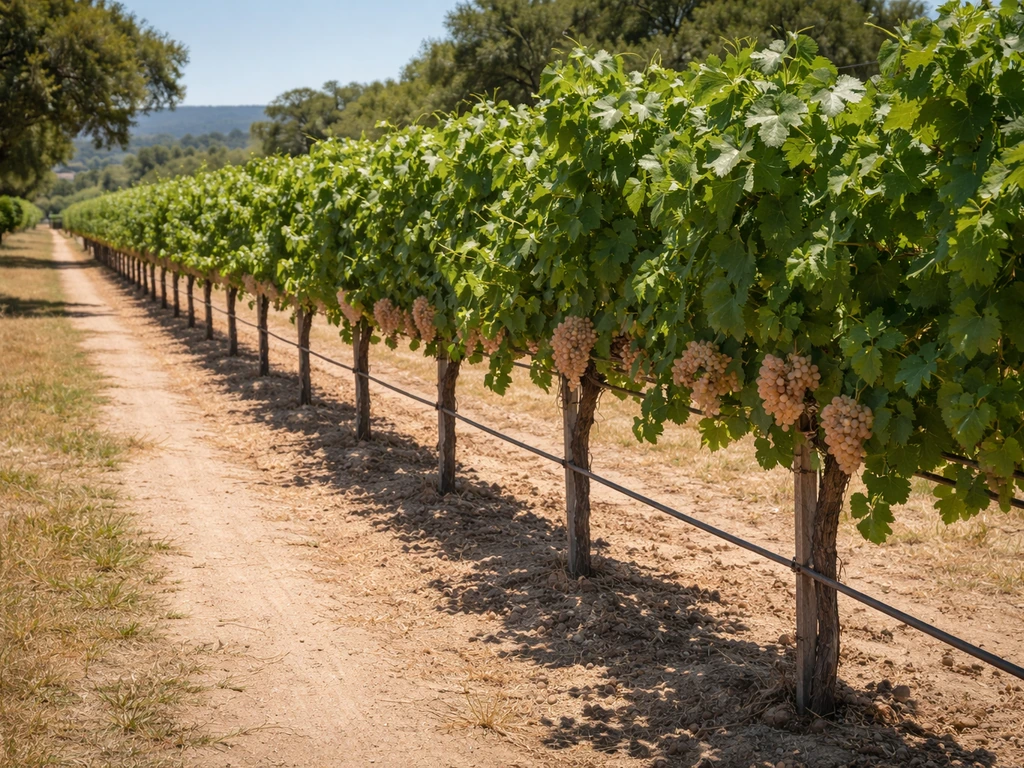
What Koshu and 'Koshu Pink' actually are
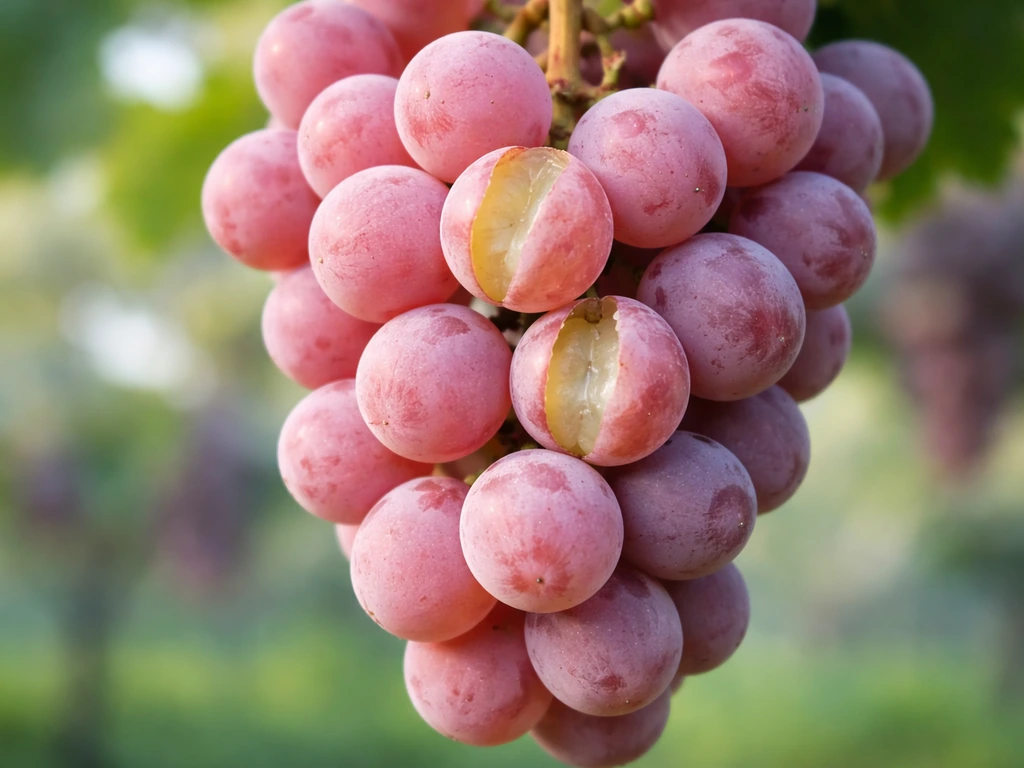
Koshu (甲州) is a pink-skinned, white-fleshed wine grape grown primarily in Yamanashi, Japan, in the foothills of Mount Fuji. Despite its pink skin, it produces wines that taste and behave more like a white wine grape: light, delicate, and aromatic. It's used for still, sparkling, and even orange-wine-style expressions. When people search for 'Koshu Pink' or 'Japanese Koshu Pink,' they're almost certainly talking about the same variety. The pink skin is a defining trait, so the name is sometimes used to emphasize it, but there isn't a separate registered cultivar by that exact name. Treat them as the same thing for growing purposes.
Genetically, Koshu is classified as Vitis vinifera, which puts it firmly in the same family as Chardonnay, Riesling, and Cabernet Sauvignon. That's important because it means Koshu shares all the classic vinifera vulnerabilities: no significant natural phylloxera resistance, moderate-to-low tolerance for extreme cold, and real susceptibility to common fungal diseases. The one edge Koshu has over many vinifera varieties is its thick skin, which helps it cope with Japan's notoriously humid, rainy summers. That's an advantage, but it doesn't make it bulletproof.
Key traits to understand before you plant
- Pink-skinned, white-fleshed wine grape used primarily for white and sparkling wine styles
- Vitis vinifera species, meaning standard vinifera cold hardiness (roughly USDA zones 6–9 with care)
- Thick skins provide some humidity tolerance, but fungal disease management is still essential
- Grown commercially in Japan in a climate similar to parts of Northern California and Washington
- UC Davis Foundation Plant Services lists Koshu in its grape variety resources, meaning certified virus-tested material exists in the US supply chain
- First US commercial Koshu wine produced in Napa Valley, confirming the variety can perform in American conditions
Is Koshu actually viable where you live?
The honest answer depends almost entirely on your climate zone and humidity levels. Koshu was domesticated in a region that gets warm summers, moderate winters, and significant rainfall during the growing season. That sounds promising for a lot of the US, but the disease pressure in humid American climates (especially the Southeast and much of the Mid-Atlantic) tends to be much more intense than what Koshu evolved to handle. Japan's Yamanashi gets rain, but it also gets reliable summer heat and decent air movement through mountain terrain. A flat, humid Georgia August is a different animal.
Washington State's wine grape territory sits within USDA hardiness zones 6 and 7, and blank" rel="noopener noreferrer">Yakima Valley, the state's oldest federally approved grape-growing region, has been producing high-quality vinifera for decades. The dry, continental climate there reduces fungal disease pressure dramatically. Northern California (especially Napa and Sonoma) is where the first US Koshu was actually grown commercially. These are your best-case US scenarios. Mediterranean-climate California and the drier parts of the Pacific Northwest are genuinely good bets.
| US Region | Climate Fit | Disease Pressure | Overall Viability |
|---|---|---|---|
| Napa / Sonoma, CA | Excellent (warm, dry summers) | Low | Strong yes |
| Central Valley, CA | Good (hot, dry) | Low to moderate | Yes, with heat management |
| Yakima / Columbia Valley, WA | Good (dry continental) | Low | Strong yes |
| Willamette Valley, OR | Moderate (cool, some rain) | Moderate | Possible with vigilance |
| Texas Hill Country / High Plains | Moderate (hot, variable) | Moderate | Maybe, needs site work |
| Virginia / Maryland | Marginal (humid summers) | High | Difficult, high spray burden |
| Mid-Atlantic / Southeast | Poor (hot, humid) | Very high | Not recommended |
| Midwest (zones 5–6) | Marginal (cold winters) | Moderate to high | Risky, frost damage likely |
| Southwest desert (AZ, NM) | Possible at elevation | Low | Maybe at 4,000+ ft elevation |
If you're in a zone where other vinifera varieties like Chardonnay or Riesling thrive with minimal intervention, Koshu is a reasonable experiment. If those varieties struggle where you are, Koshu will too, and probably more so because it's unfamiliar and sourcing help when something goes wrong will be harder.
Choosing your planting site
Grapes in general are site-picky, and Koshu is no exception. If your site checks those boxes, you are already halfway to finding the fields where winemakers grow grapes successfully Grapes in general are site-picky. The single most important factor after climate zone is air drainage. Cold air flows downhill like water, and if your vineyard sits in a low spot or against a fence line that traps it, you'll get frost damage that a site 50 feet uphill would have avoided. Look for a gentle slope (even a few percent grade helps) where cold air can drain away from your vines overnight. Remove any dense hedgerows or structures at the lower end of your planting area that could dam that cold air.
Sun exposure is non-negotiable. Grapes need full sun to produce fruit reliably, and in humid climates, good sunlight also helps dry dew off leaves quickly in the morning, which directly reduces fungal disease. A south- or southwest-facing slope is ideal in most of the continental US. Orient your rows north to south if possible to maximize light exposure on both sides of the canopy throughout the day.
Soil quality matters but is more forgiving than most people think. Grapes tolerate moderately poor soils and actually tend to produce better-quality fruit under some stress. What they can't tolerate is standing water or heavy clay that stays waterlogged. Aim for well-drained loam or sandy loam, and target a soil pH of 5.5 to 6.5, which is the optimum range for nutrient availability in grapevines. If your soil is outside that range, amend it before planting, not after.
Growing season timeline and what to expect in years one through three
In Northern California and the Pacific Northwest, Koshu budbreak typically happens in late March to mid-April, with harvest falling somewhere in September to October depending on the site and season. That's a growing season of roughly 160 to 190 days, which is similar to other mid-season vinifera varieties. In cooler zones or higher elevations, expect budbreak to push later and harvest to tighten up. In very hot inland sites, budbreak may come earlier and the grapes may ripen fast, which can compromise the delicate aromatic character Koshu is known for.
Year one is entirely about root and shoot establishment, not fruit. Your job is to get the vine into the ground correctly, keep it watered, and let it grow. Resist the temptation to let it flower and set fruit in its first season. Pulling off any flower clusters that appear gives the vine energy to develop the root system it will rely on for decades. Year two follows a similar pattern, though you'll start building the permanent structure of the vine through training. UC IPM outlines a year-by-year pruning approach, starting with training during the second dormant period and then applying cane versus spur pruning methods later.
From the third season onward, you can allow a modest crop. Penn State Extension is clear on this point: fruit production really begins in year three. Don't push the vine hard in that first crop year either. A light yield in year three means a stronger vine in year four and beyond. Expect your first real harvest, with something close to full yield potential, somewhere around years four to five.
Approximate year-by-year milestone guide
- Year 1: Plant bare-root or container vine in spring, establish 1–2 strong shoots, remove all flower clusters, water consistently
- Year 2: Select and train the permanent trunk, begin tying shoots to trellis wires, continue removing all fruit
- Year 3: Establish cordon or cane structure, allow a limited crop (2–3 clusters per vine maximum), monitor closely for disease
- Year 4–5: Full trellis established, normal pruning cycle begins, expect approaching full yield potential
Trellis, training, and pruning for Koshu
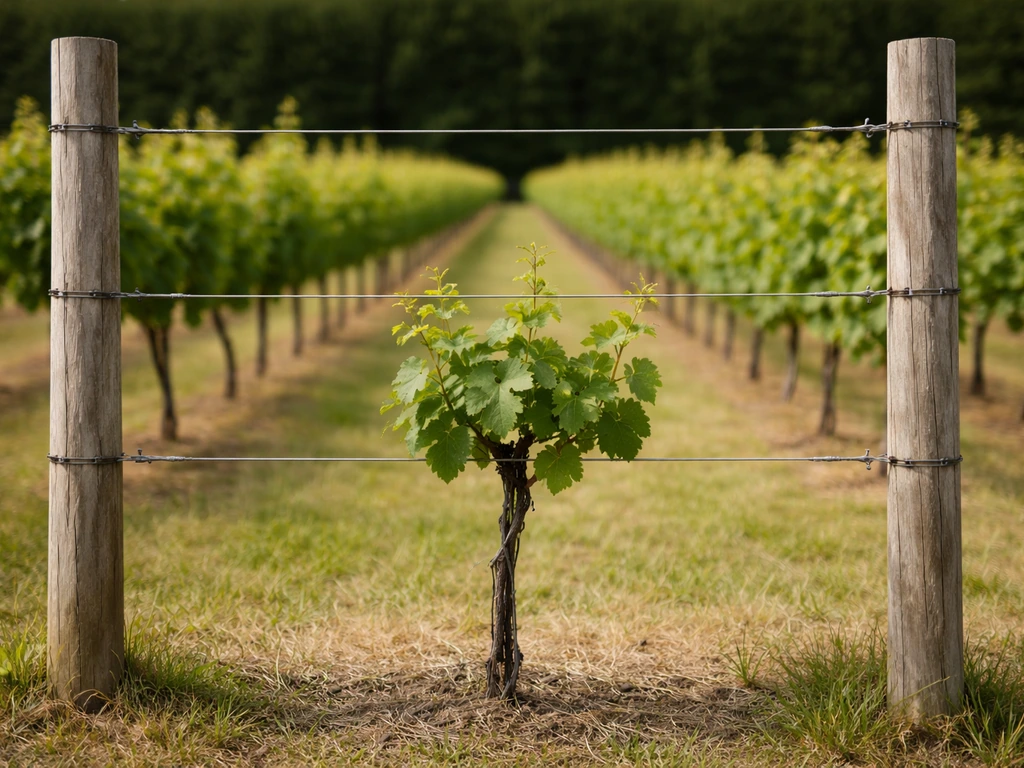
A vertical shoot positioning (VSP) trellis is the standard choice for vinifera varieties in home vineyards, and it works well for Koshu. It's manageable, well-documented, and promotes the kind of airflow and sun exposure that reduce disease pressure. You'll need two to three tiers of trellis wire: a fruiting wire at about 36 inches and one or two catch wires above it at roughly 48 and 60 inches. Posts should be set at 15 to 20 foot intervals, with your end posts anchored firmly since they carry the most tension.
For training style, you have two main options: cane pruning or spur pruning. Cane pruning (sometimes called Guyot pruning) is often recommended for vinifera varieties in cooler climates because it lets you select the healthiest one-year-old wood each season, which is where your fruit will form. Spur pruning is simpler to learn and works well in warmer sites where vines are vigorous and uniform. Either approach works for Koshu, but if you're in a marginal zone where winter damage is a concern, cane pruning gives you more flexibility to work around any damaged wood.
Pruning happens during dormancy, typically late winter (January to February in most US regions, before budbreak). The core rule: grapes fruit on lateral shoots growing from one-year-old wood, so every year you're selecting the best new growth from last season to carry the next year's crop. In the establishment years, focus is on building structure first. After that, a standard pruning removes roughly 80 to 90 percent of last year's growth to keep the vine in balance and prevent overcropping, which weakens vines over time.
Managing disease, pests, and humidity for Koshu
This is where most home growers either succeed or fail with Koshu. As a vinifera variety, it's meaningfully more susceptible to fungal disease than American or hybrid varieties. The three big threats in the US are powdery mildew, downy mildew, and Botrytis bunch rot, and your spray program needs to address all three, especially in humid climates.
Powdery mildew is the most consistent threat for vinifera everywhere in the US. UC IPM uses a Powdery Mildew Risk Index model to guide spray timing, and the key principle is that early-season applications (starting at budbreak) matter more than late-season ones. The first treatment timing depends on which fungicide group you use, vine growth stage, and local infection risk. In dry-summer climates like California, a program of 5 to 10 sulfur applications throughout the season is often sufficient. In wetter regions, you'll need a more aggressive rotation of fungicide groups.
Downy mildew is a different pathogen and thrives when you get cool, wet conditions between 55 and 86 degrees F with high relative humidity. If your region gets spring and summer rains in that temperature window, downy mildew will be a real problem. It requires different fungicides than powdery mildew, so don't assume one product covers both.
Botrytis bunch rot is particularly relevant for Koshu because it attacks clusters, and a thick-skinned berry is only so much protection once the humidity gets inside a dense bunch. The best defense is canopy management: leaf removal around the fruiting zone improves air circulation and allows spray penetration to the clusters. Both OSU and Michigan State Extension research support leaf removal as a primary cultural tool for bunch rot control. Do this in early summer, before the fruit sets, not as a last-ditch move after you see rot.
Quick disease management priorities by region
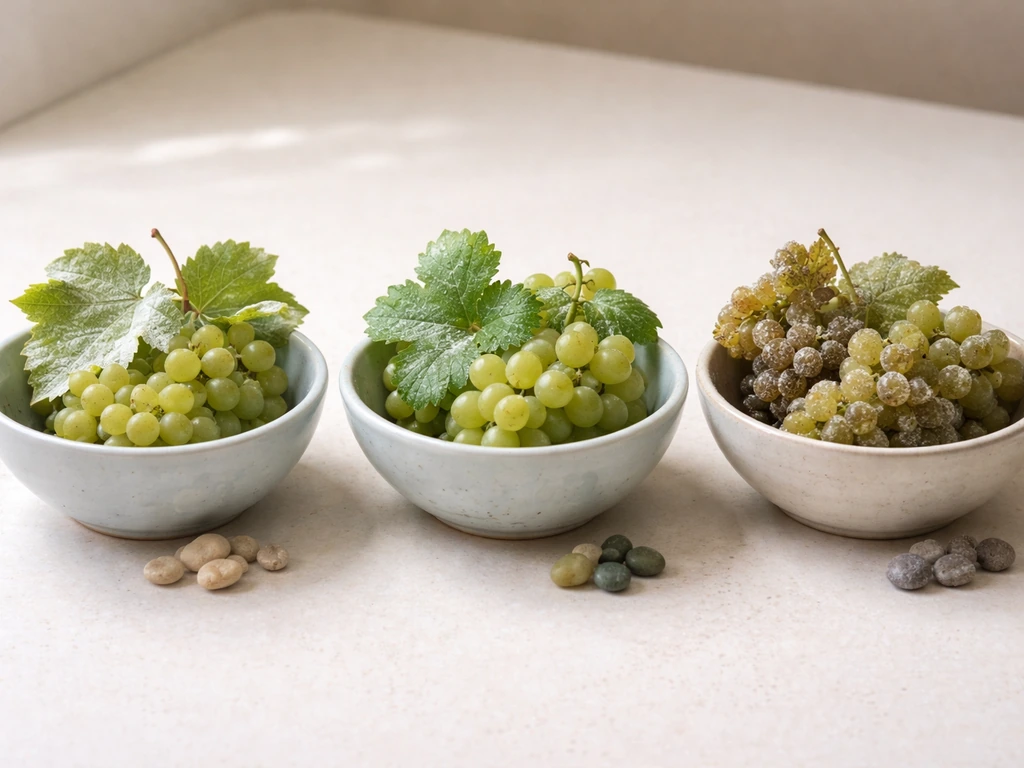
- Dry-summer California and Eastern Washington: Powdery mildew is your main focus; downy mildew is minimal; Botrytis risk is low but watch dense clusters
- Oregon Willamette Valley and similar cool-wet sites: All three diseases are concerns; leaf removal and spray timing are critical
- Texas and Southwest: Powdery mildew and spider mites are common; Pierce's Disease (spread by glassy-winged sharpshooter) is a threat in warmer TX zones
- Eastern US (any state): Downy mildew and Botrytis are intense; this is where the fight gets genuinely hard and spray schedules become nearly weekly during wet springs
Rootstocks, sourcing vines, and where to buy
Koshu is a pure Vitis vinifera, which means phylloxera will destroy it on its own roots if the pest is present at your site. Phylloxera feeds on vinifera roots and can stunt or kill vines over several seasons. In the US, phylloxera is established in California and has been detected in Washington vineyards. If you're in any area with vinifera grape history, assume phylloxera is a risk and plant on a resistant rootstock. This is not optional for long-term success.
Rootstock selection starts with your soil type and pest pressure. For California conditions, rootstocks like 110R, 1103P, and 3309C are widely used for vinifera varieties and provide phylloxera resistance and good performance on moderate soils. In Washington, similar choices apply. If nematodes are also present (common in sandy soils), rootstocks with nematode tolerance like Freedom or Harmony are worth discussing with your nursery. Avoid rootstocks with significant Vitis vinifera parentage in phylloxera-risk areas.
For sourcing Koshu specifically: UC Davis Foundation Plant Services lists Koshu in its grape variety database, which is significant. FPS-listed varieties have gone through virus-testing and certification protocols, and licensed California nurseries can propagate from that material. That's your most reliable sourcing path if you're on the West Coast. Start by contacting a licensed California grapevine nursery and asking specifically for Koshu budwood or grafted vines on your preferred rootstock. Availability will be limited compared to mainstream varieties, so order a season in advance if possible.
Outside California, sourcing gets harder. Specialty wine-grape nurseries in Washington and Oregon sometimes carry unusual vinifera varieties, so call around. Be cautious of online retailers offering Koshu without clear provenance or virus-testing information. Bringing in an untested vine can introduce viruses to your entire planting, which is a mistake that takes years to discover and is very expensive to fix.
Should you plant Koshu? A quick decision checklist
Before committing to Koshu, run through this honestly. If you answer 'yes' to most of the first group, you're in good shape. If you're nodding along to the second group, reconsider.
Green lights: you're probably a good candidate
- You're in USDA zones 7–9 in California, Oregon, or Washington
- Your summers are warm and relatively dry (under 20 inches of summer rainfall)
- Other vinifera varieties like Chardonnay or Pinot Gris grow reasonably well near you
- You have a well-drained, south-facing site with good air movement
- You're willing to build a proper trellis and commit to a seasonal spray program
- You have patience for a 3 to 5 year establishment timeline before real harvest
Red flags: think carefully or choose an alternative
- You're in zones 5 or colder and get harsh winters with temperatures below -10°F
- You live in a humid Eastern or Southern state where vinifera consistently struggles
- You want low-maintenance growing without regular spraying
- You can't find a certified, virus-tested source for Koshu vines
- You're hoping for fruit in year one or two
If Koshu won't work where you live: better alternatives
If your climate rules out Koshu, you're not out of options for growing interesting, quality wine grapes. The right alternative depends on where you are.
For humid Eastern and Midwestern climates where vinifera struggles, French-American hybrids like Vidal Blanc, Traminette, and Chardonel were bred specifically for these conditions. They carry enough American genetic heritage to resist downy mildew and cold better than Koshu ever will, while still producing wines with real complexity. Traminette in particular has aromatic qualities somewhat reminiscent of Old World white wine grapes.
For colder zones (USDA zone 5 and below), Minnesota-bred varieties like Frontenac Gris or La Crescent are the realistic path to reliable harvests. These varieties were developed to survive brutal winters and still produce quality fruit. They're not Koshu, but they're also not a constant battle.
For Texas and the Southwest where heat and Pierce's Disease are concerns, Pierce's Disease-resistant varieties like Blanc du Bois or Lenoir are worth exploring for warmer zones, while higher-elevation sites in Texas Hill Country or New Mexico can sometimes support conventional vinifera.
If you're simply curious about Japanese grape growing culture and want something closer to the Koshu experience, Muscat Bailey A is another Japanese-bred variety that has shown up in US specialty nurseries and handles slightly different conditions than Koshu. It's worth asking about when you contact nurseries.
The broader question of which varieties perform best in specific US states and regions is a genuinely deep topic, and the answer shifts significantly depending on whether you're in the Pacific Northwest, the Mid-Atlantic, or the Gulf South. If you're wondering what states grow grapes, the best approach is to look at local climate and disease pressure because grape varieties perform very differently from one region to the next. Sites focused on state-by-state and region-by-region grape variety performance are worth consulting alongside this guide to nail down exactly what's been proven to work in your specific county and microclimate. The broader question of which varieties perform best in specific US states and regions is a genuinely deep topic, and the answer shifts significantly depending on whether you're in the Pacific Northwest, the Mid-Atlantic, or the Gulf South grow grapes in your region. In general, the question of what countries grow grapes comes down to climate suitability, long growing seasons, and access to suitable vineyard sites.
Your next steps right now
- Confirm your USDA hardiness zone and average summer rainfall to assess disease pressure at your location
- Check whether other vinifera grapes (Chardonnay, Riesling, Pinot Gris) are grown successfully within 50 miles of you, as a real-world viability test
- Contact a licensed California grapevine nursery (using UC Davis FPS as a reference point) and ask about Koshu availability on phylloxera-resistant rootstock, ordering at least one full season ahead
- Walk your site and identify your best planting area: south-facing, well-drained, good air drainage downslope, full sun all day
- Test your soil pH and adjust toward 5.5 to 6.5 before planting if needed
- Build or plan your VSP trellis before the vines arrive so you're ready to start training from day one
- If your climate or sourcing situation rules out Koshu, pick a proven regional alternative (hybrid or cold-hardy variety) and focus your energy there instead
FAQ
What USDA zone is best for growing Koshu in the US?
Koshu is most realistic where late frosts do not repeatedly damage shoots and where you can still get full sun through the season. In practice, climates comparable to coastal Northern California and the drier parts of Washington are the safest starting point. If you are near zone 6 or colder, plan for delayed budbreak and winter injury risk, and strongly consider cane pruning to replace damaged one-year wood.
Can I grow Koshu in a humid backyard or small garden in the East or Southeast?
You can try, but you must be prepared for higher disease pressure than Koshu evolved for. The critical mitigation is canopy airflow plus vigilant mildew control starting at budbreak, because humid evenings and frequent leaf wetness quickly favor downy mildew. If you cannot commit to a consistent spray and leaf-removal routine, a hybrid bred for humidity is usually the better bet.
How much sun do Koshu vines need, and what if my site is only partial sun?
Aim for true full sun, roughly 8 hours per day during the growing season, with sun on the canopy early enough to dry dew. If your rows are shaded by buildings, trees, or even morning-only cover, expect weaker aromatics, slower ripening, and more mildew pressure. A practical check is to observe leaf drying time after dew, if it takes most of the day to dry, partial sun will likely make disease harder.
Should I plant Koshu on its own roots or can I use ungrafted vines?
In phylloxera-risk areas, ungrafted Koshu is a long-term losing strategy. The article emphasizes phylloxera susceptibility as a defining risk for vinifera, so the practical rule is to plant on a resistant rootstock when phylloxera is known or suspected. If you are unsure whether phylloxera is present, treat the area as risky and plan for rootstock selection.
How do I choose the right rootstock if I have both phylloxera risk and nematodes?
Start by identifying your pest problem from your soil history. If nematodes are common in your planting area, ask your nursery about rootstocks with nematode tolerance, then confirm that the chosen rootstock still provides phylloxera resistance. Also match rootstock vigor to your soil drainage, since overly vigorous combinations can worsen canopy density and increase bunch rot risk.
What is the biggest mistake new growers make when trying Koshu for the first time?
The common mistake is pushing fruit too early. The article advises removing flowers in year one and keeping yields modest through year three, because vine establishment determines long-term performance and disease resilience. If you let it crop heavily in the first couple seasons, you often get small, uneven fruit and a vine that struggles to recover after disease pressure or winter stress.
Do I have to use a VSP trellis for Koshu?
VSP is a standard fit because it supports airflow and manageable canopy positioning, but it is not the only theoretical approach. If you cannot install VSP, whichever system you choose must still deliver canopy ventilation and allow you to do leaf removal near fruiting zones. The key is that dense, poorly lit clusters are the scenario that leads to Botrytis bunch rot problems.
How do I avoid pruning mistakes that hurt Koshu yields later?
Pruning errors usually come from misunderstanding fruiting wood age and selecting weak canes. Because Koshu fruits on laterals from one-year wood, you want to consistently choose healthy one-year shoots for the next crop structure each dormant season. In colder or marginal areas, cane pruning is often more forgiving because you can replace damaged wood rather than being locked into fewer spurs.
What fungicide mistakes should I avoid when targeting powdery mildew, downy mildew, and Botrytis?
Do not assume one product or one schedule covers all three problems, because downy mildew and powdery mildew have different biology and fungicide classes. Also avoid relying only on late-season treatments, early-season timing from budbreak is critical for powdery mildew management. For Botrytis, prioritize canopy management before cluster density becomes a problem, rather than trying to fix rot after it starts inside bunches.
How can I tell if my Koshu ripening will be too fast or too slow for quality?
If budbreak is very early due to heat, you may get rapid ripening that can reduce Koshu’s delicate aromatic profile. If harvest arrives late because of cool sites or insufficient sun, you may struggle with flavors and still face disease pressure in wet conditions. Use your local trial data if possible, and track budbreak to harvest interval over time to decide whether to adjust pruning intensity or site choice.
Is leaf removal always a good idea for Koshu?
Leaf removal is beneficial for airflow and spray penetration around clusters, but it should be targeted and timed before fruit sets. Overdoing leaf removal can increase sun exposure to berries and may create uneven cluster temperatures, especially in hot inland summers. Start with early, moderate removal focused on the fruiting zone, then reassess based on your weather and canopy density.
Where should I buy Koshu vines to reduce the risk of virus problems?
The safest approach is to use certified, virus-tested planting material with clear provenance. The article highlights that UC Davis Foundation Plant Services listing supports safer propagation routes, so in practical terms you should ask nurseries whether the budwood or grafted vines come from certified sources. Avoid vague online listings that cannot explain testing and certification, since introducing viruses can reduce yields for years.
What should I do if Koshu grows well vegetatively but never produces good fruit?
First check timing and yield level, if you pushed fruit too early, the vine may still be building structure. Next check sun and cold-air drainage, weak fruiting can happen when frosts damage laterals or when low spots trap cold. Finally, review disease and canopy density, even if vines look green, mildew pressure or bunch rot risk can suppress healthy fruit development without obvious early symptoms.
If Koshu does not work in my area, what is the fastest way to pick a better alternative?
Use your local climate and disease pressure, then narrow to varieties proven in conditions like yours rather than picking based on taste alone. For humid regions, French-American hybrids bred for downy mildew and cold reliability are often a quicker path to success. For very cold zones, Minnesota-bred options can be more reliable, even if the flavor profile is not Koshu-like.