
Yes, grapes can absolutely grow in hot weather, and some of the world's best wine and table grape regions sit in genuinely scorching climates. The catch is that "hot" covers a wide range of conditions, and what works in the dry heat of California's Central Valley is a different challenge from the humid summer heat of Georgia or Florida. Pick the right species, variety, and site, manage water thoughtfully, and hot weather becomes an advantage rather than a liability. Skip those steps and you'll end up with raisins on the vine before harvest.
Can Grapes Grow in Hot Weather? Practical Guide for Gardeners
Marcus Whitfield
13 Jul 2026
Quick verdict: can grapes grow in hot weather?
The short practical answer is yes, with one important qualifier: the type of heat matters as much as the temperature itself. For a quick overview of what climate does grapes grow in, see our detailed guide on grape-climate suitability. Dry heat with cool nights is what most classic wine grape regions depend on. Humid heat with warm nights is trickier, but muscadines, hybrid varieties, and a handful of heat-adapted Vitis vinifera cultivars handle it well. Where you need to reconsider planting is when you're combining summer temperatures that regularly exceed 105–110°F with no irrigation access, or when your winters are so warm that vines never accumulate enough chill hours to break dormancy reliably. Outside of those two edge cases, there is almost certainly a grape variety worth trying in your garden.
What "hot" actually means for grapevines
Viticulturists use a few different systems to measure heat, and it's worth knowing them so you can look up your own location. The American Horticultural Society (AHS) defines a "heat day" as any day when the maximum temperature hits 86°F (30°C) or higher, and their heat-zone map divides the U. For a quick lookup of what temperature do grapes grow in, see the site's temperature guide for practical thresholds and regional examples. blank" rel="noopener noreferrer">The New AHS Plant Heat‑Zone Map (AHS publication) defines a “heat day” as a day with maximum temperature ≥86°F (30°C) and classifies U.S. locations into 12 heat‑zones by the annual number of such days (zone 1 = 0 heat days; zone 12 = ≥210 heat days). S. into 12 zones based on how many of those days occur each year. Zone 1 gets essentially zero; Zone 12 gets 210 or more. Most productive grape-growing areas in the South and Southwest sit in AHS heat zones 7 through 10.
Viticulture also uses the Winkler growing-degree-day (GDD) system, which tallies heat accumulation between April 1 and October 31 using a base of 50°F (10°C). Regions are classified into five categories: Winkler Region I (the coolest, under 2,500 GDD) through Region V (the hottest, over 4,000 GDD). Parts of California's inland valleys, Arizona, and south Texas fall squarely in Region IV or V. Knowing your Winkler region helps enormously when matching varieties to your site.
Beyond raw heat totals, nighttime temperatures are a separate and critical variable. When overnight lows stay at or above 68°F (20°C) consistently through the growing season, grape berry chemistry changes significantly: acidity drops faster, color development can stall, and sugar accumulation gets unpredictable. Elevated night minima (≈15°C → 20–25°C) reduce titratable acidity and change soluble solids accumulation in Thompson Seedless (Acta Horticulturae) blank" rel="noopener noreferrer">Controlled‑environment experiments on Thompson Seedless show higher night temperatures reduce titratable acidity and alter soluble solids accumulation trajectories. This is one reason tropical and deep-Gulf-Coast locations are harder for grapes than their warm daytime highs alone would suggest. Humidity compounds everything because it drives vapor pressure deficit (VPD) lower during the day, which sounds like it would help vines cool down, but humid heat also fuels fungal disease pressure that dry-heat growers rarely deal with.
How heat actually affects your grapevines
Vegetative growth and flowering
Heat accelerates shoot growth early in the season, which sounds great until vines put all their energy into leaves instead of fruit. Flowering is where heat does its most serious damage: exposing vines to temperatures around 107°F (42°C) for just four hours during pollen development can produce malformed pollen and dramatically reduce fruit set. A single well-timed heatwave during bloom can cut a crop by half. In practice, this means bloom timing matters enormously in hot climates, and choosing varieties with compact bloom windows or high pollen viability at warm temperatures gives you meaningful insurance.
Ripening, sugar, and acid balance
Once berries start ripening, high daytime heat accelerates sugar accumulation while simultaneously burning off malic acid. This desynchronizes the normal ripening process: you can end up with grapes that are already 26–28 Brix but taste flat and lack structure because the acid has been cooked out. High nighttime temperatures make this worse by suppressing the acidity recovery that normally happens overnight. For table grapes this matters less, but if you're hoping to ferment your harvest into wine, acid management becomes one of your main jobs in a hot climate.
Sunburn and berry shrivel
Berry surface temperatures can run 10–15°F higher than ambient air temperatures in direct sun. Research shows that sunburn symptoms appear when berry surfaces approach 102–104°F (39–40°C), and peduncle browning follows around 108°F (42.5°C). Once temperatures hold above 104°F for multiple consecutive days, berries don't fully recover between heat events. Add water stress on top of that, and you get shriveling and raisining, where berries shrink dramatically and %Brix shoots up in the remaining juice. This isn't just a cosmetic problem; it can reduce total yield significantly in a single heat wave.
Winter dormancy in warm-winter climates
Most Vitis vinifera cultivars need roughly 50 to 400 chill hours (hours below 45°F) to exit dormancy cleanly and produce a uniform budbreak in spring. In Florida, the southernmost parts of Texas, and low-elevation Arizona, winters simply don't deliver that consistently. The result is erratic budbreak, uneven shoot development, and reduced crop. This doesn't mean grapes are impossible in those regions, but it does mean variety selection becomes critical, and low-chill cultivars or species like muscadines (which are adapted to warm-winter regions) need to be at the top of your list. See the related guide can grapes grow in winter for options and strategies in warm-winter regions.
Sun requirements in hot climates
Grapes are sun-loving plants and generally need a minimum of 6 to 8 hours of direct sunlight daily to ripen fruit well. In most hot climates, full sun for 8 or more hours is the default, so the more relevant question is whether there's ever too much sun. The answer is yes, specifically during the hottest part of summer afternoons in desert or near-desert climates. Afternoon shade from structures, taller plantings, or shade cloth rated at 20–30% can reduce berry surface temperatures enough to prevent sunburn without compromising sugar development. Morning sun is more valuable for drying dew off leaves, which matters a lot if you're in a humid-heat region where fungal disease is a constant concern.
Soil and site needs for hot locations
In hot climates, drainage is the most critical soil factor, even more than fertility. Waterlogged roots in summer heat are a fast path to root rot and vine decline. Grapes thrive in well-drained loams, sandy loams, and gravelly soils with a pH between 5.5 and 6.5. Slightly acidic, lean soils actually push vines to develop deep root systems, which improves drought tolerance and helps them tap cooler, more consistent moisture deeper in the profile.
Root-zone temperature is an underrated concern in hot climates. Dark, bare soil in direct sun can reach temperatures that stress roots and restrict water uptake at precisely the times when vines need it most. A 3 to 4 inch layer of organic mulch (straw, wood chips, or similar) keeps root-zone temperatures more moderate, conserves moisture between irrigations, and reduces the total amount of water you need to apply. Avoid piling mulch directly against the trunk, which can cause collar rot.
If you're gardening in heavy clay soil, raised beds or mounded rows dramatically improve drainage and speed root-zone warm-up in spring. Rocky hillside soils, even very thin ones, are often excellent for hot-climate grapes because rocks moderate temperature swings and force roots downward. For a deeper look at soil preparation and amendment strategies, the soil guide on this site covers pH adjustment, organic matter additions, and drainage solutions in detail.
Heat-tolerant grape species, cultivars, and rootstocks
Species overview
Not all grapes are created equal when it comes to heat. Vitis vinifera (the classic European wine and table grape) can thrive in dry heat but generally struggles with humid heat and persistent warm nights. American species like Vitis rotundifolia (muscadine) are native to the humid Southeast and are genuinely heat- and humidity-tolerant. Hybrid cultivars bred from crosses between vinifera and American species occupy the middle ground, offering better disease resistance and heat adaptation than pure vinifera while still producing quality wine or table fruit.
Recommended cultivars for hot climates
| Cultivar | Type | Best for | Heat/humidity tolerance | Notes |
|---|---|---|---|---|
| Blanc du Bois | Hybrid (wine) | Humid South, Gulf Coast | High | Pierce's Disease resistant; good white wine grape for TX, FL, GA |
| Black Spanish (Lenoir) | Hybrid (wine) | Humid South, TX | High | Very drought-tolerant; red wine grape with deep color |
| Carlos | Muscadine | Southeast, Gulf Coast | Very high | Bronze table/wine grape; excellent for FL, GA, SC |
| Noble | Muscadine | Southeast | Very high | Dark-skinned; good yields; standard bearer for humid South |
| Tempranillo | V. vinifera (wine) | Dry heat (TX Hill Country, AZ, NM) | Moderate | Adapts well to high GDD zones with irrigation |
| Grenache | V. vinifera (wine) | Dry heat (CA, AZ, NM) | High | Thrives in Winkler IV-V; handles heat and drought well |
| Thompson Seedless | V. vinifera (table) | Dry heat (CA Central Valley) | High | Classic hot-climate table grape; needs dry summers |
| Flame Seedless | V. vinifera (table) | Dry heat | High | Popular home garden variety for desert Southwest |
| Chambourcin | Hybrid (wine) | Humid Midwest and South | Moderate-high | Good disease resistance; handles humidity better than vinifera |
| Conquistador | Bunch grape hybrid | FL, humid Southeast | High | Bred specifically for Florida conditions |
Rootstocks for hot, dry sites
If you're grafting or purchasing grafted vines, rootstock choice matters as much as variety in hot climates. Rootstock 1103 Paulsen and 140 Ruggeri are both derived from drought-tolerant species and perform well in hot, dry, deep soils. Ramsey (Salt Creek) is extremely vigorous and drought-tolerant, commonly used in desert regions, though its high vigor can push vegetative growth at the expense of fruit quality if not managed. Own-rooted vines are common for muscadines and many American hybrids, which have naturally good root systems for hot, humid conditions.
What to expect by region and state
Hot grape-growing regions divide cleanly into two categories: dry-hot and humid-hot. Each demands a different approach, and mixing up the strategies is one of the most common mistakes I see from gardeners who move between regions.
Dry-hot regions: California, Arizona, New Mexico
California's Central Valley is one of the most productive grape regions on earth, routinely logging 100+ consecutive days above 86°F. Thompson Seedless, Flame Seedless, Grenache, and Tempranillo all do well here with drip irrigation. AHS heat zones 9 and 10 cover most of the inland valley. Arizona's low desert (Phoenix, Tucson) presents a more extreme challenge: summer maxima regularly exceed 110°F and the region falls into AHS heat zone 10 or 11. Success there requires afternoon shade, consistent drip irrigation, and varieties with good heat tolerance like Grenache or Tempranillo. Higher elevations in Arizona (Sonoita, Willcox, at 4,000–5,000 feet) are legitimately excellent wine grape country, more comparable to Winkler Region III. New Mexico's high-desert valleys work similarly.
Dry-hot with warm winters: Southern California and low-desert AZ
In these areas, inadequate winter chilling is often the bigger limiting factor than summer heat. Many vinifera varieties underperform because they never fully enter or exit dormancy. Low-chill varieties and muscadine relatives are more reliable. Container growing allows gardeners to move vines to protected locations or even induce a form of artificial dormancy.
Humid-hot regions: Texas, Georgia, Florida
Texas is fascinating because it spans both categories. The Hill Country region around Fredericksburg has hot summers but enough elevation and dry air to support vinifera, especially Tempranillo and Viognier. East Texas and the Gulf Coast are humid-hot, where Pierce's Disease (spread by the glassy-winged sharpshooter) wipes out most V. vinifera. Here, Blanc du Bois, Black Spanish, and muscadines are the realistic choices. Georgia sits in AHS heat zones 7 to 9 depending on location. The northern mountains can support hybrid wine grapes like Chambourcin and Norton. The Piedmont and coastal plain are muscadine and hybrid territory. Florida is almost entirely a muscadine and low-chill hybrid state. Noble and Carlos muscadines, Conquistador, and Blanc du Bois are the varieties most likely to succeed in Florida's combination of high humidity, warm winters, and intense summer heat.
| State/Region | Climate type | AHS heat zone (approx.) | Recommended varieties | Main challenge |
|---|---|---|---|---|
| CA Central Valley | Dry-hot | 9–10 | Thompson Seedless, Flame, Grenache | Water management, occasional extreme heat |
| AZ low desert | Dry-hot, warm winter | 10–11 | Grenache, Tempranillo, Flame Seedless | Extreme heat, low chill hours |
| AZ highlands (4,000+ ft) | Dry-moderate | 7–8 | Tempranillo, Syrah, Malvasia | Frost risk in spring |
| TX Hill Country | Dry-hot | 8–9 | Tempranillo, Viognier, Mourvèdre | Drought, occasional freeze |
| TX Gulf Coast / East TX | Humid-hot | 9–10 | Blanc du Bois, Black Spanish, Muscadines | Pierce's Disease, humidity |
| GA Piedmont/Coastal | Humid-hot | 8–9 | Carlos, Noble, Chambourcin | Fungal disease, Pierce's Disease |
| FL (most of state) | Humid-hot, warm winter | 9–11 | Noble, Carlos, Conquistador, Blanc du Bois | Low chill hours, Pierce's Disease |
Choosing varieties for your garden
The single most important decision you'll make is whether you want table grapes, wine grapes, or disease-resistant dual-purpose varieties. This shapes everything from trellis design to pruning style. Table grape varieties like Flame Seedless and Thompson Seedless are bred for large, sweet, seedless fruit but require a dry-summer climate to perform well; they are notoriously susceptible to fungal disease in humid climates. Wine grape varieties from Europe (vinifera) demand either dry heat or carefully managed fungal prevention in humid areas. Hybrids and muscadines split the difference: they're easier to grow in challenging conditions but produce a different flavor profile that not everyone prefers.
For most home gardeners in hot, humid states, I genuinely recommend starting with muscadines. They're forgiving, productive, and native to the region. If you're in a dry-heat zone and have irrigation, Flame Seedless or a heat-adapted vinifera wine grape will reward you with classic quality. If disease resistance is your priority but you still want a wine-style grape, Blanc du Bois and Chambourcin are both solid starting points that experienced growers in the humid South return to season after season.
- Dry-hot climate, table grapes: Flame Seedless, Thompson Seedless, Perlette
- Dry-hot climate, wine grapes: Grenache, Tempranillo, Mourvèdre, Viognier
- Humid-hot climate, disease resistance priority: Muscadines (Noble, Carlos, Magnolia), Blanc du Bois, Conquistador
- Humid-hot climate, wine style with some disease resistance: Chambourcin, Black Spanish (Lenoir), Cynthiana/Norton
- Warm winters, low chill tolerance needed: Any muscadine, Blanc du Bois, low-chill hybrids
Planting location, row direction, and managing shade
In a hot climate, where you plant and how you orient rows makes a meaningful difference in vine health and fruit quality. North-south row orientation is the standard recommendation because it distributes sunlight more evenly across both sides of the canopy throughout the day. East-west rows cause the south-facing side to receive intense midday and afternoon sun while the north side stays in shade, creating uneven ripening and increasing sunburn risk on exposed clusters.
Slope and elevation are your friends in hot climates. Hillside sites with good air drainage reduce the risk of frost pockets in spring and often produce better-ventilated canopies that dry faster after rain or irrigation, which is critical for disease management. A gentle east-facing slope gives vines morning sun (which dries dew quickly) and some natural afternoon shade relief, a combination that works particularly well in desert environments where afternoon temperatures are most extreme.
Wind exposure is a double-edged factor. Light, consistent airflow through the canopy is excellent for disease prevention and canopy drying. But in desert climates, hot, dry winds above 25–30 mph can spike VPD dramatically, forcing stomata shut and halting photosynthesis during the hottest hours. Windbreaks on the prevailing hot-wind side, planted at a distance of 10 times their mature height from the vineyard, moderate this without creating stagnant air problems.
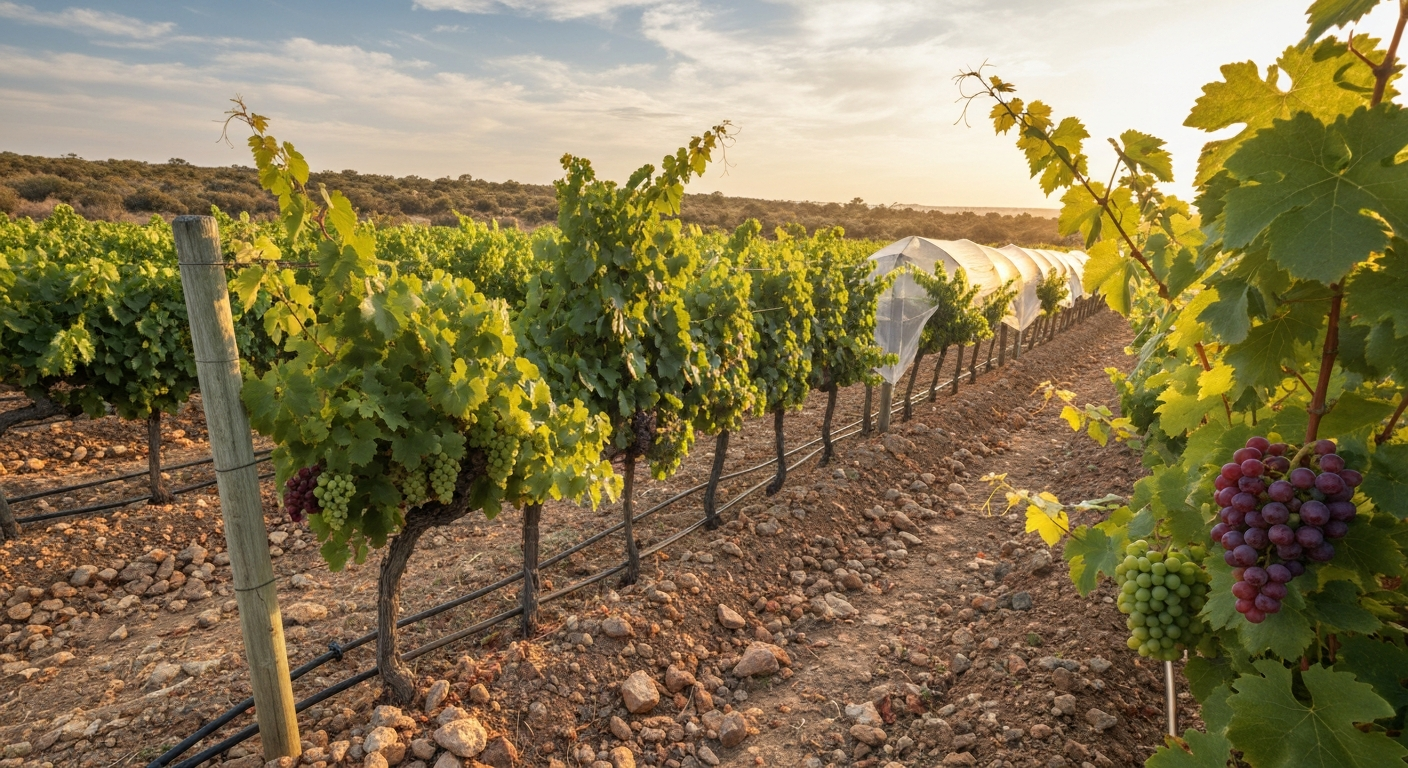
Temporary shade cloth rated at 20–30% transmission, draped over the canopy during predicted heat events above 105°F, is a practical tool for protecting fruit. Permanent overhead structures (pergola-style trellises) can also serve this function, though they complicate spray access and air circulation management. For container-grown vines in a home garden, simply rolling pots into afternoon shade during extreme heat events is one of the most effective and underused tools available.
Cultural management in hot weather
Irrigation
Drip irrigation is the gold standard in hot, dry climates. It delivers water directly to the root zone, minimizes foliar wetness (which drives fungal disease), and allows you to practice regulated deficit irrigation (RDI), where you intentionally limit water at specific growth stages to manage vigor and improve fruit quality. A general framework: keep soil moisture moderate from budbreak through bloom, allow mild stress between fruit set and veraison to control vine vigor, then increase irrigation again after veraison to support berry size and prevent shriveling. During extreme heat events (multi-day stretches above 105°F), water daily or every other day to prevent severe water stress that leads to shrivel and sunburn.
Canopy management and pruning
In hot climates, canopy management is about balance. Too much leaf removal exposes clusters to direct sun and heat, increasing sunburn risk. Too little leaf removal in humid climates creates a disease factory inside the canopy. The sweet spot is typically removing leaves on the east side (morning sun side) of the canopy to improve air circulation, while leaving leaves on the west side to provide afternoon shade on clusters. Timing matters too: leaf removal done early in the season (around fruit set) is less stressful for vines than leaf removal done during peak summer heat.
Pruning timing for hot climates also needs adjustment. In regions with mild winters, dormant pruning can be delayed slightly to reduce the risk of triggering budbreak during a late cold snap, and in truly warm-winter areas, pruning is sometimes done in stages. Heavy winter pruning is still the foundation for production, but adjusting the timing by a few weeks based on your last average frost date and local budbreak patterns pays dividends.
Pest and disease pressure in hot climates
Dry-heat regions have it relatively easy on the disease front: powdery mildew is the primary fungal threat, and it's manageable with sulfur sprays and good canopy airflow. Humid-hot regions are a different story. Downy mildew, black rot, Botrytis, and Pierce's Disease (a bacterial disease transmitted by leafhoppers, not a fungus) are all serious threats in the humid Southeast and Gulf Coast. Pierce's Disease is the single biggest reason why V. vinifera largely fails in the Deep South, which is why muscadines and resistant hybrids dominate those states. Spray programs for downy mildew and black rot should start at budbreak and continue on a 7-to-10-day schedule during rainy periods.
Heat stress troubleshooting
- Wilting midday despite adequate soil moisture: likely high VPD forcing stomatal closure; normal behavior, not a watering problem unless it persists into evening
- Sunburned berries (bleached, papery patches on fruit): increase afternoon shade, improve irrigation frequency during heat events
- Shriveling berries before full ripeness: combination of heat and water stress; increase irrigation immediately and consider shade cloth
- Erratic or delayed budbreak: likely insufficient chill hours; switch to lower-chill cultivars or muscadines
- High Brix but flat, low-acid flavor: common in hot climates; manage with earlier harvest, shade, or variety switch to naturally higher-acid types
- Stunted growth despite fertilizing: check root-zone temperature and drainage; overly hot, compacted, or waterlogged soil restricts root function
Container growing and small-space options
Container growing is genuinely useful in hot climates, not just a workaround for people without garden space. A 15 to 25 gallon container filled with a well-draining potting mix allows you to move vines to afternoon shade during extreme heat events, bring them into a protected space if a late frost threatens, and even simulate dormancy in warm-winter areas by moving pots to a cooler garage or shed for 6 to 8 weeks in winter. Smaller-growing varieties like Pixie Grape (a compact cultivar bred specifically for containers) work well at this scale. Muscadines and compact hybrids also adapt reasonably well to large containers. The main management challenge is irrigation frequency: containers dry out faster than in-ground soil and will need daily watering during peak summer heat.
Growing season length and timing in hot climates
Hot-climate grapes tend to have longer growing seasons than their northern counterparts, which is usually an asset. In California's Central Valley, the season runs roughly from March budbreak through September or October harvest. In Texas and Georgia, a similar timeline applies, though humid-heat regions require earlier attention to disease pressure from the moment buds break. In Florida, some muscadine varieties can produce nearly year-round in southern parts of the state, though vines still benefit from a rest period. For a deeper look at whether grapes can produce fruit year-round and the factors that control continuous growth, see Do grapes grow year round. The lack of a hard dormancy trigger in warm-winter areas is one reason timing and variety selection are so intertwined in the Deep South and low-desert Southwest.
Planting and care checklist for hot climates
- Confirm your AHS heat zone and Winkler GDD region (or nearest NOAA weather station data) before choosing varieties
- Choose a species appropriate for your humidity level: muscadines for humid South, heat-adapted vinifera or hybrids for dry heat
- Select a site with good air drainage, well-drained soil at pH 5.5–6.5, and at least 6–8 hours of daily sun
- Orient rows north-south for even light distribution
- Install drip irrigation before or at planting; plan for daily watering during extreme heat events
- Apply 3–4 inches of organic mulch from trunk outward (keep clear of the trunk itself) to moderate root-zone temperature and conserve moisture
- Plant in early spring after last frost risk, or in fall in low-frost regions
- Train to your trellis system in year one; focus on root and framework establishment, not fruit production
- Begin dormant pruning in late winter; adjust timing based on local budbreak patterns and frost risk
- Start a spray program at budbreak: sulfur for powdery mildew in dry climates; add copper and fungicide rotation for humid climates
- Monitor for heat stress, sunburn, and shrivel from mid-summer onward; adjust irrigation and shade as needed
- Harvest based on taste and Brix (typically 18–24+ Brix for table grapes, 21–26+ for wine grapes) rather than calendar date
FAQ
Can grapes grow in hot weather?
Yes — many grape species and cultivars grow successfully in hot climates when site selection, variety choice, and cultural practices are adapted to heat. Success depends on how hot (day vs night, frequency of heat waves), humidity, soil water availability, and variety heat tolerance.
What does “hot” mean for grape growing (practical definition)?
Practical horticultural thresholds: frequent daytime maxima ≥30°C (86°F) with recurring heatwaves of consecutive days >35°C (95°F), and nighttime minima persistently ≥20°C (68°F) are considered ‘hot’ for grapes. The AHS heat‑zone metric (count of days/year with Tmax ≥30°C) and Winkler GDD classes are commonly used to quantify heat.
How does heat affect vine growth, fruit set and ripening?
High daytime heat speeds sugar accumulation and malic acid respiration (lower acidity), can reduce anthocyanin/phenolic accumulation (poorer color/tannin), and can desynchronize ripening processes. Extreme heat impairs pollen development and fruit set; heatwaves plus water stress can cause berry shrivel and sunburn.
How do warm nights change fruit chemistry?
Elevated night minima (e.g., from ~15°C to ~20–25°C) reduce titratable acidity and alter soluble solids accumulation trajectories, often producing lower acidity for the same sugar level and changing perceived balance in table and wine grapes.
What temperatures cause sunburn or direct berry damage?
Berry surface temperatures approaching ~39–43°C can trigger sunburn symptoms; severity increases with exposure duration. Repeated multi‑hour exposures above ~40°C raise the risk of visible sunburn and tissue damage.
What soils and sun exposure do grapes need in hot sites?
Grapes need well‑drained soils; in hot sites lighter soils with good drainage are preferred to avoid root hypoxia but require careful irrigation. Full sun is still needed for ripening, but in very hot/humid areas partial midday shading, northerly row orientation, or training that preserves some leaf shade over clusters can reduce berry overheating.